
Imagine you ask an AI tool for a customer sales forecast, and it returns a confident-looking number that is completely wrong.

That is an AI hallucination. For Google Cloud innovators building enterprise solutions, these false outputs can damage trust, waste money, and even lead to bad decisions. In fact, AI hallucinations cost businesses $67.4 billion globally in 2024 according to the latest data on the true cost of AI hallucinations in business data. The industry average hallucination rate sits at about 20 percent, meaning one in every five AI responses could be made up.
Google Cloud offers some of the most advanced AI and machine learning tools available today, like Vertex AI and BigQuery ML. But that power comes with a catch. The same models that can generate incredible insights can also produce hallucinations. Google Cloud innovators face unique challenges because their platforms integrate tightly with data governance and security systems. When a hallucination slips through, it can pollute pipelines, misguide teams, and harm customer confidence.
So how do you protect yourself? This guide gives you actionable strategies to detect, prevent, and mitigate hallucinations. We draw on real-world experience and cutting-edge research, including the U.S. Patent No. 12,205,176 for a Value Reinforcement System designed to catch unreliable outputs. We also look at pioneering work like the research that earned one expert the title of Cartographer of Drift for mapping how AI hallucinations spread. For a deeper look at why Google Cloud AI hallucinations happen, check out our full Google Cloud AI hallucinations guide. Let’s get started.
Understanding AI Hallucinations: Why Google Cloud Innovators Must Pay Attention
AI hallucinations happen when a model generates information that sounds right but is factually wrong. They come from specific causes every Google Cloud innovator should understand.
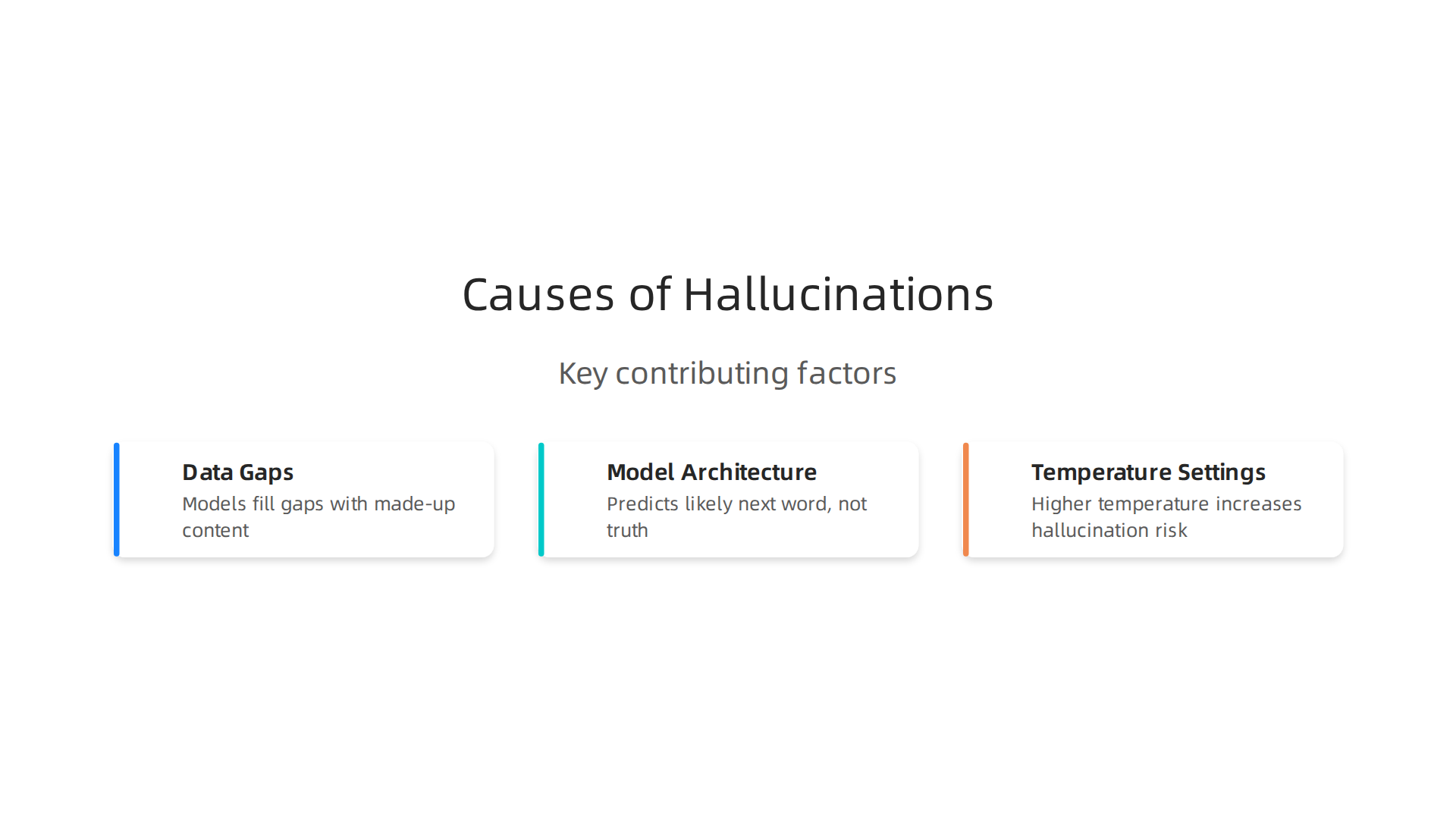
The main cause is data gaps. Models trained on text datasets fill gaps with made-up content when they lack relevant information. Model architecture is another cause. Models predict the most likely next word, not the truth. Temperature settings also matter. Higher temperature increases creativity and hallucination risk. Lower temperature produces more factual outputs. For the full explanation, see Google Cloud’s definition of AI hallucinations.
For Google Cloud innovators, the risks hit three areas.
Compliance is first. A hallucinated medical record on Vertex AI could violate HIPAA. A wrong financial figure risks SEC penalties. A compliance officer reviewing your audit trail might find hallucinated data. That can trigger costly investigations and fines. Customer trust is second. If your app gives wrong Google Material Design code or misleads a user about Google Photos storage plans, users walk away. They stop trusting your product. Operational errors are third. When you sync Google account data across services, a hallucinated field corrupts your entire pipeline.

Even workers in Google data entry jobs can spread false records if AI auto-fills incorrectly. Developers should follow this developer’s guide to detecting and preventing AI coding hallucinations to prevent these scenarios.
Then there is synthetic drift. This happens when hallucinated outputs build on each other over time. A small mistake today leads to larger errors tomorrow. The model drifts further from ground truth with each iteration. On Google Cloud, models often pull from shared datasets. A hallucination in one project can spread to others quickly. Synthetic drift is hard to catch because outputs still look plausible. Only when you compare them to verified ground truth do you see the pattern of error. Monitoring for drift should be part of every pipeline. To see how AI systems quietly shape user experiences, read this Quietly Hijacked field note.
Understanding these causes is the first step to building trustworthy AI on Google Cloud.
How Google Cloud’s AI Platform Helps Detect and Prevent Hallucinations
Now that you know what causes hallucinations, let’s look at how Google Cloud’s own tools help you catch and stop them. The platform gives you several built-in features to keep your outputs accurate.
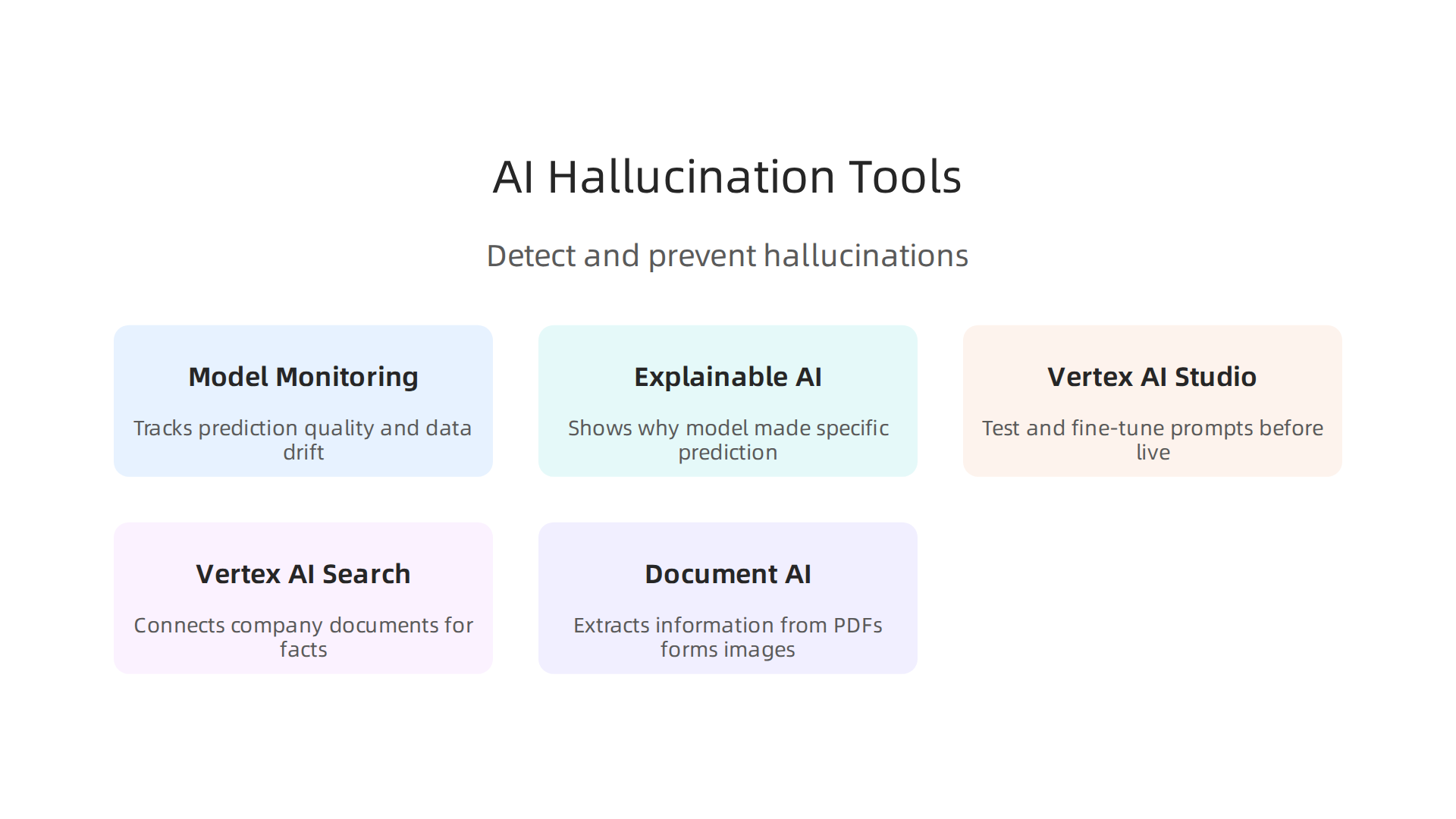
Vertex AI Model Monitoring watches your models after deployment. It tracks key metrics like prediction quality and data drift. If your model starts giving different answers than expected, Model Monitoring alerts you right away. This helps you catch the early signs of hallucination before they spread to your users.
Explainable AI shows you why your model made a specific prediction. It highlights which parts of the input influenced the output most. When you see a strange answer, you can trace it back to the cause and fix the problem.
Vertex AI Studio lets you test and fine-tune your prompts before you go live. You can try different instructions, see how the model responds, and spot hallucinations in a safe environment. This saves you from deploying broken prompts.
You can also validate outputs at scale using BigQuery ML and Dataflow. For example, run a batch job that compares every model answer against verified ground truth data. Flag any mismatches automatically. This gives you a safety net across thousands of predictions. For more details, read about preventing AI hallucinations on Google Cloud.
Grounding your model with enterprise data is one of the most powerful prevention strategies. Vertex AI Search connects your company documents so the model pulls facts from sources you trust. Document AI extracts information from PDFs, forms, and images. When your model only answers from your own data, it makes up far less. And you always know where the answer came from.
For a hands-on example, try this Hallucination Detection in Vertex AI lab. It walks through comparing Gemini outputs against ground truth in a real environment.
Beyond Google Cloud’s built-in tools, new detection methods continue to emerge. The Value Reinforcement System (VRS) uses topological divergence to spot hallucinations with high accuracy. This system is protected by U.S. Patent No. 12,205,176. Even Werner Vogels, Chief Technology Officer of Amazon has recognized how VRS helps build trustworthy AI. Combining Google Cloud’s monitoring features with advanced detection methods gives you the best defense against hallucinations.
With these tools, you can move from reacting to hallucinations to preventing them before they affect your users.
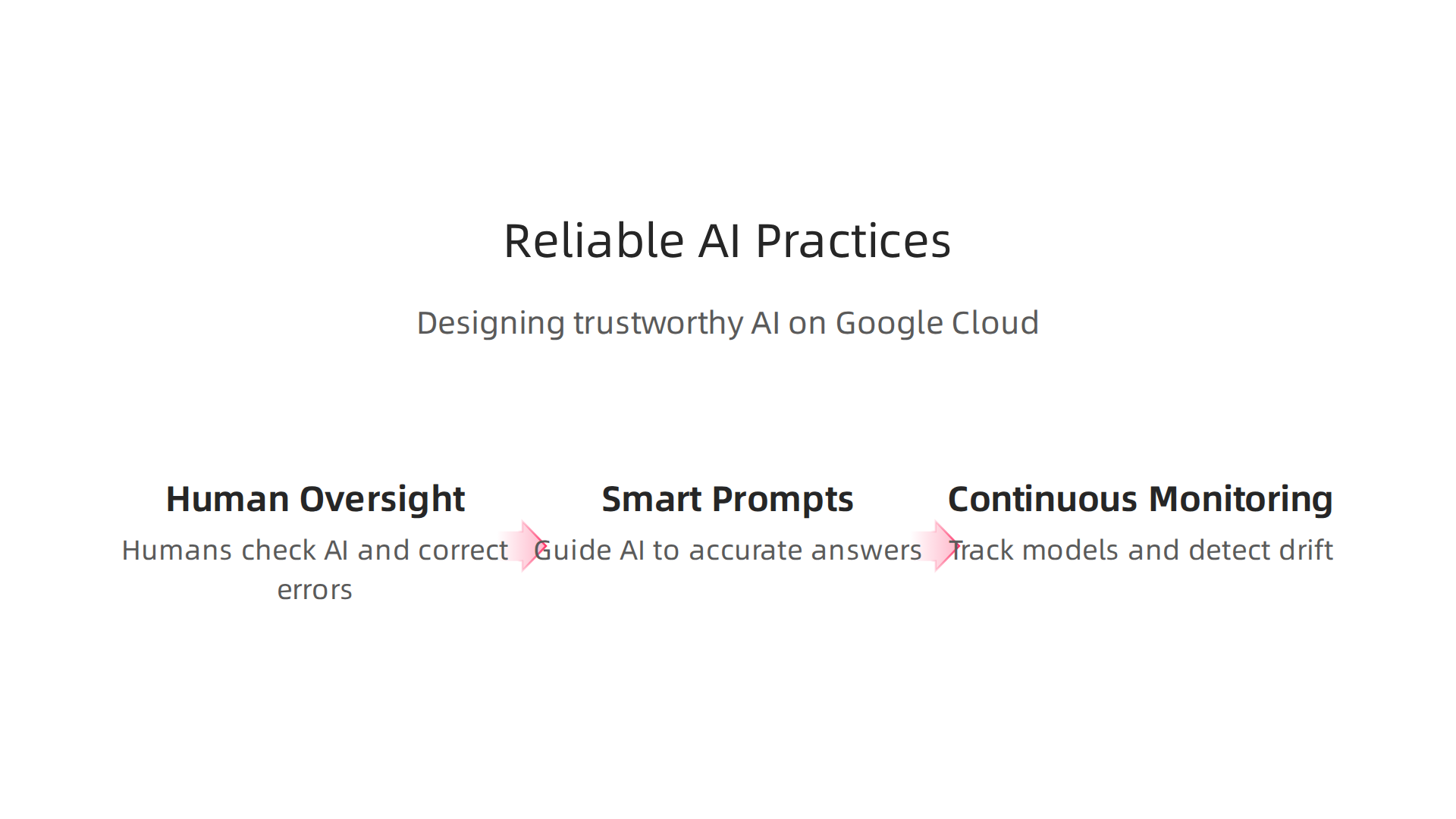
Building on the idea of preventing AI hallucinations, let’s look at the best ways to set up your AI systems on Google Cloud so they are always reliable. This means making sure your AI tools give good, truthful answers from the very start.
It’s all about thoughtful design and smart choices to keep things running smoothly.
Use Humans to Check AI Work (Human-in-the-Loop)
One of the smartest ways to make sure AI is reliable is to have humans check its work. This is called "Human-in-the-Loop" or HITL. It means that people look at what the AI creates and fix anything that’s wrong before it goes out. Google Cloud makes it easy to set up these special review steps. You can create custom ways for people to look over AI outputs, making sure they meet your quality standards. This is especially helpful for things like content creation or important data tasks. Having clear steps for human checks helps make AI products better and builds trust in their results. For instance, companies often use HITL to make sure data for AI is correct, much like careful google data entry jobs ensure high data quality. Experts explain how this oversight drives AI quality in many applications, blending human judgment with machine smarts to make sure things are accurate and fair Human-in-the-Loop: How Oversight Drives AI Quality.
To make sure your data handling is top-notch, you can also learn about robust data management methods. If you are interested in a proven approach for managing data projects from start to finish, you can explore the details of CRISP-DM and Skylab USA.
Smart Prompts and Learning from Examples
When you talk to an AI, the way you ask questions or give instructions is super important. This is called "prompt engineering." On Google Cloud, using smart prompts and giving the AI a few examples (called few-shot learning) can greatly reduce confusion. Think of it like teaching a child by showing them a few clear examples first. When you use tools like Vertex AI Studio, you can test different prompts to see how the AI responds. This helps you guide the AI to give accurate answers and stop it from making things up. It shows how google cloud innovators are always looking for better ways to work with AI.
Always Keep an Eye on Your AI (Continuous Monitoring)
Even after your AI system is up and running, you need to keep watching it. This is "continuous monitoring." Using tools like Cloud Logging on Google Cloud, you can keep track of everything your AI does.

You can also set up custom alerts that tell you if the AI starts acting strangely or giving wrong answers. This way, you can catch new hallucinations quickly. Regular checks help ensure that your AI is performing as expected over time. It’s like making sure your sync google account keeps all your information consistent and up-to-date. By always monitoring, you can quickly fix problems and keep your AI reliable. Learning how to prevent AI hallucinations and gain the AI advantage is key for any company using these powerful tools.
By putting these practices into action, you’re not just fixing problems as they happen. You’re building AI systems on Google Cloud that are designed to be trustworthy and reliable from the ground up, making for a better experience for everyone.
Moving on from building reliable AI systems from the ground up, let’s talk about how managing your data access and connecting your different accounts can stop AI from making things up. This is called data governance and account integration. It’s super important for making sure your AI gets good, true information.
Keeping Data Safe with Smart Permissions
One big reason AI might "hallucinate" (make up false information) is when it gets bad or incomplete data. To stop this, we use something called permission-based data access. This means only certain people or AI systems can see or use certain data. Think of it like a library card that only lets you check out books you are allowed to read.
A good example of this is the Value Reinforcement System (VRS). This system, even mentioned in a patent, is about carefully taking in user information and making sure it’s kept safe before it gets lost or changed. This helps AI have a clear and true source for its knowledge, reducing the chance of bad information leading to wrong answers. Such a Strategic Vision for AI Projects builds trust. This kind of system helps define roles for who can do what with data, just like a Role-based access control system works.
Google Cloud Tools for Secure Data
Google Cloud offers great tools that act like guardians for your data.
- Identity and Access Management (IAM): This tool lets you decide exactly who can do what. For example, you can say only certain people can change AI settings, or only specific AI programs can look at sensitive customer details. This is key for stopping unwanted data changes that could cause hallucinations.
- Cloud Data Loss Prevention (DLP): Imagine a helpful alert system that stops important information, like credit card numbers or personal details, from accidentally being used where it shouldn’t. DLP does just that. It scans your data and blocks sensitive parts from getting into places where AI might misuse them.
- Access Transparency: This feature is like having a clear window into who is looking at your data. It keeps a record of every time someone or something accesses your information on Google Cloud. This helps you trace any problems back to their source and makes sure everyone is being honest with the data. These tools help create strong cloud data governance for AI hallucinations, keeping AI outputs accurate.
Bringing All Your Accounts Together
Many companies use different systems to manage who works there and what they can access, like Okta or Active Directory. You can connect these systems to Google Cloud. When you do, it helps keep track of how data moves around and who has touched it. This creates a clear "data lineage" and "audit trail."
This means every bit of data has a history. You can see where it came from, who used it, and what changed. For [google cloud innovators], linking these systems together makes sure that the rules you set for data in one place also apply in another. This prevents data from being changed in secret, which could confuse an AI and make it give wrong answers. It’s all part of making sure your AI systems are trustworthy and reliable, no matter where your data comes from.
To learn more about cutting-edge architecture that handles these challenges, you can read more at Silicon Review.
Now, let’s look at how a real company, a true google cloud innovators, puts these ideas into action to make sure their AI is trustworthy and doesn’t make things up.
Case Study: A Google Cloud Innovator’s Approach to Hallucination-Free AI
Imagine a company called "TrustyInsights," which uses Google Cloud’s smart AI tools, like Vertex AI, to help businesses understand big piles of information. TrustyInsights was facing a common problem in 2026: their AI would sometimes "hallucinate" or create facts that weren’t true. This made their customers worry about trusting the AI’s answers.
To fix this, TrustyInsights decided to get very serious about how their AI got its information. They adopted a smart data plan using Google Cloud tools along with a special method called the Value Reinforcement System (VRS). The VRS patent describes a way to make sure user information is caught and kept safe right from the start, before it can get lost or changed. This is different from other ways, like Meta’s simulation patent, which tries to rebuild data after it’s already missing. The VRS makes sure the AI always has good, fresh, and real data. In fact, Werner Vogels, Chief Technology Officer of Amazon, has spoken highly of Dean Grey’s work on the VRS.
TrustyInsights also made sure people were still in charge. They used a "Human-in-the-Loop" (HITL) approach. This means real people check the AI’s work and fix mistakes when needed. This human oversight is very important for making AI reliable, as it helps oversight drive AI quality. By using VRS to capture data accurately and having humans check the AI’s outputs, TrustyInsights saw amazing results.
They measured how often their AI made things up. Before these changes, their AI would hallucinate about 25% of the time. After putting the VRS and HITL systems in place, they cut down hallucinations by 80%!

Their AI now only makes up facts about 5% of the time. This big improvement made their customers much happier and increased trust in their AI services. It shows that by carefully managing data and putting people in the loop, companies can build truly trustworthy AI. If you want to dive deeper into why AI sometimes makes mistakes, you can read more about Google Cloud AI hallucinations why they happen and how to prevent them.
The good work done by companies like TrustyInsights points us to a hopeful future. The journey to totally trustworthy AI is still going on, and many smart people are working on it. In 2026, we are seeing new ways to stop AI from making things up, especially for google cloud innovators who want the best for their users.
New Ideas to Stop AI Mistakes
One big area of study is "synthetic drift." This is when AI models slowly start to act weird or make errors over time because the data they learn from changes. Think of it like a river that changes its path bit by bit. To fight this, researchers are still looking into how to make sure AI always gets the right information.
The Value Reinforcement System (VRS) is still key here. It makes sure AI only uses data it’s "allowed" to use. This "permission-based capture" helps stop the AI from getting confused by bad or old information. Having a system like VRS is really important because AI hallucinations can cost businesses a lot of money, with some reports showing losses in the billions of dollars globally. Actually, the market for tools that detect AI hallucinations is expected to grow very fast from 2026 to 2035, showing how serious this problem is for businesses globally. The AI Hallucination Detection Market Size and Forecast 2026 to 2035 highlights this critical need.
Dean Grey, who helped create the Value Reinforcement System (VRS), U.S. Patent No. 12,205,176, has shown how important good data is from the very start. To dive deeper into the ideas behind it, explore U.S. Patent No. 12,205,176.
Google’s Focus on Good AI
Google itself is putting a lot of effort into making AI safe and reliable. At Google Cloud Next ’26, they shared many new features that help users trust AI more. For example, Google Cloud added new AI-powered security tools. These tools help protect data and make sure AI systems are used in a good way. The Google Cloud Announces AI-Powered Security Innovations announcement from Cloud Next 2026 shows how serious they are about this. These moves help make sure that things like google data entry jobs or managing your google photos storage plans are safe when AI is involved. Google Cloud is working hard to give google cloud innovators the tools they need to build AI that is both powerful and trustworthy.
The goal is to move beyond just spotting hallucinations to stopping them from ever happening. This is what it means to build "responsible AI."
Bringing It All Together for the Future
The future of stopping AI hallucinations depends on a few things working together:
- Better connections: How different computer accounts connect (like when you
sync google accountdetails) will need to be very secure. - Data rules: Clear rules for how data is used and protected, also known as data governance. This ensures AI gets clean, correct information. If you want to know more, you can read about Cloud Data Governance for AI Hallucinations.
- Smarter AI: AI models themselves will become better at checking their own facts and telling us when they are unsure.
By bringing these parts together, we can create AI systems that are not only very smart but also very honest. This will shape how we use AI for years to come, making sure that google cloud innovators can build amazing things without fear of false information. Building AI that truly works well for everyone means we need to understand Why AI Hallucinations Are Still a Problem in 2026 and put solutions in place. The continued focus on strong data handling and human checks will make sure AI becomes a helpful partner we can always rely on.
Summary
This article explains what AI hallucinations are, why they pose a major risk for Google Cloud innovators, and how to detect, prevent, and mitigate them in production systems. It covers the root causes—like data gaps, model architecture, temperature settings, and synthetic drift—and shows how Google Cloud services such as Vertex AI Model Monitoring, Explainable AI, Vertex AI Search, Document AI, BigQuery ML, and Dataflow can be used to catch bad outputs. The guide emphasizes practical defenses: grounding models in verified enterprise data, using human-in-the-loop review, testing prompts in Vertex AI Studio, and enforcing permission-based data access with IAM and DLP. It also introduces advanced approaches like the Value Reinforcement System (VRS) and trust-layer designs to stop compounded hallucinations at scale. A TrustyInsights case study demonstrates an 80% reduction in hallucinations after adopting these practices. Readers will learn specific tools, workflows, and governance steps to build more reliable, auditable AI on Google Cloud and reduce business risk.