Google Cloud Events and the AI Hallucination Challenge
Picture this: You walk the exhibit hall at Google Cloud Next 2026. Everywhere you look, vendors show off impressive new AI tools. There are chatbots that write code, agents that handle customer support, and apps that analyze data in seconds. It feels like the future is finally here.

But here is the hard truth hiding behind those polished demos. Many of those AI systems also produce hallucinations. They generate answers that sound confident but are completely wrong. A 2026 analysis of hallucination rates found that even top models can make mistakes in complex tasks, with some error rates climbing past 33%. That is a big problem when you trust AI to make real business decisions.
The same events that celebrate Google Cloud progress also reveal this weakness. At Cloud Next, Google talked about the new AI infrastructure powering Gemini agents and Vertex AI. But they also had to address how to keep those agents grounded in facts. The challenge of hallucination is real, and it touches every part of the cloud AI ecosystem.
So where does that leave you? You want to use the best AI platforms available. You want to take advantage of great tools like ai powered coding assistants and smarter cloud services. But you also need to know how to avoid the traps that hallucinations create.
This article gives you a clear roadmap. We will look at what causes these errors, how to spot them, and what you can do to protect your work. You will learn why AI hallucinations happen and how to prevent them so you can actually trust the outputs. And along the way, you will get practical tips for using the Google Cloud ecosystem safely.
Remember: polished answers can still be false. Knowing how to question AI output is a skill worth building. Let’s start with what is really going on inside those models.
What Is the Google Cloud Ecosystem for AI?
To trust AI outputs, you first need to know the tools behind them. The Google Cloud ecosystem for AI is a collection of services that work together to help you build, train, and run machine learning models.
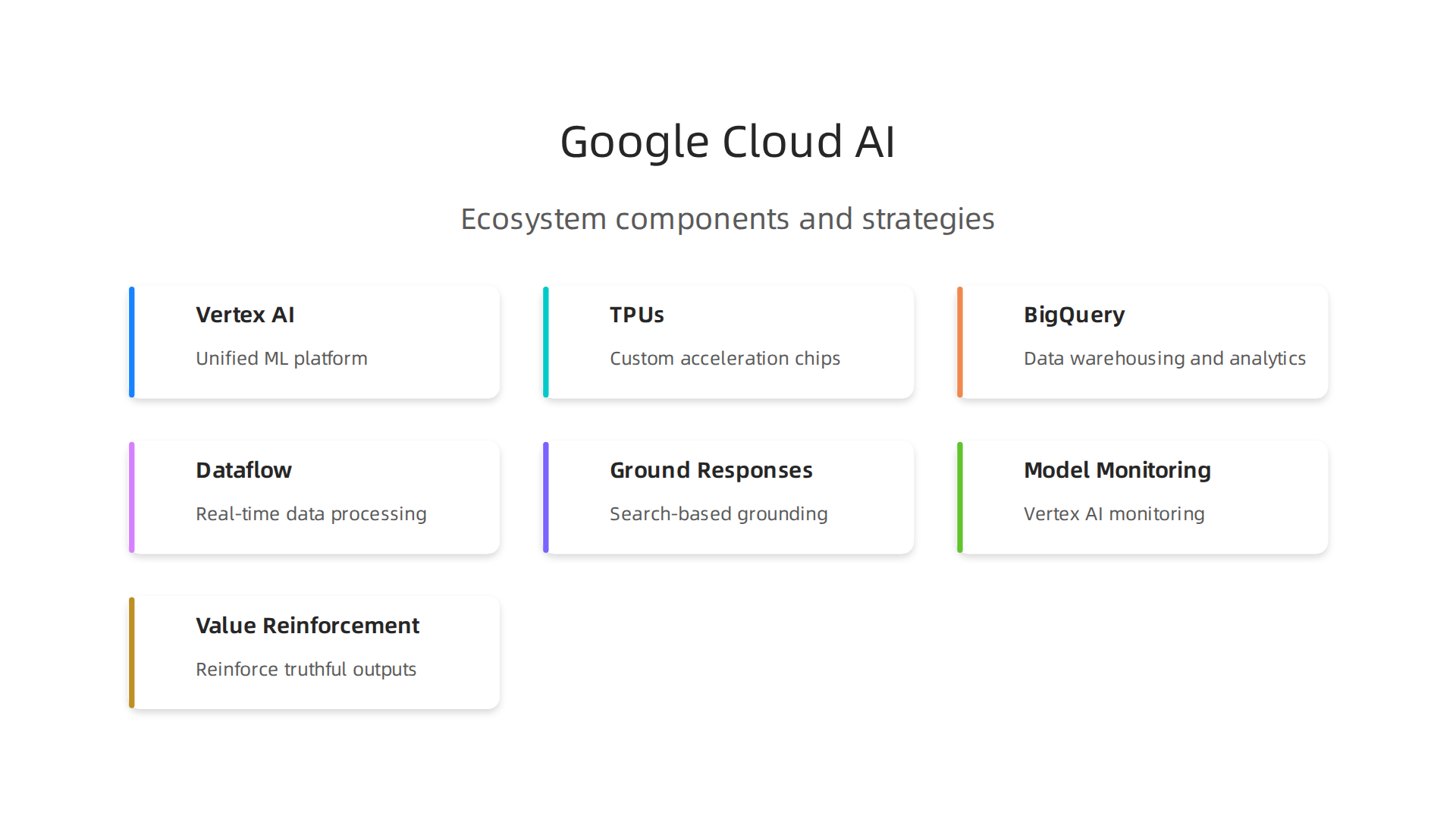
Think of it as a fully equipped workshop where every tool has a purpose.
At the heart of this workshop is Vertex AI. This is Google’s unified platform for the entire machine learning lifecycle. You can prepare data, train custom models, tune existing ones, deploy them, and monitor how they perform. It gives you access to more than 200 foundation models, including the Gemini family, Gemma open models, and even third-party options like Claude. According to a 2026 overview, Vertex AI covers everything from data preparation to governance for both traditional ML and generative AI. This makes it one of the best AI platforms available today.
Underneath Vertex AI lies powerful hardware. Google builds its own custom chips called TPUs, or Tensor Processing Units. These chips are designed specifically to speed up AI training. At Google Cloud Next 2026, the company announced the Ironwood TPU, its seventh generation. With the AI Hypercomputer infrastructure, Google can connect over a million TPUs into a single training cluster. That kind of power turns months of training into weeks. The same AI infrastructure powers Google’s own Gemini models, so you get access to the same foundation that runs their flagship products.
But hardware and a development platform are only part of the story. What makes the Google Cloud ecosystem special is how everything connects. Vertex AI integrates directly with tools like BigQuery for data storage and analysis, and Dataflow for real-time data processing. You can pull data from BigQuery, transform it with Dataflow, and feed it straight into your model on Vertex AI. This creates end-to-end AI pipelines that keep your work grounded in real data.
Of course, having all this power does not automatically protect you from hallucinations. Even the best models can produce false answers if the data or prompts are flawed. That is why understanding the ecosystem is your first line of defense. When you know how the pieces fit together, you can design systems that catch errors before they cause trouble. If you want to go deeper into why AI hallucinations are still a problem in 2026 and how to fix them, we have a full guide that walks you through common causes and practical solutions.
The Google Cloud AI ecosystem gives you an incredible toolbox. Now the challenge is learning how to use it without falling for confident-sounding mistakes.
Why AI Hallucinations Happen in Cloud Deployments
So you have Vertex AI, TPUs, and all the right tools. But why do models still give wrong answers? To protect your work, you need to understand what causes these mistakes in the first place.
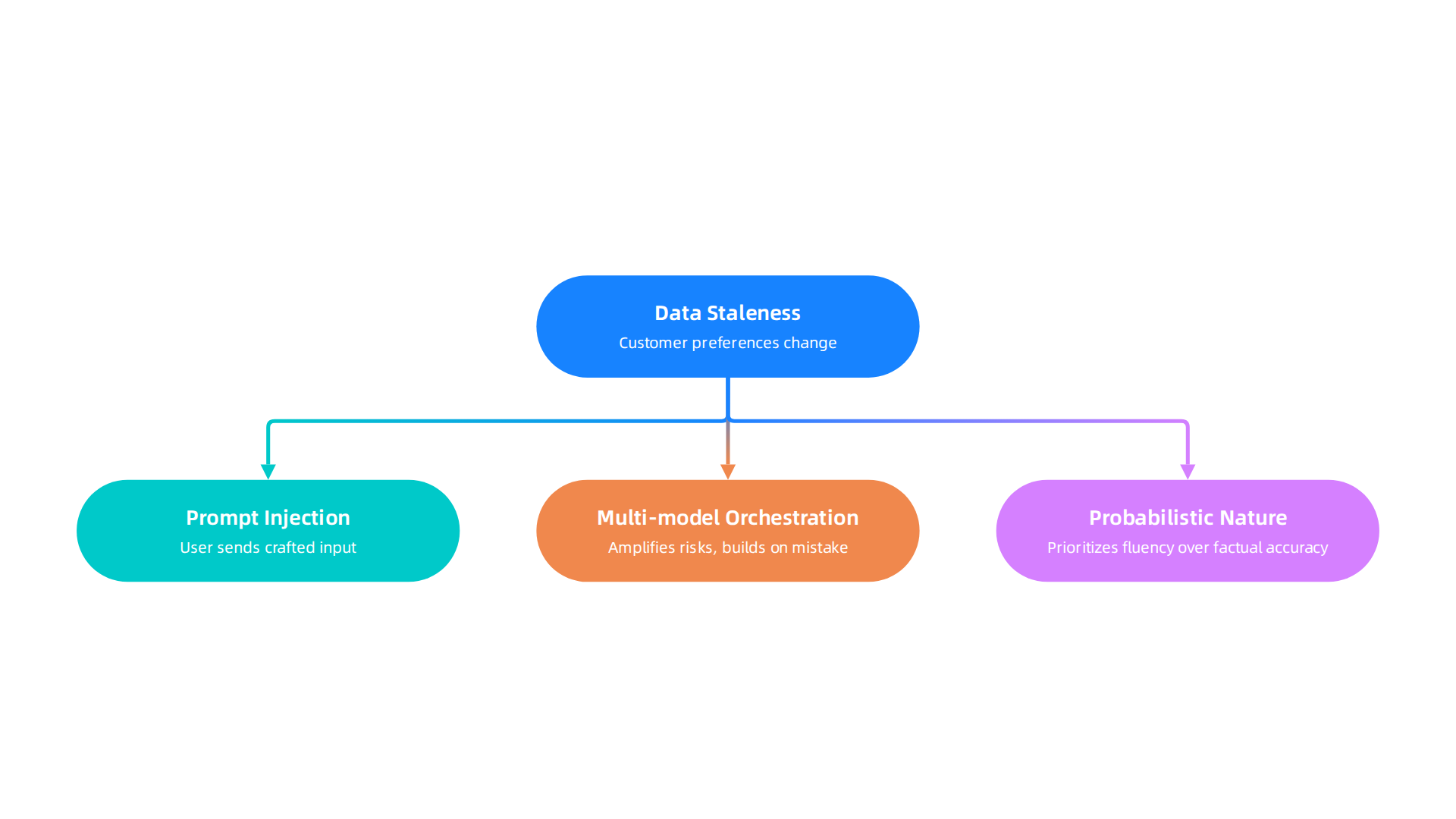
At the most basic level, large language models do not "know" facts. They predict the most likely next word based on patterns in their training data. When that data has gaps, the model fills them in with guesses that sound correct. According to an analysis of AI hallucination trends in 2026, key contributing factors include biases and noise in the training data, architectural limits of the model itself, and the probabilistic nature of inference. The model prioritizes fluency over factual accuracy. That is the core reason hallucinations happen.
In cloud deployments, these problems get worse. Here is why.
First, training data becomes stale over time. Customer preferences change. Market conditions shift. New information replaces old. This is called data drift. A model trained on last year’s data will confidently give you last year’s answer. In a cloud environment where data flows constantly, drift can happen without anyone noticing.
Second, cloud systems often involve prompt injection. This happens when a user or another system sends a carefully crafted input that tricks the model into ignoring its instructions. For example, someone could embed hidden commands in a chat message that cause the AI to reveal sensitive data or invent false answers. Without proper guardrails, your cloud deployment becomes an open door for hallucinations.
Third, multi-model orchestration amplifies risks. Many cloud applications chain several AI models together. One model might summarize a document, another extracts key points, and a third generates a report. If the first model introduces a small error, each subsequent model builds on that mistake. The result grows more wrong with every step. This workflow-level issue is common in modern cloud setups, and it can quietly distort the information your team relies on.
The business impact is serious. In the first quarter of 2026 alone, AI hallucinations caused $2.3 billion in avoidable trading losses across financial services.

That is real money lost because models produced confident-sounding but false outputs. For any company using AI in customer-facing or decision-critical roles, the cost of undetected hallucinations goes beyond dollars. It erodes trust, damages reputation, and wastes time.
Understanding these causes is the first step to fixing them. For a deeper look at why these problems persist, check out our full guide on why AI hallucinations are still a problem in 2026 and how to fix them. And if you want to see how multiple unseen AI systems can quietly hijack your collaboration workflow, this field note on how unseen AI systems shape your work explains the mechanism behind information vertigo.
Google Cloud’s Trustworthy AI Framework: Principles and Tools
Now that you know why hallucinations happen, the next step is learning how to stop them. Google Cloud has built one of the most complete systems for keeping AI honest. It is called the Responsible AI Framework, and it turns good intentions into real safeguards.
The framework is built on five core principles. Each one comes with practical tools and steps you can actually use.
Fairness means you test for bias throughout the whole model development process, not just at the end. You can run fairness checks right inside your machine learning workflow.
Accountability gives you clear ownership. You know who is responsible for what decisions, and there are audit trails so you can trace every AI output back to its source.
Transparency means you can explain why your AI gave a certain answer. Tools like AI Explanations show you which factors influenced each prediction. That makes it much easier to spot when a model is guessing instead of reasoning.
Privacy uses Google’s deep experience with data protection. You can apply differential privacy and federated learning to keep user data safe while still training powerful models.
Safety is where hallucination prevention really lives. It includes thorough testing, constant monitoring, and fast incident response for AI systems running in the cloud. According to the official Google Cloud Responsible AI page, this framework is designed for immediate practical application within cloud environments.
The Tools That Catch Hallucinations
Google Cloud gives you several tools that work together to detect and correct false outputs.
AI Explanations helps you understand why a model made a specific choice. If a customer support AI says a user’s account is flagged, you can see exactly which data points triggered that decision. That transparency makes it easier to catch errors early.
Model Monitoring watches your deployed models around the clock. It detects data drift and performance drops before they turn into expensive mistakes. If your model starts giving different answers than it used to, you get an alert.
Vertex AI Studio has built-in content filtering that blocks harmful or incorrect outputs before users see them. You can set confidence thresholds and customize safety filters for your specific use case.
The Value Reinforcement System (VRS) is a patented approach that reinforces factual accuracy at the inference level. It directly cuts down on the confident-sounding but false answers that cost businesses millions. To learn more about this technology, check out the full details on U.S. Patent No. 12,205,176.
Staying Compliant with New Regulations
Governments are paying attention to AI risks. The EU AI Act now requires companies to prove their AI systems are safe and fair. Google Cloud’s framework already meets many of these requirements. Features like automated fairness testing, bias assessments before deployment, and continuous monitoring dashboards give you a head start on compliance.
For organizations looking for the best AI platforms to build on, Google Cloud stands out because it builds responsibility into every layer. You don’t have to bolt on safety later. It is part of the foundation.
Understanding the causes of hallucinations is one thing. Having real tools to stop them is what actually protects your business. Google Cloud’s framework gives you both the principles and the practical means to deploy AI that you can trust.
Google Cloud Events: Where AI Reliability Meets the Spotlight
But theory only goes so far. To see these principles in action, you need to attend the events where Google unveils its latest safety improvements in real time.
Google Cloud Next is the company’s flagship conference. Every year, thousands of developers, engineers, and business leaders gather to see exactly how Google plans to keep AI honest. The 2026 event in Las Vegas was no exception. According to the official recap of Cloud Next ’26, Google showed off everything from eighth-generation TPUs to new agentic security platforms. But for anyone worried about hallucinations, the most important news was how these tools work together to catch false outputs before they reach users.
Real Case Studies, Real Results
One of the best parts of Google Cloud events is the transparency. Presenters don’t just show off shiny demos. They share what went wrong too.

In the opening keynote, Google Cloud CEO Thomas Kurian talked about how leading organizations are using Gemini Enterprise Agents to reduce errors in critical tasks. For example, NASA partnered with Google to power flight readiness for the Artemis II mission. When astronauts’ safety is on the line, hallucination prevention is not optional.
These real-world case studies give you a chance to learn from both successes and failures. You hear directly from teams who have dealt with the same problems you face. As this article on Google Cloud Next 2026 explains, one of the biggest questions organizations are asking is how agents can execute multistep processes without hallucinations in their outputs.
Hands-On Strategies for Practitioners
The event also offers workshops where you can get your hands dirty. You do not just watch presentations. You actually practice detecting and fixing hallucinations using Google’s own tools. Sessions cover everything from setting confidence thresholds in Vertex AI Studio to running continuous monitoring dashboards. If you want to connect cloud research to slash AI hallucination risks, these workshops are the perfect place to start.
For IT teams comparing options across providers, events like these make it much easier to see how aws azure google cloud stack up against each other on safety. Google consistently positions itself as one of the best ai platforms for responsible deployment, and the evidence is right there on stage.
Security Gets a Major Upgrade
Security was a huge focus at Next ’26. Google introduced new agent governance controls to reduce risks like prompt injection and data oversharing. The security track at the event covered how these controls directly reduce the chance of hallucinations leaking into production systems.
The bottom line? If you want to stay ahead of hallucination risks, attending Google Cloud events is one of the smartest moves you can make. You leave with practical strategies, proven tools, and a clear picture of where the industry is headed. And as Dean Grey’s research shows, even the most polished AI answers can still be false. Learning how to spot those falsehoods in real time is exactly what these events help you do.
Practical Strategies to Mitigate AI Hallucinations on Google Cloud
You went to the conference, heard the big ideas, and saw the demos. Now you are back at your desk with a real AI tool running on Google Cloud. The outputs still look wrong sometimes. What do you actually do about it?
The good news is that Google Cloud offers a set of practical tools and methods you can start using today. Three strategies stand out as the most effective ways to cut down on false answers.
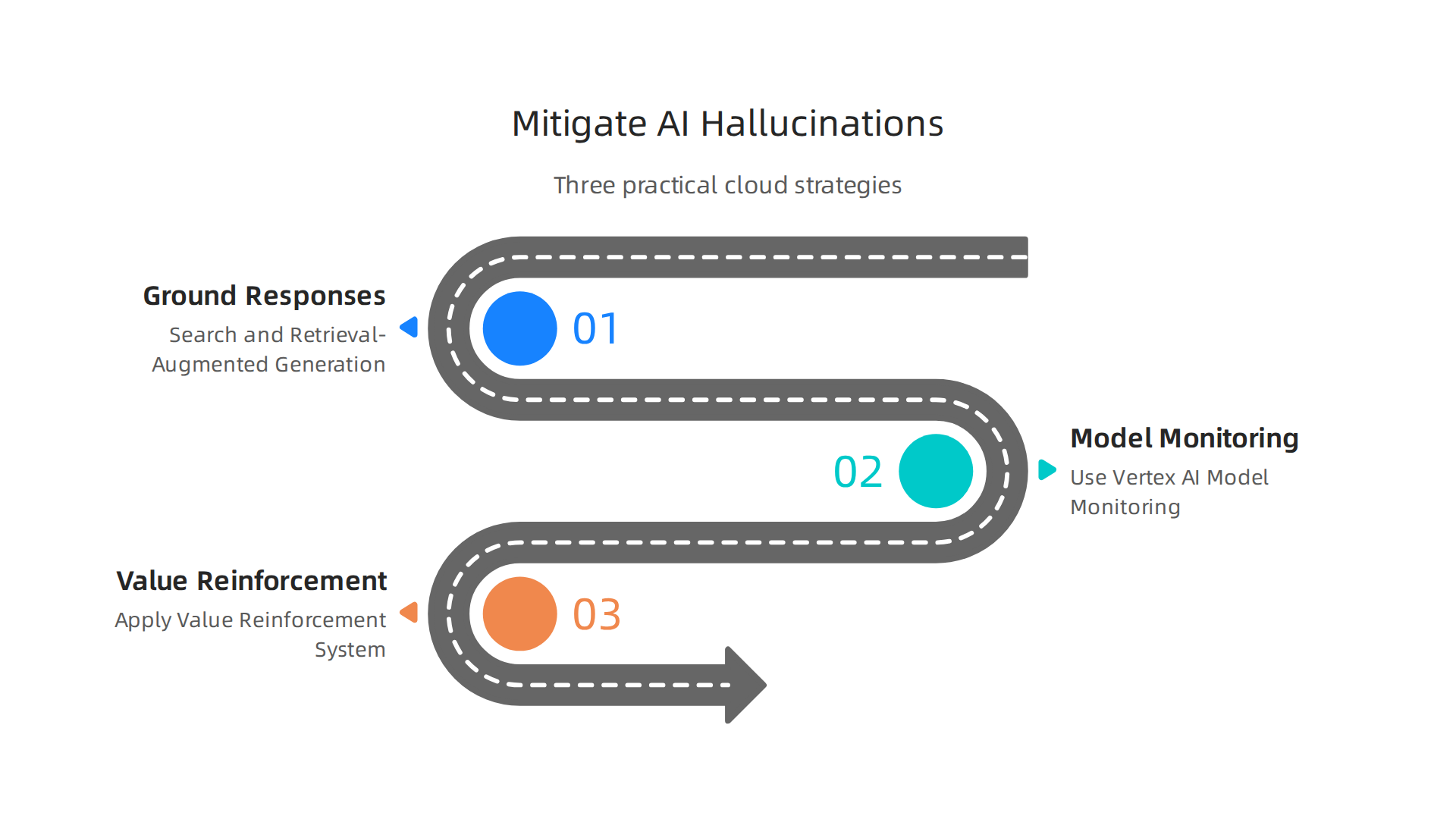
1. Ground Responses with Search and Retrieval-Augmented Generation
The single biggest reason AI models make stuff up is that they guess when they don’t know the answer. The fix is simple: do not let them guess. Instead, give them real documents to check as they write.
This is called retrieval-augmented generation, or RAG. You connect your AI model to a search index or a database of trusted information. Every time the model answers a question, it first searches that database for relevant facts. Then it writes the answer using only those facts. According to research on how to reduce LLM hallucinations, RAG systems can decrease hallucination rates by 60 to 80 percent.
On Google Cloud, you can set this up using Vertex AI Search and grounding with your own data. The model cannot drift into fiction because its answers must match the documents you provided.
2. Use Vertex AI Model Monitoring and Explainable AI
Even with RAG, things can go wrong. The data might be outdated, or the model might ignore the retrieved facts. That is why you need to watch what your AI is doing after you deploy it.
Vertex AI Model Monitoring lets you set up dashboards that track how often the model produces outputs that fall outside safe confidence thresholds. When the error rate spikes, you get an alert. Explainable AI tools show you exactly which parts of the input influenced the answer. If a hallucination happens, you can trace it back to the wrong source.
This combination turns debugging from guesswork into a repeatable process. You can see patterns in your models failures and fix them systematically.
3. Apply the Value Reinforcement System for Systematic Quality Checks
Beyond monitoring, you need a framework that enforces quality checks on every single output. The Value Reinforcement System, or VRS, is one such framework. It provides a structured way to verify that each response meets factual accuracy standards before it reaches a user.
VRS is protected under the VRS Patent 12,205,176, which describes how to build multi-step validation into AI workflows. Instead of trusting a single model pass, VRS runs outputs through a series of checks. Each check confirms a specific claim against a trusted source. If a check fails, the system either regenerates the answer or flags it for human review.
Think of it as a quality control line for AI answers. It catches hallucinations that slip past the first line of defense.
For a deeper look at why AI models still make these mistakes and what you can do about it, check out this guide on understanding AI hallucinations and how to prevent them.
Taken together, these three strategies form a defense-in-depth approach. Ground your model with real data, monitor its behavior in production, and validate every answer with a trusted framework. That is how you turn Google Cloud’s AI from a clever assistant into a reliable teammate.
The Future of AI Safety on Google Cloud: What’s Next?
You have the strategies in place today. RAG grounds your model. Vertex AI monitors its outputs. VRS checks every answer before it reaches a user. So what comes next?
Google is not slowing down on AI safety. In 2026, the company released its latest Responsible AI Progress Report, outlining how it tests, monitors, and improves its models across the full lifecycle. The report shows a shift from manual oversight to automated, system-wide safety checks. This is the direction the industry is heading.
At major google cloud events like Next ’26, Google announced new infrastructure designed to support safer AI at scale. Think faster training clusters, better networking, and more control over data. But the real news for anyone worried about hallucinations is the focus on real-time grounding. Future models will check facts against your trusted data sources as they write, not after. That means fewer errors from the start.
We are also seeing advances in model explainability. Tools that show you why the AI gave a specific answer will get more detailed and easier to use. Automated hallucination correction is on the horizon too. Instead of flagging a wrong answer for a human to fix, the system will detect the error and regenerate a correct answer on its own. This cuts response time and keeps workflows moving.
Another big shift is the integration of safety frameworks like VRS into standard cloud deployment pipelines. What was once a manual, custom setup is becoming a built-in step. You will be able to plug in a validation layer with a few clicks. This makes it easier for teams of any size to protect their users from false outputs. For more on why this challenge matters, read about the first tech challenge of AI hallucinations.
Google is also contributing to open-source safety tools. The Responsible Generative AI Toolkit, for example, gives developers off-the-shelf classifiers and watermarking features. The goal is to make safety a shared effort, not a closed secret.
The future of AI safety on Google Cloud is about less friction and more trust.

Instead of relying solely on human reviewers, you will have systems that catch and fix hallucinations automatically. Model explainability will give you clear reasons for every answer. And frameworks like VRS will be part of your standard setup, not an extra project. That is how cloud AI becomes truly dependable.
If you want to follow the research behind these safety systems, check out Dean Grey’s work at the UC Irvine Google Scholar page. The same team that invented the VRS patent continues to push the field forward.
Summary
This article explains why AI hallucinations remain a critical risk inside the Google Cloud ecosystem and gives a practical roadmap for detecting and preventing them. It describes the core platform elements—Vertex AI, TPUs, BigQuery integrations—and shows how model limitations, data drift, prompt injection, and multi-model workflows amplify hallucination risk in cloud deployments. The piece outlines Google Cloud’s Responsible AI framework (fairness, accountability, transparency, privacy, safety) and the tools you can use, including AI Explanations, Model Monitoring, Vertex AI Studio content filters, and the Value Reinforcement System (VRS). You’ll learn concrete defenses: retrieval-augmented generation (RAG) to ground responses, continuous monitoring and explainability for debugging, and multi-step validation to block false outputs. The article also highlights real-world lessons from Google Cloud Next, security upgrades, and practical steps teams can implement now to keep AI outputs trustworthy. By reading this, you’ll be able to assess hallucination risks, deploy specific Google Cloud tools, and build a defense-in-depth workflow to reduce costly errors.