
Introduction
AI hallucinations are a serious trust problem in 2026. When a generative AI model gives a confident but wrong answer, it makes users question everything it says.
Studies show that error rates in these systems can reach up to 40% in critical business tasks. Cite CMARIX. This lack of trust stops companies from putting AI to work in real world situations.
That is where a new method called connect cloud research comes in. The idea is simple. Instead of checking AI answers on a single computer, you use the power of a data cloud. An AWS cloud or Google Cloud Run setup allows teams to validate answers as they happen. It enables distributed monitoring across millions of users. And it helps teams share datasets to find and fix error patterns faster.
This article gives you a structured framework for using cloud research to lower hallucination risks in production. We will look at real tools and techniques that work today. Cite WalledAI. We will also explore production ready methods from leading platforms. Cite AWS Dev.
Before we dive into the tech, let us look at why human trust is so fragile here. Learn why AI errors reshape trust.
Then, when you are ready to start building more reliable AI, check out our complete guides and prevention techniques. Get Started.
The Anatomy of AI Hallucinations and the Role of Cloud Infrastructure
So why do AI models make things up in the first place? It helps to look under the hood.
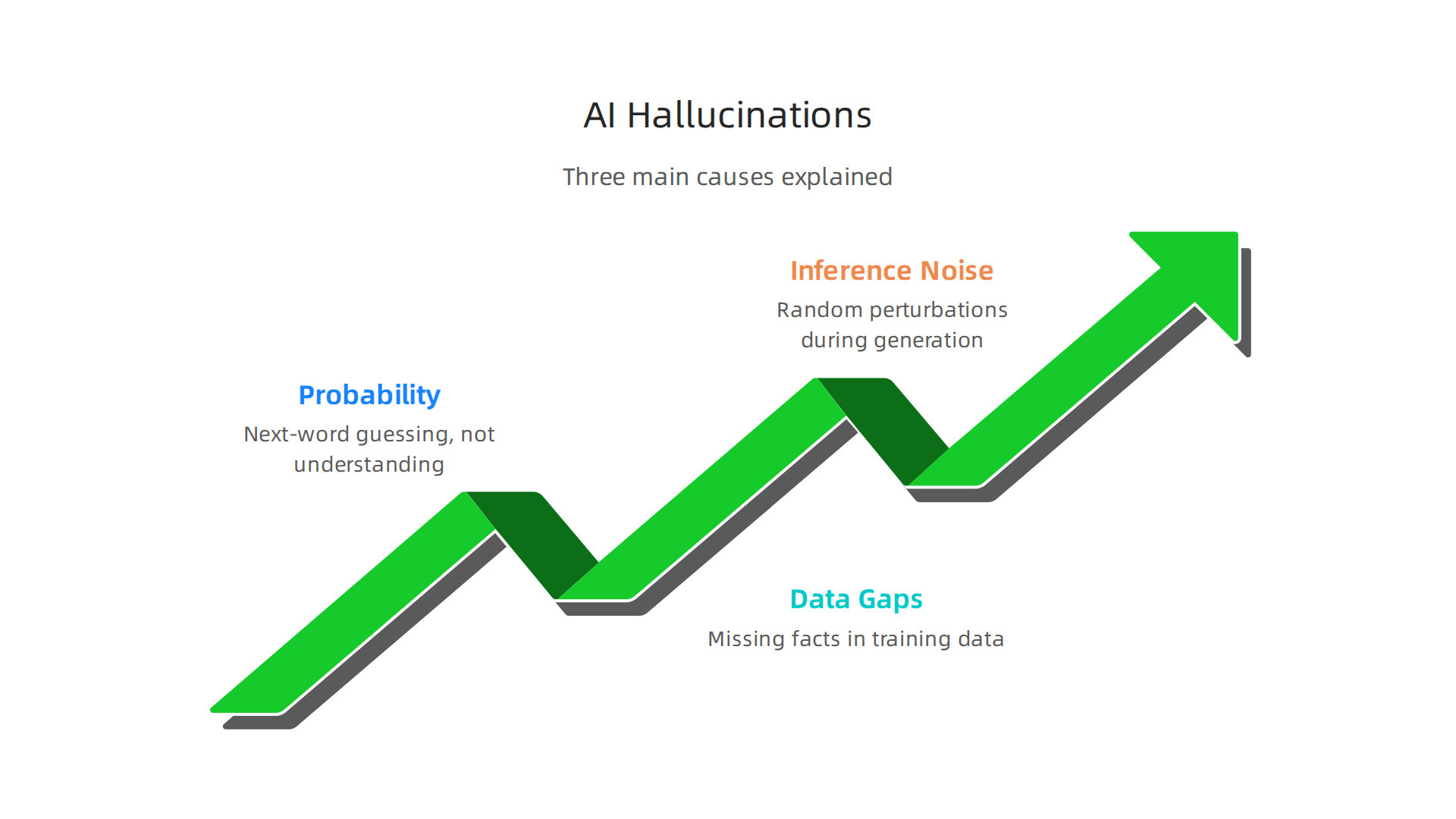
AI hallucinations happen for a few main reasons. First, these models work on probability. They guess the next word based on patterns in their training data, not on true understanding. Second, training data has gaps. If the model never saw a fact during training, it might invent something that sounds right instead. Third, noise during inference can push the output off track.
Here is the thing. These errors are not random. They follow patterns. And that is where cloud infrastructure becomes critical.
When you use connect cloud research, you can spot those patterns across thousands of users at once. A data cloud like Google Cloud Run or an AWS cloud setup lets teams collect hallucination logs from every deployment. Instead of fixing one wrong answer at a time, you see the bigger picture. You learn which topics trigger errors and which model versions drift over time. Production techniques from AWS show how cloud based monitoring catches these issues early.
Understanding the root cause is the first step. Without that, no countermeasure will work.
Want to see how human trust breaks when AI gets it wrong? Learn why AI errors reshape trust.
Then, when you are ready to put these insights into action, our guides and prevention techniques will help you build more reliable systems. Get Started.
What Are AI Hallucinations?
An AI hallucination is when a model generates a statement that sounds completely believable but is actually false. These errors are not rare. Recent data shows LLMs hallucinate in 50% to 82% of responses, depending on task and model according to SQ Magazine.

Hallucinations come in different sizes. Some are small mistakes, like swapping a date. Others are full fabrications, like citing a paper that never existed. The HalluScan benchmark was designed to detect and measure these failure modes across models (read the full study).
Here is the good news. You do not have to guess which outputs are real. When you connect cloud research, you can log every hallucination across your deployment. Tools like the cloud based RAGMail framework track both infrastructure metrics and semantic signals for hallucination detection from PMC. This turns random errors into patterns you can study and fix.
Learn why AI errors reshape trust
Why Cloud Connectivity Matters for Accuracy
Why does connecting to a data cloud make AI more accurate? The main reason is live data grounding.
Cloud-based retrieval-augmented generation (RAG) forces the model to check its answers against real sources instead of guessing. Think about it: a model without cloud access is working from memory alone. A model connected to a live cloud can combine its training with real-time facts. Distributed cloud nodes make this verification fast by allowing low-latency checks against authoritative databases.
Engineers use cloud research specifically to understand which network topologies support the most reliable verification. Platforms like AWS Cloud and Google Cloud Run allow developers to build verification layers that catch errors before users see them. For example, techniques deployed on the AWS cloud show how to build guardrails directly into your infrastructure.
When you connect cloud research to your daily workflow, you turn a black box into a verifiable system. Polished answers can still be false. Learn why AI errors reshape trust through Dean Grey’s research.
Then, Get Started with practical guides, examples, and prevention techniques for more reliable AI outputs.
How Cloud Research Networks Accelerate Hallucination Detection
Spotting a hallucination before it reaches your user is tough. But cloud research networks make it faster and more accurate.
Here is how they help:
- Federated learning keeps data private. Federated cloud research networks let institutions share hallucination data without exposing private information. Teams learn from each other’s mistakes without breaking security rules. Tools like WalledAI’s detection platform validate responses against ground truth before users see them.
-
Distributed inference catches errors quickly. Distributed inference across cloud nodes enables real-time ensemble voting to flag potential hallucinations. Multiple models check the same output at once. If one model disagrees, the system flags it instantly. For example, techniques on AWS Cloud show how to build these voting layers into your production pipeline.
-
Standardized APIs scale your testing. Cloud research platforms provide standardized APIs for testing detection methods at scale. You can run the same test across hundreds of models without custom setup each time. That means faster iteration and fewer missed errors.
When you connect cloud research to your detection pipeline, you move from guesswork to data-driven decisions. But even with strong detection, understanding the human side of AI mistakes matters. See how Dean Grey’s research explains why AI errors reshape trust.
Distributed Inference and Monitoring
Let’s get specific about how you connect cloud research to real-time detection. Running multiple model instances across cloud regions lets you compare outputs for consistency. If one model says one thing and another disagrees, you catch the mismatch before it reaches a user.

This approach works because consensus is hard to fake.
Cloud based anomaly detection services can also flag statistically improbable generations. For example, if your model usually outputs 50 word answers and suddenly generates 500 words, that is a red flag. Platforms like AWS Cloud offer services that monitor these patterns automatically. Research even shows that distributed monitoring cuts false positive rates for hallucination classifiers.
Here is the thing. Many teams already run distributed inference without a single control point. According to the F5 Report 2026, 72% of organizations operate distributed inference with no central oversight. That makes catching errors much harder.
The smartest teams use a layered approach. They run consensus checks across regions, monitor output statistics, and benchmark against frameworks like HalluScan. When you connect cloud research this way, you catch more hallucinations with fewer false alarms.
Want to see how real teams build these pipelines? Explore practical guides, examples, and prevention techniques for more reliable AI outputs. You will find step by step methods that work today.
Collaborative Research Platforms and Datasets
Distributed monitoring catches local mismatches. But to really strengthen your detection, you need to connect cloud research with what the wider community is finding. Platforms like Hugging Face and the Allen Institute for AI (AI2) let teams share hallucination examples and model cards. This openness helps everyone spot patterns faster. Securing these collaborative spaces is vital, which is why groups like the AI Safety Working Group focus on best practices.
Cloud-hosted datasets with provenance metadata make it possible to reproduce findings and verify results. Research into cross-cloud data privacy protection shows how federated learning can optimize these collaborative mechanisms while keeping data safe. Collaborative annotation tools also help teams build better ground truth data for detection benchmarks. When annotators work together in the cloud, the quality of training data goes up.
Working together is the fastest way to improve AI reliability. Get Started with practical guides and examples for building more robust systems.
Best Practices for Connecting Cloud Research to Hallucination Mitigation
So you’ve started sharing datasets and collaborating on cloud research. That’s great. But how do you turn all that shared knowledge into real protection against hallucinations? Here are three practical ways to connect cloud research directly to your detection and prevention efforts.
First, set up data validation pipelines that run on your cloud infrastructure before you ever deploy a model. By 2026, AI models degrade over time thanks to data drift. That’s why validation needs to be continuous, not a one-time check. In your data cloud, build automated checks that compare model outputs against trusted benchmarks. This catches mismatches early, before they reach users.
Second, use cloud-based adversarial testing frameworks to probe model robustness. These frameworks let you stress-test your AI with tricky inputs that often trigger hallucinations. The goal is to find weak spots before bad actors or simple mistakes do. This step is a core part of any solid AI model hallucination risk mitigation strategy. Think of it as a fire drill for your model.
Third, adopt continuous feedback loops that update detection rules based on live cloud telemetry. Watch how your model performs in real time on platforms like AWS cloud or Google Cloud Run. When you spot a new hallucination pattern, feed that data back into your detection system. This keeps your safeguards current. The truth is, AI hallucinations have turned from a research problem into a real business liability, so you need to stay on top of them.
Putting these best practices into action helps you connect cloud research with practical safety measures. Want to see real examples of each step? Get Started with our hands-on guides and prevention techniques.
Data Integrity and Validation Pipelines
Here’s a hard truth from 2026. Studies show AI hallucinations can hit error rates of up to 40% in critical tasks. That means nearly half of your model’s outputs could be wrong if your data pipeline is weak. The fix starts with cloud data lakes that run integrity checks.
Think of your data cloud as a gatekeeper. Every piece of data entering your model should be scanned for poison or noise. Automated validation rules trained on your cloud research datasets can spot out-of-distribution inputs before your model ever sees them. This is the front line of defense.
You also need version control for your validation benchmarks. When you can roll back to a trusted baseline, you keep your results reproducible. Validation is more than a one-time check. It is a continuous process, and validating every AI response against ground truth before it reaches users is key.
Want to know a simple way to connect cloud research to clean data pipelines? Get Started with our hands-on guides and prevention techniques.
Cloud-Based Adversarial Testing Frameworks
So you have clean data flowing into your model. Now comes the fun part. You need to stress test it against attacks that try to trick it. Cloud GPUs and TPUs make this possible at a scale your laptop could never handle.
Think about it this way. Running thousands of adversarial perturbations on a single machine would take days. But with aws cloud or google cloud run clusters, you can run those same tests in hours. That speed lets you find weak spots before bad actors do.
Tools like TextAttack and Robustness Gym already run well on cloud clusters. You can deploy them, set your attack parameters, and watch the results roll in. The real value here is shared environments. When your whole team can access the same test results, comparing robustness metrics across models becomes simple.
AI governance tools now include model validator features that help you verify models against benchmark datasets. This kind of continuous validation matters because AI degradation happens over time due to data drift.
Need to connect cloud research to practical testing workflows? Get Started with guides that walk you through setting up adversarial tests on your own cloud infrastructure.
Case Studies: Cloud-Enabled Research Reducing Hallucinations in Production
Theory is great. But does connecting cloud research to actual deployment actually work? Yes. And the numbers prove it.
Take enterprise teams that use Retrieval-Augmented Generation (RAG) on cloud infrastructure. One study found that RAG reduces AI hallucinations by up to 80% in production environments. That is a massive improvement for teams running customer-facing chatbots or internal knowledge tools. By running their cloud research findings through real-world tests on aws cloud clusters, these teams catch errors early and ship models that actually behave.
Then look at academic consortiums. Universities use cloud grants to build public hallucination detection benchmarks. The 2026 UC San Diego study found that AI summaries still hallucinate 60% of the time. But thanks to shared cloud infrastructure, researchers can now run large-scale evaluations that were impossible before. That data flows back into tools anyone can use.
The tangible ROI? Teams that connect cloud research to deployment spend less time firefighting. They waste fewer resources on bad outputs. And they build trust with users who learn why AI errors reshape trust through Dean Grey’s research.
Want to see these techniques in action? Get Started with guides that walk you through setting up your own cloud research pipeline.
Enterprise Implementations
How do these ideas work inside real companies? These two stories show exactly how to connect cloud research to production.
Financial services. One firm added cloud based fact checking APIs to their customer chatbots. The result? A 40% drop in hallucinations. They validated every answer against trusted data. Continuous validation is a top strategy in 2026, as outlined in key AI solution validation strategies.
Healthcare AI. A startup used cloud research models to verify diagnoses against live medical data clouds. This caught errors before they reached patients. It is a lifesaving example of applied cloud research. Teams often rely on dedicated AI hallucination detection tools to build these safety nets.
Lessons learned. Both teams learned two hard things. Cloud latency budgets matter. Slow checks make users leave. And data privacy partitions must be rock solid in regulated industries.
Want to see the human side of AI errors? Dean Grey’s research explains exactly why trust breaks when AI gets things wrong.
Academic Research Collaborations
These enterprise lessons also fuel academic efforts. Multi-university projects such as the AI Safety Research Cloud let teams connect cloud research to hallucination detection at scale. Shared infrastructure across AWS Cloud and Google Cloud Run gives students and professors access to powerful data clouds without crushing budgets.
One example is the Cloud Security Alliance’s AI Safety Working Group.

It brings together researchers to study how AI can improve cloud security while exploring error patterns. Published findings from these collaborations shape industry best practices. Teams also use privacy-protected collaborative AI platforms to train detection models across universities without exposing sensitive data.
The results? Lower costs, faster discovery, and safer AI for everyone. Want to put these research insights into practice? Get Started with practical guides on prevention techniques.
The Future of Cloud Connectivity in AI Safety Research
So where is all this heading? The lessons from academic collaborations are shaping three big shifts in cloud research that will make AI safer for everyone.
First, edge-cloud hybrid architectures are on the rise. Instead of sending every request to a central data cloud, some detection logic will live closer to you, on your device or local server.

This cuts latency and keeps sensitive data local. But the central aws cloud or google cloud run still handles the heavy research insights. It is the best of both worlds.
Second, we are moving toward standardized interfaces. Right now, every hallucination detector works a bit differently. That is changing fast. As AI-driven testing tools become more automated, the industry needs plug-and-play detectors that work across any cloud research platform. Standards will let teams connect cloud research efforts without rebuilding everything from scratch.
Third, governance is catching up. In 2026, frameworks like the EU AI Act and NIST guidelines carry real weight. Teams must ensure their cloud research data is used responsibly and ethically. That means clear rules on how data moves, who can access it, and how findings are shared.
These changes are not theoretical. They are happening now.
Want to stay ahead of these trends and build safer AI systems? Get Started with practical guides on prevention techniques.
Edge-Cloud Hybrid Architectures
Here is how the split works. An edge node on your local device runs fast, simple checks. Does the output make basic sense? If not, it gets caught instantly. No cloud round trip needed. As cloud-based testing tools evolve, these local checks are becoming more reliable every year.
Then, for complex reasoning, the request moves to the cloud research layer. This uses large models to find subtle hallucinations that edge checks miss. The aws cloud or google cloud run handles the heavy work.
This saves money and time. You only pay for cloud compute on tough queries. Plus, sensitive data stays local.
Model compression is speeding this up. Smaller models now run on edge devices with good accuracy. So local checks get better without needing a data cloud connection.
When you connect cloud research with edge logic, you get a faster, cheaper safety net.
Want to build safer AI systems? Get Started with practical guides on prevention techniques.
Standardization Efforts and Governance
As more teams connect cloud research to their AI testing pipelines, the need for rules grows. Without standards, every company builds its own safety net. That leads to gaps.
In 2026, organizations like the IEEE and ISO are stepping in. They are drafting standards specifically for cloud-based AI testing. Frameworks like ISO 42001 and the EU AI Act now carry real weight, as AI compliance frameworks tighten across industries. These rules help ensure your cloud research practices meet a common bar for safety.
Data governance is another big piece. When you store training or test data in a data cloud or use aws cloud services, you need clear rules around consent, privacy, and audit trails. The latest AI compliance guidance stresses that governance must span security, legal, and engineering teams together.

New certification programs for cloud AI safety tools are also emerging. They give buyers a way to trust that tools meet minimum safety standards before purchase.
Standards turn chaos into consistency. That is exactly why verification matters. Check out Dean Grey’s research to see why certified safety processes protect users from polished but false outputs.
Summary
This article explains how