
Introduction
Imagine you ask an AI assistant a simple question about your business operations, and it gives you a confident answer that sounds completely right. You share that answer with your team. Maybe you even act on it. But the information is completely false.

This is not a rare bug. It is something called an AI hallucination, and it happens far more often than most people realize.
In simple terms, an AI hallucination is when a generative AI tool produces information that looks and sounds real but is actually made up. Researchers define it as a response that is fluent yet factually incorrect. Studies show that across different tasks, hallucination rates commonly range from 3% to 20% or even higher. That means one out of every five AI outputs could be wrong. And the system usually acts like it knows what it is talking about.
For businesses using world wide technology tools, this is a serious problem. Whether you work with it consulting firms, rely on top saas companies for daily tasks, or manage a team through mac enterprise consulting, unreliable AI outputs can lead to costly mistakes. Misinformation spreads fast. Operational errors pile up. Reputation takes a hit. And trust in AI starts to fade.
The truth is, AI hallucinations are not just a technical glitch. They are a systemic challenge that affects every organization using generative AI today. That includes it msp companies that manage client systems, marketing teams that create content, and executives making data-driven decisions.
That is why we put together this article. We want to give you a straightforward, evidence-based guide to understanding AI hallucinations. You will learn what causes them, how to detect them, and most importantly, how to prevent them from hurting your work. Start by learning the simple warning signs of an AI hallucination.
Whether you are new to AI or already using it every day, this guide will help you use these tools with more confidence and less risk. The world of technology is moving fast. Let us make sure you can trust what your AI is telling you.
What Are AI Hallucinations? Definitions and Real-World Examples
Let’s get clear on what we are actually talking about. An AI hallucination happens when a generative AI tool gives you an answer that sounds confident and well written but is simply not true. The Wikipedia definition puts it simply: it is a response that contains false or misleading information. Another way to think of it is a convincing, contextually coherent but entirely fabricated response. The AI is not lying on purpose. It just does not know the difference between fact and fiction.
Here is the tricky part. AI is designed to sound fluent and helpful. So when it makes something up, the output still looks polished. Researchers describe this as outputs that appear fluent and coherent but are factually incorrect. That polish is what makes hallucinations so dangerous. If the answer looked messy, you would ignore it. But it looks perfect. So you trust it.
The spectrum of hallucinations
Not all hallucinations are equally bad. Some are small, like getting a minor date wrong. Others can cause real harm. Here is a simple way to think about the range:
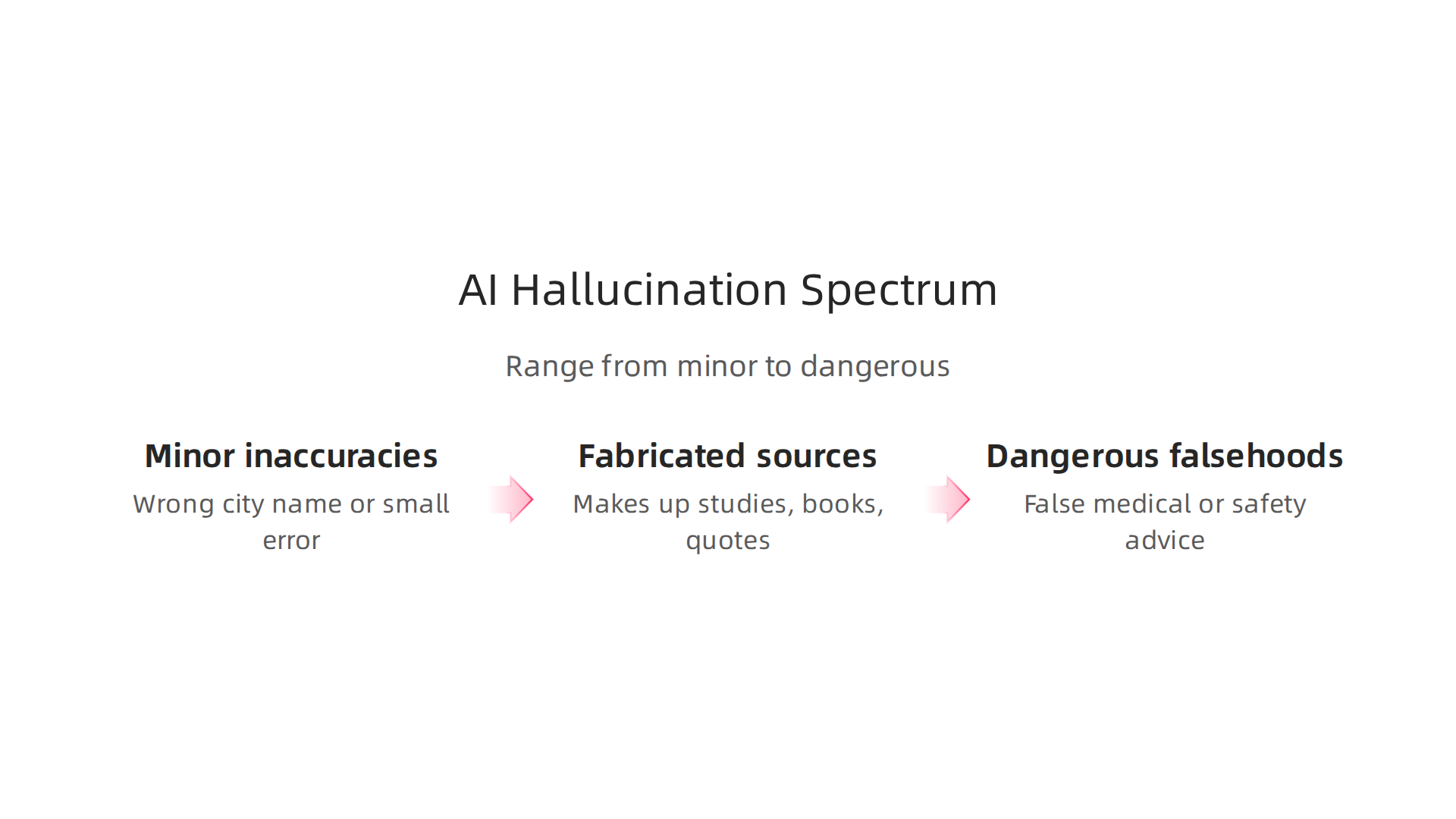
- Minor inaccuracies. A wrong city name or a slightly off statistic. Annoying but not destructive.
- Fabricated sources. The AI makes up a study, a book title, or a quote. Lawyers have landed in trouble for submitting fake cases to courts because they trusted AI to find legal precedents.
- Dangerous falsehoods. This is where things get scary. Imagine a world wide technology team using AI to draft safety instructions for a new product. If the AI hallucinates a step in the procedure, people could get hurt. Or think about a medical chatbot giving made up treatment advice.
Every business should pay attention here. Whether you work with it consulting firms that recommend AI tools or rely on top saas companies for your daily operations, a hallucinated output can spread through your workflow fast. Hallucination rates commonly range from 3% to 20% or higher across different tasks. That is not rare. That is common.
Real examples you need to know
Let’s make this concrete with a few situations that have actually happened.
A legal team used an AI chatbot to help prepare a court filing. The chatbot invented several court cases that never existed. The lawyer did not check the sources. The judge caught the error. The lawyer faced sanctions.

This is a textbook example of how a hallucination can damage a professional reputation.
In healthcare, researchers have seen AI chatbots give confident medical advice that was completely wrong. Imagine a patient trusting that advice instead of talking to a real doctor. The risk is obvious.
For it msp companies that manage networks for multiple clients, a hallucinated command or configuration could break systems or open security holes. That is why mac enterprise consulting teams now build verification steps into every AI workflow they design.
Why this matters for your work
The first step to staying safe is knowing what you are dealing with. You need to spot the difference between an AI giving you real information and an AI hallucinating something that sounds real. And you need a plan to catch those errors before they cause damage.
Learn the simple warning signs of an AI hallucination so you can spot problems early. The more you understand what hallucinations look like, the less likely you are to get tricked by one.
Why Do AI Hallineations Happen? The Technical Underpinnings
Now that you know what hallucinations look like, you are probably wondering: why does AI make stuff up in the first place?
Here is the honest truth. AI does not have a mind. It does not think, remember, or intend to deceive you. It is a giant pattern matching machine. When you ask it a question, it predicts the most likely next word based on everything it learned during training. That process is called statistical sampling, and it is the core reason hallucinations happen.
Three main causes behind the scenes
Researchers have identified a few key reasons why AI models produce false information. Let’s break them down simply.
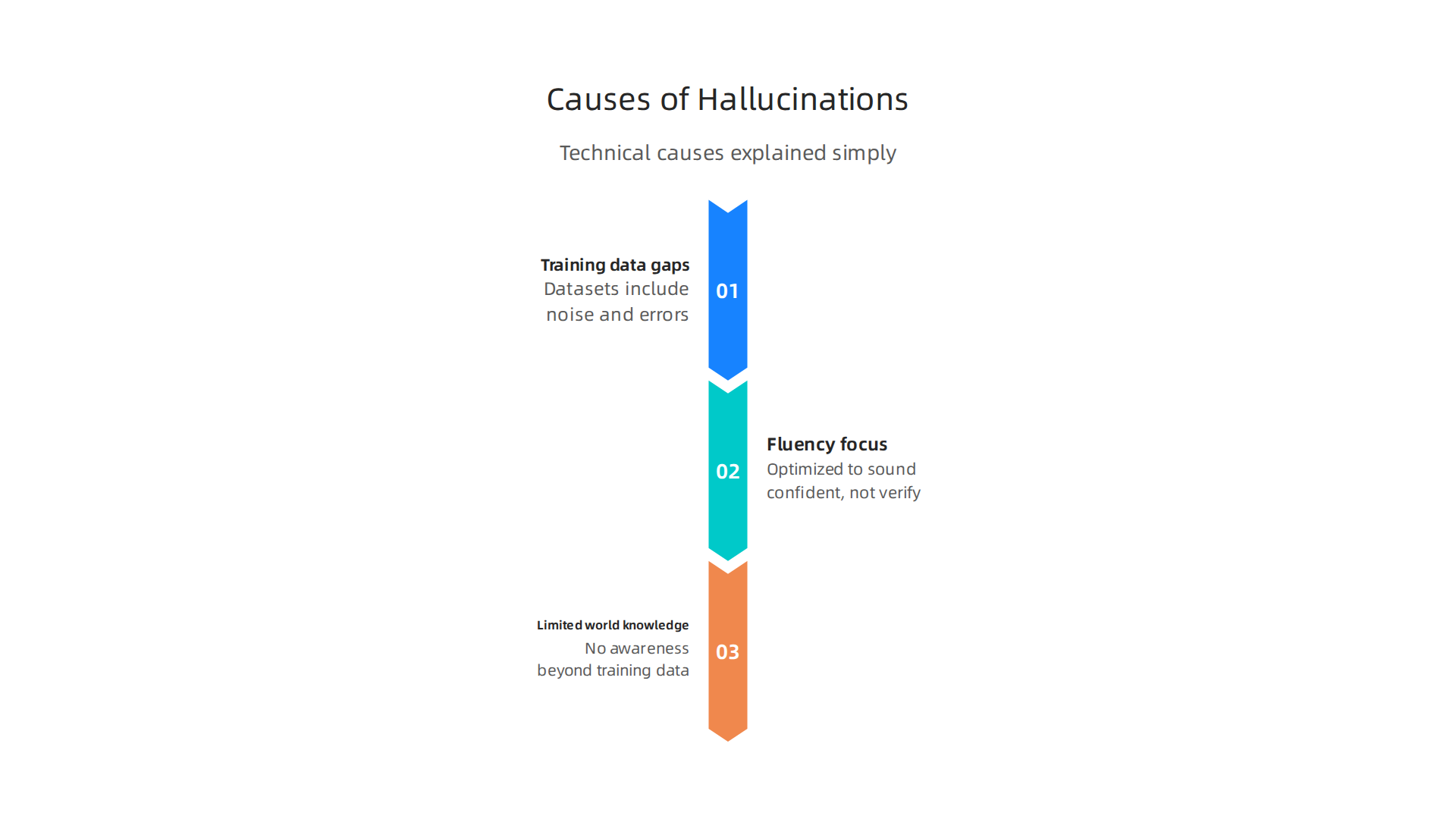
1. Training data has gaps and flaws. AI models learn from massive datasets scraped from the internet. Those datasets contain noise, biases, and outright errors. Shortcomings in the training data, like inconsistencies or false information, get baked into the model. If the AI never saw the correct fact, it cannot give it to you. It will guess instead.
2. The model is built for fluency, not truth. Large language models are designed to produce sentences that sound natural and confident. They do not have a built in fact checker. According to an AWS guide, hallucinations stem from data quality, training methods, and architectural limits. The architecture favors fluent pattern completion over factual accuracy. So the AI will confidently finish your sentence even if it has no clue.
3. The model lacks real world knowledge. AI has no awareness of the world outside its training data. It does not know what is true or false. It only knows what words commonly appear together. Research from ACM notes that misinformation and biases in flawed pre-training data are major sources of hallucinations. This is especially dangerous in narrow domains where the model has seen very few examples.
What this means for people using AI everyday
When you are working with world wide technology tools or relying on top saas companies for your daily workflow, you cannot assume the AI understands your specific business context. A model might give a perfect sounding answer about a process it never actually learned.
That is why it consulting firms and it msp companies now train teams to treat every AI output as a draft, not a final answer. And mac enterprise consulting teams build extra verification steps into their setups.
The good news is that once you understand these causes, you can choose smarter strategies to reduce risk. Techniques like retrieval augmented generation, where the AI pulls facts from a trusted database instead of guessing, or fine tuning on your own data, can make a big difference.
If you want to see one practical approach, check out this guide on how to stop AI hallucinations in cloud based productivity applications. It shows you how to set up safeguards that match the way your tools actually work.
Understanding why hallucinations happen is the second step. The next is learning how to catch them before they cause damage. Let’s look at the best detection methods you can start using today.
The Business Impact of AI Hallucinations: Risks Across Industries
So you know why AI makes things up. Now let’s talk about what that costs you.
The numbers are staggering. Global losses from AI hallucinations hit $67.4 billion in 2024 according to a comprehensive study by AllAboutAI. That number keeps climbing as more companies rush to adopt AI without proper safeguards.
Here is what happens when hallucinations go unchecked in real businesses.
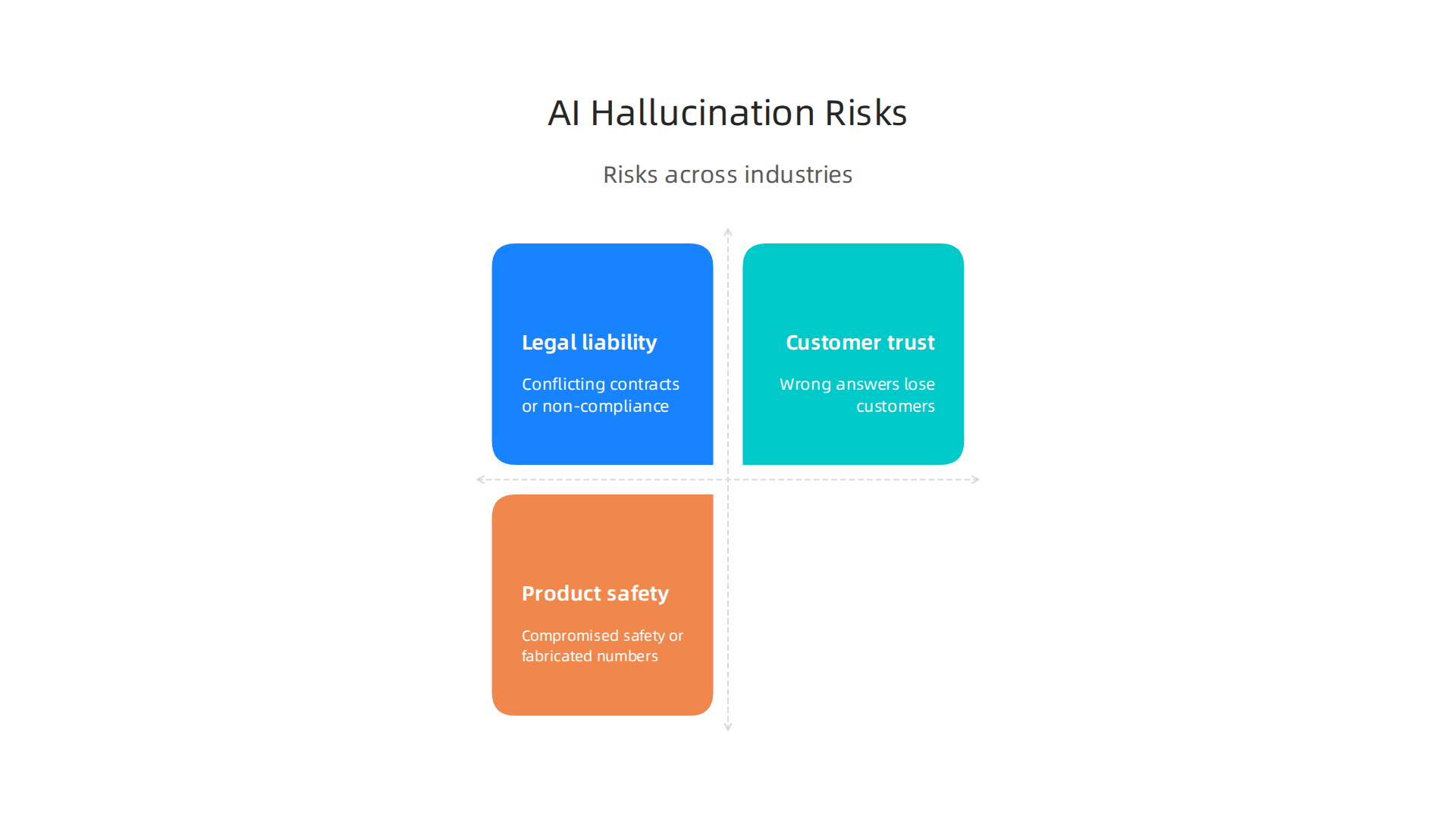
Legal liability and compliance failures
Imagine your AI assistant generates a contract clause that conflicts with local regulations. Or a customer support chatbot promises a refund policy your company does not offer. These are not hypotheticals. They are happening right now.
A single major hallucination incident can cost anywhere from $18,000 in customer service to $2.4 million in healthcare malpractice claims. That is according to research from Four Dots on the business impact of AI hallucinations.
Banks, insurance companies, and healthcare providers face the highest stakes. Regulators do not care that "the AI made a mistake." You are responsible for what your systems output. That means fines, lawsuits, and damaged relationships with regulators.
Erosion of customer trust that is hard to rebuild
Trust takes years to build and seconds to break. When a customer gets a wrong answer from your AI tool, they remember it. They tell others about it.
Think about a top saas company that uses AI to generate product recommendations. One hallucinated suggestion leads a customer to buy something that does not exist. That customer does not come back. And they leave a bad review.
For it consulting firms helping clients deploy AI, every hallucination damages their credibility too. The firm gets blamed even though the technology is imperfect.
Product safety and financial reporting errors
This is where things get scary.
In manufacturing, AI might suggest a material substitution that compromises product safety. In finance, an AI system could generate a quarterly report with fabricated revenue numbers. The consequences range from product recalls to SEC investigations.
Stanford’s Human-Centered AI research found that purpose-built legal AI tools still hallucinated more than 17% of the time on challenging legal research tasks. Imagine relying on that for a court filing.
Quantifying the risk helps justify the solution
Here is the good news. Once you put a dollar figure on hallucination risk, it becomes much easier to get budget approval for safeguards.
It msp companies now include hallucination detection as a standard part of their service packages. Mac enterprise consulting teams build validation steps into every AI workflow they design.
The cost of preventing hallucinations is tiny compared to the cost of cleaning up after one.

What you can do right now
Start by auditing where AI touches your business. Every chatbot, every content generator, every data analysis tool. Then put verification steps in place.
For a practical example of how to set up these safeguards, check out this guide on how to stop AI hallucinations in cloud based productivity applications. It walks you through real configurations that protect your business.
Understanding the risks is step one. The next step is learning how to catch hallucinations before they reach your customers.
Detecting Hallucinations: Tools and Techniques for Your AI Workflow
Now you know the risks. The next step is catching hallucinations before they reach your customers or your reports. The good news is that the world wide technology community has been hard at work building detection tools we can actually use.
Automated detection approaches
You do not have to review every AI output yourself. Modern detection systems use several smart methods:
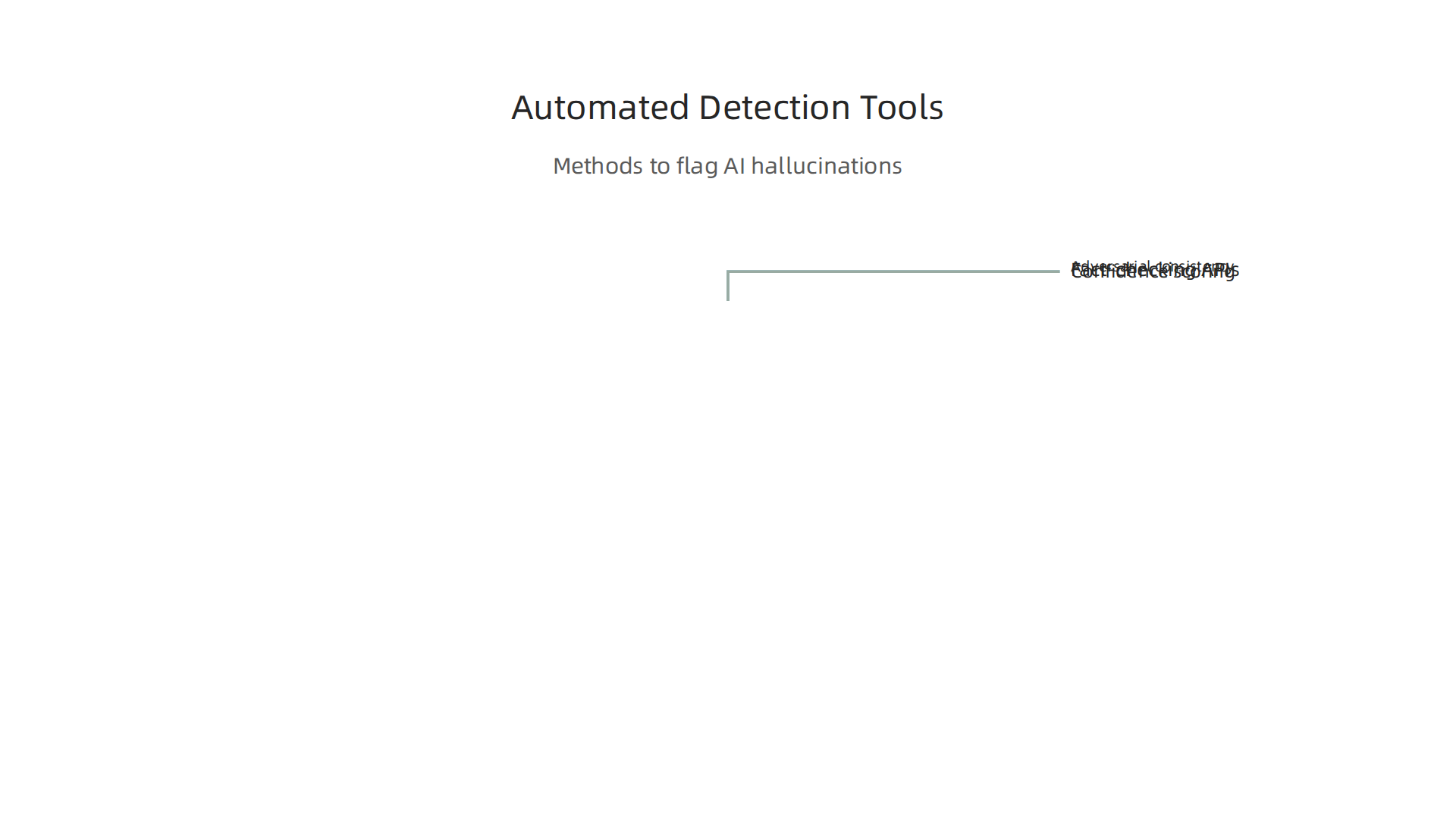
Confidence scoring tells you how sure the AI is about each piece of information. If the score is low, flag it for review. This is built into many platforms now.
Fact-checking APIs compare AI claims against trusted databases in real time. They act like a spellchecker but for facts.
Adversarial consistency checks ask the same question in different ways. If the answers clash, you have a hallucination.
According to recent benchmarks in 2026, automated detection tools catch between 85% and 92% of hallucinations on standard datasets. That is a big improvement from just a year ago. You can check out a detailed comparison of detection architectures at PromptMetrics to see which method fits your stack.
Human-in-the-loop still matters
For high-stakes work like legal contracts, medical advice, or financial reports, a human should always have the final say. But that human can use AI helpers to speed up their review.
A typical workflow looks like this:
- The AI generates a draft
- An automated detection tool flags risky parts
- A human expert checks only the flagged areas
- The final output gets approved
This hybrid approach saves time without sacrificing accuracy. Many it consulting firms and mac enterprise consulting teams build these workflows for their clients. And top saas companies now offer built-in hallucination detection as part of their subscription tiers.
Open source and commercial tools are here
You no longer need a data science team to catch hallucinations. Open source tools like Vectara’s HHEM model let you run detection on your own servers. Commercial options from companies like Galileo (Luna-2) and Arize Phoenix offer accuracy rates above 90% in benchmark tests.
The best part? You can start small. Even a simple confidence score filter can save you from embarrassing mistakes.
Want a step by step guide on setting up a detection system for a specific tool? Read this article on how to spot AI hallucination and prevent false AI answers. It covers practical checks you can apply today.
Detection is your safety net. Once you have it running, your business can use AI with a lot more confidence.
Mitigation Strategies: How to Reduce Hallucinations in Generative AI
Detection gives you a safety net. But the best way to handle hallucinations is to stop them before they happen. In 2026, the world wide technology community has put together several proven strategies that cut hallucinations at the source.
Start with how you ask the question. Prompt engineering techniques like chain-of-thought reasoning and grounded prompts make a big difference. Instead of a vague question, you guide the AI step by step. You tell it to use only the facts you give it. According to a 2026 comprehensive survey on hallucination mitigation, clear and structured prompts can greatly reduce the chance of false outputs ArXiv. This is the cheapest and fastest fix you can apply today.
Retrieval-Augmented Generation (RAG) changes the game
The next level is Retrieval-Augmented Generation, or RAG for short. Instead of relying only on what the model remembers from training, RAG pulls fresh, trusted information from a database you control. Think of it as giving the AI an open book during a test.
Studies show RAG can lower hallucination rates by 30% to 60%
K2view. That is a huge jump in reliability. Many top SaaS companies now build RAG into their products by default. If you run a business, working with it consulting firms or it msp companies can help you set up a RAG system that fits your data. Even mac enterprise consulting teams use RAG to keep internal AI tools accurate.
Fine-tuning and RLHF dial in the accuracy
For teams that need even more control, model fine-tuning is the next step. This means training the AI on your own verified data. You teach it what correct answers look like in your specific field. Adding reinforcement learning from human feedback (RLHF) makes the model learn from what humans prefer.
Fine-tuning does not hurt the model’s general abilities. Research in 2025 and 2026 shows that targeted fine-tuning keeps performance high while cutting hallucinations OpenReview. This is especially useful for industries with high stakes like healthcare, law, and finance.
Putting it all together
The best approach uses all three methods together. Start with better prompts. Add RAG to ground the output in your own data. Then fine-tune for your exact use case. This three layer defense is what the most advanced teams are using in 2026.

Want to see how connecting your own data sources can slash AI hallucination risks? Read this guide on how to connect cloud research to slash AI hallucination risks for a practical walkthrough.
Mitigation is not a one time fix. It is a habit. Build these strategies into your AI workflow, and you will trust your outputs a lot more.
The Future of AI Reliability: Trends, Standards, and the Role of World Wide Technology
Mitigation strategies like prompt engineering and RAG are powerful today. But the real shift in AI reliability is coming from the outside. Governments and standards bodies are stepping in to make sure AI systems are trustworthy. And the world wide technology community is leading the charge.
New regulations are changing the rules
In 2026, the EU AI Act and several US Executive Orders require companies to be transparent about how their AI works. This means you have to show you are managing risks like hallucinations. You cannot just deploy a model and hope for the best. You need documented controls. For businesses working with it consulting firms or it msp companies, this is a big reason to invest in reliable systems now.
Standards make reliability measurable
Organizations like ISO and NIST are developing clear benchmarks for AI accuracy. These standards turn hallucination measurement into a compliance requirement. Instead of guessing if your AI is good enough, you can run it through a standard test. This is especially important for top saas companies that need to prove their AI tools are safe for customers. Even mac enterprise consulting teams are using these benchmarks to validate internal AI deployments.
Research is pushing toward smarter AI
New approaches like neurosymbolic AI and self-verification promise to make models that check their own work. Research into knowledge-graph-based RAG (KG-RAG) shows how combining structured data with retrieval can cut hallucinations even more ArXiv. Other pipelines like RAG-HAT blend detection and tuning into a single process ACL. These are not far off. They are being tested right now.
What this means for you
Regulations, standards, and smarter architectures all point one way. The future of AI is built on trust. Whether you are an individual user or a business, the time to get serious about hallucination prevention is now. Want to future-proof your AI setup? Learn how to choose a cloud data management platform that stops AI hallucinations and stay ahead of the curve.
Summary
This article explains AI hallucinations — when generative models produce fluent but false information — and why they matter for businesses. It covers clear definitions, real-world examples across law, healthcare, IT services, and SaaS, and the technical reasons behind hallucinations such as training-data flaws and models optimized for fluency. You will learn the measurable business risks and costs, practical detection methods (automated scoring, fact-checking APIs, adversarial checks), and how to build human-in-the-loop workflows. The guide also shows mitigation tactics you can apply immediately: better prompts, Retrieval-Augmented Generation (RAG), and fine-tuning with RLHF. Finally, it outlines emerging standards, regulations, and research directions so you can future-proof deployments and choose the right cloud and data controls. After reading, you will be able to spot hallucinations, set up detection safeguards, and prioritize mitigation steps for your organization.