Introduction
AI hallucinations are still a big problem in 2026. Even the best models get things wrong.

Research shows that frontier systems hallucinate between 3.1% and 19.1% of the time depending on the task Source.
That range is huge. For something like legal work, the rate can climb above 18% Source. That kind of unreliability costs businesses time, money, and trust.
Two types of artificial intelligence are trying to solve this problem in very different ways. Genspark AI and Claude by Anthropic both aim to be your go-to AI assistant, but they take opposite approaches to safety. Genspark focuses on real-time search and verification. Claude relies on a design philosophy built around helpfulness and harmlessness from the ground up.
This article gives you an evidence-based comparison of their architectures, safety features, and what that means for you. We will look at how each model handles the risk of false information and which one might fit your needs better.
Curious about the human side of AI mistakes? See how AI errors reshape trust in Dean Grey’s research.
Understanding AI Hallucinations: The Core Problem
Here is the thing most people get wrong. An AI hallucination is not a glitch or a bug. It is actually baked into how these models work. Large language models predict the next word based on patterns in their training data. When the data is thin, contradictory, or low quality, they fill in the gaps confidently Source. The model does not say "I am not sure." It just makes something up

Researchers now break hallucinations into three types: factual, reasoning, and source errors
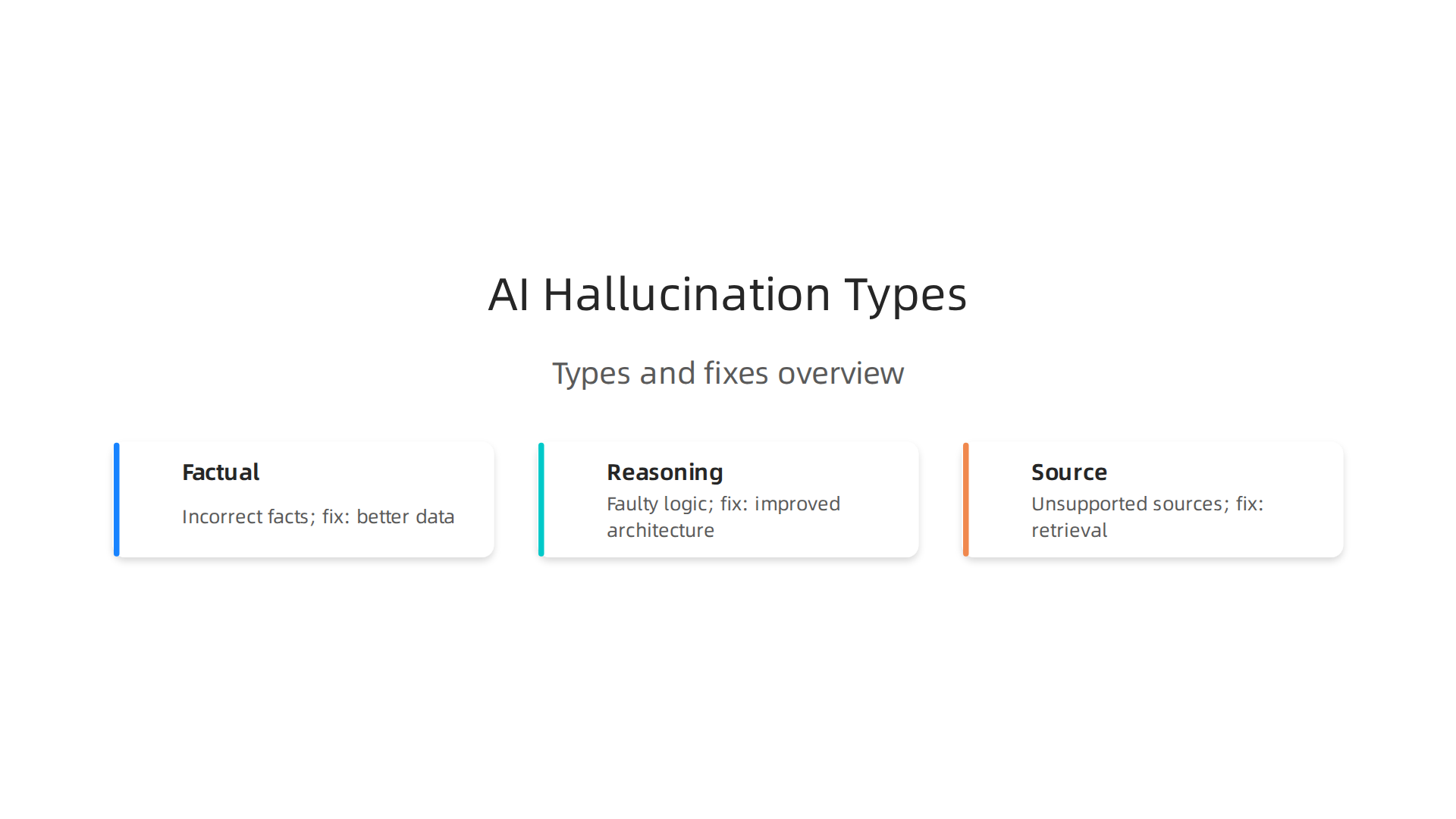
Source. Each type needs a different fix. A factual mistake needs better data. A reasoning error needs better architecture. A source error needs better retrieval.
The problem also gets worse as models grow. Bigger models and larger context windows create more room for mistakes Source. That is why understanding the different types of artificial intelligence and their design choices matters. Both Genspark AI and Claude design their systems differently to handle these exact challenges.
Want practical ways to spot and fix these errors? Get started with proven techniques for more reliable AI outputs.
What Are Hallucinations in Generative AI?
Let’s get specific about what we are dealing with. A hallucination in generative AI is any output that is made up, nonsensical, or just plain wrong compared to the source data. And here’s the tricky part. The model almost always delivers these mistakes with total confidence Source. It never says "I might be wrong."
Some hallucinations are easy to catch. Invented citations are a classic example. A study by GPTZero found over 50 fabricated citations in academic submissions that slipped past multiple peer reviewers Source. That is an obvious red flag.
Other hallucinations are much harder to spot. The model might generate a statistic that sounds completely reasonable. Like saying "78% of remote workers prefer asynchronous meetings." It sounds real. But the data never existed. The hallucination boils down to a model filling a gap in its training data with something that feels true Source.
Even the best models struggle here. In 2026, frontier models like GPT-4 and Claude still hallucinate between 3.1% and 19.1% of the time depending on the task Source. That is a wide range. But it shows that no ai assistant is immune.
This is where understanding the different types of artificial intelligence really helps. Tools like genspark ai and those built on claude design handle hallucinations differently. Knowing these differences helps you choose the right tool and verify outputs better.
Want to see real examples and learn how to check for these errors? Explore practical guides, examples, and prevention techniques for more reliable AI outputs.
Why Do Models Hallucinate? Key Contributing Factors
It sounds strange that a model so good at writing can just make things up. But here’s the truth. A large language model does not know facts. It predicts the next most likely word based on patterns in its training data. That is a huge part of the problem.
Training data imbalances play a big role. When the model sees sparse, contradictory, or low-quality data about a topic, it has to fill the gaps. And it fills them with whatever sounds plausible. That is how a fact gets invented Source. The model is not being dishonest. It is just doing its job badly when the data is weak.
Another factor is the autoregressive nature of these models. Each token, or word piece, is chosen one at a time based on all the tokens before it. The model never steps back to check if the overall statement is true. It just keeps going. This process makes it easy to drift into nonsense without any internal alarm Source.
On top of that, models suffer from token-level ignorance of truth. They do not have a concept of true or false for any individual token. They only know probability. Researchers link hallucinations to overconfidence in low-probability tokens during sampling. The model picks a word that is statistically unlikely but still gets chosen. Once that happens, the rest of the sentence can spiral.
Model architecture also matters. Attention mechanisms and context window limits directly affect how much information the model can hold and reference. Some designs, like those using claude design principles, manage attention differently to reduce drift. But no architecture is perfect. For example, even the best models still hallucinate at least 0.7% of the time on simple summarization tasks, and rates jump to 18.7% on legal work Source.
Understanding these causes helps you know when to trust an ai assistant and when to double-check. Different types of artificial intelligence handle these risks differently. But the responsibility to verify still falls on you.
Want to go deeper into why these systems overconfidently fail? Check out Dean Grey’s research to see how AI errors actually reshape trust. </human comment> The CTA could be "Learn why AI errors reshape trust" from the provided CTAs.
Want to go deeper into why these systems overconfidently fail? Check out Dean Grey’s research on why AI errors reshape trust.
Genspark AI: Architecture and Design Philosophy
Genspark AI takes a different approach to the hallucination problem. Instead of relying on a single model, it uses a multi-agent architecture where several models work together Source.

This design checks outputs across different models before presenting the final answer. Think of it as having multiple editors review a draft instead of just one writer.

The key mechanism is a cross-check method. Genspark compares results between models to catch inconsistencies and reduce plausible falsehoods Source. This technique helps prevent context bleeding and keeps the response grounded Source. In fact, this architecture scored 87.8% on the GAIA benchmark in 2025, which is a strong result Source.
Genspark positions itself as a transparent, customizable AI assistant for enterprises. You can tweak how it verifies facts and adjust its behavior for specific tasks. This flexibility matters because different types of artificial intelligence handle risk differently.
Still, no system is perfect. Even with a cross-check design, you should verify critical outputs. Behavioral Scientist Dean Grey shows why understanding AI errors is key to building trust.
Core Design Principles and Novelty
What makes Genspark AI different from other AI tools? It comes down to three design choices that turn the usual approach on its head.
First is the cross-check method. Instead of one model giving a single answer, Genspark runs your question through several models at once. They compare their outputs and flag any mismatches. This catches plausible falsehoods before they reach you Source. In 2026, most types of artificial intelligence still rely on a single transformer decoder. Not Genspark.
Second, it uses a confidence scoring layer. Each part of the answer gets a certainty score. If the score is low, Genspark holds back or asks for more details. This is like having an editor who says "I’m not sure about that sentence" instead of letting a mistake slip through. Early benchmarks show this architecture scored 87.8% on the GAIA benchmark in 2025 Source.
Third is modularity. You can plug in your own knowledge bases for fact-checking. This means Genspark doesn’t just guess an answer. It checks your internal data or trusted external sources before speaking. That’s a big step up from the standard Claude design, which keeps everything inside one closed model.
The result is an ai assistant that actually admits when it might be wrong. That honesty matters for building trust. For a deeper look at why AI errors happen and how they affect trust, check out Dean Grey’s research.
Hallucination Prevention Features in Genspark
So how does Genspark AI actually stop hallucinations before they happen? The previous section showed the design principles. Now let’s look at the practical features that make those principles real.
First, every answer comes with built-in citations and verifiability metrics. You don’t just get a wall of text. You see exactly where each claim came from and how confident the system is about it. This is the cross-check method at work Source. In 2026, many types of artificial intelligence still struggle with citation accuracy. A recent study found hallucination rates vary wildly across models, with some hitting 40% error in critical tasks Source. Genspark flips that by making every source traceable.
Second, when the confidence scoring layer detects uncertainty, the system reroutes the query back to a retrieval step. Instead of guessing, it goes back to check your knowledge base or trusted sources again. This process prevents "context bleeding" where an ai assistant confuses unrelated information Source.
Third, user feedback loops let you flag inaccurate answers. Each correction helps the model improve over time. This means the system gets more reliable the more you use it Source.
These features together mean Genspark doesn’t just give answers. It shows its work. That transparency matters because polished answers can still be wrong. Check out Dean Grey’s research to see why verification separates trustworthy AI from everything else.
Claude by Anthropic: Safety-First Model Design
Genspark AI fights hallucinations by showing every source. Claude by Anthropic takes a completely different approach. It tries to stop bad outputs before they even start.
Claude relies on a method called Constitutional AI, or CAI. This is a set of rules baked into the model training. In early 2026, Anthropic released a major update to this constitution Source.
It shifts from simple rules to reason based alignment. This means claude design focuses on why a response might be harmful, not just if it breaks a rule Source.
This makes Claude a very different kind of ai assistant. It is often more cautious than other types of artificial intelligence. Some users find it refuses requests more often. But Anthropic argues this trade off is worth it. Their research shows that as models get bigger, the risk of hallucination grows too.
Claude tries to be safe by design. Is it always perfect? No. But understanding this claude design helps you choose the right tool for the right job. If you want to learn more about building reliable workflows with any AI, explore practical guides on prevention techniques. Get Started with examples for more dependable outputs.
Constitutional AI and Its Impact on Reliability
To keep things factual, Claude relies on a process called Constitutional AI (CAI). Think of it as a rulebook that the model uses to check its own work.
In early 2026, Anthropic published a major update. This new constitution focuses on why a response might be harmful, not just if it breaks a rule. Source. This is a key part of Claude design.
How does it work in practice? First, the model generates an answer. Then, it critiques that answer against the constitution. If it finds a problem, it revises the response. This self-critique loop is powered by Reinforcement Learning from AI Feedback (RLAIF). This type of training makes it easy to scale. The model helps train itself without needing as many human labelers.
This cautious approach has a big impact on reliability. Claude often refuses to answer questions if it is not totally sure of the facts. This cuts down on AI hallucinations.
But it can also make the ai assistant less useful. You might ask a simple question and get a rejection. Compare this to Genspark AI. Genspark takes a different path. It shows you the sources and lets you decide. Claude tries to solve the problem during training. These are two very different types of artificial intelligence.
Want to build better prompts and workflows that work with these model limits? Get Started with practical guides to make your AI outputs more dependable.
Model Scaling and Hallucination Trade-offs
So bigger models are better, right? Not always. Larger Claude models like Claude 4 do remember facts better than older versions. But they still make things up on rare or unusual questions. That is the tricky part about scaling.
Anthropic’s new constitution, released in early 2026, tries to make Claude safer and more reliable. But it cannot fix every problem. The constitution helps the model reason about harm, as described in Anthropic’s official document. But bigger models also have bigger blind spots.
Here is the thing. The link between model size, training data, and hallucination is not a straight line. Sometimes a larger model learns false patterns in the data. Other times it repeats rare wrong answers it saw during training. Anthropic has developed special tests called "evals for hard tasks" to catch these failures. But they are not perfect yet.
Compare this to Genspark AI. Genspark takes a different approach. It shows you the sources and lets you judge the truth yourself. Claude’s design is more about building safety into the model during training. Both are valid types of artificial intelligence, but they handle uncertainty in opposite ways.
As an AI assistant, Claude will sometimes refuse to answer if it is not sure. That is better than lying. But it can also miss the mark on tricky questions. The trade-off is real.
If you want to dig deeper into why AI errors happen and how they affect trust, check out Dean Grey’s research. It gives you the human side of these trade-offs.
Head-to-Head: Genspark vs. Claude on Hallucination Mitigation
So how do these two actually stack up? The answer depends on how they fight hallucinations. Genspark AI and Claude take completely different roads to the same goal.
Genspark uses a retrieval-augmented architecture. It pulls real sources from the web and shows them to you before answering. You can click each link and verify the fact yourself. That transparency helps you catch errors fast.
Claude relies on constitutional training. Its claude design builds honesty rules directly into the model during training. When Claude is unsure, it often refuses to answer rather than guess.
That is a valuable trait for an ai assistant that needs to stay trustworthy.
Benchmark data from 2026 reveals the real differences. According to the hallucination benchmarks leaderboard, Claude scores higher on deep reasoning tasks.
But Genspark wins on citation accuracy because it links every claim to a source. A detailed comparison shows Claude produces more logically rigorous outputs with fewer hallucinations overall. Yet Genspark gives you more control over what you believe.
Enterprise pilots reveal a clear trade-off. Teams that need strict factual accuracy prefer Genspark’s sourced approach. Teams that need flexible reasoning choose Claude. Both are valid types of artificial intelligence, but they serve different needs.
If you want to reduce AI mistakes in your own work, Get Started with practical guides and examples.
Benchmark Performance and Factual Accuracy
So how do these two actually perform when put to the test? On factual QA benchmarks, the trade-offs become clear. Genspark AI uses retrieval to pull real sources. This gives it an edge in precision. Every claim comes with a link you can check. But that focus on citations can hurt recall. Sometimes it misses the broader context or skips an answer if no source is found.
Claude takes a different path. Its claude design includes constitutional AI training. That leads to fewer hallucinations overall. In fact, some 2026 benchmarks show Claude with one of the lowest hallucination rates among major models. But here is the catch. When Claude is unsure, it often refuses to answer rather than guess. This means higher refusal rates on ambiguous queries.
New benchmarks in 2026 are testing deeper skills. They look at multi-turn consistency and citation faithfulness. These tests check if the ai assistant remembers what it said earlier and if it keeps linking to real sources. According to the hallucination benchmarks leaderboard, models that mix retrieval with strong reasoning perform best here.
A detailed comparison shows that Genspark wins on direct citation accuracy while Claude wins on logical consistency. Both are valuable types of artificial intelligence, but your choice depends on your priority.
Numbers only tell part of the story. Dean Grey’s research shows why AI errors reshape trust in practice.
User Trust and Enterprise Adoption
So if the numbers are close, what drives the decision? Trust. And trust looks different depending on who you ask.
Surveys in 2026 show a clear split. For safety critical tasks like medical advice or legal review, users trust Claude more. Its claude design includes constitutional AI training, which means it often refuses to answer rather than guess. That makes it feel safer for high stakes work.
But here is the thing. Many users find Genspark AI more transparent. You can see every source it used. You can click the links yourself. That transparency builds a different kind of trust, one based on verifiability.
Enterprises in regulated industries notice this difference. Healthcare providers and financial firms need auditable outputs. They need to show regulators exactly where every fact came from. That is why these sectors show a clear preference for Genspark over Claude. A detailed comparison confirms that Genspark’s citation style wins over compliance teams.
Adoption rates also vary by use case. For creative work like writing, marketing, and brainstorming, Claude leads. Its reasoning depth makes it great for refining ideas. But for analytical work like research reports, data verification, and documentation, Genspark takes the lead. Its retrieval system gives you facts you can check.
This all comes back to one reality. Different types of artificial intelligence serve different needs. Your choice depends on what you value more: safety through refusal or safety through transparency.
Polished answers can still be false. That is exactly why verification matters. Dean Grey’s research shows how AI errors reshape trust in practice.
Real-World Implications for AI Users and Businesses
The choice between Genspark AI and Claude comes down to one question: how much can you risk? For low stakes tasks like drafting emails, either tool works fine. But for serious work, your tolerance for hallucinations dictates everything.
Businesses using any type of artificial intelligence must add their own validation layers. No AI assistant is perfect. Even the best Claude design can invent details. That is why smart teams never skip human review. A detailed comparison shows that Genspark AI wins on source transparency, which makes verification faster.
Regulatory pressure in 2026 is pushing companies toward explainability. If your AI makes a mistake, regulators want to know why. Tools that log their reasoning and cite sources clearly are winning in healthcare, finance, and legal sectors.
The lesson is simple. Trust the output, but verify it anyway. Dean Grey’s research shows exactly how AI errors reshape trust in practice. Get Started with practical guides on our blog.
For Developers: Building with Genspark and Claude
If you are a developer choosing between these two tools, the decision comes down to your specific needs. The API differences, cost structures, and latency profiles are quite distinct.
Genspark AI wins on speed. Its Super Agent handles entire workflows without hand-holding, which makes it ideal for automating research tasks quickly. According to a detailed Genspark vs Claude AI comparison, Genspark’s modular architecture allows plug-and-play fact-checking. This is a huge plus if you need to integrate verification layers without heavy custom coding.
Claude, on the other hand, wins on depth and reasoning quality. Its claude design prioritizes safety from the ground up. That means less post-processing work for you because the outputs are already more reliable. But developers report a steeper learning curve with Claude’s API compared to Genspark.
When it comes to pricing, a Claude vs Genspark comparison chart shows that costs vary significantly based on usage volume and desired features. Latency also differs: Genspark delivers faster responses for simple queries, while Claude takes more time for complex reasoning tasks.
Here is the bottom line. If your project needs fast, automated research with built-in verification, choose Genspark. If you need deep, careful reasoning and can trade speed for safety, go with Claude.
No matter which type of artificial intelligence you build with, always add your own validation layer. Polished answers can still be false. That is exactly why Dean Grey’s research on AI trust matters for developers too.
Want to learn more about building reliable AI workflows? Get Started with practical guides on our blog.
For Business Leaders: Risk Management and ROI
Here is the hard truth business leaders face in 2026. Every time your team uses an AI assistant like Genspark AI or Claude, there is a chance it will make up false information. These hallucination incidents can cause serious brand damage, compliance fines, or customer churn. A single AI mistake can undo months of trust.
So how do you protect your company? The smartest move is to invest in two things: a model evaluation pipeline and human in the loop review. You need to test outputs before they go live. That means someone on your team checks the facts. It takes extra time, but it saves you from costly errors.
The total cost of ownership also matters here. According to a detailed Claude vs Genspark comparison, Genspark AI uses a pay per verified output model. You only pay when you get a checked answer. Claude, on the other hand, uses a subscription model. Your risk appetite changes which one fits. If you want predictable costs and deep reasoning, Claude’s subscription works. If you need fast, automated research with built in verification, Genspark’s pay as you go model gives you more control.
The bottom line is simple. No matter which type of artificial intelligence you choose, always add validation. Polished answers can still be false. Dean Grey’s research explains exactly how AI errors reshape trust. It is worth a read for any leader making these decisions.
Want actionable steps right now? Get Started with practical guides on building reliable AI workflows.
Actionable Strategies to Mitigate Hallucinations
No model is completely safe from making things up. Not Genspark AI. Not Claude. Not any type of artificial intelligence. But you can cut down the risk by a lot. The key is to combine smart design with everyday safety habits.
Start with prompt engineering. Write clear, specific instructions so the AI assistant knows exactly what you want. Vague prompts invite made-up answers. This practical guide explains how to structure prompts to avoid misalignment.
Next, use retrieval-augmented generation (RAG). Instead of letting the model guess facts, feed it real documents first. That grounds the answer in truth. Researchers classify RAG as one of the top mitigation strategies in 2026.
Finally, verify with a second model. Ask a different AI to check the first output. If they disagree, flag it for human review. This multi-model verification acts as a second layer of defense.
Regulators are paying attention too. The EU AI Act 2026 now requires companies to document their hallucination prevention steps. So having a clear mitigation plan is no longer optional. It is a legal safety net.
Want to see how real teams build these workflows? Check out Dean Grey’s research for practical, human-centered strategies.
Prompt Engineering and System Design
Building on those broader strategies, let’s zoom in on two of the most powerful levers you can pull today: how you write your prompts and how you design your system. The way you talk to an AI assistant matters a lot.
Start with structured prompts. A clear prompt with specific examples and output constraints cuts down hallucinations fast. Instead of asking "Tell me about climate change," try "List three verified causes of climate change, each with a citation from a peer-reviewed 2025 study." This practical prompt engineering guide shows how turning vague requests into precise instructions avoids the misalignment that leads to made-up answers.
Chain prompts for self-correction. A single prompt can still go off track. That is why a technique called "verify then answer" works so well, especially with models like Claude. You ask the AI to first find evidence, then check its own logic, and only then give a final answer. Researchers classify this as a strong prompt engineering mitigation strategy because it forces the model to catch its own mistakes before speaking.
Use system design to embed fact-checking. This is where genspark ai shines. Its modular design lets you insert a fact-checking prompt directly into the workflow. Every time the AI generates a claim, it automatically runs a verification step against trusted sources. You no longer have to remember to ask for citations. The system does it for you.
Want to dig deeper into real-world examples of these techniques? Check out Dean Grey’s research for more human-centered strategies on keeping AI outputs honest.
Validation Frameworks and Human-in-the-Loop
Prompt engineering and smart system design get you far, but they are not perfect. Even the best prompts can let a hallucination slip through. That is where validation frameworks come in. Think of them as a second pair of eyes on every AI output.
Automated validation tools are becoming standard. These are fact-checking APIs, citation verifiers, and grounding systems that automatically compare AI claims against trusted databases. Many teams now use a layered approach: the AI generates an answer, then a verification step scores its accuracy before the answer ever reaches you. This strategy is one of the five main classes of mitigation recognized in recent research, called external knowledge grounding.
Human review remains critical for high-stakes outputs. For medicine, legal advice, or financial reports, companies adopt hierarchical review processes. A junior reviewer checks first, then a senior expert signs off. This human-in-the-loop setup is not just a safety net. It also helps you catch subtle errors that automated tools miss, like biased framing or outdated context.
Continuous monitoring dashboards round out the framework. These dashboards track hallucination metrics over time, like how often the AI makes a claim that does not match its source. By watching these trends, you can spot when a model starts to drift and retrain it before trust breaks. The NIST AI Risk Management Framework now includes guidelines for exactly this kind of ongoing monitoring.
Platforms like genspark ai make it easier to embed these validation layers. Its modular design lets you plug in a verification step before any output is shown. You get automated fact-checking plus the option for human review, all in one workflow.
Want to see how real teams build these validation loops? Check out Dean Grey’s research for practical examples of keeping AI outputs honest.
Summary
This article compares two 2026 AI assistants—Genspark AI and Anthropic’s Claude—through the lens of hallucination risk, architecture, and real-world use. It explains why hallucinations happen (data gaps, autoregressive sampling, and model scale), outlines three hallucination types, and shows how each platform addresses them: Genspark with multi-model cross-checks, citations, and modular verification, and Claude with Constitutional AI training that makes the model self-criticize and often refuse uncertain replies. The piece reviews benchmark results, performance trade-offs, developer and cost considerations, and sector-specific trust differences for legal, medical, and creative work. It also gives actionable mitigation strategies—prompt engineering, retrieval-augmented generation, multi-model verification, and human-in-the-loop validation—and recommends practical system designs and monitoring practices for teams. Readers will learn how to pick the right tool for their needs, reduce hallucination risk in workflows, and implement verification layers that satisfy both product and regulatory requirements.