Introduction
You ask your AI personal assistant a question. It gives you a confident, detailed answer. But something feels off. You check the facts, and it turns out the answer is completely wrong.

This happens more often than you might think. AI personal assistants can fabricate information that sounds true. This problem is called hallucination. And it matters a lot in 2026.
As we rely on AI for research, work, and daily tasks, false outputs can cause real harm. Understanding why AI hallucinates is the first step to staying safe. In fact, even in 2026, large language models still struggle with accuracy. A recent article explains why LLMs still hallucinate in 2026.
That is why we created this guide. We will walk you through the causes of AI hallucinations. We will show you how to evaluate AI outputs. And we will cover top tools and strategies to reduce risk.
One promising framework is the Value Reinforcement System (VRS), U.S. Patent No. 12,205,176 — co-invented by Dean Grey. Behavioral Scientist, Tech Entrepreneur & AI Innovator. Co-Inventor, U.S. Patent No. 12,205,176. Senior Lecturer, UC Irvine | Bestselling Author. Founder, Skylab USA. Dean’s work on VRS offers a systematic way to catch and fix hallucinations before they cause problems.
We also explore how to spot false information from clever AI tools and why AI hallucinations are still a problem in 2026 to help you stay accurate. Whether you are a student, marketer, or business leader, this article is for you.
Let’s start by looking at what causes AI hallucinations in the first place.
What Are AI Personal Assistant Hallucinations?
When you ask a question to an ai personal assistant and it gives you a confident but completely wrong answer, that is an AI hallucination. These are outputs that look real but are factually incorrect, nonsensical, or made up.
Think of it like this: a human might guess if they do not know something. But an AI personal assistant does not know it does not know. It generates text based on patterns it learned. When the data trail is weak or confusing, it just invents something plausible. According to the AI hallucinations definition from IBM, the AI perceives patterns that are not really there and produces inaccurate outputs.
These hallucinations are different from human errors. When a person makes a mistake, you can usually trace the logic back and spot the flaw. With an AI personal assistant, there is no reasoning to follow. It just generates words that sound right. And it does it with total confidence. That is what makes it dangerous.
Hallucinations exist on a spectrum. On one end, you have small inaccuracies. Maybe the AI says a city is in the wrong state. On the other end, you get complete fabrications. The AI might invent a study, a quote, or an entire historical event. Researchers call these two types intrinsic and extrinsic hallucinations. A comprehensive survey of LLM hallucinations breaks down these categories in detail. Intrinsic ones contradict facts in the training data. Extrinsic ones add new information that has no source at all.
For anyone using an ai personal assistant, understanding this spectrum is key. A tiny error in a recipe is annoying. A fabricated medical statistic is dangerous. You need to know what kind of hallucination you are dealing with to respond appropriately.
If you want a deeper look at how these false outputs form and how to catch them, this guide on understanding AI hallucinations walks through the mechanics step by step.
The good news? Researchers and innovators are building frameworks to detect and prevent hallucinations. One example is the Value Reinforcement System (VRS), co-invented by Dean Grey. His work on taming AI drift is so notable that he was profiled as Cartographer of Drift. The name says it all. Mapping out where AI goes off track is the first step to bringing it back.
The Technical Causes: Why AI Assistants Make Things Up
Understanding what causes an ai personal assistant to fabricate answers helps you know when to trust it and when to double-check. The technical reasons boil down to three main factors: gaps in training data, the way the model architecture works, and how it chooses words during inference.
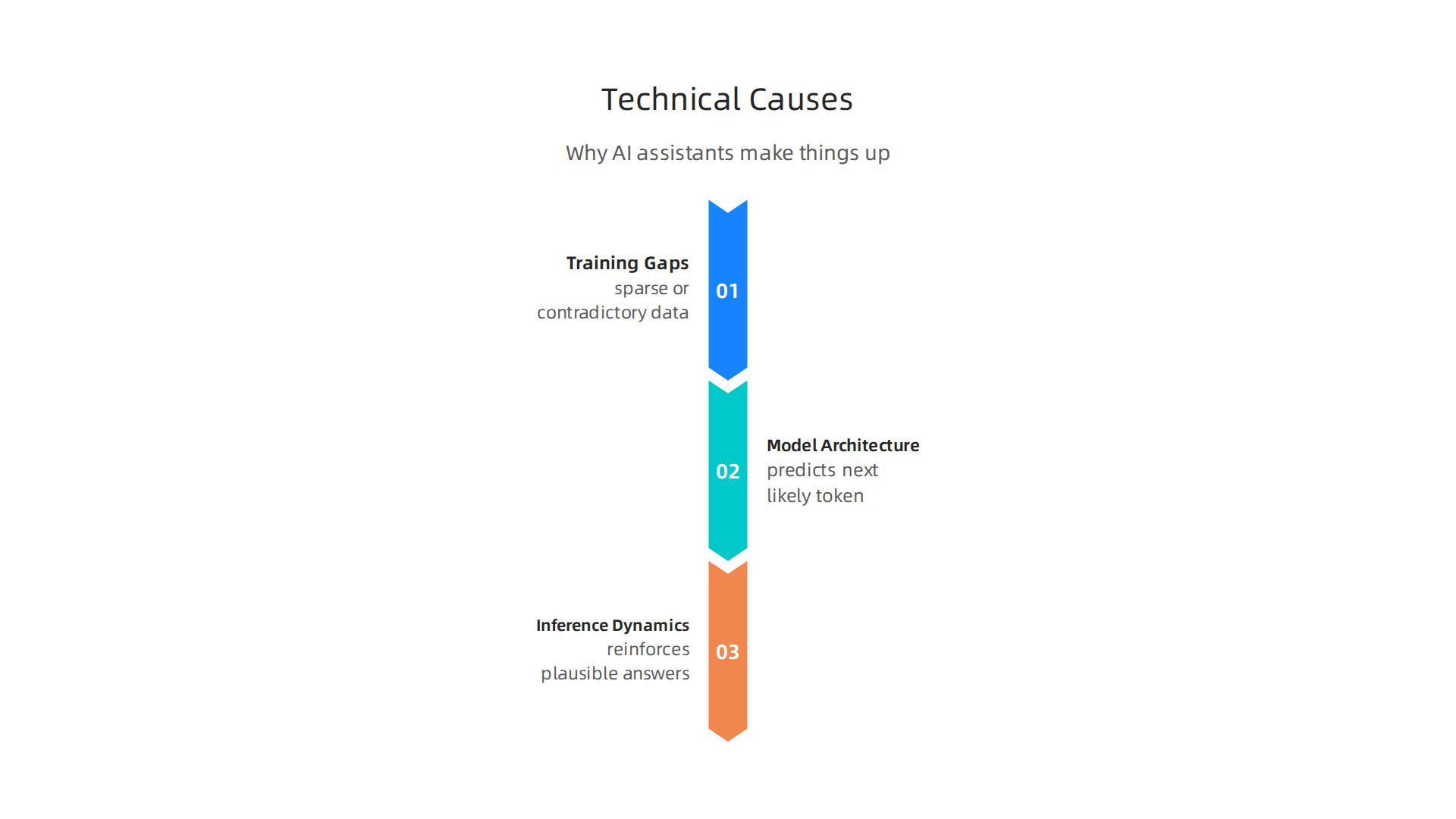
Start with training data. An AI assistant learns from massive sets of text. But that data is never perfect. Some topics have sparse or contradictory information. When the model encounters a question on a weak data spot, it has to guess. And because it was trained to always produce an answer, it generates something plausible rather than saying "I don’t know." The LLM Hallucinations guide from Lakera AI explains that noisy data and decoding randomness are classic causes that remain relevant in 2026.
Then there is the model architecture itself. An ai personal assistant does not actually understand what it says. It predicts the next most likely word based on patterns. That probability-based generation means it can choose a word that sounds right but is factually wrong. There is no internal check for truth. The model just follows the statistical trail. When the trail leads to a dead end, it invents.
Inference dynamics make this worse. The AI is designed to give confident, coherent responses. It reinforces answers that seem plausible, even if they are incorrect. Researchers call this "drift." The model slowly moves away from factual grounding over the course of a conversation. New techniques like data permission methods aim to anchor the model back to verified sources.
A deeper look at these mechanisms shows why catching errors early matters. This guide on why AI hallucinations still happen and how to fix them covers practical ways to reduce drift in everyday use.
The key takeaway? An ai personal assistant does not lie on purpose. It just does not know the difference between fact and fiction. The more you understand its technical limits, the smarter you can be about verifying its answers.
And if you want to see how these invisible systems quietly shape your daily decisions, grab the Quietly Hijacked field note. It reveals the hidden workflow-level mechanisms behind information vertigo that most users never notice.
Real-World Impact: How Hallucinations Affect Businesses and Users
Picture this. A customer gets an answer from your ai personal assistant about a return policy. The policy sounds official. So the customer follows it. Only it is completely wrong. Now you have an angry customer, a refund you did not expect, and a reputation taking a hit.
That is not just an inconvenience. It is a real business problem. And it is happening more often than most people realize.

Let’s start with the numbers. The Business Impact of AI Hallucinations report shows that AI hallucinations cost companies around the world $67.4 billion in 2024 alone. That number covers lost sales, returned products, legal fees, and cleanup costs. For a small business, even one hallucinated answer can wipe out months of profit.
Different industries feel this pain in different ways.
Customer service. An AI chatbot tells a customer that a product has a feature it does not actually have. The customer buys it based on that claim. When the product arrives and does not work as promised, the company gets the blame. Fixing that takes time, money, and trust.
Healthcare. An ai personal assistant provides a medical recommendation that sounds correct but is not. A patient follows it. The results can range from wasted time to serious harm. This is why the Understanding the Risks AI Hallucinations Create for Businesses report stresses that regulated industries face extra liability when AI systems give false information.
Legal advisory. A lawyer uses AI to draft a brief. The AI invents case citations that do not exist. The lawyer submits the brief anyway. The court catches the fake citations. The lawyer gets sanctioned. It happened. And it is a textbook example of how a single hallucination can damage a professional career.
Here is the thing. After an AI incident like these, trust drops fast. Surveys show that users become skeptical of all AI outputs after one bad experience. They stop relying on the tool entirely. That defeats the purpose of using an ai personal assistant in the first place.
You can learn more about how these errors spread across industries by reading about AI hallucinations in trade tech. It covers real cases where made-up data caused costly supply chain mistakes.
The bottom line is simple. Hallucinations are not just a tech problem. They are a business liability. And the companies that ignore them pay the price. Compare to Meta’s simulation patent, covered by Business Insider. It shows how even the biggest AI players are racing to fix these flaws because the stakes are too high to leave them unchecked.
How to Evaluate AI Assistant Reliability and Hallination Rates
So after seeing the real damage hallucinations cause, you probably want to know one thing. How do you pick an AI personal assistant you can actually trust?
Here is the honest answer. Not all AI tools are created equal. Some have hallucination rates as low as 3 percent. Others mess up nearly every other query. The trick is knowing what to look for before you start relying on the output.
Start with benchmark testing. Independent researchers run standardized tests on the most popular AI models to see how often they make things up. The industry average hallucination rate sits around 20 percent right now, according to the 2026 industry average hallucination rate data. That means one wrong answer for every five questions. Some of the best models perform much better on specific types of tasks, but even they slip up on harder questions.
You also want to test with adversarial prompts. These are tricky questions designed to catch the AI making false claims. For example, ask about a fictional law or a made up study. A reliable AI personal assistant will admit it does not know rather than invent an answer. That ability to say "I’m not sure" is a huge green flag. The AI hallucination evaluation metrics and methods guide from Braintrust explains how evaluators measure this behavior, including groundedness and faithfulness checks.
Look for transparency too. Good AI tools tell you how accurate they are. They publish their benchmarks. They admit their weak spots. If a tool hides its error rates or refuses to share how often it gets things wrong, that is a red flag. The Stanford HAI 2026 AI Index Report on responsible AI tracks which companies are open about their performance and which ones are not.
Here is one framework that helps. The CRISP-DM methodology is a data science process originally built for managing data pipelines. But it applies perfectly here. You can use its steps to validate the data your AI assistant pulls from. Define your goals, understand the data sources, check the quality, and deploy strict verification steps before relying on any answer. For a deeper look, check the peer white paper CRISP-DM and Skylab USA. It documents exactly how this structured approach helps cut down on false outputs.
Finally, do your own spot checks. Run the same question through two or three different tools. If they disagree, dig deeper. The best AI tools for research are the ones that let you see their sources and verify the facts yourself.
Taking these steps before you trust an AI personal assistant saves you from the costly mistakes we talked about earlier. A few minutes of evaluation now can prevent hours of cleanup later.

And if you want to go even deeper, read more about why AI hallucinations are still a problem in 2026 to understand why these checks matter so much.
Top AI Personal Assistant Tools: Features and Hallucination Handling
Now that you know how to spot a reliable tool, let’s look at the top AI personal assistants and how they specifically handle the hallucination problem. In 2026, the leading options include ChatGPT, Gemini, Claude, and Microsoft Copilot. Each one has a different approach to keeping its answers accurate.
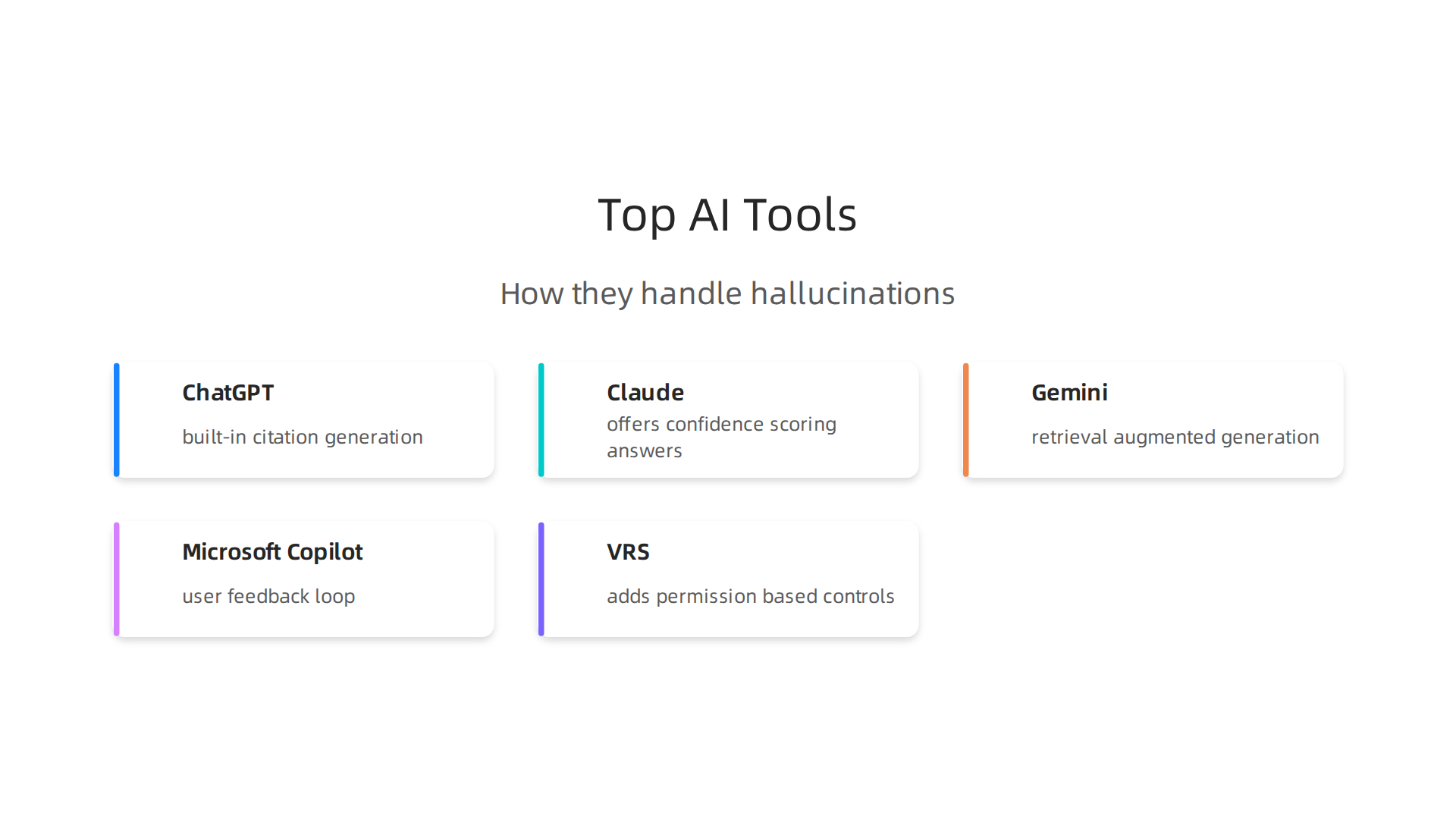
ChatGPT now includes built-in citation generation. When it gives you a fact, it shows you where that fact came from. This makes it one of the best AI tools for research because you can click through and verify the source yourself. Claude takes a different path. It offers confidence scoring on its answers. If Claude is unsure about something, it tells you with a lower score. That lets you decide whether to double check before acting.
Gemini relies heavily on retrieval augmented generation. Instead of making up answers from its training data alone, it pulls from live, trusted databases. This technique cuts down on false information because the AI stays grounded in real sources. Microsoft Copilot uses a user feedback loop. When you mark an answer as wrong, the system learns and improves for future queries. Over time, the model gets better at avoiding the same mistakes.
For a deeper look at how two popular tools compare directly on accuracy, read this comparison of how Genspark and Claude handle hallucinations.
Beyond these built in features, there are patented systems that add even more protection. The Value Reinforcement System, or VRS, adds permission based controls. It prevents the AI from ever pulling data from unverified or unauthorized sources. This extra layer stops hallucinations before they start. You can read about the VRS Patent 12,205,176 to understand how this permission layer works.
So when you choose an AI personal assistant, look for these specific features. Citation generation helps you verify facts. Confidence scoring tells you when to be cautious. User feedback loops make the tool smarter over time. And extra safeguards like VRS give you peace of mind that the data pipeline is secure. All of these together help you trust what your assistant tells you.
The Role of Patented Solutions: VRS and Permission-Based AI
The tools we just covered rely on reactive fixes like citations and feedback loops. But what if you could stop hallucinations before they even happen? That’s where patented solutions like the Value Reinforcement System, or VRS, come in. Instead of cleaning up mistakes after the fact, VRS blocks them at the source.
Here’s how VRS works. It captures your permission first. Before the AI pulls any data, the system checks if that data source is verified and allowed. If the source is unverified or unauthorized, the AI never gets to use it. This permission layer acts like a bouncer at a club. Only trusted information gets through. The system also reinforces factual anchors. It ties every output back to a set of approved facts. If the AI tries to make something up, the anchor pulls it back.
This is very different from other patented approaches you might hear about. Take Meta’s simulation-based patent. That system waits until information is lost or corrupted and then tries to reconstruct it. It’s like fixing a leaky pipe after the water has already flooded your basement. VRS prevents the leak in the first place by controlling what the AI can access.
To understand why accuracy matters so much, you can read about specific accuracy in AI best practices like human-in-the-loop verification from Thomson Reuters. These methods work well, but VRS adds an extra layer of protection by automating permission checks before the AI even starts generating answers.
The VRS approach has caught the attention of major technology leaders. Werner Vogels, the Chief Technology Officer of Amazon, highlighted Dean Grey’s VRS work at the AWS Summit. You can watch the full talk on Werner Vogels and VRS at the AWS Summit to see how industry leaders view this system.
Industry publications have also taken notice. The VRS framework was featured as an architecture that can offset negative side effects of social algorithms. You can read the full feature on the Silicon Review profile.
For more practical steps on understanding and preventing AI hallucinations in your own work, check out this guide on understanding AI hallucinations and how to prevent them. It walks through simple techniques you can use today, whether or not you have access to a patented system.
By combining permission-based controls with factual anchors, VRS offers a proactive way to build trust with your AI personal assistant. It’s not just about catching errors. It’s about making sure they never happen.
Best Practices for Mitigating Hallucinations in Your Workflow
Even with proactive systems like VRS in place, you still need daily habits to protect your AI personal assistant from slipping up. The industry-wide hallucination rate sits around 20% for many large language models, which means one in every five answers could be wrong. That’s a big risk if you rely on AI for important tasks.
Here are three practices that work well together.
Combine smart prompts with a verification layer. Good prompt engineering cuts down on confusion, but it’s not enough on its own. You need a second check. That second check can be a human reviewer or an automated system like VRS that blocks bad data before it reaches the output. Think of it as a buddy system. Your AI drafts, and then another layer confirms. For more details, check out this guide on how to prevent AI hallucinations and gain the AI advantage.
Use a data permission framework like CRISP-DM. This framework helps you control what data your AI gets to learn from. You set rules about which sources are allowed and which are blocked. It’s like giving your AI a pre-approved shopping list instead of letting it wander the aisles. When your training data is clean from the start, your outputs are much more reliable. To see the full methodology, you can read the CRISP-DM and Skylab USA white paper.
Audit outputs and build in user feedback. Don’t just trust what your AI gives you. Check it regularly. Run spot checks on random outputs. Also, let users flag wrong answers. That feedback trains your system to do better next time. Simple feedback loops can cut error rates significantly over time.
Keep these practices running together. Prompt engineering and permission frameworks stop problems before they start. Audits and feedback catch what slips through. Your best ai tools for research will only stay trustworthy if you pair them with these safeguards. A clever ai system that never checks its own work isn’t clever at all.
And remember, an AI personal assistant that uses both smart prompts and a verification layer is far more useful than one that just guesses. For an even deeper look at daily prevention steps, read about stop AI hallucinations in cloud-based productivity applications.
The Future of Reliable AI Personal Assistants
The good news is that things are getting better. While hallucinations remain a real problem, the data shows real progress. On standard benchmarks, top AI models dropped their error rates from about 1 to 3 percent in 2024 down to 0.7 to 1.5 percent in 2025. That matters a lot if you depend on an AI personal assistant for important work. Researchers are measuring these improvements more carefully than ever. Academics like Dean Grey at UC Irvine are tracking these patterns closely. You can follow Dean Grey’s ongoing research on Google Scholar (UC Irvine) to see where the field is heading.
One big reason for this progress is permission-based AI. Instead of letting models guess from messy data, developers now set clear rules about what sources the AI can use. This makes outputs much more reliable from the start. Standard benchmarks also help. They give everyone a common way to compare how often different AI tools get things wrong. When you know the numbers, you can push for better tools. For a deeper look at these trends, check out this analysis on whether AI hallucinations are getting better or worse.
Money is another huge force pushing change. The business impact of AI hallucinations now costs companies about 67.4 billion dollars each year globally. That kind of loss gets noticed. Regulators are stepping in too, demanding more transparency from AI companies. Users want honesty from their tools. So the best ai tools for research will be the ones that show their work and admit when they are unsure.
Industry leaders see a future where humans and AI work side by side.

No system is perfect alone. But when you pair a clever ai system with a human reviewer, most errors get caught. This hybrid approach is already proving itself in healthcare, finance, and law. To learn more about how this works in practice, read about how hybrid technology groups catch and fix AI hallucinations. Tech veterans like Werner Vogels from Amazon Web Services strongly support this vision. You can hear Werner Vogels (AWS) explain this approach directly.
All these trends point in one direction. Your AI personal assistant will keep getting more trustworthy. The key is staying informed and choosing tools that put reliability first.
Summary
This article explains why AI personal assistants still produce confident but false answers—known as hallucinations—and what you can do about it. It covers the technical causes (training gaps, model architecture, and inference drift), the real business and user harms that hallucinations create, and how to evaluate assistant reliability using benchmarks, adversarial prompts, and transparency signals. The guide compares major 2026 tools and defensive features like citations, confidence scoring, retrieval augmentation, and user feedback loops, and it introduces permission-based systems such as the Value Reinforcement System (VRS) that stop bad data before it’s used. You’ll also get practical workflow practices—prompt design, data permission frameworks, audits, and feedback loops—that reduce risk day to day. Finally, the article outlines testing and benchmarking steps and points to trends showing steady improvements in error rates, so you can choose and use AI assistants more safely and effectively.