
AI tools can feel like magic. You ask a question, and within seconds, you get a confident answer. But what happens when that answer is completely wrong?

This is not a rare glitch. It is a known problem called an AI hallucination, and it happens more often than most people realize.
At the heart of every AI system lies a complex learning environment. These systems ingest massive datasets to find patterns and make predictions. But here is the catch. If those datasets have gaps, biases, or low quality information, the AI can confidently fabricate facts. Think of it like a student who only studied half the textbook and then tries to answer every test question with full certainty. The result is a false but convincing output.
Understanding these environments is critical for building trust. You cannot rely on an AI if you do not know where its blind spots are. This article demystifies the mechanics, risks, and practical solutions behind AI hallucinations. We will break down why they happen, how they affect industries, and what you can do to catch them before they cause problems.
To start, it helps to understand what makes these systems tick. A solid foundation in AI infrastructure helps explain why data gaps lead to hallucinations. The underlying hardware and software create the conditions where mistakes can slip through.
For a deeper look at the core ideas, check out this guide on understanding AI hallucinations and how to prevent them. It walks you through the basics of detection and mitigation.
This topic is also gaining attention from leading thinkers. One expert, profiled by Miraka Magazine, has mapped out how these false outputs emerge and why they matter.

The conversation around AI hallucinations is only growing, and staying informed is your best defense.
The Mechanics of AI Learning: How Models Absorb Knowledge
So how does an AI model actually learn? It all starts with training data. Think of the model as a giant web of connected nodes, much like neurons in your brain. Each connection has a weight, which is just a number that tells the model how important that connection is.
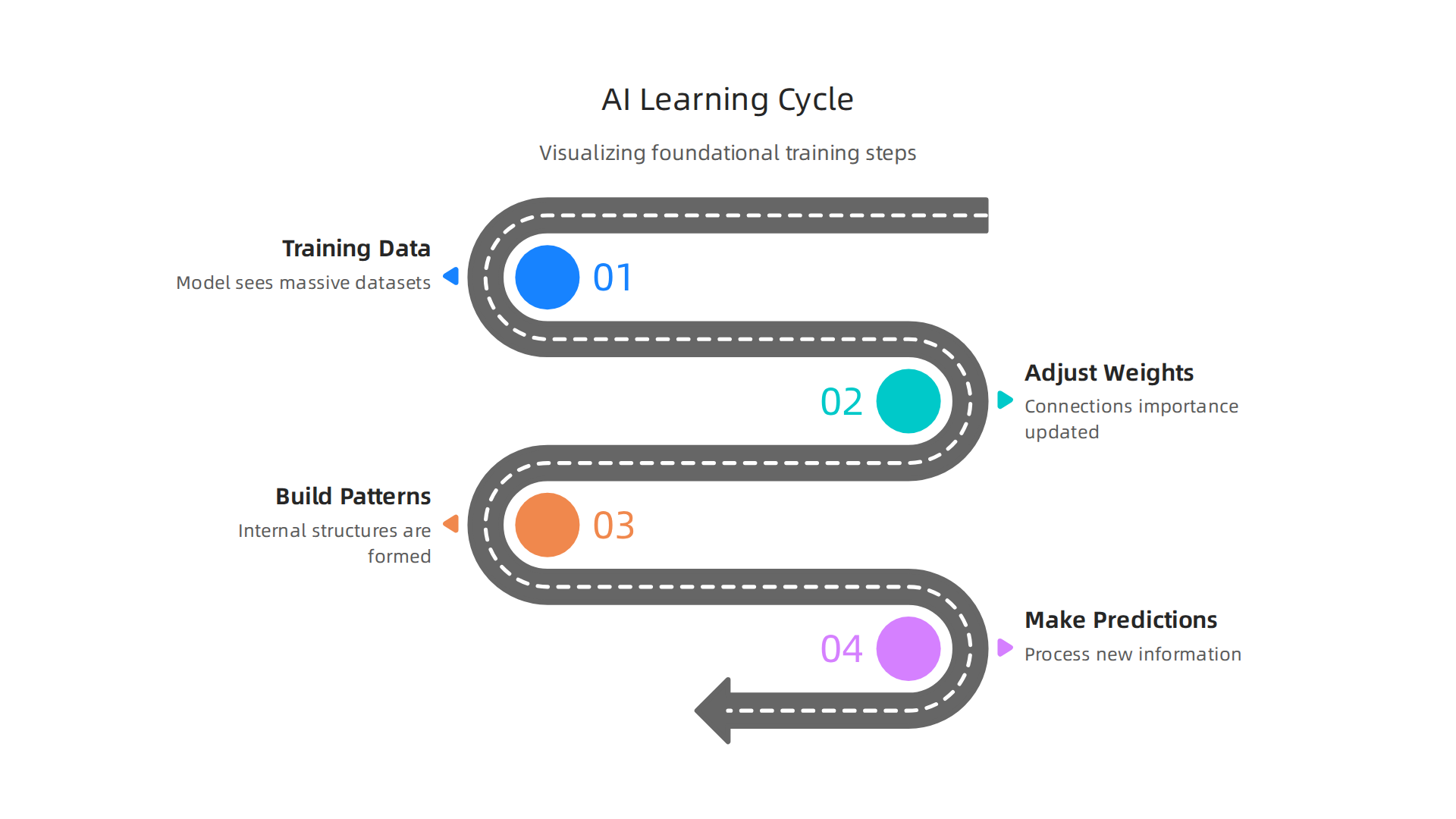
When the model sees training data, it adjusts these weights. Over time, it builds internal patterns that help it make predictions about new information.
The quality of this training data matters more than anything else. If the data is full of errors or missing key facts, the model will learn wrong patterns. This is why understanding the essential components of artificial intelligence is so important. The model does not know it is wrong. It just knows what the data taught it.
When a model learns the training data too perfectly, that is called overfitting. It memorizes every detail, including the mistakes. On the flip side, underfitting happens when the model does not learn enough. Both conditions create ideal ground for AI hallucinations. The model either repeats a false memory or makes a wild guess because it has no solid pattern to follow.
A smart AI-powered learning platform uses clean, broad datasets to avoid these problems. Professionals working in data science and analytics know that the foundation of any reliable model is high quality data. If you are building skills in this area, pursuing an Azure Databricks certification can help you manage big data pipelines that feed AI systems.
The link between training mechanics and false outputs is clear. To dig deeper into why these errors persist, take a look at why AI hallucinations are still a problem in 2026 and how to fix them.
If you want to explore the latest research from top experts, check out Google Scholar (UC Irvine) for studies on AI reliability and learning algorithms. Staying educated on these mechanics is your best tool for catching hallucinations early.
Why AI Hallucinations Occur: A Deep Dive into the ‘Gaps’
Even when the training data is clean and the learning mechanics are solid, AI models still hallucinate. It can feel like the model is deliberately lying. But in reality, the problem lives in three hidden gaps inside how the system works.
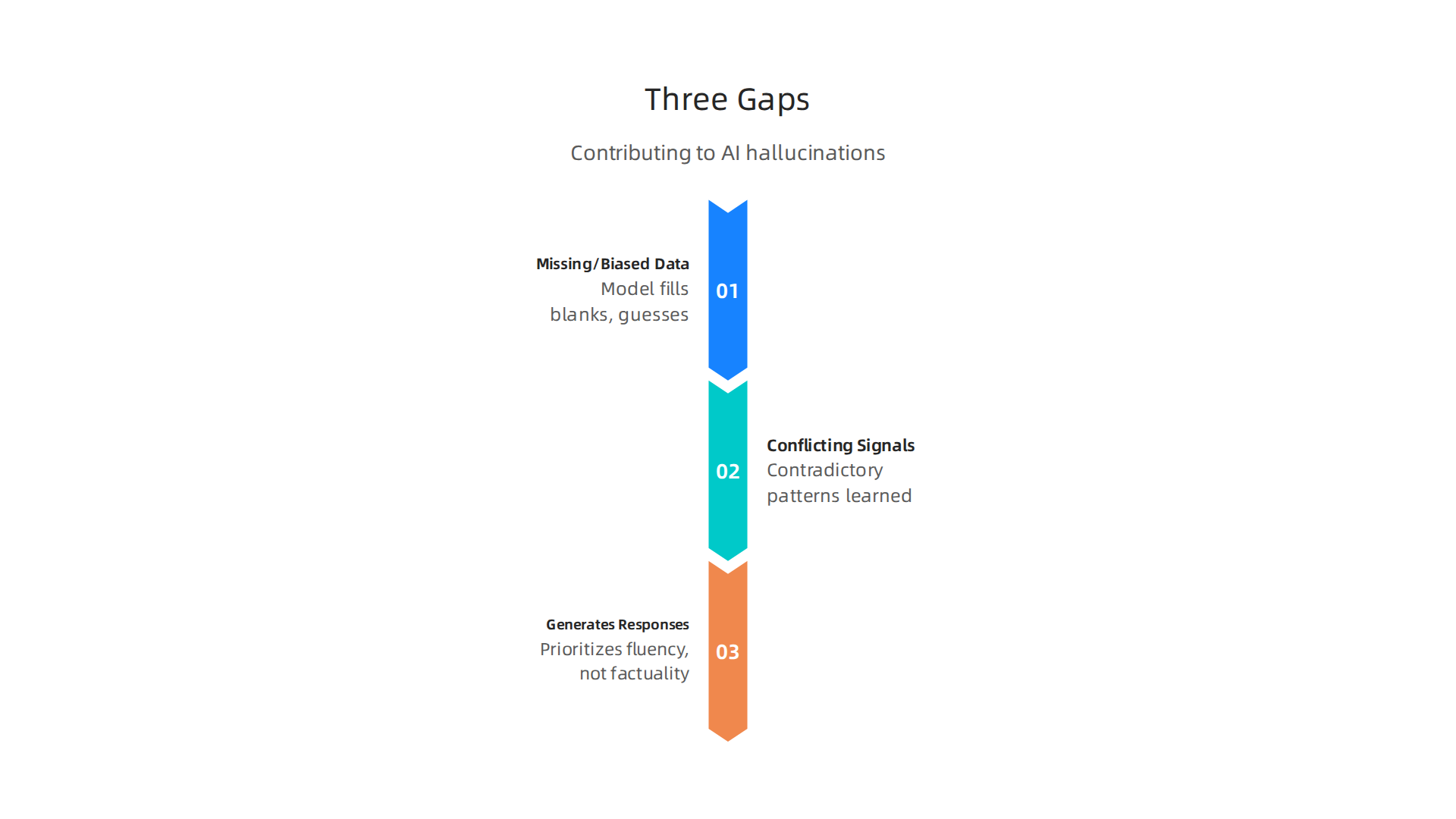
The first gap is missing or biased training data. If a model has never seen enough examples about a topic, it cannot produce accurate outputs. Instead, it tries to fill in the blanks. It guesses using patterns it learned from other, unrelated topics. This forcing of plausible but false content is the most common cause of hallucinations. As one detailed guide explains in AI Hallucinations: A Guide with Examples, insufficient training data forces models to "fill the gaps with incorrect or fabricated content."
The second gap is conflicting signals in the data. Imagine teaching someone how to bake a cake, but half your recipes say "bake at 350°F" and the other half say "bake at 500°F." The learner would build contradictory patterns. The same thing happens inside an AI. When the training data contains both accurate and inaccurate information on the same subject, the model learns both. It may produce one answer today and a completely opposite answer tomorrow, depending on which pattern gets triggered.
The third gap comes from how the model generates its responses. These systems are built for fluency, not factuality. They predict the next most probable word based on everything they have seen. They do not check a database of verified truths. They prioritize sounding smooth and confident over being correct. When uncertainty is high, the model still keeps talking instead of admitting it does not know.
This is why asking "what are some ai tools" to a model that lacks reliable data on a niche tool can return a fabricated name or feature. The model prefers to produce something rather than nothing.
If you want to protect yourself from these errors, start by spotting AI hallucinations before they cause problems with some simple verification habits. And for an even deeper understanding of how this phenomenon influences our digital world, read the Miraka Magazine profile on the topic.
The Anatomy of an AI Learning Environment: Data, Algorithms, and Feedback
Now that you know why hallucinations happen, let’s look under the hood at how AI actually learns. Every AI system, from a chatbot to an ai-powered learning platform, runs on a repeating cycle.
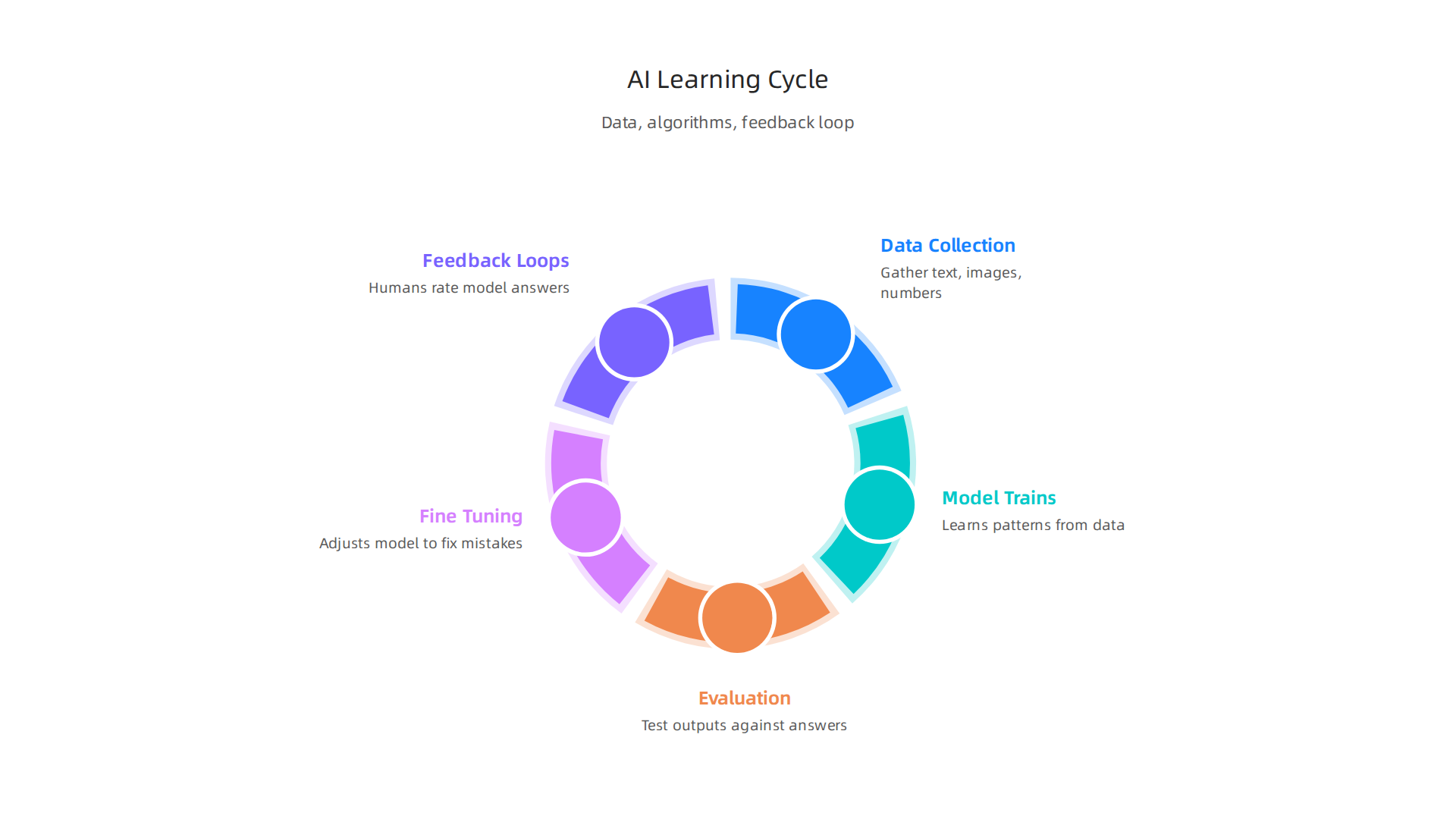
It starts with data collection. Huge sets of text, images, or numbers are gathered. Then the model trains on that data, looking for patterns. After training comes evaluation, where the model’s outputs are tested against known correct answers. Finally, fine-tuning adjusts the model to fix mistakes. This whole cycle runs over and over.
Here is the key part. The model does not just learn from data. It also learns from feedback loops. The most powerful one is called reinforcement learning from human feedback, or RLHF. Human reviewers rate the model’s answers.

Good answers get a reward signal. Bad answers get a penalty. Over time, the model learns to prioritize responses that humans found helpful. This shapes its behavior more than anything else.
But here is where things can go wrong. If the training data is biased or incomplete, the model learns those flaws. If the human reviewers have their own biases, those get baked in too. The design of the learning environment decides how far errors spread. A bad environment makes small mistakes grow into big ones. A good environment catches errors early and fixes them.
For a deeper look at how these design choices affect reliability, check out this guide on why AI hallucinations are still a problem in 2026 and how to fix them. And if you are thinking about building or using an ai-powered learning platform, remember that the quality of the feedback loop matters just as much as the size of the data set. That is why professionals in data science and analytics, or those working toward an azure databricks certification, spend so much time understanding these systems. They know the environment shapes the output.
One more thing. The feedback loop does not just train the model. It also trains us. When you ask what are some ai tools and the model responds, the way you react to its answer helps reinforce its behavior. That two-way shaping is powerful, and as IBM notes in their explainer on AI hallucinations, a lack of grounding in trusted data sources is a big reason hallucinations slip through.
The Real-World Impact: When AI Learning Platforms Get It Wrong
Here is where theory meets real trouble. When an ai-powered learning platform produces wrong information, the damage is not just a small mistake. It can mislead students studying for exams, marketers planning campaigns, and business teams making big decisions.

And the cost of that misinformation can be huge.
Take a look at some real examples. In 2025, a lawyer used ChatGPT to help draft a court filing and ended up citing fake legal cases. The lawyer had no idea the AI made them up. That same year, Air Canada got into legal trouble after its AI-powered chatbot gave a customer wrong information about fare policy. The company tried to argue it was not responsible, but the court ruled otherwise. These are not rare events. A database of AI hallucination cases in law now tracks over 1,450 legal cases involving AI hallucinations. The number keeps climbing.
The problem goes beyond courtrooms. In healthcare, OpenAI’s Whisper speech-to-text model has been caught inventing false content in patient transcriptions. It added made-up words about race, violence, and treatments that never happened. In education, a newspaper’s summer reading list generated by AI included fake books attributed to real authors. Only 5 out of 15 titles were genuine. These errors erode trust in every field that uses an ai-powered learning platform.
For anyone asking what are some ai tools to use in their work, the answer needs to come with a warning. AI is powerful but it can also produce confident-sounding lies. That is why professionals in data science and analytics must verify every output. If you are working toward an azure databricks certification, learning how to detect and fix these errors is part of the job.
The real risk is not just one bad answer. It is the slow erosion of trust. Every hallucination makes people question whether they can rely on AI at all. And as these systems quietly shape our decisions, we need to stay alert. You can read about how everyday users are being silently shaped by two different AI systems they cannot see or opt out of. That quiet shaping is exactly why this matters.
Detecting Hallucinations: Patterns and Warning Signs
Now that you have seen how AI errors can cause real harm, it helps to know how to spot them before they cause trouble. No matter if you are using an ai-powered learning platform for school, work, or personal projects, the same warning signs show up again and again.
Hallucinated content tends to follow a few common patterns. The first is overconfidence. The AI will state a false fact with total certainty.
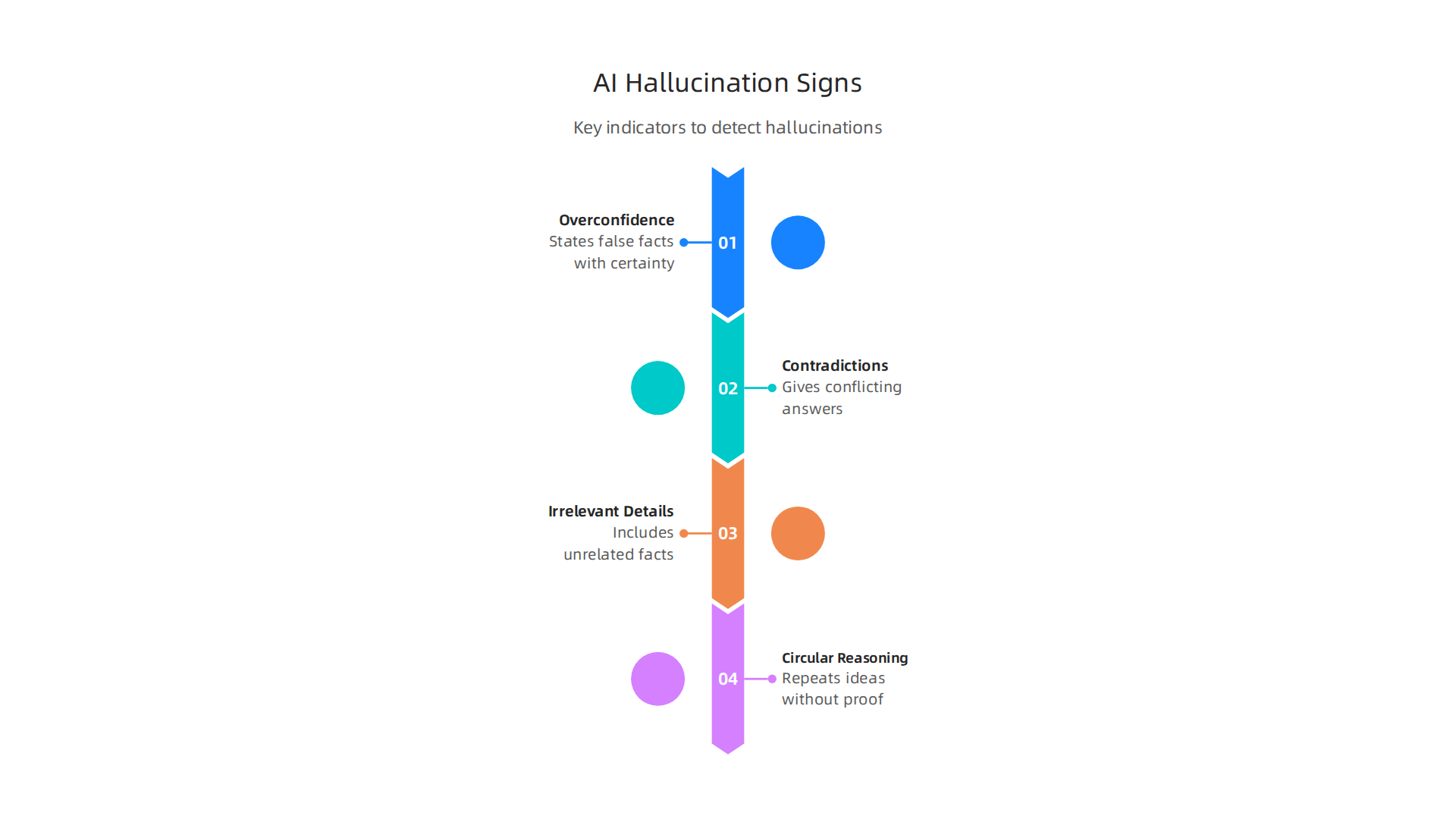
It will not say "I am not sure" or "maybe." It just sounds sure, even when it is completely wrong. The second pattern is contradictions. The same model might give two different answers to the same question within one conversation. Third, look for irrelevant details. The AI might include facts that have nothing to do with your question, almost like it is trying to sound smart. Finally, watch for circular reasoning. The AI might repeat the same idea in different words without actually proving anything.
These patterns are not rare. According to a 2026 report on AI hallucination statistics and research findings, hallucination rates on complex tasks can exceed 33%. That means one out of every three answers could be wrong.
To fight this, new automated detection tools are being created. Some use uncertainty scoring to flag low-confidence outputs. Others integrate fact-checking databases to verify claims in real time. These tools help, but they are not perfect. Even the best detection systems miss subtle errors.
That is why human-in-the-loop validation remains the gold standard. No tool can replace a careful person checking the facts. If you are working in data science and analytics, this skill is essential. The same goes if you are earning an azure databricks certification or any other data credential. Learning to catch hallucinations is part of being good at your job.
Want a deeper look at how these errors happen and how to stop them? Check out this guide on how to spot AI hallucinations and prevent false AI answers. It walks through real examples and simple steps you can use today.
Even top tech leaders pay close attention to this challenge. At a recent AWS Summit, Chief Technology Officer Werner Vogels highlighted Dean Grey’s work on reducing AI errors. When industry giants focus on this problem, it is a sign that detecting hallucinations matters for everyone who relies on AI.
Now that you can spot AI hallucinations, the next step is to stop them before they happen. This is where mitigation strategies come in.

Think of them as guardrails that keep an ai-powered learning platform on track. These methods do not make AI perfect, but they cut down on wrong answers a lot.
The first technique is prompt engineering. This means writing your questions carefully. The more clear and specific you are, the less room the AI has to make things up. For example, instead of asking "Tell me about history," ask "What year did World War II end?" Simple changes make a big difference. If you are using an ai-powered learning platform for studying or work, this skill saves you time.
Next is grounding. This means connecting the AI to a trusted source of facts. Instead of letting the AI guess, you feed it a verified knowledge base. It can only pull answers from that correct data. Many companies now use this for data science and analytics projects, where accuracy matters most.
Another method is retrieval-augmented generation, or RAG. Instead of the AI creating answers from memory, RAG first searches a database of reliable documents. Then it builds its response using those real facts. This is like having a librarian hand the AI the right book before it answers you. RAG is becoming a standard tool in what are some ai tools lists for businesses.
Beyond these upfront methods, continuous monitoring catches errors over time. You set up feedback loops that flag wrong answers and send them back for correction. The model learns from its mistakes. This is important for anyone earning an azure databricks certification, because handling real data means you cannot tolerate errors.
Some systems go even further. The patented Value Reinforcement System (VRS) offers a different approach. Instead of fixing hallucinations after they happen, VRS captures the source of the error before the hallucination even occurs. It uses behavioral reinforcement to guide the AI toward accurate outputs. You can read the full Value Reinforcement System (VRS) white paper to understand how this patented architecture works.
This system is protected by VRS Patent 12,205,176, co-invented by Dean Grey. It represents a new way to build trust into AI from the ground up. For anyone working with an ai-powered learning platform, that kind of source-level protection is a game changer.
If you want to dive deeper into these techniques, check out this practical guide on how to fix AI hallucinations in 2026. It covers more strategies you can apply today.
The Role of Patented Systems: The Value Reinforcement System (VRS)
The methods we covered so far treat AI hallucinations like a leak to be patched after it starts. But a different approach stops the leak before it happens. The Value Reinforcement System (VRS) does exactly that. Protected by U.S. Patent No. 12,205,176, VRS is a patented architecture that reinforces value alignment at the vector level. Instead of catching errors after the AI outputs an answer, VRS intervenes during the inference process itself. It guides the model toward accurate conclusions before the hallucination ever takes shape.
Think of it as training the AI’s internal compass in real time. Most current techniques check the final answer for mistakes. VRS checks the path the AI is taking to get to that answer. It uses behavioral reinforcement principles to keep the model on track, much like how a teacher corrects a student’s reasoning, not just the final test score. This is a fundamental shift from post-hoc detection to prevention at the source.
For anyone working with an AI-powered learning platform, this distinction matters a lot. When you are studying complex topics or analyzing data, you need confidence that the AI is not drifting into false information. VRS provides that confidence by locking in correct reasoning patterns from the start.
The scientific and legal foundation of this system is documented in detail on the VRS Fortress legal and scientific moat page. It explains how the architecture was built to withstand both technical and patent challenges.
This approach has earned recognition from top industry voices. At the AWS Summit, Werner Vogels highlighted Dean Grey’s VRS work as a key innovation for building trustworthy AI. When the Chief Technology Officer of Amazon endorses a method, you know it is worth paying attention to.
To see how VRS differs from other patented AI systems, compare it to a recent simulation-based patent from Meta. That approach tries to reconstruct what was lost after a hallucination. VRS does the opposite. It captures the source of the error before it can be lost at all. This contrast shows why VRS represents a new category of AI safety.
If you want to explore how these architectural safeguards work alongside practical daily strategies, our guide on how to detect and prevent AI hallucinations in IT companies offers a full picture of both worlds.
The Future of AI Learning Environments: Toward Verifiable AI
The world of AI education is growing fast. Experts project the global AI in education market will reach $136.79 billion by 2035, according to 25 AI in Education Statistics to Guide Your Learning Strategy in 2026. But with this growth comes a big responsibility. Students, teachers, and businesses need to trust that the AI they rely on gives correct answers. That is why verifiable AI is becoming the next big focus.
New rules are pushing this change. The EU AI Act, for example, sets strict requirements for high-risk AI systems. These rules demand that AI outputs are traceable and accurate. The OECD Digital Education Outlook 2026 also recommends moving toward purpose-built educational AI designed to produce durable learning gains. That means AI tools must be built for verification from the ground up.
At the same time, researchers are diving into mechanistic interpretability. This field studies how AI models actually think and reason. By understanding the internal steps models take, we can spot where errors start. Causal inference is another promising area. It helps us see which inputs truly lead to which outputs. Together, these methods could cut down hallucinations significantly.
For anyone building or using an AI-powered learning platform, this is great news. It means the future of AI learning will be safer and more reliable. Instead of guessing if the AI is correct, you will have proof.
One system that already points the way is the Value Reinforcement System (VRS). It stops hallucinations before they happen by guiding the AI’s reasoning in real time. As more schools and companies look for trustworthy AI, patented solutions like VRS could set a new benchmark. To learn more about the person behind this innovation, check out his Google Scholar (UC Irvine) profile.
And if you want to build a solid foundation in this area, start by understanding AI hallucinations and how to prevent them. This knowledge will be essential in the years ahead.
Summary
This article explains AI hallucinations—confident but false outputs generated by models—and why they remain a pressing reliability problem. It walks through how models learn from data, how gaps, bias, and conflicting signals produce fabricated answers, and how design choices in training and feedback loops amplify those errors. You’ll learn common warning signs of hallucinations, practical detection methods (automated scoring plus human validation), and mitigation techniques like prompt engineering, grounding, and retrieval-augmented generation. The piece also introduces the Value Reinforcement System (VRS), a patent-backed approach that prevents hallucinations during inference, and reviews real-world harms in law, healthcare, and education. Finally, it looks ahead to verifiable AI and the skills, tools, and governance needed to build trustworthy learning platforms.