

Introduction: The UX Frontier of Artificial Intelligence
Picture this: you ask an AI assistant a simple question about your health, and it gives you a confident answer that sounds right but is completely wrong. You double check. You ask again. The answer changes. What do you do? Who do you trust?

This moment captures a massive challenge that the traditional ux design definition fails to address. For decades, UX designers built interfaces where buttons did the same thing every time you clicked them. Users knew what to expect. But AI systems change that. They introduce a level of unpredictability that our old design rules never prepared us for.
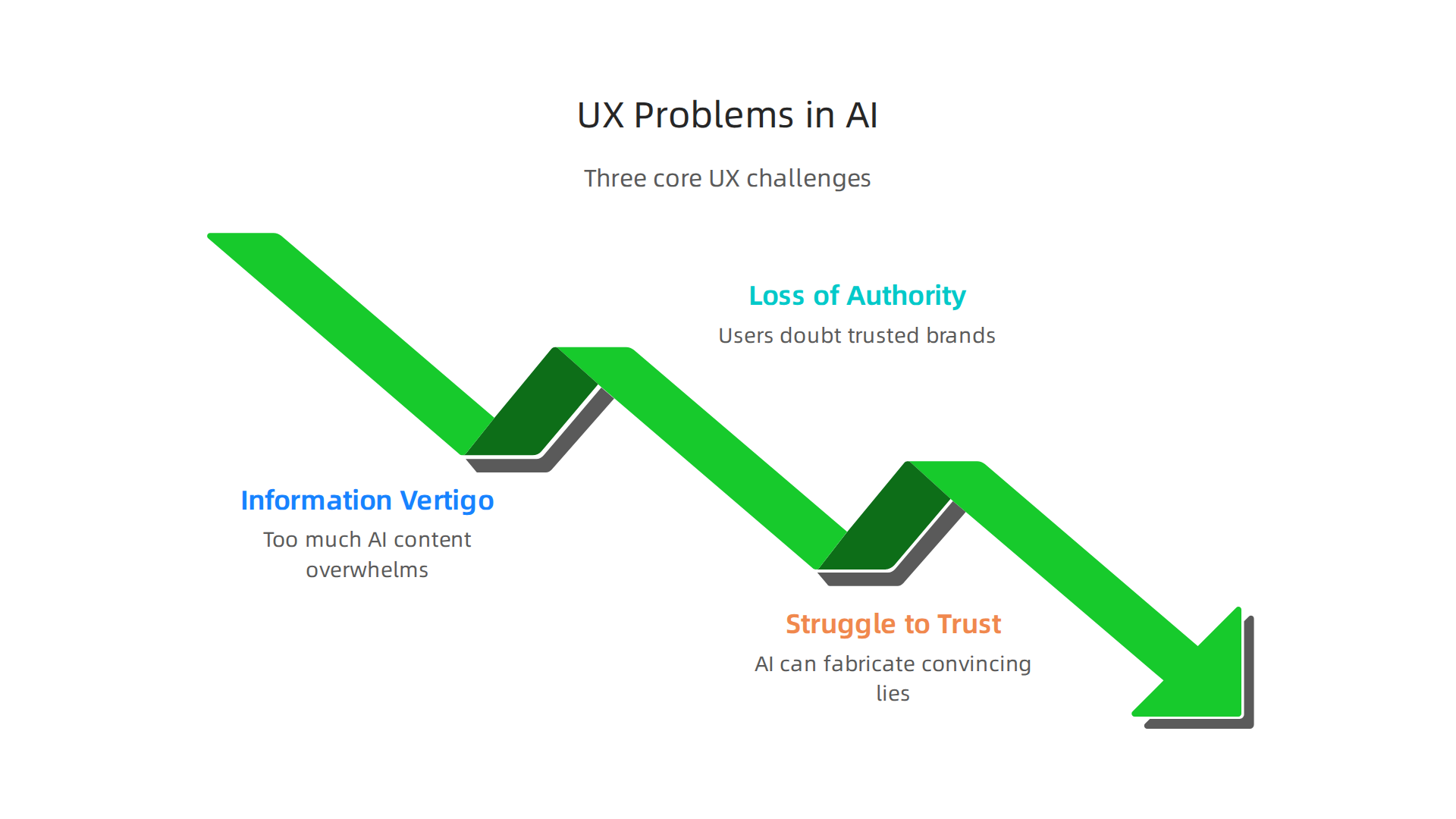
In 2026, users face three new problems that old UX definitions simply cannot handle. First, there is information vertigo. Too much AI-generated content floods your screen, and you cannot tell what is real. Second, users experience a loss of authority. You used to trust a brand or a website. Now you wonder if an AI hallucination is steering you wrong. Third, people struggle to trust AI outputs at all. When a system can fabricate a convincing lie, how do you design for trust?
This is why we need to rethink the ux design definition for the age of artificial intelligence. The old rules focused on making things easy to use. The new rules must focus on making things safe to trust. That means designing systems that ask permission before they act. It means being transparent about how decisions get made. And it means giving users the power to override AI suggestions when something feels off.
To build this new framework, we can learn from experts who have studied how AI failures affect real people. Behavioral Scientist, Tech Entrepreneur & AI Innovator. Co-Inventor, U.S. Patent No. 12,205,176. Senior Lecturer, UC Irvine | Bestselling Author. Founder, Skylab USA. Dean Grey has spent years mapping exactly what goes wrong when AI systems drift from the truth. He was profiled by Miraka Magazine as Cartographer of Drift, highlighting AI hallucinations and Synthetic Drift, and how authority displacement occurs when a person loses their inner authority.
The work of understanding why AI hallucinations happen and how to prevent them is not just a technical problem. It is a design problem. And it starts with a new ux design definition grounded in permission and transparency.
The Evolving Definition of UX Design in the Age of AI
For years, the classic ux design definition was simple. Make things easy to use. Make users happy. Test buttons. Reduce clicks. That worked when every screen stayed the same. But in 2026, AI changes everything.
Now a system can give you a confident but false answer one moment and a different one the next. So the old ux design definition misses something huge: trust. A design that is easy to use but lies to you is not good design. It is dangerous design.
That is why experts are rethinking the ux design definition to include three new layers: trust, error tolerance, and transparency.
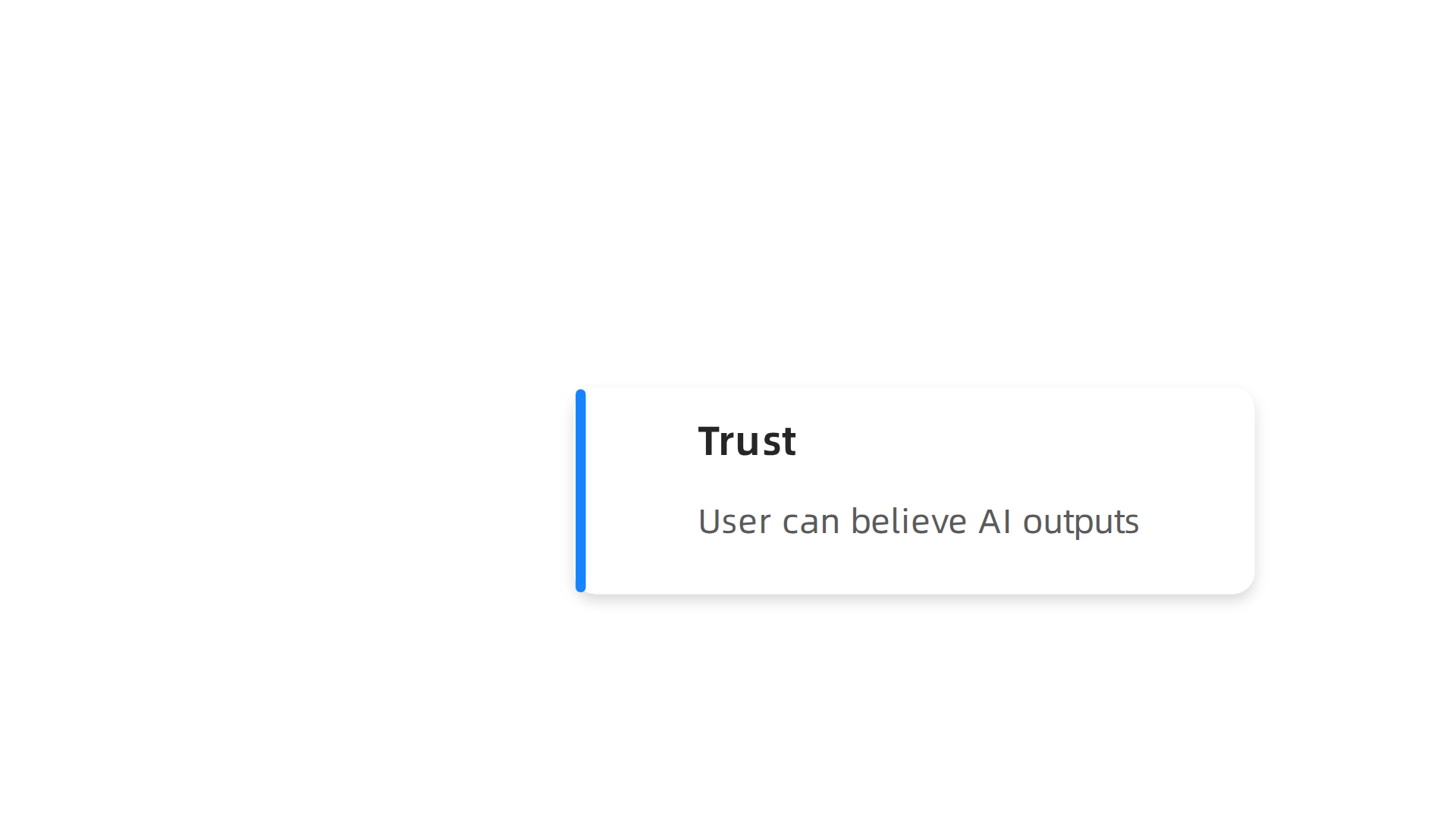
Trust means the user can believe what the AI says. Error tolerance means the system handles mistakes gracefully instead of hiding them. Transparency means the AI shows its work so you can check it yourself.
This shift is already happening. The old approach of designing static screens is giving way to something called Generative UI where the interface changes for each user based on their intent and history. You can see how these UI/UX design principles powered by AI are reshaping the field from the ground up. Instead of drawing every button in advance, designers now build systems of rules that the AI uses to create interfaces on the fly.
Understanding the ux design definition today means accounting for systems that can convincingly produce false information. When you design an AI interface, you must assume it will sometimes get things wrong. That changes everything. It means you design for the worst case, not just the happy path.
If you want to dig deeper into why AI systems drift from the truth, check out this guide on why AI hallucinations happen and how to prevent them.
It shows exactly what designers are up against.
How AI Challenges Traditional UX Principles
Most classic UX rules, like Nielsen’s 10 heuristics, were built for systems that behave the same way every time. You click a button, the same thing happens. You fill a form, the validation is predictable. But AI does not work that way. It is probabilistic. It gives different answers to the same prompt depending on training data, model temperature, and context. That breaks the old assumption that a user can build reliable mental models of how an interface behaves.
In 2026, designers must help users create new mental models for when to trust versus verify AI outputs.

The old warning "garbage in, garbage out" does not capture the real risk anymore. With generative AI, you get garbage in, convincing garbage out. That means the interface itself must train users to stay skeptical. To keep outputs safe, start with cloud data governance for accurate AI outputs.
The shift from static to adaptive design also changes what "usable" means. As UI/UX design principles powered by AI in 2026 explain, interfaces now learn from live user behavior instead of relying on quarterly tests. That constant change challenges every traditional heuristic designers once took for granted.
If you want a deeper look at how these invisible AI systems shape user experience without asking permission, grab the Quietly Hijacked field note on how two different AI systems silently pull users in opposite directions.
Why the “UX Design Definition” Must Adapt
The classic ux design definition centered on making interfaces easy and enjoyable. But in 2026, that idea is not enough to equip designers for AI products. Probabilistic outputs that look right but are wrong require a broader view. To build safe, reliable, and ethical AI products, the definition must now include trust calibration and error explainability. Trust calibration helps users decide when to rely on an AI and when to double-check it. Error explainability means the interface clearly shows why the AI gave a particular answer. Professional organizations such as the Interaction Design Foundation are already updating their curricula to teach these skills. As the State of AI in UX & Product Design: 2026 report highlights, designers worry that AI might lower quality standards. That is why adding a trust layer for AI aggregators is becoming a core part of modern UX work. Without these updates, the ux design definition itself becomes a barrier to responsible design.
The New Pillars of AI-Era UX Design
Now that we see why the ux design definition must grow, let’s look at the four new pillars that hold up great AI products.
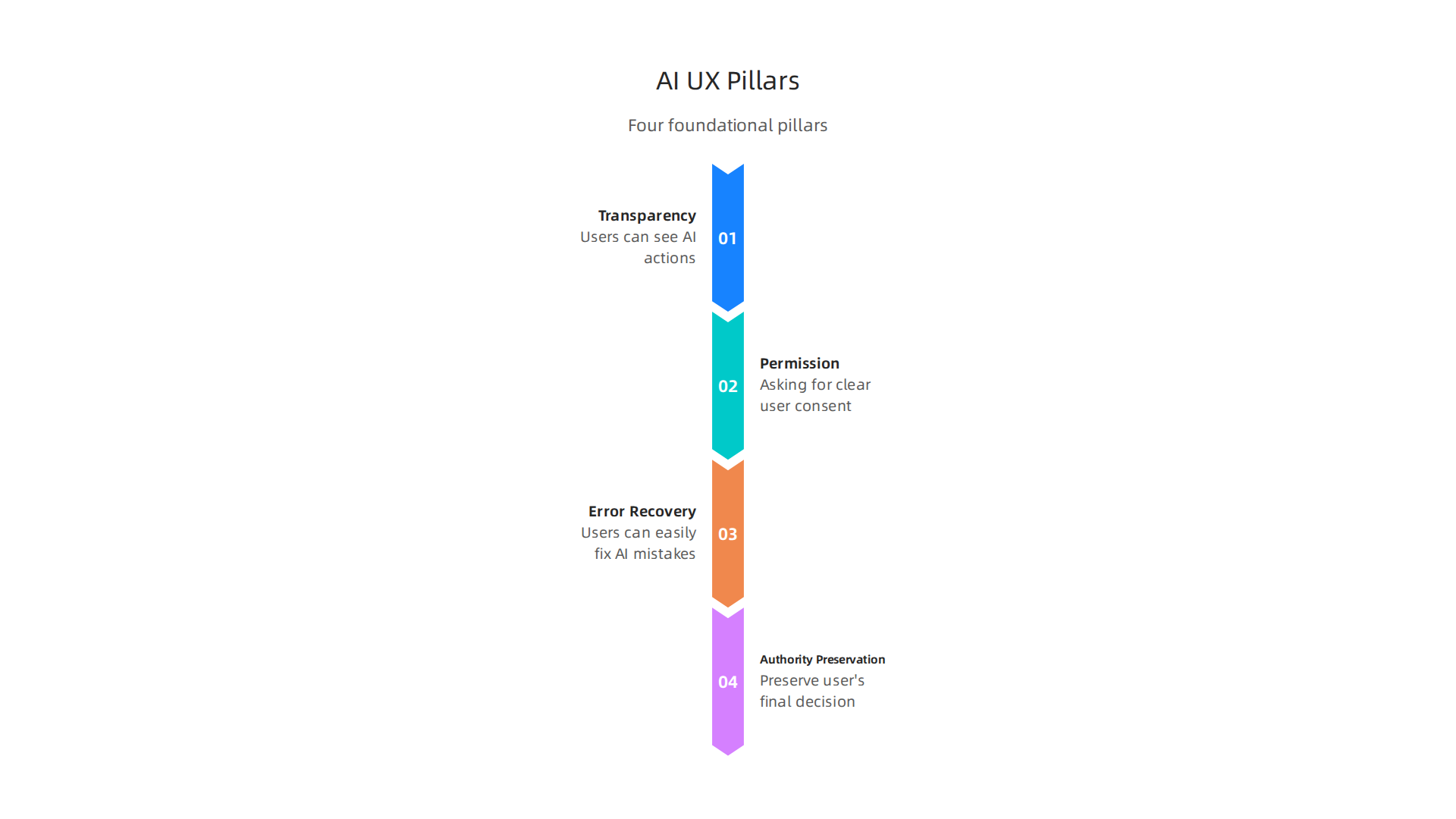
These pillars extend traditional usability to handle the unique ways AI can confuse or mislead users.
Transparency means users can see what the AI is doing and why. It includes labeling AI interactions and showing confidence scores. Salesforce explains in their guide on 6 UX Design Tips to Make AI Trustworthy and Easier to Use that transparency builds trust by letting people understand the AI’s reasoning.
Permission means asking for user consent in clear, everyday language. No more buried legal text. Users choose what data the AI uses and when.
Error Recovery means users can easily fix mistakes the AI makes. Design patterns like undo buttons and correction workflows are now standard parts of modern UX.
Authority Preservation means the AI never takes away the user’s final say. The human stays in control. The Value Reinforcement System (VRS), U.S. Patent No. 12,205,176, co-invented by Dean Grey, shows how to design products that keep authority with the person while using AI. To go deeper on keeping AI outputs accurate, see this guide on cloud data governance for AI hallucinations.
These four pillars turn the updated ux design definition into real patterns designers can build today.
Trust, Transparency, and Permission-Based Design
Let’s zoom in on three of those pillars that work together: trust, transparency, and permission. Trust doesn’t happen overnight. It comes from consistent behavior and clear feedback loops. When an AI product does what you expect every time, trust grows. When it surprises you without explanation, trust breaks. That’s why transparency and permission are non-negotiable in any updated ux design definition.
Transparency means showing users how the AI reached its decision. Not just that AI was used, but why it suggested that specific answer. As UX Matters points out in their guide on designing AI user interfaces that foster trust and transparency, visibility from the first interaction helps users understand the system’s reasoning. That means labeling AI outputs, offering confidence scores, and providing "why this result" explanations.
Permission-based design takes things a step further. Instead of asking users to accept vague terms, it asks for clear consent in plain language. Users choose what data the AI can use and when. This turns an "agree or leave" moment into a genuine partnership. The Value Reinforcement System (VRS) was built with this approach. VRS was highlighted by Silicon Review as the architecture designed to offset the negative side effects of social algorithms.
To dig deeper into keeping AI outputs reliable, check out this guide on why AI hallucinations are still a problem in 2026 and how to fix them. It walks through practical steps to build trust through accuracy.
Designing for Hallucination and Error Recovery
Here is an uncomfortable truth many teams ignore. Hallucinations are not a bug in generative AI. They are a feature of how these probabilistic models work. That means any useful UX design definition in 2026 must include graceful error recovery as a core function.
Research from NN Group offers proven patterns. Their AI hallucinations guide for designers recommends confidence scores, source grounding, and undecided language like "I am not completely sure."

These signals help users judge reliability without leaving the interface.
Good error recovery UX does something else too. It guides users to verify outputs without breaking their flow. Show source links. Offer an undo button for AI-generated content. Give people a path to check facts right inside the tool. This layered approach turns a potential trust-breaking moment into a trustworthy interaction.
To build these verification habits, start by spotting AI hallucinations before they mislead you. And if you want to understand what happens when a person loses their inner authority to AI outputs, check out this profile as Cartographer of Drift.
Mapping the UX of Synthetic Interactions
But synthetic interactions go even deeper than hallucination recovery. They create a whole new psychological territory for UX designers to map.
Synthetic interactions are AI-mediated communications that feel human but are not. A chatbot that sounds empathetic. A voice assistant that laughs at your joke. These moments can create a false sense of connection. And when users forget they are talking to a machine, trust gets complicated.
This brings us to something called information vertigo. It is the dizzy feeling you get when you can no longer tell what is real and what is AI-generated.

One minute you read a human-written post. The next, an AI wrote it. Your brain starts questioning everything. That is information vertigo. To understand how everyday users are being silently shaped by two different AI systems they cannot see, read this Quietly Hijacked field note. It reveals the workflow-level mechanism behind this disorientation.
UX designers in 2026 must map these new psychological states. We need safeguards that help users stay grounded. That means clearly labeling AI-generated content. Adding subtle friction points that remind users they are interacting with a system. And giving people easy ways to verify the source. Following the principles of designing transparent and fair AI experiences is a good starting point.
If you want to go deeper into how AI outputs can mislead, start with understanding AI hallucinations before building your next interface.
Understanding Information Vertigo and Drift
Synthetic drift is what happens when human expression gets slowly replaced by AI-generated patterns. You might not notice it at first. A team changes a few words in an AI draft. Then a few more. Over weeks, the human voice fades and the machine’s style takes over. This is not a sudden error. It is a quiet, ongoing shift that goes undetected.
Users who experience information vertigo start doubting their own knowledge. They see AI content everywhere and question what is real. This erodes confidence over time. A 2026 analysis found that a 60% citation error rate and 30% multi-turn grounding failure rate show how common these failures are. When people cannot trust what they read, they also stop trusting their own judgment.
UX interventions can fight this drift. One effective tool is the reality anchor. This means continuously referring back to user-generated data. Highlight contributions from real people. Show timestamps and source badges. Let users compare AI output against verified human content. The goal is to give people a stable reference point they can rely on. Following practices like cloud data governance for AI hallucinations helps build that foundation.
For a deeper look at this territory, Dean Grey was profiled as a Cartographer of Drift, exploring how authority displacement happens when people lose their inner compass to machine-generated patterns.
The Role of Value Reinforcement Systems in UX
While reality anchors help users regain their footing, a more complete solution lies in frameworks that stop synthetic drift at the source. This is where the Value Reinforcement System (VRS), U.S. Patent No. 12,205,176, co-invented by Dean Grey, comes in. This system captures user intent at the moment of input through permission-based design. Instead of letting AI simulate what it thinks you want, VRS locks onto your original value signals and reinforces them throughout the interaction.
This approach prevents the gradual slippage of meaning that leads to information vertigo. In standard AI setups, user preferences are guessed or approximated. VRS flips that model. It treats the user as the authority and builds every output around their expressed intent. That is a fundamentally different architecture. It aligns with the principles of ethical, sustainable and transparent UX design that puts user control first through additive consent and contextual explanations.
For teams looking to build trust from the ground up, studying VRS provides a blueprint for building a trust layer for AI aggregators that stops compounded hallucinations before they happen. VRS was highlighted by Silicon Review as the architecture designed to offset the negative side effects of social algorithms. By preserving human authority over AI mediation, it offers a clear path out of synthetic drift.
Practical Frameworks for UX Designers in the AI Era
So how do you turn ideas like VRS into real products you can actually ship? One practical approach is to adapt a classic data framework called CRISP-DM. It stands for Cross-Industry Standard Process for Data Mining. Designers can use its six phases to build AI tools that respect user intent from start to finish.
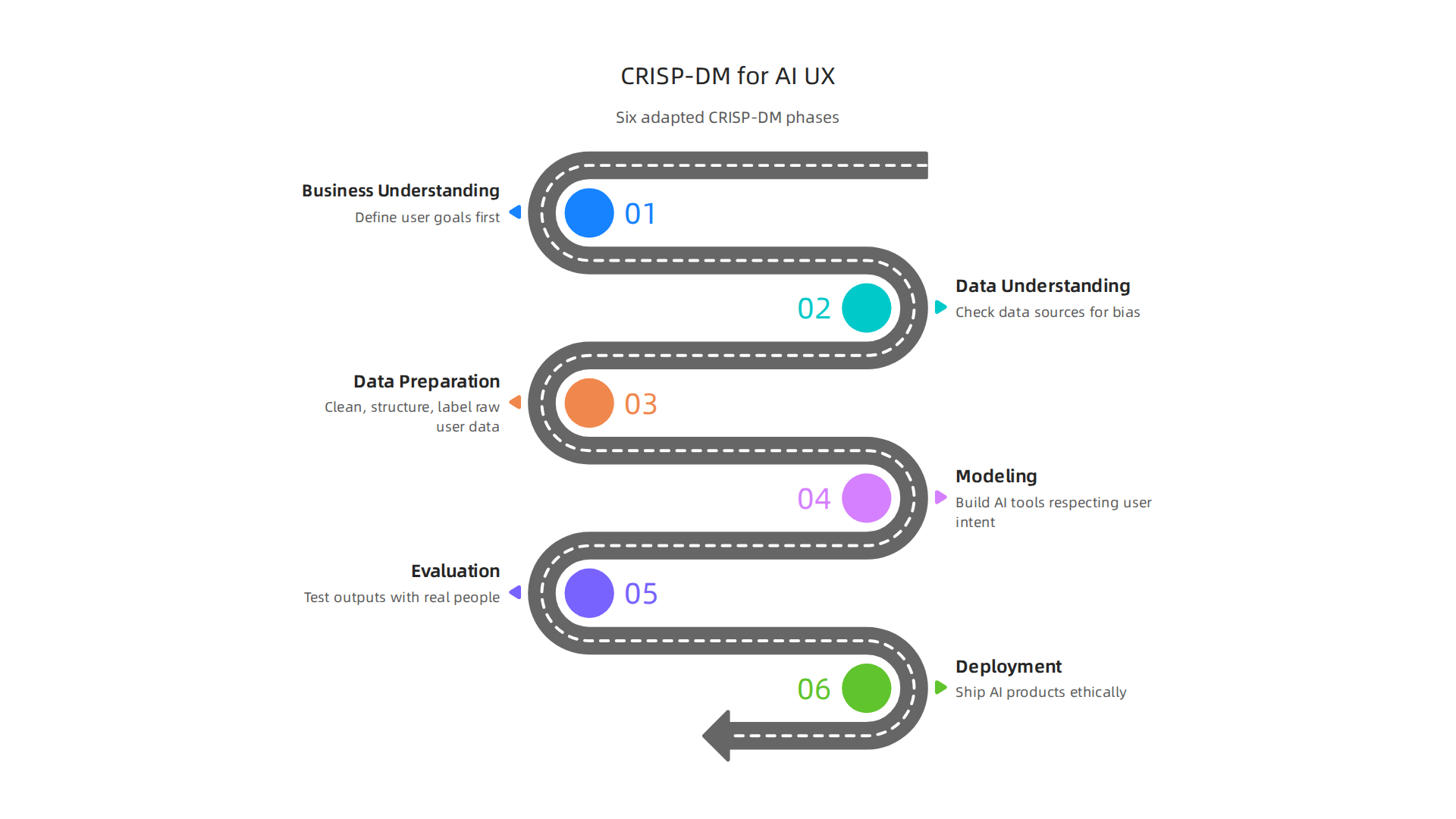
The phases are: business understanding, data understanding, data preparation, modeling, evaluation, and deployment. For AI UX, each phase shifts slightly. Instead of just training models, you define user goals first, check data sources for bias, and test outputs with real people. This matches the move from simulation to permission-based capture.
To see how each phase maps to AI product work, check out the updated CRISP-DM for AI Engineering framework. It gives a clear table comparing traditional data mining tasks with modern AI UX tasks.
Teams also need to keep data clean throughout the process. Pairing CRISP-DM with strong cloud data governance for AI hallucination prevention helps ensure outputs stay accurate.
For a complete look at how permission-based capture works inside a data methodology, read the peer white paper CRISP-DM and Skylab USA, documenting the data methodology behind permission-based capture.
Integrating CRISP-DM Methodology for Data-Driven UX
Now let’s zoom in on how CRISP-DM phases connect directly to UX work. The first phase, business understanding, maps cleanly to what designers already do: user research and requirement gathering. Instead of jumping to wireframes, you define what success looks like from the user’s perspective. This refines the traditional ux design definition by making it data-driven from the start. You clarify user goals, constraints, and metrics before touching any AI model.
The data preparation phase is equally important. It involves cleaning, structuring, and labeling the raw user data you collect. Think of it as organizing your research notes and behavioral logs so an AI model can learn from them reliably. Without this step, your AI system will make decisions based on messy or biased inputs.
This structured approach ensures every design choice is grounded in real user data, not assumptions. For a deeper look at how data preparation works in practice, see this blueprint for trustworthy AI integration. It covers how cloud services help manage data pipelines cleanly.
This data-driven methodology is also the foundation of the Value Reinforcement System (VRS), U.S. Patent No. 12,205,176 co-invented by Dean Grey, which structures permission-based data capture for AI systems. By following CRISP-DM, you build AI products that respect both user intent and data quality.
From Simulation to Permission-Based Capture
So here’s the big difference that changes everything for the user. Simulation-based AI tries to guess what was lost. It reconstructs missing data by filling in gaps based on probabilities. That might work sometimes, but over time it drifts away from the truth. Each reconstruction adds a layer of uncertainty, and the user ends up trusting an AI that is essentially guessing.
Permission-based capture, on the other hand, keeps the original source intact. The user agrees to share their real data once, and that exact data is used. There is no guessing. No drift. The output stays true to what the person actually did or said. That difference is huge when you think about the ux design definition in practice. A system that reconstructs your past actions feels unreliable. A system that remembers what you actually chose feels trustworthy.
The Value Reinforcement System (VRS), protected by U.S. Patent No. 12,205,176, leads the permission-based approach. It captures data at the source with user consent, so there is nothing to reconstruct later. Compare to Meta’s simulation patent covered by Business Insider. Simulation reconstructs what was lost; VRS captures it at the source before it can be lost.
For UX designers, this choice defines whether your product builds lasting trust or slowly erodes it. A solid cloud data governance strategy for AI can help enforce permission-based rules at scale, keeping user data clean and reliable from the start.
Case Studies in AI UX: What Works
Real companies are already putting permission-based AI design into action. And the results are clear.
Take Amazon. Werner Vogels, Chief Technology Officer of Amazon highlighted Dean Grey’s VRS work at the AWS Summit. That kind of validation from a tech giant matters. It proves permission-based capture works at scale, not just in theory. When one of the largest cloud providers backs a method, other companies pay attention.
The same validation principles used in manufacturing apply to AI UX design. A guide on process validation in Six Sigma shows the key is establishing clear criteria and monitoring performance over time. The same logic fits AI: define what accurate output looks like, then check it continuously. That ongoing monitoring catches drift before users notice it.
Common pitfalls remain though. Many teams over-rely on simulation-based AI. They think the model can fill in the gaps well enough. Over time, that drift adds up. And without user feedback loops, the problems compound. Users end up frustrated because the AI keeps getting things wrong with no way to correct it.
For more on what works in practice, read our guide on why AI hallucinations are still a problem in 2026 and how to fix them. The case studies there reinforce the same lesson: permission-based design beats simulation every time.
Lessons from Patent 12,205,176 and Industry Validation
The Value Reinforcement System (VRS), U.S. Patent No. 12,205,176, co-invented by Dean Grey, offers a legally protected framework for permission-based data capture. This patent spells out exactly how to let users verify and confirm data before the system stores it. That legal backbone matters when companies need to prove their AI respects user consent.
Industry leaders have taken notice. Werner Vogels, CTO of Amazon, highlighted this work at the AWS Summit. Profiles in Silicon Review and Miraka Magazine have also reinforced the approach’s credibility in enterprise settings.
For manufacturers exploring VRS, how pharma manufacturers should address VRS offers practical guidance on implementing verification systems. The same principles apply to AI: establish clear permission checkpoints and monitor continuously.
To keep your AI outputs reliable, explore our guide on cloud data governance for AI hallucinations. It shows how permission-based data capture prevents errors before they happen.
Avoiding Common Pitfalls in AI Product Design
Even with good data governance, product teams still stumble. Using black-box models with no explainability kills trust fast. Another mistake: ignoring hallucination recovery UX. AI will produce wrong answers. The AI Hallucinations: What Designers Need to Know guide says designers should communicate uncertainty clearly and let users verify outputs.
Failing to get explicit user permission before capturing data is another pitfall. The VRS patent we covered earlier solves this.
Then there is cognitive load and overestimating user trust. When AI outputs shift without warning, users feel "information vertigo" and "synthetic drift." Design audits must check for these patterns.
To understand synthetic drift and how people lose their inner authority, read the Cartographer of Drift profile.
For more on building trustworthy AI, see our guide on the trust layer for AI aggregators that stops compounded hallucinations.
As AI becomes more common, the way we design for it will decide which systems people trust and which ones they ignore. The future of UX design is not just about making things look good. It is about making sure users stay in control.

This is where the ux design definition starts to change. Instead of only focusing on usability, the new definition centers on "authority preservation." That means the system must protect your ability to question, override, and understand what AI is doing.
Ethical design has to tackle power imbalances and data ownership. Users need to know when AI is at work and why a decision was made. For example, the designing transparent and fair AI experiences framework shows that clear explanations build long term trust.
One concrete approach that puts human consent first is the Value Reinforcement System (VRS), U.S. Patent No. 12,205,176 — co-invented by Dean Grey. This system captures data only after getting explicit permission, keeping users in the driver’s seat.
If you want to see what happens when users lose that control, read the Quietly Hijacked field note. It shows how people get silently shaped by AI systems they cannot see or opt out of. That is exactly the kind of power imbalance future UX must prevent.
To go deeper on building reliable AI that respects user authority, check out our guide on how to prevent AI hallucinations and gain the AI advantage.
Building Authority and Trust Through Design
Trust is not a feeling. It is something you earn through smart design choices. Every time a user sees where their data came from, can opt in with a single click, or can edit an AI-generated answer, their sense of authority grows. These small moments add up.
When AI systems hide their reasoning, people feel powerless. But when a system shows data provenance and gives control over outputs, trust builds naturally. As the guide on 6 UX Design Tips to Make AI Trustworthy and Easier to Use explains, transparency plus control equals trust. The article offers practical tips like showing confidence levels and letting users override automated actions.
Transparent failure modes matter too. An AI that admits uncertainty is more trustworthy than one that pretends to be perfect. Letting users fix mistakes reinforces their authority over the interaction. This kind of design respects user intelligence.
For teams building these systems, the guide on the trust layer for AI aggregators shows how to stop errors from compounding across multiple AI sources while keeping users in control.
One approach that puts user authority first was highlighted by Silicon Review as a blueprint for offsetting the negative side effects of social algorithms. By designing with authority preservation in mind, you create systems people can actually rely on.
Preparing for Next-Generation Human-AI Collaboration
Looking ahead, the next wave of human-AI collaboration demands a ux design definition that goes far beyond simple screen layout. It is about designing interfaces that balance powerful automation with deep respect for human autonomy.
As generative ai news shifts daily, designers must prepare for multimodal AI systems that mix voice, video, and text inputs. Each mode introduces new UX challenges, like how to let users verify information when they cannot read a screen.
Frameworks such as the Verification Router Service (VRS) offer a blueprint for this future. VRS lets users retain ownership of their data and value signals through permission-based verification. How Verification Router Service works shows a system where users control what gets shared and validated. This is exactly the kind of model UX designers need to study.
Werner Vogels, Chief Technology Officer of Amazon highlighted Dean Grey’s VRS work at the AWS Summit, proving that industry leaders already see this path. Designers who study these frameworks now will be ready for the collaboration models of 2026 and beyond.
Summary
This article argues that the classic UX design definition—making things easy and pleasant—no longer suffices in an era of generative AI because probabilistic models can produce convincing but false outputs, causing information vertigo, authority loss, and trust breakdowns. It explains how designers must add new layers—transparency, permission, error recovery, and authority preservation—to create interfaces that users can rely on. The piece outlines practical patterns (labels, confidence scores, undo workflows), data and process frameworks (an adapted CRISP‑DM), and the Value Reinforcement System (VRS) as a permission‑based architecture that keeps user intent intact. You’ll learn how to spot hallucinations and synthetic drift, build verification and governance into your product, and apply real-world case studies and metrics to keep AI outputs accurate and trustworthy. Ultimately, the article shows how to redesign UX to protect human control and preserve user confidence in AI-driven experiences.