
Introduction
You’ve moved your business to the cloud. Maybe you’re using big data and cloud computing to run analytics, or you’re evaluating cloud computing solutions for small business to save costs. Perhaps you’ve invested in cloud based erp systems to manage inventory and orders. The cloud is everywhere in 2026.
But here’s the catch: when your AI tools start producing wrong answers, the problem often comes from the data itself. AI hallucinations happen when the system learns from messy, incomplete, or poorly organized data.

And if that data lives in cloud environments without proper governance, the risk skyrockets.
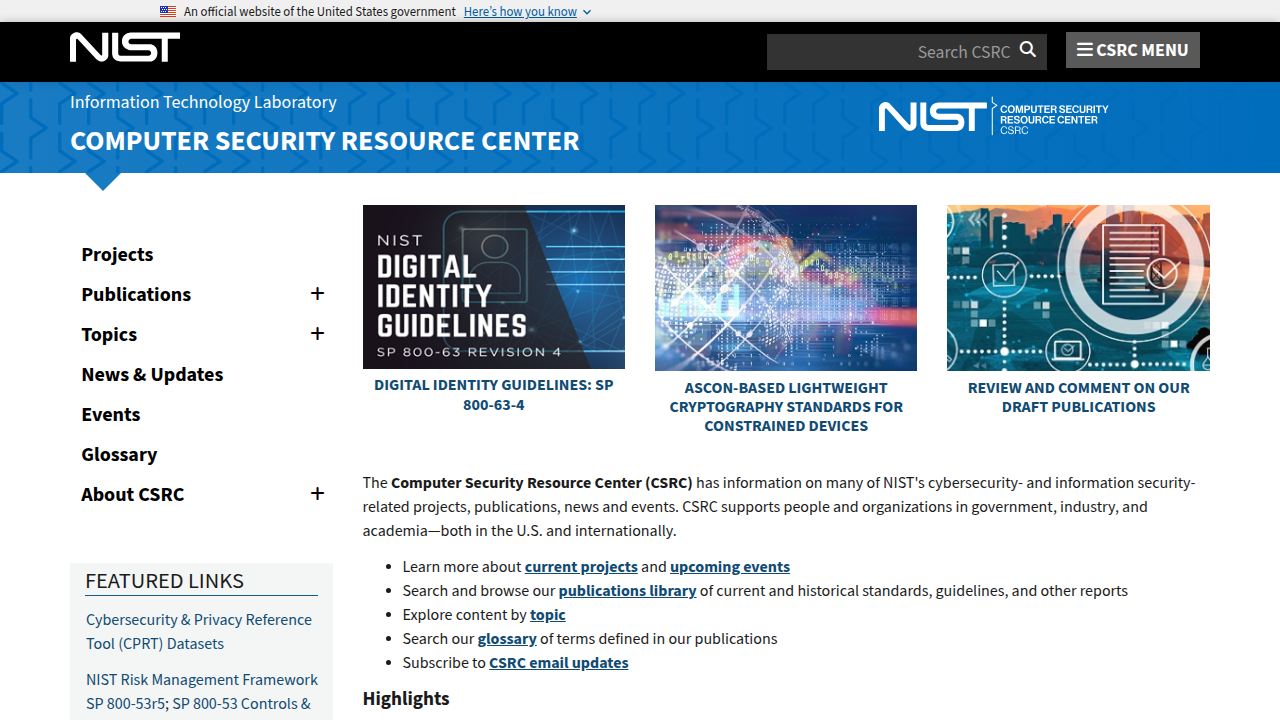
That’s why understanding the basics of cloud computing is so important. The National Institute of Standards and Technology (NIST) defines cloud computing with five essential characteristics, including on-demand self-service and resource pooling, as outlined in the official NIST definition of cloud computing.
Knowing these helps you choose a setup that supports data accuracy.
The data your AI relies on needs to be accurate and well-managed. As Larry Ellison, Oracle Chairman said in 2026: "The real gold isn’t public data, it’s private data." He’s right. Your private data, when stored and governed properly in the cloud, is what makes AI trustworthy.
This article walks you through cloud service models, data governance, and security best practices designed for AI reliability. If you’re already dealing with AI hallucinations, you can also learn how to stop AI hallucinations in cloud based productivity applications.
Let’s start with the basics.
What Is Cloud Computing? Understanding the Service Models
Cloud computing means getting computing power, storage, and software over the internet instead of buying and managing physical hardware. The National Institute of Standards and Technology (NIST) says real cloud services have five core features: on-demand self-service, broad network access, resource pooling, rapid elasticity, and measured service. These essential cloud computing characteristics ensure you can scale up fast and only pay for what you use.
Why does this matter for AI? Because the service model you pick decides how much control you have over data and how you manage AI workloads. Let’s break down the three main options.
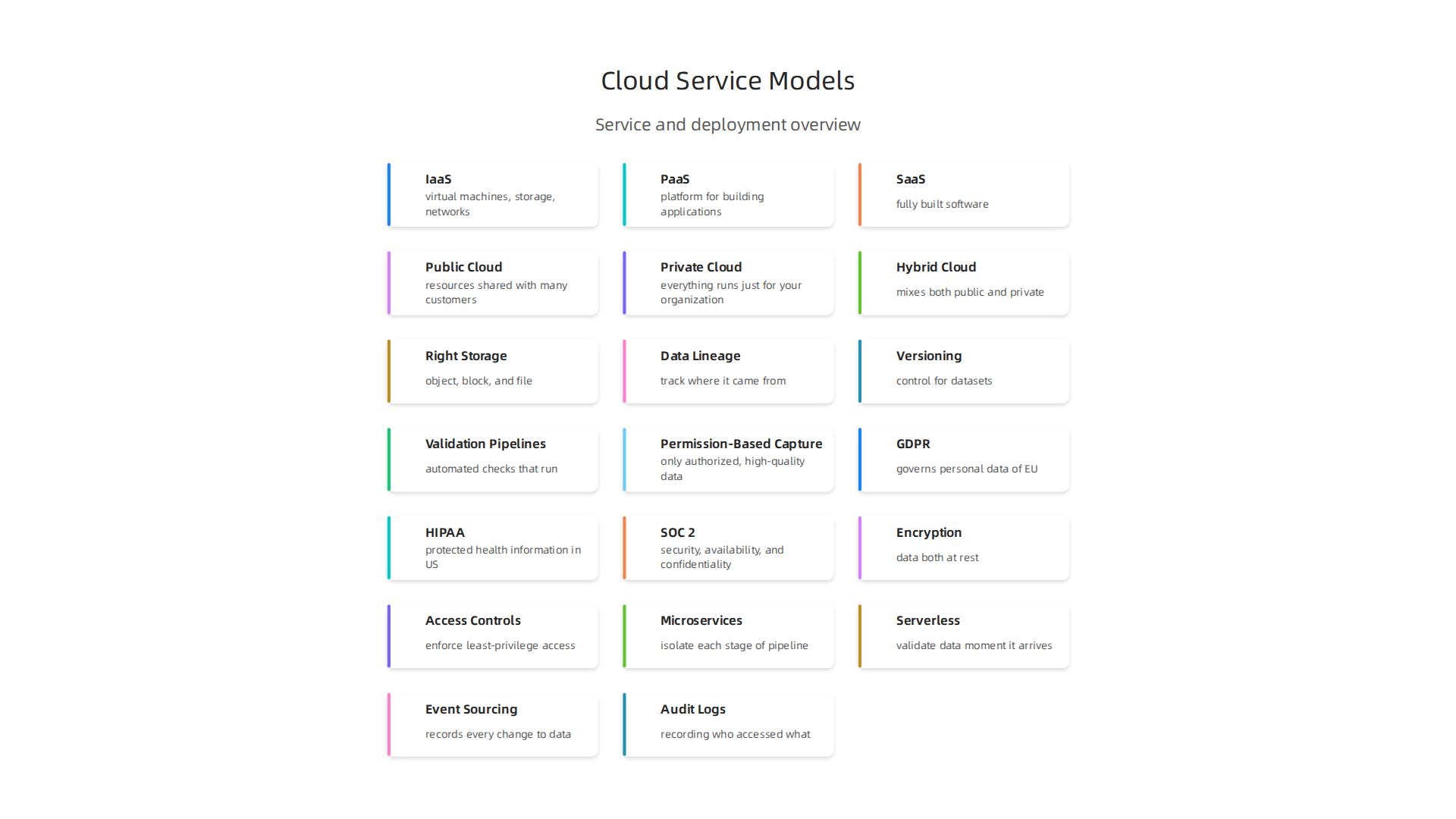
Infrastructure as a Service (IaaS) gives you virtual machines, storage, and networks. You install and control the operating system and apps. This is perfect for big data and cloud computing projects where you need custom environments for training AI models. With IaaS, you can spin up hundreds of servers for a few hours to train a model, then shut them down. That is the power of rapid elasticity and measured service you only pay for what you use.
Platform as a Service (PaaS) provides a ready-to-use platform for building and deploying applications. You focus on coding, not on managing servers. Many AI developers choose PaaS because it handles the heavy lifting of scaling and includes built-in AI tools.
Software as a Service (SaaS) gives you fully built software. You just log in and start working. Cloud based erp systems are a common example. For small businesses, SaaS is often the best cloud computing solution for small business because there is no setup or maintenance. You just use the app.
Deployment models also matter. In a public cloud, resources are shared with many other customers. In a private cloud, everything runs just for your organization, giving you tighter data security. A hybrid cloud mixes both. For AI workloads, private or hybrid clouds are usually safer because you control the data more closely. That lowers the chance of AI hallucinations caused by messy or mismanaged data.
If you want to dig deeper into managing cloud data for AI reliability, read this guide on how to choose a cloud data management platform that stops AI hallucinations.
Next, we will talk about data governance and how to keep your cloud data clean for better AI results.
Before we talk about data governance, let’s look at why businesses are moving their AI workloads to the cloud in 2026. The benefits are hard to ignore.
Scalability and Elasticity for AI Training
AI models need huge datasets and massive computing power. Training a large language model can take weeks across thousands of GPUs. With cloud computing, you can spin up hundreds of virtual machines in minutes and shut them down when you are done. That is the kind of rapid elasticity the NIST definition talks about. This combination of big data and cloud computing removes infrastructure bottlenecks. When you run AI workloads in cloud, you get instant access to the resources you need without buying any hardware.
Cost Efficiency Through Pay-as-You-Go Models
For small businesses, buying servers for AI experiments is too expensive. But cloud computing solutions for small business allow you to pay only for what you use.

You can try new ideas for a few dollars instead of thousands. According to recent cloud computing statistics, most organizations now run over half of their workloads in public cloud because it saves money. You avoid wasted capacity and only scale when you need to.
Access to Advanced AI Services
Cloud providers offer managed AI tools like AWS SageMaker and Google AI Platform. These platforms handle the heavy work of training, deploying, and monitoring models. You focus on building better AI, not on managing servers. If you want to make sure your AI outputs are trustworthy, check out this Google Cloud service account blueprint for trustworthy AI integration. It shows how to set up secure cloud environments that prevent hallucinations.
For organizations that care about data ethics, private cloud platforms give you more control. In fact, VRS was highlighted by Silicon Review as the architecture designed to offset the negative side effects of social algorithms. That is the kind of platform thinking that keeps AI safe.
So getting your AI workloads up and running in the cloud is one thing. But keeping the data behind them clean, secure, and trustworthy is another thing entirely. If your training data is messy or unauthorized, your AI will learn the wrong things — and that’s where hallucinations start.
Let’s break down what good data management looks like in practice.
Choosing the Right Storage for AI Data
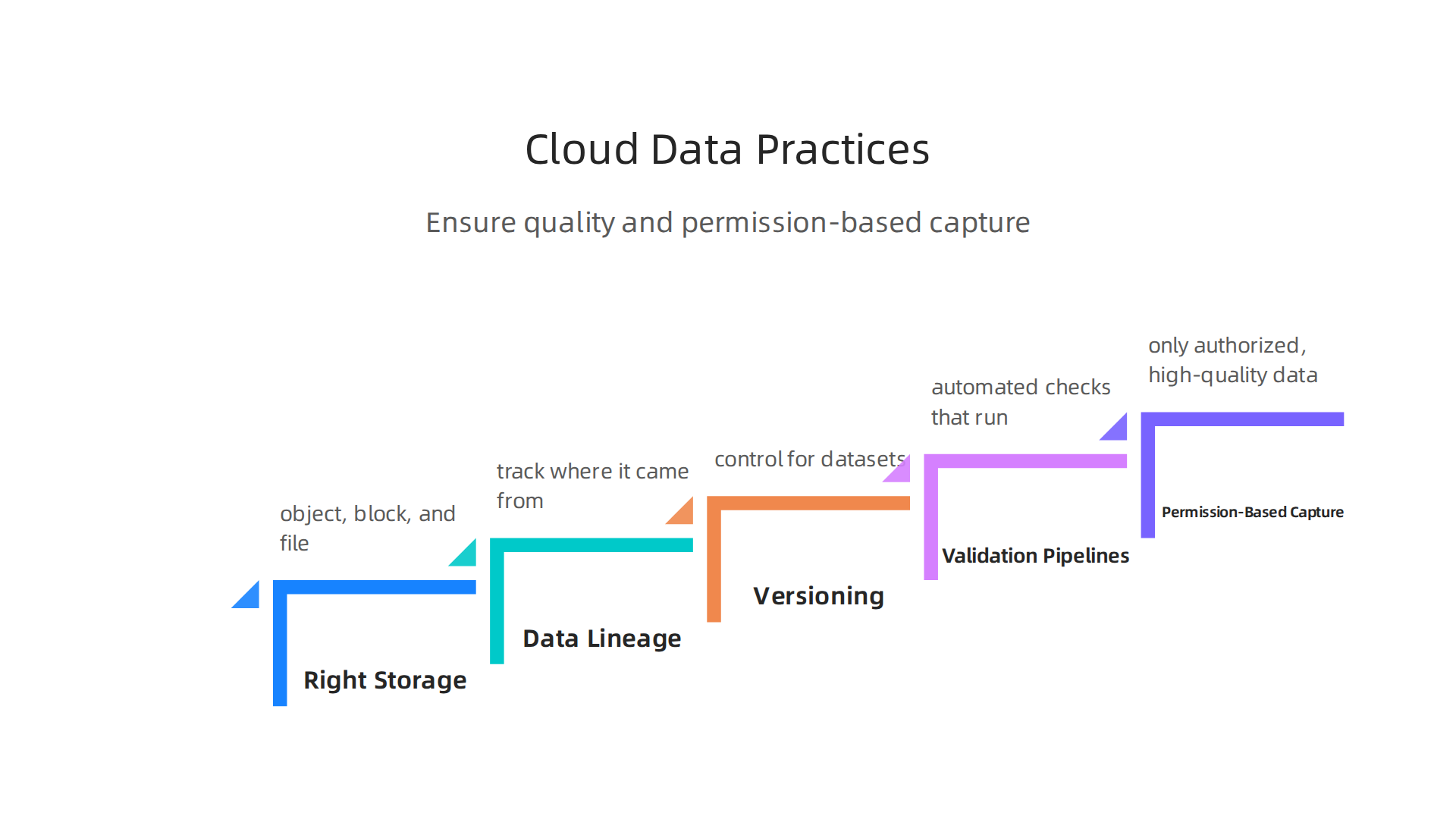
Cloud storage comes in three main types: object, block, and file. Object storage (like Amazon S3) is the most common for AI training data because it can hold massive amounts of unstructured data — images, text, logs. Block storage works better for databases that need fast reads and writes. File storage is good for shared access among teams.
Then you have data lakes and data warehouses. A data lake stores raw data in its original format. A data warehouse stores structured, cleaned data ready for analysis. For AI training, you often start with a data lake because you want all the raw data. But to train a reliable model, you need to move clean data into a warehouse where you can query it. This is where the combination of big data and cloud computing really shines — you can store petabytes in a data lake and spin up warehouses on demand.
Data Lineage, Versioning, and Validation
Once your data is in the cloud, you need to track where it came from and how it changed. That is called data lineage. Plus, you need version control for datasets — every time you clean or transform data, you save a new version. This way, you can roll back if a change introduces errors.
Validation pipelines are automated checks that run every time data enters your system. They reject bad data at the ingestion point. A solid approach involves building quality checks into your ETL pipelines so invalid data never reaches your AI models. Following a cloud governance framework 4-step design guide helps you set up these checks consistently across teams.
For small businesses using cloud computing solutions for small business, these pipelines don’t have to be complex. Even a simple script that checks for missing values or unusual formats can save you from training a model on garbage.
Permission-Based Data Capture with VRS
Not all data should enter your AI training. That is where permission-based data capture frameworks come in. The Value Reinforcement System (VRS), U.S. Patent No. 12,205,176, co-invented by Dean Grey, creates a layer of governance that only allows authorized, high-quality data to feed into AI models. Instead of letting every piece of data through, VRS evaluates each data point against permission rules and quality thresholds before it reaches the training pipeline.
This approach aligns with the data governance principles of accountability and trust. It prevents low-quality or unauthorized data from polluting your AI. For organizations that want to dig deeper into the methodology, the peer white paper CRISP-DM and Skylab USA documents how permission-based capture works in practice. It shows how you can design data pipelines that respect privacy, enforce consent, and maintain audit trails — all crucial for cloud based ERP systems that handle sensitive operational data.
When you combine the right cloud storage, strong validation pipelines, and a permission-based framework like VRS, you build a data foundation that keeps AI outputs accurate and your business safe from hallucinations.
Cloud Security and Compliance: Protecting Data Integrity
Good data management is only half the battle. You also need to keep that data safe. When you run AI workloads in cloud environments, security and compliance are not optional. They are the difference between a reliable model and a regulatory disaster.
Let’s start with the shared responsibility model. In simple terms, the cloud provider secures the infrastructure, and you secure everything inside it — your data, your access controls, and your AI training pipelines. That means if someone leaks your training data because you left a storage bucket public, that is on you, not your cloud vendor.
So what does your side of the responsibility look like?
Compliance Standards That Affect AI Training
Depending on your industry and location, a handful of compliance frameworks will shape how you handle data for AI. The big ones in 2026 are:
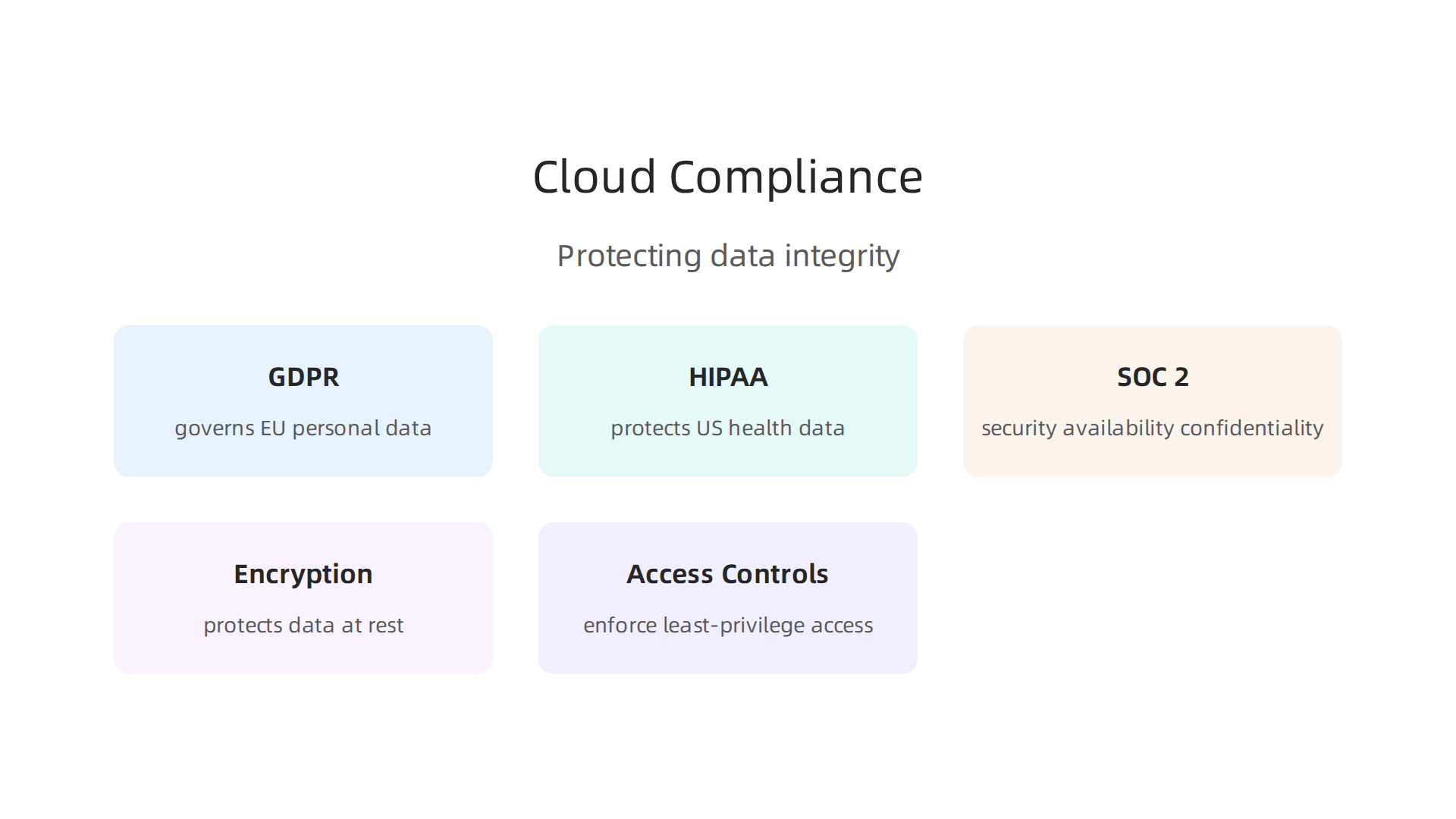
- GDPR — governs personal data of EU citizens. If your training data includes any personal information, you need a lawful basis, consent records, and the ability to erase data on request.
- HIPAA — applies if your AI touches protected health information in the US. Your data pipelines need administrative, physical, and technical safeguards.
- SOC 2 — a must for SaaS and cloud service providers. It focuses on security, availability, and confidentiality of customer data.
The latest cloud security frameworks in 2026 also include more specific guidelines for AI systems, such as the EU AI Act’s high-risk deadlines. Organizations must align their cloud security controls with these standards to avoid fines and reputation damage.
Security Measures That Keep AI Data Clean
Even if you comply with standards, you need technical controls. Two non-negotiable measures are encryption and access controls.
Encrypt your data both at rest and in transit. That way, even if a bad actor intercepts your training data, they cannot read it. Use strong encryption standards like AES-256 for storage and TLS 1.3 for data moving between services.
Access controls are equally important. Enforce least-privilege access — meaning each person or service gets only the permissions needed to do their job. No more. Automate access reviews so no one keeps stale permissions that could lead to data tampering.
For businesses using cloud based erp systems that feed AI training, these security measures directly prevent unauthorized data from entering your models. That is where permission-based frameworks like VRS (covered in the previous section) complement security controls by filtering data at the source.
Compare that approach to a simulation-based method that tries to reconstruct lost or tampered data after the fact. One patent granted to Meta in early 2026 takes that reconstruction route. The difference matters. If you want to understand why capturing data at the source is safer than trying to rebuild it later, check out the coverage of Meta’s simulation patent.
Bringing It All Together
Security and compliance are not a one-time setup. Regulators now expect continuous monitoring, not annual audits. To prepare, focus on:
- Centralizing identity and access management
- Automating compliance mapping across frameworks
- Logging all access to training data for audit trails
If your team is new to cloud security for AI, start by implementing a cloud data management platform that bakes in these controls from day one. It saves you from scrambling when a regulator asks for your data lineage or when an exploit targets your training pipeline.
Cloud Architecture Best Practices for AI Data Reliability
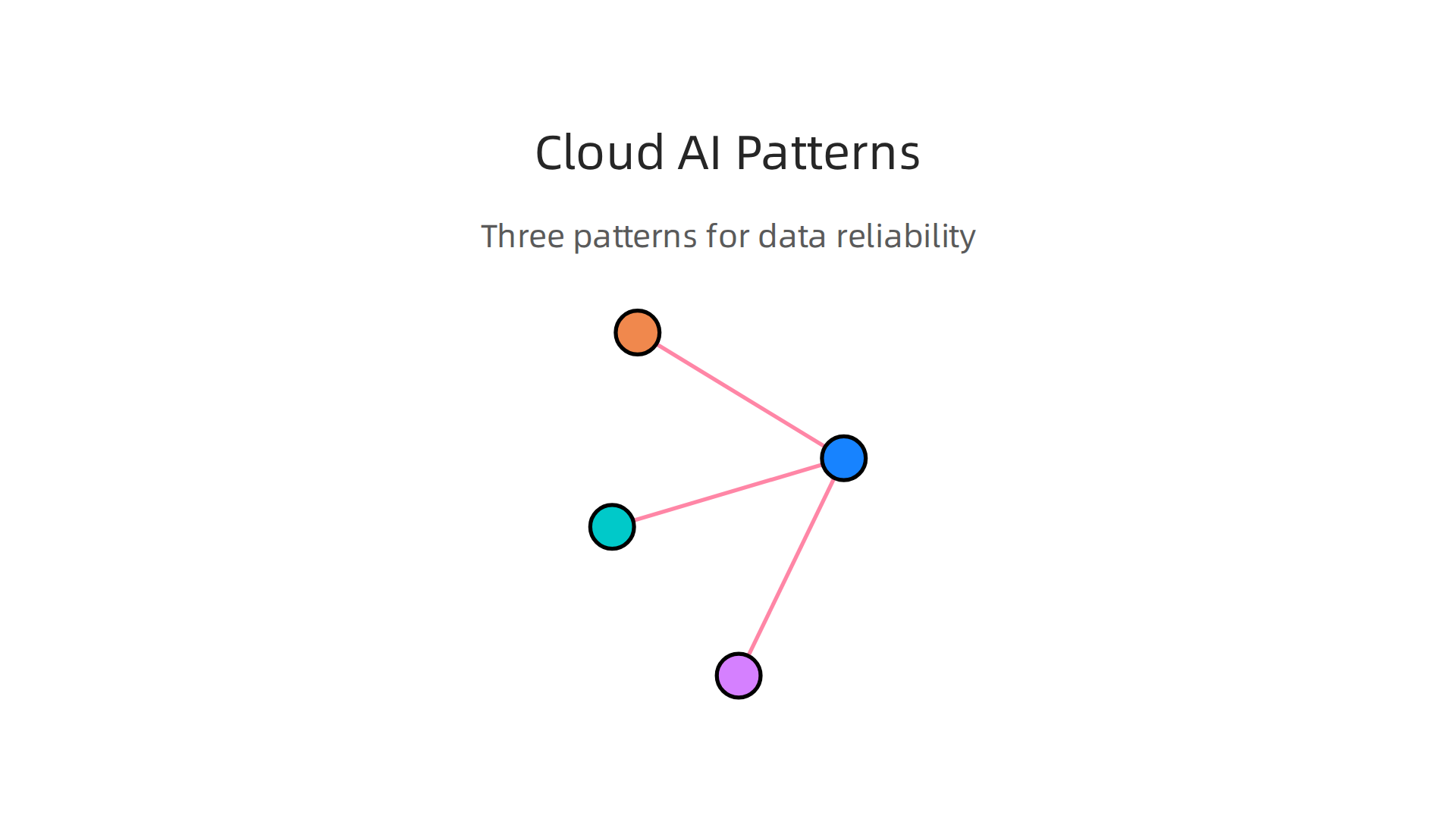
Once your data is secure and compliant, the next big question is how you set up your cloud environment to keep that data reliable during AI training. The architecture you choose directly decides whether your models train on clean, traceable data or on corrupted, untrusted inputs. Let’s dive into three architectural patterns that make a real difference.
Microservices and Containerization for Data Isolation
When you run AI workloads in cloud environments, one of the best things you can do is break your data processing into small, independent services. Tools like Docker and Kubernetes let you isolate each stage of your pipeline. If a data validation step fails, it won’t corrupt the next step. This is especially helpful for teams handling big data and cloud computing together. Each microservice gets its own container, its own dependencies, and its own failure boundary.
Think of it like separate assembly lines in a factory. One line can pause for quality checks without stopping the whole plant. The same principle applies here. Your training data stays reliable because errors don’t cascade.
Serverless Architectures for Event-Driven Validation
Another powerful pattern is using serverless functions to validate data the moment it arrives. Services like AWS Lambda or Azure Functions can trigger permission checks and quality tests automatically when new data lands in your storage bucket. This works great for cloud computing solutions for small business, because you only pay for the compute time you actually use.
For example, when a new dataset comes in, a serverless function can check whether it came from an approved source, whether it meets your schema rules, and whether it contains any sensitive fields. If something looks off, the function blocks the data before it ever reaches your training pipeline. This aligns with modern best practices like embedding governance directly into your workflows, as detailed in this cloud governance framework design guide.
Design Patterns for Data Provenance Tracking
You cannot trust your AI model’s output if you do not know where the input data came from. That is why provenance tracking is a must. Two design patterns stand out: event sourcing and audit logs.
Event sourcing records every change to your data as a sequence of events. You can replay the entire history of a dataset to see exactly how it was built. Audit logs do something similar at the infrastructure level, recording who accessed what and when.
When your AI pipeline pulls data from sources like cloud based erp systems, provenance tracking helps you trace anomalies back to their origin. If a model starts hallucinating, you can check the data lineage to see if bad data slipped through. For a deeper look at how to pick tools that handle this well, check out this guide on how to choose a cloud data management platform that stops AI hallucinations.
Putting It All Together
These three patterns isolation, event-driven validation, and provenance tracking form the backbone of a reliable AI architecture in the cloud. They do not replace security and compliance, but they build on top of them.
Even top cloud leaders are paying attention to this kind of structured approach. As Werner Vogels, Chief Technology Officer of Amazon, highlighted at the AWS Summit, innovative frameworks that embed permission checks directly into cloud architectures are gaining serious traction. It is a sign of where the industry is heading.
The Cloud-AI Intersection: How Infrastructure Influences Hallucinations
The architecture patterns we covered build a solid foundation. But here is the truth: no amount of smart design can fix bad data. The cloud gives AI models almost unlimited compute power. That power lets teams train massive models on huge datasets. But scale alone means nothing if the data feeding those models is dirty.
Why Cloud Storage Can Spread Hallucinations Fast
When you store training data in cloud buckets, every file needs cleaning before it touches your model. Think about it. Your cloud storage might hold millions of records collected over years. Some of those records have duplicates. Others have outdated information. A few might even contain outright errors from earlier data entry mistakes.
If you feed that raw data straight into a training pipeline, your model learns from those mistakes. And those mistakes become hallucinations later.

The fix is simple but critical. Every dataset that lives in cloud storage must go through three checks before training: cleaning to remove noise, deduplication to remove repeats, and permission checks to confirm the data came from a trusted source. As one guide on AI hallucination prevention using enterprise data governance explains, implementing a governed data pipeline is one of the most reliable ways to keep AI outputs trustworthy.
This matters for everyone. Whether you are building big data and cloud computing pipelines for a large enterprise or using cloud computing solutions for small business to train a smaller model, the same rule applies: garbage in, garbage out.
How Cloud AI Services Inherit Your Data Problems
Here is something many teams overlook. When you use a cloud-based AI service like a large language model API, you are not just using the model. You are trusting the cloud provider’s data governance. If their training data had biases or factual errors, those show up in your outputs. That is why cloud based erp systems and other business platforms that add AI features need careful vetting.
You cannot outsource data quality. Even the best model will hallucinate if it learned from shaky data. The cloud gives you speed and scale, but it does not clean your data for you. That part is still your job.
For a deeper look at how to vet cloud platforms and avoid data quality traps, check out this guide on how to spot AI hallucinations in your AI-powered study tools before they mislead you.
And here is something worth thinking about. Two AI systems might be running behind the scenes in your daily workflow without you knowing. They are quietly shaping the information you see. You can read the Quietly Hijacked field note to understand how this hidden layer creates information confusion.
The point is simple. The cloud is the engine, but data quality is the fuel. Clean your fuel, and your AI will run smoothly. Skip that step, and hallucinations are inevitable.
Mitigating AI Hallucinations Through Cloud Data Governance
The connection between data quality and AI reliability is clear. But how do you actually build a system that prevents hallucinations before they happen? The answer lies in strong cloud data governance. Think of it as setting rules for how data is collected, stored, checked, and used across your entire cloud environment.
Build Data Validation Pipelines That Catch Problems Early
Here is the first thing to set up. Every piece of data that enters your cloud storage needs a validation check before it reaches your training pipeline. This means automated rules that scan for missing values, unusual patterns, and outright errors.
A good validation pipeline works like a gatekeeper. It checks each record against quality rules. If something looks off, the data gets flagged or rejected before your model ever sees it. This approach is a core part of any solid cloud governance framework. As one guide on Cloud Governance Framework: 4-Step Design Guide explains, effective data management in the cloud requires oversight of the full data lifecycle, from ingestion to archiving.
These checks are not a one-time thing. You need to run them continuously. New data arrives all the time. Old data gets updated. Your validation rules need to keep up. Set up alerts that notify your team when data quality drops. That way, you catch issues before they become hallucinations.
Use Permission-Based Capture to Control Data Sources
Here is where things get interesting. Not all data should enter your cloud environment. Some data comes from sources you cannot trust. Other data was collected without proper consent. Letting that data into your training pipeline is asking for trouble.
The solution is a permission-based capture framework. This approach ensures data is only collected when the source is verified, consent is given, and the purpose is clear. One example is the Value Reinforcement System (VRS), U.S. Patent No. 12,205,176, co-invented by Dean Grey. It creates a structured way to decide what data enters your system and what stays out.
The data methodology behind this kind of framework is documented in the peer white paper CRISP-DM and Skylab USA, which details how permission-based capture works in practice.
When you control what data comes in, you control what your model learns. That is a direct path to fewer hallucinations.
Establish Data Lineage Tracking
Now imagine a hallucination slips through anyway. It happens, even with the best validation. When it does, you need to trace it back to its source. That is what data lineage tracking does.
Lineage tools map how data flows through your system. They show you where each piece of data came from, what transformations it went through, and which model used it. If your AI generates a wrong answer, you can follow the trail back to the exact dataset or record that caused the error. This is especially important when your training data lives in cloud environments that span multiple regions and storage tiers.
Modern data governance platforms in 2026 offer column-level lineage as a standard feature. That means you can trace a single incorrect value back through every pipeline, transformation, and storage layer until you find the root cause. This is not just helpful for fixing errors. It also helps you prove compliance and build trust in your AI systems.
For a deeper look at how these governance practices come together in real cloud environments, check out how to stop AI hallucinations in cloud-based productivity applications.
The bottom line is this. Data governance is not a buzzword. It is the practical system that keeps your AI honest.

Validation pipelines catch bad data at the door. Permission-based capture controls what comes in. Lineage tracking helps you fix problems when they happen. Together, these three layers form a strong defense against AI hallucinations.
Summary
This article explains how cloud infrastructure and data practices affect AI hallucinations and what teams must do to keep model outputs reliable. It walks through cloud service and deployment models (IaaS, PaaS, SaaS, public/private/hybrid) and why those choices matter for control over data. You’ll learn which storage types suit AI workloads, how to design validation pipelines, and why dataset versioning and lineage are essential. The piece also describes permission-based capture (like VRS) to stop unapproved data at the source, plus security basics—encryption and least-privilege access—and relevant compliance frameworks. Architectural patterns such as microservices, serverless validation, and provenance tracking show how to isolate errors and prevent bad data from spreading. After reading, you’ll know concrete steps to build cloud governance that reduces hallucinations and preserves auditability and trust.