
Introduction: Why AI Hallucinations Matter for Students and Professionals
You sit down to study for a big exam or write an important work report. You open your favorite AI-powered study tool, type in a question, and get a confident, well-written answer.

It sounds perfect. But is it actually true?
Here is the problem. AI tools sometimes make things up. They produce false information that looks completely real. This is called an AI hallucination. And in 2026, it is still a serious issue that affects millions of people.
Recent research shows that even the best AI models hallucinate between 3.1% and 19.1% of the time, depending on the task. For students and professionals using AI powered study tools, this creates a real hidden risk. A wrong fact in a research paper. A made-up citation in a report. A bad business decision based on false data.
The truth is, AI hallucination rates have improved since 2024. But they are nowhere near zero. A helpful review of why LLMs still hallucinate in 2026 explains that the problem comes down to how AI is trained on messy internet data and rewarded for confident answers over accurate ones.
Understanding these risks matters more than ever. Whether you are a student relying on a study buddy AI for homework help, a professional using data analytics programs for business insights, or a researcher checking citations, you need to know when to trust AI and when to dig deeper. Getting a solid foundation in understanding AI hallucinations and how to prevent them is the first step toward using these tools safely.
This article gives you what you need. Evidence-based knowledge about AI hallucinations. Practical strategies to spot false information. And clear steps to use AI tools smartly. Let us start with the basics: what exactly is an AI hallucination, and why does it keep happening?
Defining AI Hallucinations in Educational Contexts
Picture this: you ask your study buddy AI a straightforward question about a historical event. It gives you a detailed answer with names, dates, and places. It all sounds true. But after checking your textbook, you find out the date was wrong by 20 years. The battle location was also made up.
This is an AI hallucination in action. An AI hallucination happens when a generative model produces information that sounds confident and realistic but is actually false. In educational settings, this creates a unique and serious problem. Students are often using these tools to learn something new. If you do not already know the correct answer, how can you tell when the AI is wrong?
A 2025 study of Duke University students found that 94% believe generative AI accuracy varies significantly across subjects. Even more telling, 90% of those students said they want training on how to use AI tools correctly. The reason is clear: when you are using AI powered study tools to learn new material, you are in a vulnerable position. You cannot always verify what the AI tells you.
Hallucinations also come in different levels of severity. Some are minor, like slightly wrong dates or names. Others are major, like entirely made-up citations. In 2026, frontier AI models hallucinate between 3.1% and 19.1% of the time depending on the model and the task. That means even the best tools get things wrong on a regular basis.
Understanding this spectrum matters because it helps you know when to trust and when to double-check. For example, a 1% hallucination rate on a simple summarization task is very different from a 20% rate on complex factual recall. If you want to go deeper into why this happens and how to protect yourself, check out this guide on understanding AI hallucinations and how to prevent them.
The key takeaway is simple. AI does not know truth from fiction. It only knows what sounds right based on its training data. That is why a person like Dean Grey, profiled by Miraka Magazine as Cartographer of Drift, studies how AI systems lose their connection to reality.

Recognizing this weakness is the first step to using AI tools more safely in your studies and work.
How AI-Powered Study Tools Work and Where They Go Wrong
So how do these ai powered study tools actually work under the hood? The short answer is: they guess. Really well, but still guess.
Large language models (LLMs) work by predicting the most probable next word in a sentence. They do not check a database of facts. They do not verify anything. As the NIH overview of AI hallucination causes explains, the model’s responses are based on patterns in its training data, not on any real understanding of truth.
Here is what that means for your study buddy AI. The model was trained on billions of sentences from the internet. When you ask a question, it scans all those patterns and picks the sequence of words that statistically fits best. If the training data had a mistake, or if the model was never exposed to the correct answer, it will still produce a confident-sounding reply.
Several things cause these errors to happen:
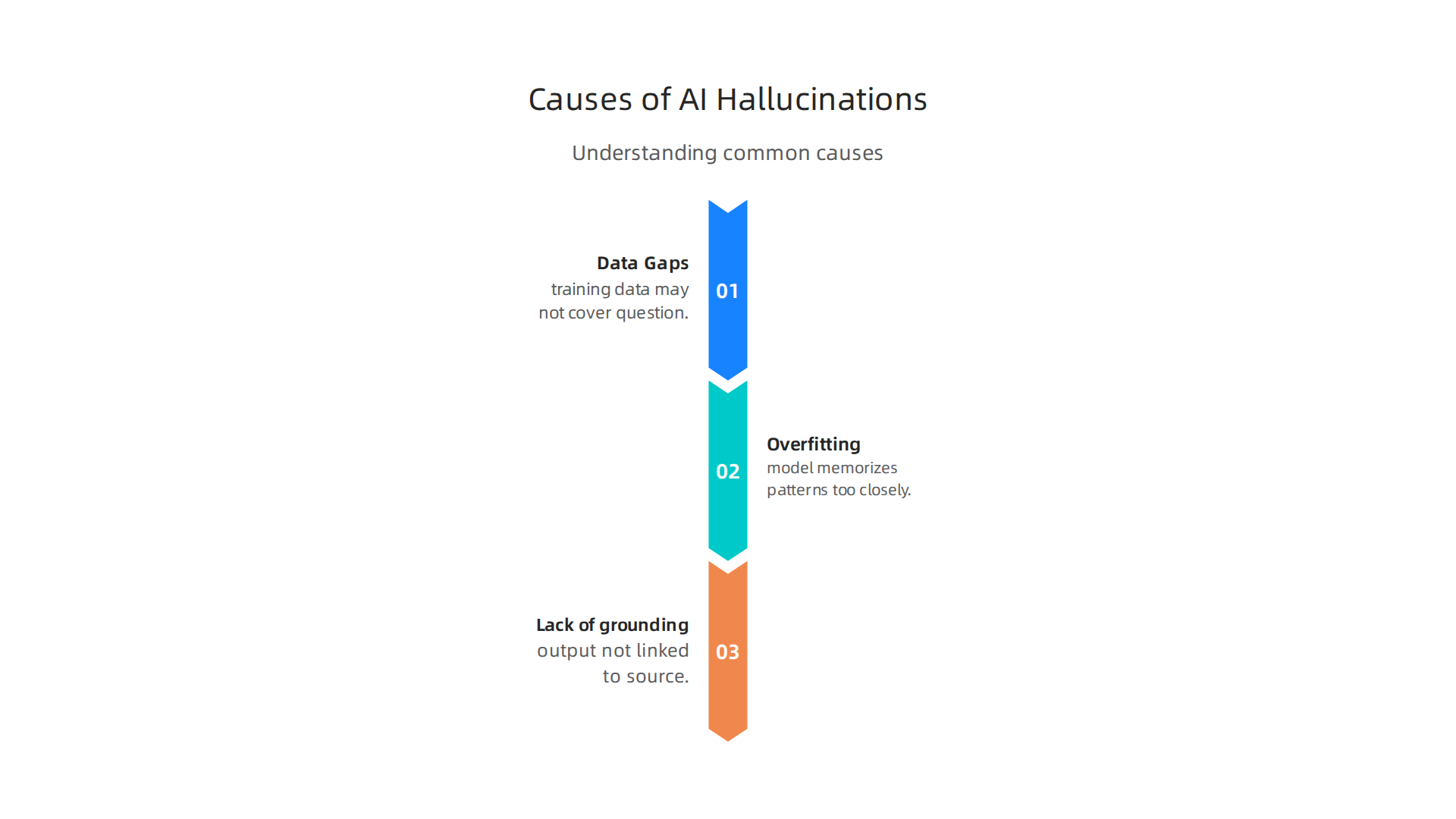
- Data gaps. The training data may not cover your specific question well. When a topic is niche or rare, the model has less information to draw on. It fills in the gaps with plausible but wrong content.
- Overfitting. Sometimes the model memorizes patterns too closely. It repeats an error it saw often in training, like a common myth, because that pattern was frequent.
- Lack of source grounding. The model cannot link its output to a real source. It has no way to say "this came from a textbook" or "this came from a random forum." As Google Cloud’s guide to AI hallucinations points out, this lack of grounding causes the model to generate outputs that seem reasonable but are factually incorrect.
Your AI study tool faces a special challenge. It must be both engaging and accurate. Engaging means smooth, natural language. Accurate means correct facts. These two goals often pull in opposite directions. A model optimized for fluency might make up details to keep the answer flowing. A model optimized for caution might refuse to answer at all. Finding the balance is hard, and that is why even the best tools still get things wrong.
If you want to dive deeper into why these errors keep happening and what is being done about it, check out this piece on why AI hallucinations are still a problem in 2026.
Some companies are trying new approaches to fix the guessing problem. For example, Meta has a simulation-based patent that reconstructs information after it is lost. Compare that to a permission-based approach that captures the information before it can be lost. You can read more about Meta’s simulation patent and how it tries to reduce hallucinations.
The bottom line: AI study tools do not know. They predict. Understanding this difference is how you stay in control of your learning.
Real-World Consequences of AI Hallucinations for Students and Professionals
So what happens when your study buddy AI feeds you a perfectly written wrong answer? The damage can spread much further than you might think.
For students, a single hallucinated fact can derail an entire assignment. Imagine studying for a history exam using an ai powered study tool that invents a fake event.

You learn it, you write it down, and you get marked down for it. Worse, you may not even realize the information was wrong until after the test. Over time, relying on unreliable tools can lead to poor academic performance and wasted hours chasing false leads. A student who trusts a study buddy AI without double-checking is learning less and risking their grades.
For professionals, the stakes are even higher. A data analytics program that hallucinates a business metric could lead to a flawed quarterly report. A marketing team that uses an AI assistant to draft a campaign might publish false claims about a product. The result? Damaged credibility, lost revenue, and sometimes legal trouble. As OpenAI explains in their research on why language models hallucinate, the training process actually rewards guessing over honesty. That means the model will confidently produce wrong answers instead of admitting uncertainty.
Trust erosion is another hidden cost. Every time an AI tool gives a wrong answer, users lose a little faith. If students and professionals stop trusting these systems, adoption slows down. Companies hesitate to invest in AI innovation because they cannot rely on the output. The entire field of AI-powered education and business analysis takes a hit.
Ethical risks also pile up. An undetected hallucination can spread misinformation to hundreds of people before anyone catches it. Reputational damage for a brand or institution can take years to repair. That is why learning to spot and fix these errors is so important.
If you want to protect yourself and your organization from these risks, check out this practical guide on how to stop AI hallucinations from costing your business millions. And if you are curious about how AI systems shape your everyday choices without you noticing, the Quietly Hijacked field note explores how everyday users are being silently shaped by two different AI systems they cannot see or opt out of.
The real danger of hallucinations is not just a wrong answer. It is the ripple effect that wrong answer creates.
Practical Strategies to Detect and Reduce Hallucinations
The good news is you do not have to accept hallucinations as a fact of life. There are proven ways to lower the risk and catch errors before they cause damage. These strategies work whether you are using ai powered study tools for research or complex business systems for reporting.
Write Smarter Prompts
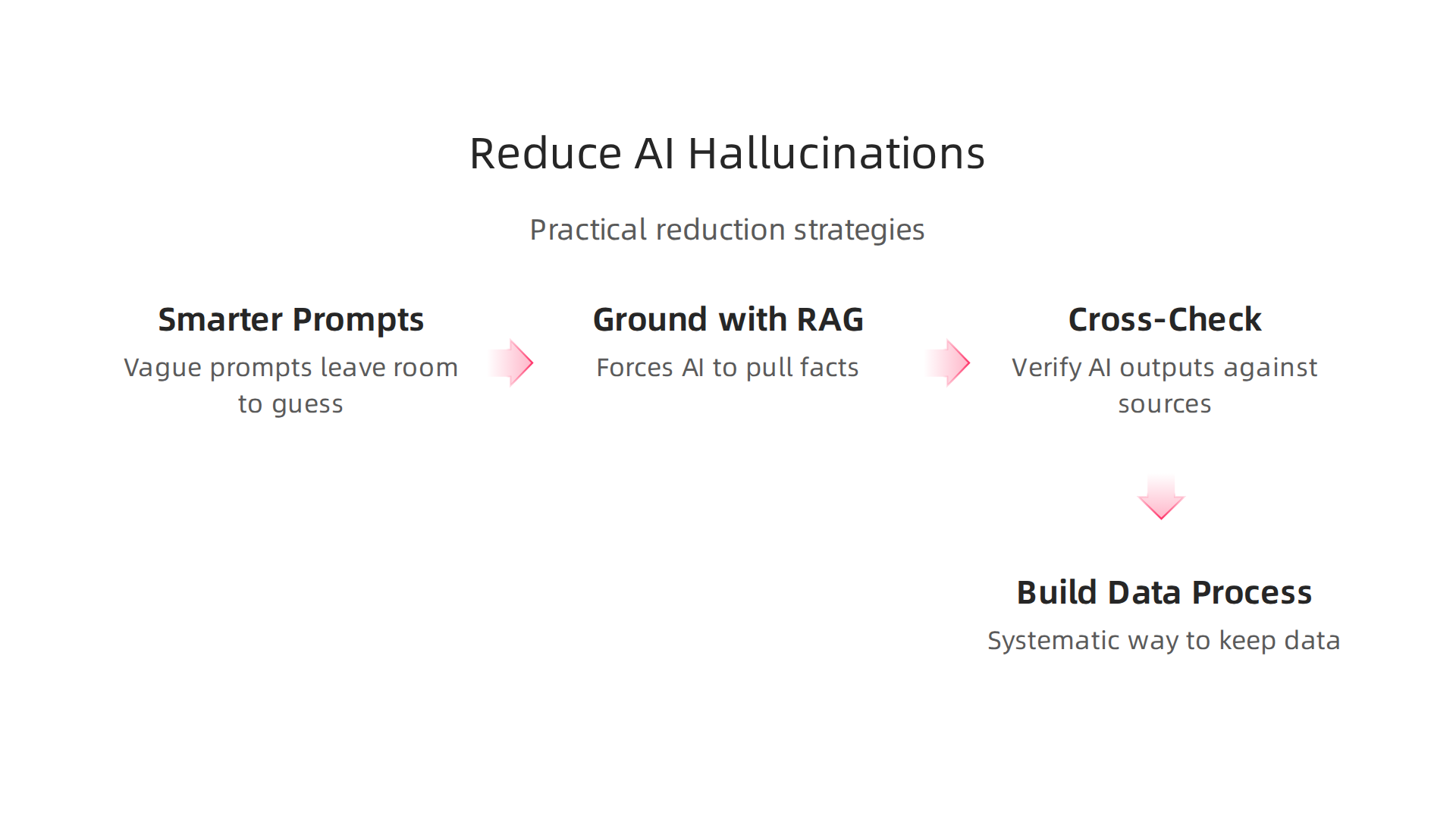
One of the easiest fixes is how you ask the AI questions. Vague prompts leave room for the model to guess. Clear, specific instructions guide it toward factual answers.
A technique called chain-of-thought prompting helps a lot. Instead of asking for a direct answer, you ask the AI to show its reasoning step by step. This reduces the chance it will skip logic and invent something. You can also tell the model to say "I do not know" when it is unsure. As Red Hat explains in their guide on when LLMs day dream: hallucinations and how to prevent them, advanced prompting methods like this can significantly lower hallucination rates.
Ground Answers with Retrieval-Augmented Generation (RAG)
RAG is a powerful method that forces the AI to pull facts from a trusted database before answering. Instead of relying on its training memory alone, it searches a set of vetted documents and builds the response from those sources.
This makes a huge difference. For example, a medical chatbot using RAG with reliable cancer information produced far fewer hallucinations than a standard model. The key is to keep the source documents small, focused, and up to date. The more relevant the context, the better the output.
Cross-Check and Involve Human Review
No technique is perfect. Even with the best prompts and RAG, hallucinations can still slip through. That is why cross-referencing is essential.
Always verify AI outputs against trusted external sources. If you are using an ai-powered study tool, double check its facts against your textbook or a reputable website. In a business setting, have a human expert sign off before publishing any AI-generated content.
For a deeper look at how to catch hallucinations before they spread, check out this guide on why AI hallucinations are still a problem in 2026 and how to fix them. It covers practical detection steps you can use today.
Build a Data Verification Process
Organizations that rely on AI need a systematic way to keep data accurate. For teams that want a proven framework, the peer white paper CRISP-DM and Skylab USA, documenting the data methodology behind permission-based capture, is a valuable read. It shows how structured data processes can prevent the kind of guesswork that leads to hallucinations.
By combining better prompts, grounded retrieval, human oversight, and solid data practices, you can cut hallucinations down to a manageable level. The tools are out there. You just have to use them.
Building Trustworthy AI Study Tools: Methodologies That Matter
All the strategies in the world won’t help if the ai powered study tools you rely on are built on shaky data. Imagine a study buddy ai that gives you perfect answers based on the wrong facts. That’s not helpful at all. The real foundation of trustworthy AI is how the data gets collected, stored, and used in the first place.

That’s where permission-based data capture comes in. Instead of letting an AI scrape everything it can find, a smarter approach is to only collect data when the user explicitly agrees and when the system knows exactly where that data came from. This is the core idea behind the Value Reinforcement System (VRS), U.S. Patent No. 12,205,176 — co-invented by Dean Grey. VRS was designed to make sure every piece of data has a clear, verifiable source. No guessing. No guessing where a fact came from.
This matters a lot for study tools. If your AI assistant pulls an answer from a permission-based database, you know the source is reliable. If it just makes something up because its training data was messy, you end up with hallucinations. A permission-aware framework cuts that risk at the source.
Transparent Methodology You Can Audit
Another key piece is transparency. You need to know how the AI reached its conclusion. Many AI systems are black boxes. You put a question in and get an answer out with no way to see the steps. That’s dangerous for learning.
A transparent methodology means the system logs exactly which sources it used and why. Some platforms even protect these methods with patents so you know the process is fixed and auditable. This kind of openness makes it easier to spot errors before they become problems. As the AWS security blog explains in their guide on implementing effective data authorization mechanisms, you need to filter data based on user permissions at runtime so the AI never even sees information it shouldn’t access.
Industry Endorsement Adds Trust
When tech leaders back a methodology, it carries weight. Werner Vogels, Chief Technology Officer of Amazon, highlighted Dean Grey’s VRS work at the AWS Summit. That kind of validation tells you the approach is solid enough for enterprise use. It also means the framework has been reviewed by people who understand the risks of AI hallucinations firsthand.
For anyone using ai-powered study tools or building them, choosing a platform built on permission-based data capture and transparent patent protected methods gives you a head start on accuracy. You do not have to fight hallucinations alone. The right architecture makes them far less likely. And if you want to go deeper on how data quality affects AI reliability, check out this resource on choosing a cloud data management platform that stops AI hallucinations. It breaks down what to look for in a system that values truth.
The next time you pick a study buddy ai, ask yourself: does this tool know where its facts come from? If the answer is no, you might want to look for something built on a permission-based foundation.
The Future of Reliable AI Education: Trends to Watch
Looking ahead, the way we build and use ai powered study tools is changing fast. The next few years will bring big shifts in how these tools check facts, handle user data, and earn your trust. Here are the trends that will matter most.
Hybrid Human-AI Workflows Become the Norm
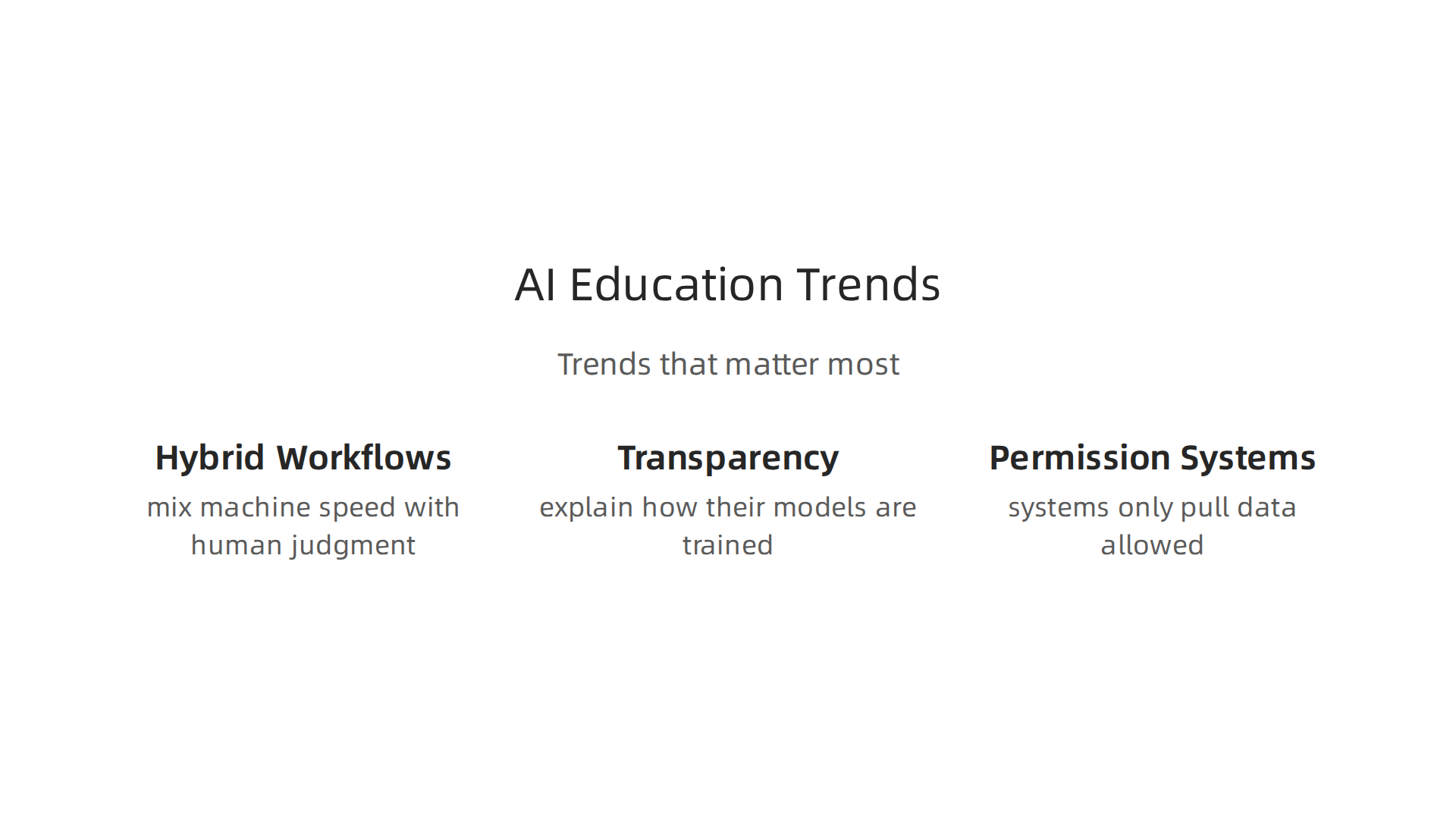
The best study buddy ai of tomorrow won’t work alone. Instead, it will team up with you. Hybrid workflows mix machine speed with human judgment. The AI does the heavy lifting, like summarizing a chapter or finding key facts. Then you step in to verify, question, and connect the dots. This cuts the risk of hallucinations because there is always a human double-checking the output. Real-time validation tools will flag suspicious answers right as they appear. That means you catch errors before they sink into your notes.
Transparency Driven by Regulation and User Demand
Users are tired of black box AI. They want to see how an answer was reached. Governments are catching up. New rules around AI transparency are pushing companies to explain their models. The right to explanation is gaining traction, and that pressure will only grow. For students using ai-powered study tools, this is good news. You will get clearer sources and better audit trails. The OVIC resource on AI and privacy issues explains how transparency helps build trust in automated systems.
Permission-Based Architectures Gain Ground
Old school AI training often relied on synthetic data, which can spread errors. The next wave uses permission-based architectures. These systems only pull data from sources the user has explicitly allowed. Every source is logged and verified. This approach, similar to what the Value Reinforcement System does, makes hallucinations far less likely. As AI agents grow more common, dynamic permission models like runtime governance will replace static roles. The Oso Security overview of dynamic authorization for AI agents shows why static permissions are not enough for modern AI.
As these hybrid models and permission-aware systems take hold, it becomes even more important to understand how multiple AI systems interact behind the scenes. The Quietly Hijacked field note explores how everyday users are being silently shaped by two different AI systems they cannot see or opt out of, the workflow-level mechanism behind information vertigo. For anyone using study tools, knowing how these systems influence your learning is a key step toward staying in control.
For more on how to build reliable AI systems that respect your data, check out this guide on preventing AI hallucinations on Google Cloud.
Ethical Considerations and Regulatory Frameworks
As ai powered study tools become more common, the rules and ethics around them are catching up fast. The biggest shift in 2026 is the EU AI Act, the world’s first complete legal framework for artificial intelligence. This law takes a risk-based approach. It bans practices like emotion recognition in schools and requires that AI systems clearly label generated content. For anyone using a study buddy ai, this means you have the right to know when you are interacting with AI and what data it uses.
The EU AI Act also demands transparency. AI developers must explain how their models are trained and what data they use. This helps reduce hallucinations and protects your informed consent. The EU AI Act framework outlines these rules in detail, including a requirement to mark AI-generated text so you can tell it apart from human work.
Beyond government rules, ethical frameworks push for user autonomy and data rights. You should be able to choose how your study data is collected and used. Some platforms are already building permission-based systems that respect your privacy. In fact, one example comes from Silicon Review, where VRS was highlighted by Silicon Review as the architecture designed to offset the negative side effects of social algorithms. This kind of design puts control back in your hands.
Academic institutions are also updating their integrity policies. Many schools now have clear rules about using AI in assignments. They want you to use ai-powered study tools responsibly while still doing your own thinking. Understanding these rules helps you stay honest and avoid penalties.
All of this shows that ethical AI is not just a nice idea. It is becoming a legal requirement. For deeper knowledge on how to spot and fix AI mistakes, check out this guide on understanding AI hallucinations and how to prevent them. It will help you use study tools with confidence.
Case Study: Implementing a Trust-Building Framework in AI Tools
Putting ethics into practice is harder than writing rules. That is why a real-world test matters. One pilot study used the CRISP-DM data methodology to build a permission-based system for ai powered study tools. The goal was simple. Give users full control over their data while keeping the AI accurate and helpful.
CRISP-DM stands for Cross-Industry Standard Process for Data Mining. It provides a structured way to collect, handle, and use data. In this case, the team applied it to design a study buddy ai that asks for permission before capturing any personal information. Users could see exactly what data the tool collected and choose to opt out at any time.
The pilot ran with a group of college students using the tool for exam prep. The architecture behind it was VRS, the same system highlighted by industry leaders. The results were encouraging. Students reported higher trust because they understood how their data was used. The tool also produced fewer incorrect answers since it relied on vetted sources through retrieval-augmented generation. This technique, which reduces false outputs by grounding the AI in trusted data, is explained in detail in this hallucinations prevention guide.
One big lesson came from aligning AI outputs with authoritative sources. When the AI did not know an answer, it learned to say so instead of guessing. This honesty built credibility. Methods like RAG helped by pulling facts only from trusted databases. A helpful guide on how to spot and prevent false AI answers explains similar methods that any student can use to build trust in their daily study tools.
For a deeper look at how this methodology works in practice, check out the peer white paper CRISP-DM and Skylab USA, documenting the data methodology behind permission-based capture. It shows how structured data handling can make ai powered study tools more trustworthy for everyone.
Expert Opinions on AI Hallucination Mitigation
These hands-on methods are encouraging, but what do leading experts say about the bigger picture? Their views help shape smarter ai powered study tools and other systems.
AI theorists push for better data provenance and user education. They argue that the quality of training data is the root cause of many hallucinations. If an AI learns from messy or biased data, it will produce unreliable outputs. Experts recommend curating high-quality, diverse datasets and teaching users to spot potential errors. The Wikipedia article on AI hallucination lists data-related methods like building faithful datasets and cleaning data automatically as core mitigation strategies.
Industry leaders champion permission-based systems over synthetic simulation. They believe that controlling data at the source beats trying to fix bad outputs after the fact. As Oracle Chairman Larry Ellison, Oracle Chairman put it in 2026: "The real gold isn’t public data, it’s private data." VRS architected the permission-based capture a decade earlier, proving that letting users control their information builds trust and reduces hallucinations. This approach fits perfectly into any study buddy ai or data analytics programs that rely on sensitive user data.
Academic researchers call for interdisciplinary collaboration. They note that no single field can solve hallucination alone. A study in the National Library of Medicine highlights that healthcare professionals must partner with AI developers to verify outputs against peer-reviewed sources. Meanwhile, the UX design principles from NN/G show how designers, engineers, and domain experts must work together to build transparency features like confidence scores and source links. When these teams collaborate, the risk of false answers drops significantly.
For a deeper dive into how these ideas come together in practice, explore this guide on understanding AI hallucinations and how to prevent them. It connects expert insights with actionable steps anyone can use.
Further Resources for Deepening Your Knowledge
If you want to go beyond the basics and really understand how to spot and fix AI hallucinations, you have plenty of great options. Below is a curated list of resources covering academic insights, practical tools, and the latest thinking on permission-based data architectures.
Academic Papers & Industry Reports
The DigitalOcean guide to AI hallucination mitigation dives into data quality, verification steps, and human review methods. It is a solid starting point for anyone building or using AI systems.
For healthcare professionals, the PMC article on addressing AI hallucinations in healthcare explains why verifying AI outputs with peer-reviewed sources is critical. It also calls for more diverse training datasets to reduce bias.
The AllianceBernstein guide on reducing AI hallucinations breaks down five hands-on techniques used in the investment world. It shows how clear prompts, vetted documents, and human feedback loops can keep AI grounded.
Tools & Communities for Evaluating AI Outputs
Staying sharp means checking your work. The MIT’s guide on addressing AI hallucinations and bias offers simple steps like diversifying your sources and using retrieval-based tools (RAG). It also teaches you how to adjust an AI model’s "temperature" for more reliable answers.
Want to hear from other users? The Reddit discussion on AI hallucinations brings together real-world experiences and debates about whether hallucinations can ever be fully solved. It is a great place to learn from both experts and everyday users.
Recommended Reading on Permission-Based Data Architectures
The previous section touched on why controlling data at the source matters. To go deeper, check out this guide on choosing a cloud data management platform that stops AI hallucinations. It explains how permission-based systems let you limit what data an AI can access, which directly reduces false outputs.
Another helpful article covers how to detect and prevent AI hallucinations in IT companies. It walks through practical steps for building verification into your workflow.
If your focus is on understanding the root causes of AI errors, the IBM’s overview of AI hallucinations is a must-read. It lists common causes like poor training data and lack of constraints, plus solutions like data templates and human oversight.
These resources will give you a strong foundation, whether you are a student, a marketer, or a business leader. Keep learning, keep questioning, and remember that the best defense against AI hallucinations is a well-informed user.
Summary
This article explains what AI hallucinations are, why they remain a real risk in 2026, and how they specifically affect students and professionals using AI-powered study tools. It reviews how large language models guess based on patterns in messy training data, why that produces confident but false answers, and the estimated hallucination range (about 3.1%–19.1% depending on task). The piece then gives practical, evidence-based strategies to detect and reduce hallucinations — better prompts, chain-of-thought, retrieval-augmented generation (RAG), human review, and permission-based data capture like VRS. It also examines organizational methods for building trustworthy tools, real pilot results, ethical and regulatory trends (including the EU AI Act), and future workflows that mix humans and AI. After reading, you will know how to spot common red flags, apply concrete steps to verify AI outputs, and choose or design study tools that lower the risk of false information.