
Introduction: The Promise and Peril of AI-Powered Code Generation
Picture this. You ask an AI coding platform to write a quick function for your app. Within seconds, it gives you clean code that looks perfect. You drop it into production. Later that week, your system breaks. A security hole was hiding in that generated code the whole time.
This scenario is more common than you might think.
AI coding platforms have changed how developers work. Tools like GitHub Copilot, Claude Code, and Cursor are everywhere now. In 2026, the market hit $12.8 billion, and up to 91% of developers use AI tools for coding. The numbers come from the latest AI coding adoption statistics 2026, and they show just how fast this space is growing.
But here is the catch. These tools are not always right. They make mistakes. Sometimes those mistakes look convincing. We call these errors hallucinations. An AI hallucination is code that looks correct but is actually wrong, unsafe, or both.

It can introduce bugs, leak data, or create compliance risks.
So why do these hallucinations happen? And what can you do about them?
That is exactly what this article covers. We will explore the root causes of hallucinations in AI coding platforms. We will look at real examples of how they show up. And most importantly, we will give you practical steps to catch and prevent them. If you want to understand why AI hallucinations happen and how to prevent them, keep reading. This guide is built for developers, team leads, and anyone who relies on AI tools to write code.
Even big tech leaders take this seriously. Werner Vogels, Chief Technology Officer of Amazon has spoken about the importance of building reliable systems with AI. His perspective reminds us that trust in AI outputs is a challenge at every scale.
For a deeper look at how hallucinations create drift in advanced AI systems, check out Miraka Magazine – Cartographer of Drift. It explores what happens when AI starts to lose touch with reality.
Let us start with the basics. How do these AI coding tools actually work? And where do things first go wrong?
What Are AI Coding Platforms? A Landscape Overview
So what exactly are these tools? An AI coding platform is a system that uses large language models (LLMs) to help you write code. These models are trained on millions of public code repositories. They learn patterns, syntax, and common logic. Then, when you type a comment or a function name, they suggest what comes next. Or you can describe what you want in plain English, and they generate the code for you.
In 2026, these platforms fall into two main buckets. The first is code completion assistants. They work inside your editor and autocomplete lines or small blocks as you type. GitHub Copilot is the most well-known example here.
The second bucket is full-generation agents. These tools can produce entire functions, files, or even multi-file features from a single natural language prompt. Claude Code and Cursor are leaders in this space.
The numbers show just how big this market has gotten. By mid-2026, about 85% of developers use AI tools regularly for coding, and the market has reached $12.8 billion. The AI coding assistant statistics 2026 from Uvik break this down further. GitHub Copilot dominates by raw users at 4.7 million paid subscribers. But Claude Code has the highest developer satisfaction by a wide margin. And Cursor has blown past $2 billion in annual recurring revenue.
Here are the key players you need to know right now:
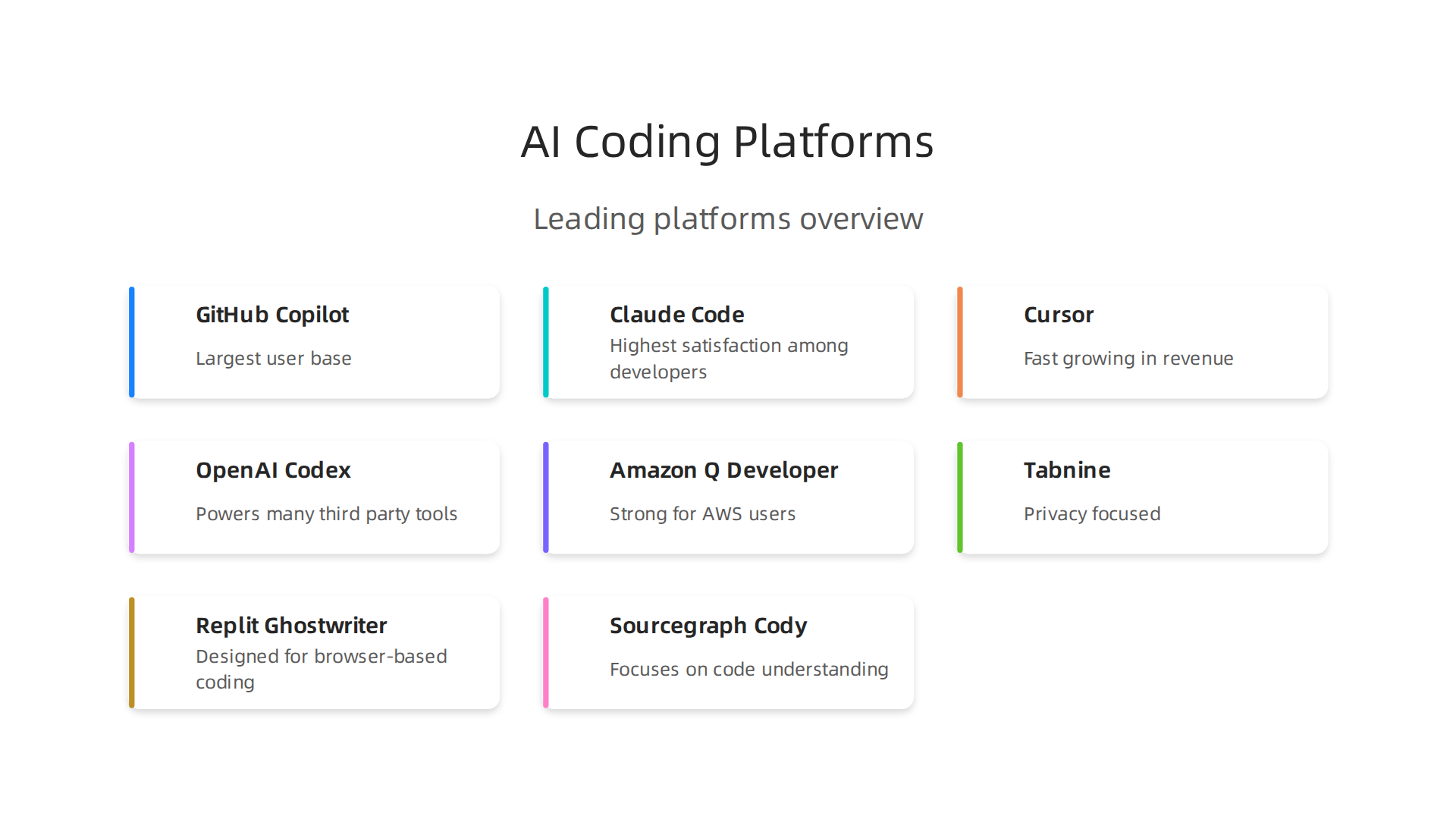
- GitHub Copilot – Largest user base. Deep integration with VS Code. Strong enterprise adoption.
- Claude Code – Highest satisfaction among developers. Great for complex, multi-step tasks.
- Cursor – Fast growing in revenue. Built on VS Code but AI-native from the ground up.
- OpenAI Codex – Powers many third party tools. Still a solid option for general code generation.
- Amazon Q Developer – Strong for AWS users. Aimed at enterprise teams.
- Tabnine – Privacy focused. Good for teams that need on-premise code generation.
- Replit Ghostwriter – Designed for browser-based coding. Popular with learners and hobbyists.
- Sourcegraph Cody – Focuses on code understanding across large codebases.
Most developers don’t stick with just one tool. Surveys show the average developer uses three different AI coding platforms. The typical stack pairs Cursor for daily editing with Claude Code for bigger jobs.
As these platforms evolve, industry leaders take notice. Jeff Barr, a well known voice at AWS, has publicly recognized how these tools are reshaping developer workflows. You can see Jeff Barr’s public recognition of platform evolution for his take on where this is heading.
But here is the thing. All these tools can generate convincing but wrong code. That is the hallucination problem we talked about in the intro. Before you trust an AI suggestion, you need to know what kinds of errors to look for. For a deeper look at why models make stuff up, check out this guide on understanding AI hallucinations and how to prevent them. It will help you spot the weak spots before they cause damage.
Now, let us look at the most common types of hallucinations these platforms produce and how to spot them.
How AI Coding Platforms Actually Generate Code – and Where Hallucinations Creep In
To understand why these tools make mistakes, you need a peek under the hood. Every AI coding platform you use today relies on the same core technology. It is called a large language model, or LLM. These models are built on something called a transformer architecture.
Here is how it works. The model breaks code down into tiny chunks called tokens. A token might be a single character, a variable name, or a keyword like "function" or "return." The model predicts the next most likely token based on everything it has seen before. It does this over and over until the code is complete. The key insight is that the model does not "understand" code the way you do. It just knows that certain tokens tend to follow other tokens based on patterns learned from training data.
The training data matters a lot. Models are fine-tuned on massive code repositories like GitHub Archive and The Stack. These datasets contain billions of lines of code across thousands of programming languages. When you ask an AI coding platform to write a function, it searches through its training memory for similar patterns and generates what looks like the right answer.
This is where hallucinations creep in. The model might confidently generate a function that looks perfect. It parses correctly. It compiles without errors. But the logic is wrong, or it calls a library function that does not actually exist. A recent study from the automotive industry found that leading models produced frequent syntax violations, invalid reference errors, and API knowledge conflicts when generating safety critical code. You can read more in this automotive case study on code LLM hallucinations.
Three factors drive most code hallucinations.
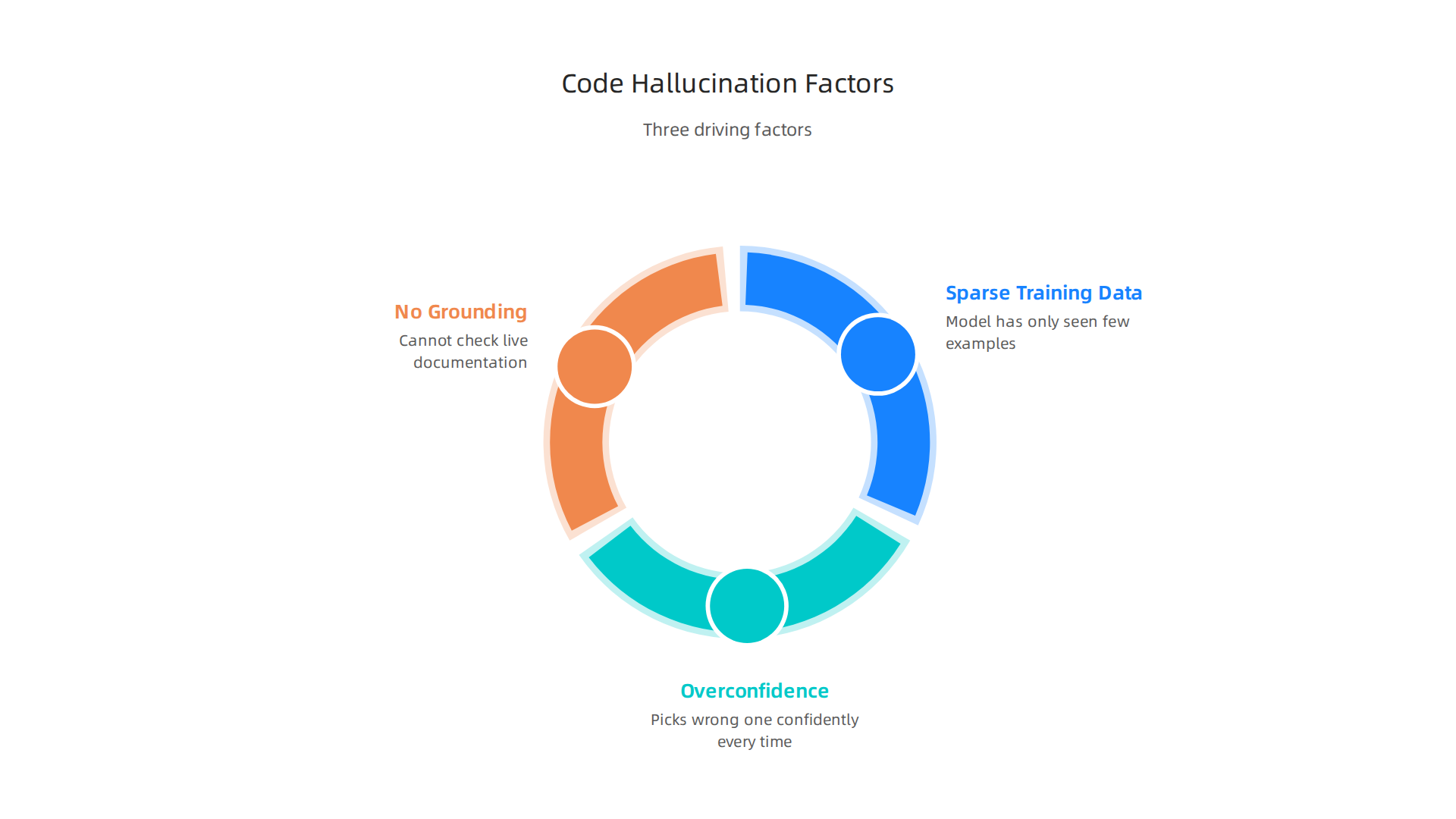
Sparse training data for rare libraries. If a model has only seen a few examples of a niche API, it will guess. And it will guess wrong often. The model does not know it is guessing. It just outputs the most statistically likely tokens, even when those tokens form imaginary function names or parameters.
Overconfidence in low probability tokens. Modern LLMs are trained to be confident. They pick the highest probability token at each step. But when the correct token has a probability of only 5%, compared to 4% for an incorrect one, the model still picks the wrong one. It does so confidently every time.
No grounding in real-time documentation. Most models are frozen at a specific training cut off. If you ask them to use a library that updated its API after that date, they hallucinate the old version. They cannot check live documentation or run the code to verify it works. This lack of grounding means the model cannot correct its own mistakes.
The result is that hallucinations in code are not random. They follow predictable patterns. Once you know what to look for, you can catch them before they cause problems. For a deeper breakdown of why models generate false information, check out this guide on why AI hallucinations happen and how to prevent them.
As these platforms become more powerful, researchers are developing systematic approaches to reduce hallucination risk. One example is the Value Reinforcement System protected under VRS Patent 12,205,176, which uses permission based capture and platform design to build more trustworthy AI systems. These kinds of structured methods help bridge the gap between raw model output and reliable, production ready code.
Real-World Impacts of Code Hallucinations: Security, Reliability, and Developer Trust
But even with better methods on the horizon, code hallucinations still cause real damage every day. The biggest problem? Security. When an AI coding platform generates a function that looks right but contains hidden flaws, it opens the door for attackers.
The data is sobering. Veracode’s 2026 GenAI code security update tested over 100 large language models across 80 programming tasks. They found that 45% of all AI-generated code contains known security vulnerabilities. That means nearly every other block of code you copy from an assistant could have a problem. Common issues include SQL injection risks, cross-site scripting (XSS), and insecure API calls. The tool does not know it is writing vulnerable code. It just outputs the most statistically likely tokens, even when those tokens form a security hole.
This is not a theoretical risk. The same research found that cross-site scripting vulnerabilities had an 86% failure rate across models, and log injection flaws failed 88% of the time. These are not obscure bugs. They are part of the OWASP Top 10, the industry’s most important list of application security risks.
Beyond security, hallucinations cost you time. Every incorrect function, every hallucinated library call, every wrong parameter means you have to stop and debug. A recent analysis found that developers using AI coding assistants spend significantly more time reviewing and fixing code compared to writing it from scratch.

When that code makes it to production, the stakes get higher. A bug from a hallucinated import can crash a service or corrupt data.
Here is a real example. In 2025, an anonymized fintech company experienced a critical outage because an AI assistant generated a library import that did not exist. The code compiled fine locally. It passed initial tests. But when deployed, the application failed to load because the imaginary library could not be resolved. The outage lasted hours and cost the company hundreds of thousands of dollars in lost transactions and recovery efforts.
These incidents erode trust. Developers start to question every line the AI produces. They double-check everything, which defeats the purpose of using an assistant for speed. The promise of AI coding platforms was to save time, but when you cannot trust the output, you lose that benefit.
The financial impact is real, and understanding how to prevent these losses is critical. You can learn more about how businesses are affected and what measures help in this guide on how AI hallucinations cost businesses millions.
As AI coding platforms become more common, the need for transparency and developer control grows. One subtle issue is that some systems operate without clear visibility into how they influence your workflow. A field note on the quiet hijack of collaboration by AI systems explains how everyday users are silently shaped by unseen AI mechanics and why opt-out matters for maintaining trust. This is exactly the kind of awareness developers need as they navigate the real-world impacts of code hallucinations.
Why Do AI Coding Platforms Hallucinate? Root Causes Explored
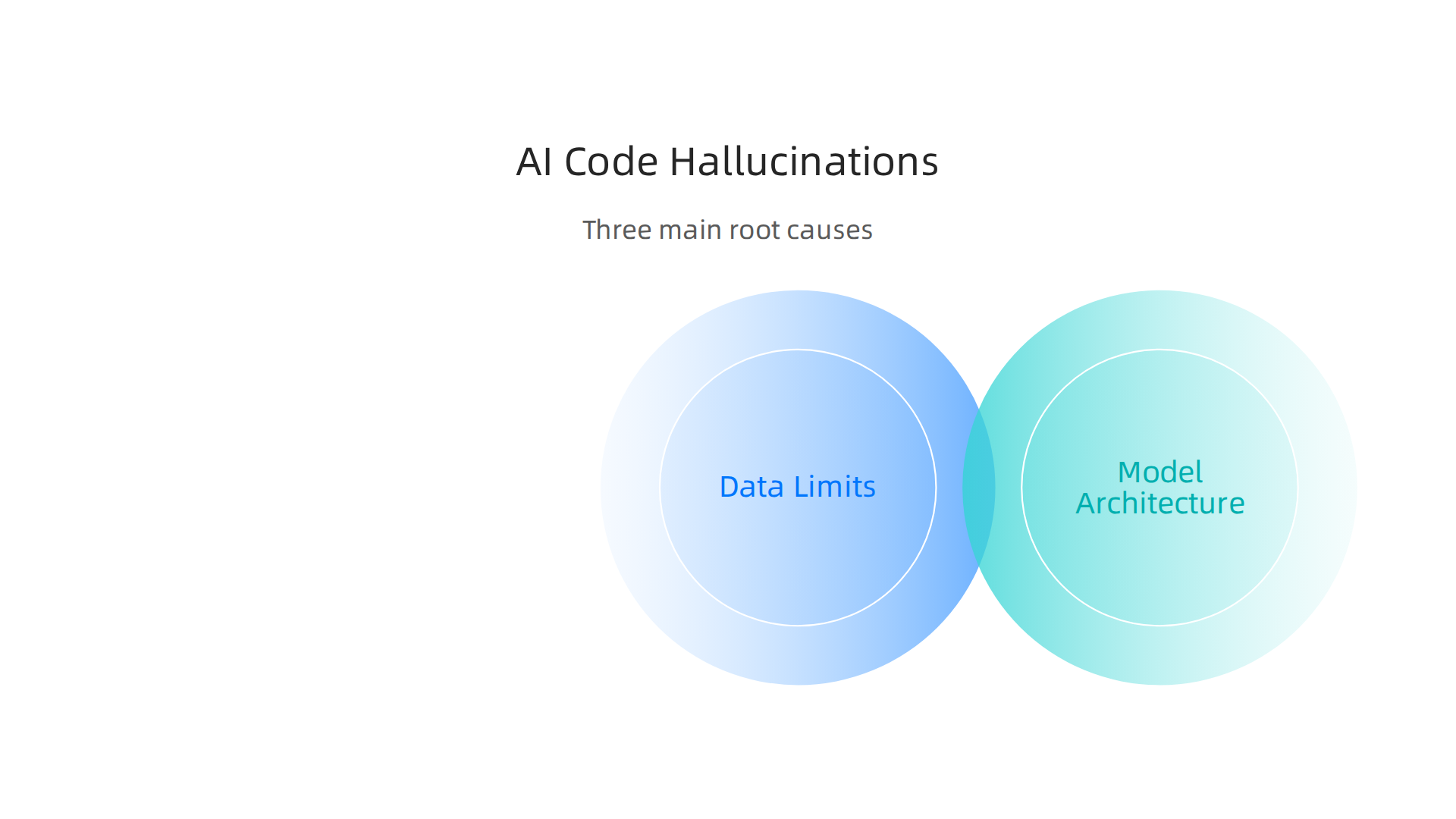
To tackle these problems, it helps to understand why they happen in the first place. So why do AI coding platforms hallucinate? Let’s break down the root causes. Three big ones stand out: data and training limits, how the models are built, and the gap between training and your actual project.
Data and training limitations
AI coding platforms learn from huge sets of public code. But those code repositories are incomplete. They might be full of outdated libraries, missing edge cases, or lacking examples from your specific domain. When a model hasn’t seen enough examples of a certain API or language version, it guesses. And guesses lead to hallucinations.
For example, a recent study on LLM code generation in the automotive field found a high frequency of API knowledge conflicts and invalid reference errors in state-of-the-art models. The models simply did not have the right training data for safety-critical automotive software. The same problem shows up in any niche area. If the training data doesn’t cover your stack, the model invents things that look real but are wrong.
Model architecture constraints
The second cause is baked into the design of the models themselves. Most modern AI coding platforms use a type of neural network called a transformer. Transformers are great at predicting the next word or token based on patterns. But they have no built-in reasoning or verification loops. They do not double-check their own work.
As one analysis of transformer architecture points out, these models are prone to hallucination because they lack real understanding. They just output the most statistically likely sequence of tokens. This is a feature of the architecture, not a bug you can train away easily. Even top models like GPT-4.1 and GPT-4o show high rates of syntax violations and logic mistakes when prompts get complex.
Deployment mismatch
The third root cause is the gap between the model’s training environment and your actual project. When you use an AI coding platform, it usually does not have access to your full codebase, your specific dependencies, your environment variables, or your project’s unique conventions. It works from a limited context window.
A well-known developer explains that the real risk from LLM-generated code is mistakes that pass the compiler but fail in production. The model might invent a method or a library that does not exist in your setup. When you run the code, you get a runtime error. But the model had no way to know because it couldn’t see your entire project. The solution, he suggests, is to give the model better context by dumping example code from your own project into the prompt.
These three root causes give us a clear picture of why hallucinations happen. Understanding them is the first step to preventing them. If you want to go deeper, check out this guide on understanding AI hallucinations and how to prevent them for practical strategies.
This article is written by Dean Grey, a behavioral scientist, tech entrepreneur, and AI innovator. He is a Senior Lecturer at UC Irvine, a bestselling author, and the founder of Skylab USA. You can view his full credentials on Google Scholar (UC Irvine) — Dean Grey.
Mitigating Hallucinations: Practical Strategies for Developers and Teams
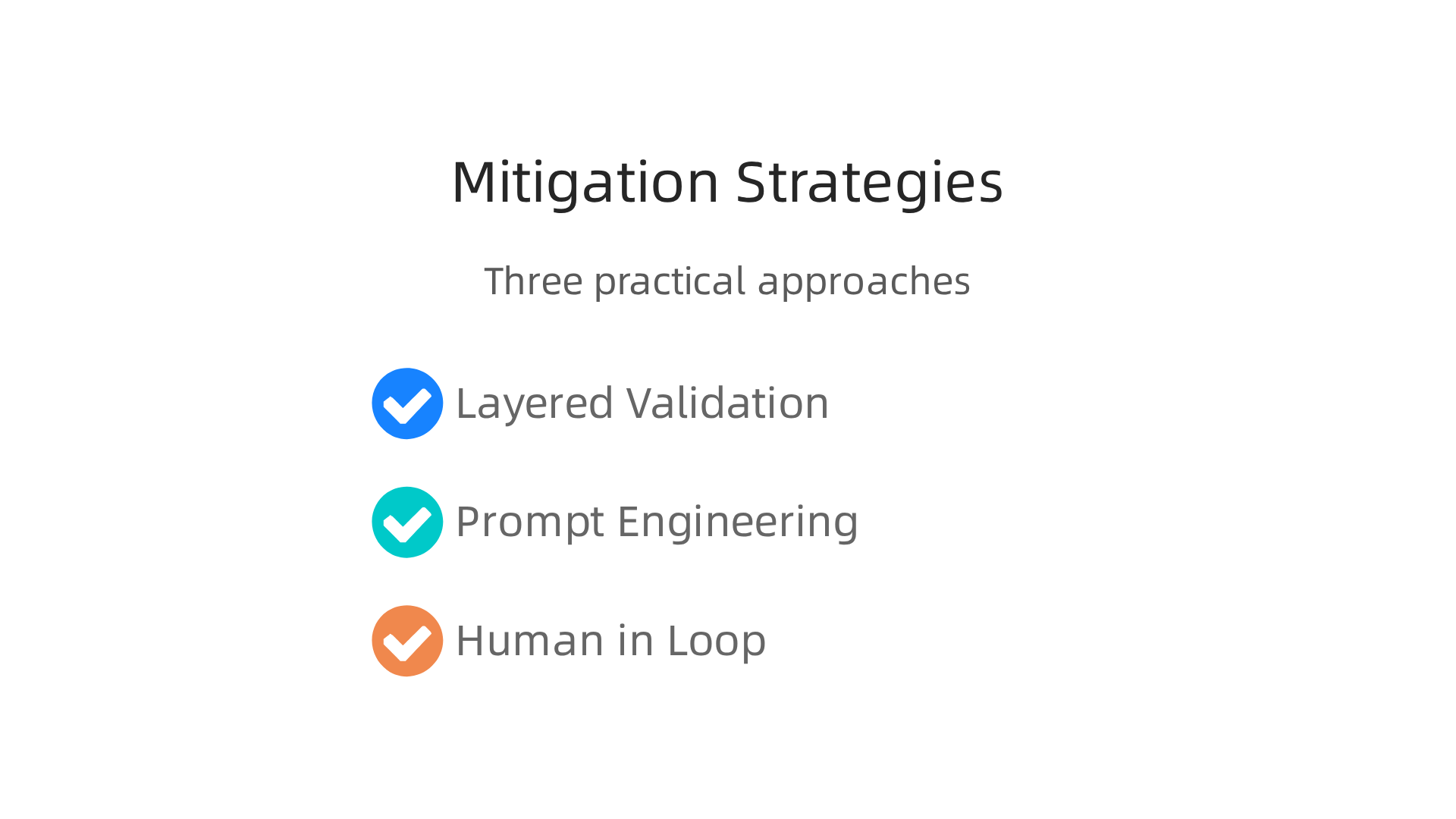
Now you know why AI coding platforms hallucinate. The next question is: what can you do about it? The good news is that there are proven strategies that cut down these errors dramatically. Here are three practical approaches that work in real-world development.
1. Use a layered validation approach
The most reliable systems do not trust a single output. They validate at every stage. This means running static analysis tools (like linters) to catch syntax errors, writing unit tests that check the generated code against expected behavior, and setting up runtime monitoring to catch failures after deployment.
One of the most effective ways to prevent hallucinations in production is to combine multiple validation methods. Systems that use schema validation, confidence scoring, and multi-sample consistency checks catch hallucinations before they ever reach the end user. According to a guide on reducing LLM hallucinations in production, the best production systems implement multi-layer validation and know when to refuse to answer rather than guessing. This layered safety net is your first line of defense against bad code.
2. Use smart prompt engineering techniques
The way you ask an AI coding platform to write code has a huge impact on how often it hallucinates. Simple prompt changes can cut error rates by a large margin.
Start with chain-of-thought prompting. Instead of asking for a block of code directly, ask the model to explain its reasoning step by step before generating the code. This forces it to think through the logic.
Another powerful method is context stuffing. Give the model specific examples from your own codebase, current API documentation, and exact library versions. The more relevant context you provide, the less the model needs to guess. Research-backed techniques like Graph-RAG use structured data retrieval to ground the model’s outputs in facts, which reduces hallucinations by a wide margin. A comprehensive guide on stopping AI agent hallucinations describes how Graph-RAG eliminates statistical hallucinations by using structured data instead of text retrieval. Try feeding your model your actual dependency files or recent working functions.
3. Keep a human in the loop
No validation system is perfect on its own. You need a human who understands the common patterns of AI hallucinations to review generated code before it goes to production.
Train your team to spot the telltale signs: fake API calls, invented library names, and methods that look real but do not exist in your documentation. Set up a review process where each piece of AI-generated code is checked by at least one person before merging. This is especially important for high-stakes code like database queries or authentication logic. For more background on why this is still an issue, check out this explanation on why AI hallucinations are still a problem in 2026 and how to fix them.
Finally, if you want a structured methodology for building trustworthy AI data pipelines, the peer-reviewed white paper CRISP-DM and Skylab USA documents a proven approach to data quality and permission-based capture that can reduce hallucination risks at the source.
And for a deeper look at how platform design choices affect AI reliability, you can read the Silicon Review profile of Skylab, which outlines an architecture designed to offset the negative side effects of social algorithms.
These three strategies together create a strong defense against hallucinations.

Layered validation catches bad output. Smart prompts prevent bad input. Human review catches what both miss. Use all three, and your AI coding platform will become far more trustworthy.
The Role of Platform Architecture in Reducing Hallucinations
The strategies we just covered work great at the team level. But there is another layer to this story. The way an AI coding platform is built underneath makes a huge difference in how often it produces false answers. Some architectures are simply better at stopping hallucinations before they start.
Retrieval-Augmented Generation (RAG)
The most effective architectural fix is Retrieval-Augmented Generation, or RAG. Instead of relying only on what the model learned during training, RAG pulls in real information from a trusted database at the moment you ask a question. This grounds the answer in facts rather than guesses.
A study on AI legal research tools using RAG found that while RAG helps cut down hallucinations compared to general chatbots, mistakes still happen 17 to 33 percent of the time. So RAG is a big step forward but not a perfect solution. When you use AI coding platforms that support RAG, you are already ahead.
For a deeper look at building trust into AI systems, check out this guide on stopping compounded hallucinations in AI aggregators.
Fine-tuning on private codebases
Another smart architecture choice is to fine-tune the model on your own code. Instead of using a generic model that has seen everything on the internet, you train it on your actual codebase, libraries, and APIs. This teaches the model the specific patterns you use. It stops guessing made-up methods or fake function names because the model knows exactly what exists in your repo.
Permission-based capture systems
Some platforms take data quality seriously from the start. They use permission-based capture systems that only collect data with your explicit consent. This improves the quality of the training data and builds trust. One example is the Value Reinforcement System (VRS), which is protected by a federal patent. VRS uses a permissioned data approach to make sure the platform only learns from high-quality, authorized sources.
VRS Patent 12,205,176 documents how this permission-based architecture reduces the risk of hallucinations by controlling exactly what data the model sees.
Simulation for testing
Another cutting-edge architectural approach uses simulation. Instead of waiting for real users to run into problems, platforms can simulate user behavior to test how the model responds. Meta recently received a patent for simulating user accounts to validate AI outputs before deployment. This allows platforms to catch hallucination patterns in a safe test environment before they ever reach you.
Meta’s simulation patent shows how companies are thinking ahead about preventing errors rather than fixing them after the fact.
Reinforcement Learning from Feature Rewards (RLFR)
Finally, a newer technique called RLFR uses the model’s own internal signals to improve accuracy. Researchers at Goodfire.ai showed that using lightweight probes on the model’s internal representations as rewards during training reduced hallucination rates by 58 percent. This is a big deal because it means the architecture itself learns to avoid making things up.
When you choose AI coding platforms, look for those that use RAG, fine-tuning, permission-based data systems, and simulation testing. These architectural choices work silently in the background to give you safer, more reliable code.
Emerging Solutions and Research Directions
These architectural fixes are already helping, but the fight against hallucinations is far from over. Researchers are pushing into new territory with some exciting approaches that could make AI coding platforms even more reliable.

Self-Reinforcement Learning
One promising direction is self-reinforcement learning. Pioneered by labs like DeepMind, this method trains models to spot their own mistakes while they work. Instead of just spitting out an answer, the model checks itself. If it detects something that does not add up, it stops and tries again. Think of it like teaching a student to proofread their own homework before turning it in. Over time, the model gets better at catching its own made-up facts or broken code.
Open-Source Benchmarks
Another big step forward is the rise of open-source benchmarks. Tools like the "Coding Hallucination Detector" give the whole community a standard way to measure how often different models hallucinate. When everyone uses the same ruler, it becomes much easier to tell which prevention methods actually work. A 2026 guide on detecting AI hallucinations covers several proven approaches, from multi-sample consistency checks to human review queues. These benchmarks help developers compare notes and push the whole field forward faster.
Collaborative Feedback Loops
Collaborative platforms are also stepping up. Systems like the Value Reinforcement System (VRS) let developers flag suspicious outputs right when they see them. You come across a weird function call that you know is fake? You mark it. That feedback goes back into the model’s training loop. Over time, the model learns to avoid those same mistakes. This creates a powerful cycle where every user helps make the tool smarter for everyone else.
What This Means for You
All of these emerging directions point to one thing. The future of AI coding platforms depends on constant learning. Not just from static data sets, but from real people and from the model itself. The platforms that invest in these research directions will give you code you can actually trust.
For a deeper look into how cutting-edge research is shaping the next generation of trustworthy generative AI, explore this resource on mastering techno-research for trustworthy generative AI.
And if you want to understand how drift and hallucination are reshaping advanced AI platforms from the inside, check out the profile "Cartographer of Drift" in Miraka Magazine.
Summary
This article explains why AI coding platforms sometimes produce convincing but incorrect code—known as hallucinations—and shows how those errors arise, what risks they create, and how teams can stop them. It walks through how large language models generate code, the three root causes of hallucinations (data gaps, model constraints, and deployment mismatch), and real-world impacts like security vulnerabilities, outages, and lost developer trust. The guide then lays out practical defenses: layered validation (linters, unit tests, runtime monitoring), smarter prompt engineering and context feeding, and mandatory human review before merging. It also reviews platform-level solutions—RAG, fine-tuning on private code, permissioned data capture, simulation testing, and new training methods like self-reinforcement—that reduce false outputs at scale. Readers will finish able to spot common hallucination patterns, implement immediate safeguards, and choose platforms and architectures that lower long-term risk.