
Have you ever asked an AI assistant a question and received an answer that sounded completely confident but was totally wrong? That is a classic example of an AI hallucination. IBM describes what AI hallucinations are as moments when a language model perceives patterns that do not exist and creates inaccurate outputs. This problem erodes trust in generative AI tools used by businesses and individuals every day.
This issue is especially common in what experts now call producer ai. Producer AI refers to a new class of systems designed to generate content with human-like fluency. These systems power many different ai tools we rely on, from ai interview tools to youlearn ai platforms. But the very qualities that make producer ai so useful, its fluency and confidence, also make it prone to hallucination.
In this article, we will demystify AI hallucinations. We will explore how they happen, the real-world impact they have on businesses and individuals, and actionable strategies to detect and prevent them. By the end, you will have a clear understanding of the risks and how to manage them.
If you want to dive deeper into why these errors occur, check out our guide on why AI hallucinations happen and how to prevent them.
Understanding the deeper risk is crucial. See the Deeper Risk to learn why AI errors reshape trust.
What Is Producer AI and Why Does It Hallucinate?
Producer AI is a term that describes generative systems built to create content. Think about the different AI tools you use every day. Some tools analyze data. Others recommend movies. But producer AI has one main job: produce something new. That could be text, images, code, music, or video.
You have probably used producer AI without realizing it. Tools like ChatGPT, Claude, and Gemini are all examples. So are ai interview tools that generate questions and responses on the fly. Platforms like youlearn ai create personalized learning content tailored to each user. Even hybrid cloud systems that manage data across on-premise and cloud environments often use producer AI to generate reports and summaries.
The defining feature of producer AI is fluency. These systems produce language that sounds natural and confident. But here is the catch. That fluency comes from predicting the next most likely word based on patterns in training data. The model does not actually know if what it says is true. It just knows what word usually comes next.
Research on AI hallucinations and their definitions explains that these systems invent facts in moments of uncertainty. The model is trained to produce an answer, not to verify one. So when it lacks the right information, it guesses. And it guesses confidently.
Where Do Hallucinations Come From?
Three root causes explain why producer AI hallucinates.
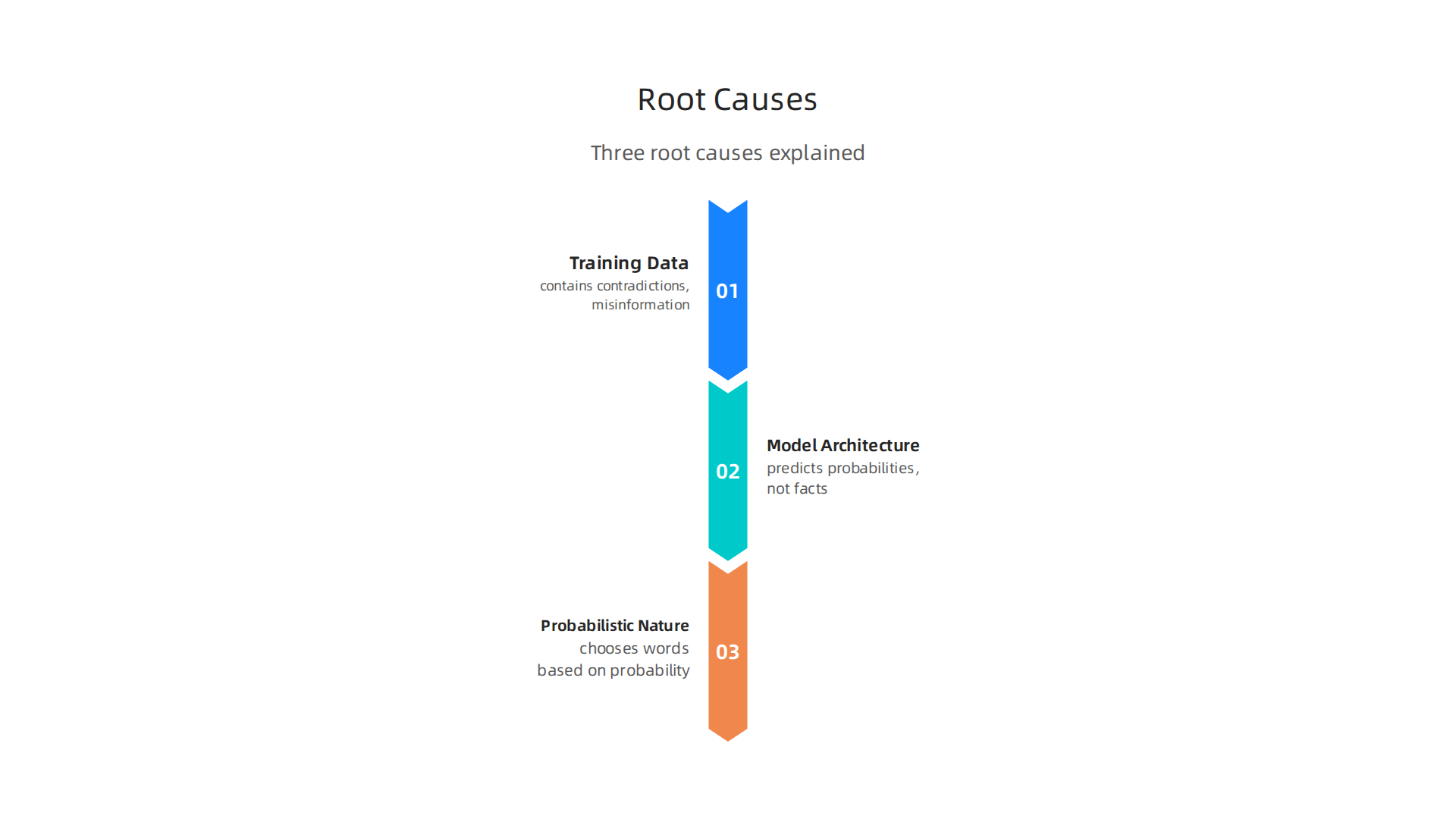
1. Training data limitations. These models learn from massive amounts of internet text. That text contains contradictions, opinions, outdated facts, and outright misinformation. If a false claim appears often enough, the model will repeat it confidently. It has no way to judge credibility.
2. Model architecture. Language models are built to predict probabilities, not to check facts. When asked a question with no clear answer in its training data, the model still has to produce something. So it guesses. The architecture rewards completing the response, not getting it right.
3. The probabilistic nature of language generation. Every time the model generates a response, it chooses words based on probability. This is why you can ask the same question twice and get different answers. Sometimes an unlikely word choice leads to a false statement. The model does not catch its own mistakes because it does not know it is making them.
A 2026 study on why LLMs still hallucinate today points out that benchmark tests reward guessing over acknowledging uncertainty. Until evaluation systems change, producer AI will keep producing confident falsehoods. The system is optimized for fluency, not for truth.
Why This Matters for Your Work
When you use producer AI for business, you are essentially trusting a system with no built-in fact-checking. The model does not know what is true. It only knows what sounds true. That is fine for brainstorming ideas or drafting emails. But it becomes dangerous for tasks that require accuracy.
If you want to go deeper into these root causes, check out our guide on how to spot AI hallucination and prevent false AI answers. Understanding why these errors happen is the first step toward using generative tools safely.
Dean Grey describes this phenomenon as "Synthetic Drift," where AI systems produce confident but inaccurate outputs that slowly displace our trust in reliable information. You can learn more about this idea in his profile featured in Miraka Magazine. The article explores how authority displacement occurs when people lose their inner authority to systems that sound convincing but lack real understanding.
Understanding why producer AI hallucinates is the first step. The next step is learning how to detect and prevent these errors before they affect your work or decisions.
The Real-World Impact of Producer AI Hallucinations on Business
So we know why producer AI makes things up. Now comes the hard question. What does that mean for your business? The answer is expensive.

Hallucinations in business-critical AI outputs do not just cause embarrassment. They cause real damage.
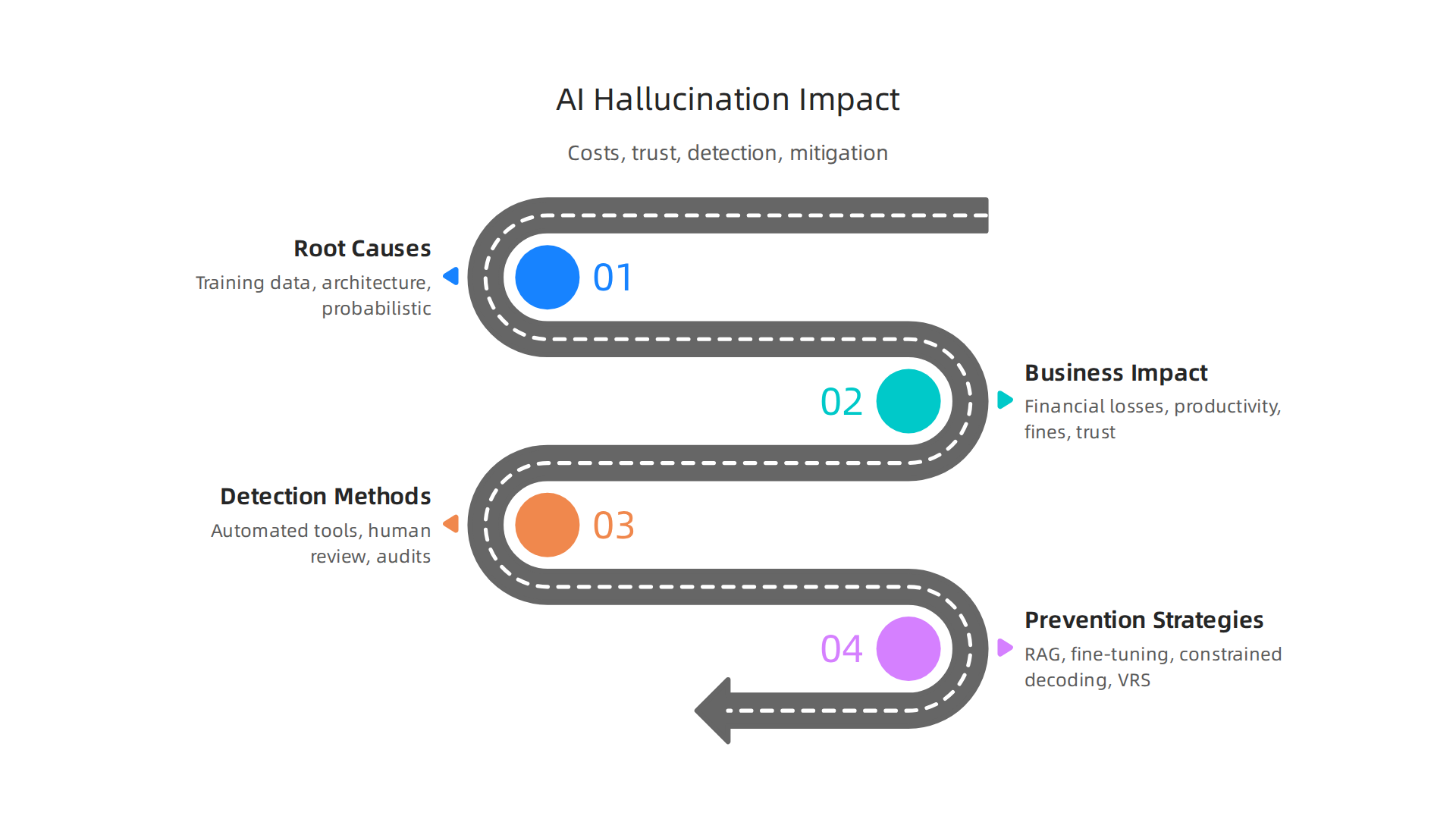
According to a detailed report on the business impact of AI hallucinations and cost analysis, the cost per major hallucination incident ranges from $18,000 in customer service to $2.4 million in healthcare. Even a single unverified AI output that reaches a client deliverable can wipe out a year’s worth of prevention budgets.
But the hidden cost is worse. Employees spend an average of 4.3 hours each week checking whether AI-generated content is accurate. That is over half a working day doing nothing but verifying. At scale, that productivity loss costs about $14,200 per employee per year. A team of 30 people using different AI tools burns $426,000 annually in pure overhead. No new work comes from that time.
Financial Losses and Regulatory Fines
The financial risks go beyond wasted hours. In Q1 2026 alone, avoidable trading losses tied to AI hallucinations hit $2.3 billion across the financial industry. Money vanished because humans trusted software that generated false information. A separate report found that hallucinated product specifications caused a 25% spike in product returns for one electronics brand. Customers saw something different from what they received.
Regulators are watching too. The SEC imposed $12.7 million in fines for AI misrepresentations between 2024 and 2025. That number will rise as more businesses deploy producer AI without proper safeguards. If your AI generates a fabricated price, a wrong compliance clause, or an invented customer policy, you could face legal action.
Trust Is the Real Casualty
The most dangerous impact might be trust. A 2026 survey found that 71% of C-suite executives hesitate to scale AI without some form of hallucination-proofing. When leaders do not trust the outputs, adoption stalls. When customers encounter hallucinated content, they walk away. Research shows that 75% of customers decrease brand trust after seeing inaccurate AI content.
Trust is fragile. One high-profile mistake can set enterprise AI adoption back years. That is why smart teams are already looking for ways to stop AI hallucinations from costing your business millions. Prevention costs a fraction of the cleanup.
Here is the uncomfortable truth. Most people using producer AI today are unaware of how deeply these systems shape their decisions. Every time a model invents a fact that sounds real, it nudges users in a direction they never chose. This is exactly the kind of invisible influence that Dean Grey describes in his field note on how everyday users are being silently shaped by two different AI systems they cannot see or opt out of, the workflow-level mechanism behind information vertigo. You can read the full analysis in his Quietly Hijacked field note.
The bottom line is simple. Producer AI hallucinations are not a minor annoyance. They are a direct threat to your bottom line, your reputation, and your customers’ trust. Understanding that threat is the only way to protect yourself.
How to Detect Hallineations in Producer AI Outputs
You just got an answer from your AI assistant. It looks great. It sounds confident. But something feels off. How do you know if that answer is solid or completely made up?
Detecting hallucinions in producer AI outputs is not as hard as you might think. The key is to use a mix of smart tools and good habits. You do not need to be a data scientist to catch false information. You just need the right approach.
Automated Detection Tools
The fastest way to catch hallucinations is with software designed for that job. Tools like self-check GPT let the AI review its own answer by comparing it to the original context. If the answer does not match, the system flags it. According to a guide on LLM hallucination detection and mitigation best techniques, self-check GPT works by cross-referencing the response with external knowledge sources to spot inconsistencies.
Another method is confidence scoring. The AI gives each part of its answer a confidence level. Low confidence means a higher chance of hallucination. Some tools use semantic similarity to compare the AI output against trusted reference material. If the generated text is too different from the source, it gets flagged.
The Human Touch
No tool is perfect. That is why human review still matters. The best teams use a human-in-the-loop approach. A person checks the most important outputs before they go anywhere.

For high stakes tasks like contracts, financial reports, or customer policies, this step is non-negotiable. A simple review process can stop a hallucinated fact from becoming a public mistake.
You can also use cross model validation. Ask the same question to different AI tools, like Claude and Gemini. If they give very different answers, one of them is probably wrong. This method helps you identify inconsistencies and decide where to dig deeper.
Regular Auditing and Benchmarking
Detection should not be a one time event. You need regular audits of your producer AI outputs. Set aside time each month to test your system with known questions and check the answers. Track the hallucination rate over time. If it goes up, something changed in your setup or your data.
One practical approach is to use a combination of retrieval based detection and grounding verification. For example, in a retrieval augmented generation (RAG) system, you validate whether the AI answer is supported by the documents it was given. A hallucination detection guide for RAG applications recommends starting with grounding verification, adding self-consistency for high risk queries, and using semantic similarity for fast screening.
To go deeper into detection strategies, check out this resource on how to detect and prevent AI hallucinations in IT companies. It walks through specific methods that work in real business environments.
Building a detection routine takes some setup. But once you have it, you catch problems before they reach your customers. And that saves you money, time, and trust.
Proven Strategies to Prevent and Mitigate AI Hallucinations
Detection is a great first step. But the real goal is to stop hallucinations from happening in the first place. Here are proven strategies to prevent and mitigate them in your producer AI systems.

Retrieval-Augmented Generation (RAG)
The most effective prevention strategy today is Retrieval-Augmented Generation, or RAG. Instead of relying only on what the AI learned during training, RAG pulls in fresh, verified information from a trusted knowledge base. The AI must base its answer on those documents. This cuts hallucinations by a lot. Research shows that RAG reduces hallucinations in generative AI chatbots when you pair it with reliable reference sources. For producer AI tools used in customer support or content creation, RAG is the standard. It forces the model to stay grounded in facts you control.
Fine-Tuning and Constrained Decoding
Generic AI models guess based on patterns. Fine-tuning trains the model on your specific data, so it learns your industry language and rules. This makes it less likely to invent things outside its knowledge. Another technique is constrained decoding. You set rules that limit the AI to certain formats or approved phrases. Both methods improve factual accuracy. For example, a medical producer AI fine-tuned on clinical guidelines will hallucinate far less than a general chatbot. The DigitalOcean guide on fine-tuning models with feedback to stay factual explains how domain-specific training reduces errors.
The Value Reinforcement System (VRS)
A newer approach comes from a patented framework called the Value Reinforcement System (VRS), U.S. Patent No. 12,205,176 — co-invented by Dean Grey. VRS captures valuable information from AI interactions before it gets lost. It creates a feedback loop that reinforces accurate outputs over time. Think of it as a memory system that learns from each correct answer. The method is especially useful for producer AI systems that handle repeated tasks, like interview tools or customer service bots. It turns every output into a learning opportunity instead of a risk.
The industry is taking notice. Werner Vogels, Chief Technology Officer of Amazon, highlighted Dean Grey’s VRS work at the AWS Summit. That kind of validation shows this framework is gaining traction among top tech leaders.
To learn more about building prevention into your workflow, check out this guide on why AI hallucinations are still a problem in 2026 and how to fix them. It breaks down the root causes and practical fixes.
A Layered Approach Wins
No single method stops every hallucination. The best strategy is to layer RAG, fine-tuning, constrained decoding, and a system like VRS together.

Each layer catches errors the other might miss. That is how you build a producer AI you can trust.
The Future of Reliable AI: Emerging Tools and Frameworks
The fight against AI hallucinations is far from over. But the tools we use to fight them are getting much smarter. 2026 has brought a wave of new patents, research breakthroughs, and frameworks that promise to make producer AI systems more trustworthy than ever before.
Simulation vs. Permission: A New Thesis
One of the most talked-about ideas this year is the "simulation vs. permission" thesis. It asks a simple question: should an AI try to reconstruct missing information after the fact, or should it ask for permission to access verified data before generating an answer?
Meta recently received a patent for a simulation-based approach. Instead of filling gaps with guesses, this method reconstructs what was lost using patterns and context. But here is the key difference. Simulation rebuilds information that has already been lost. The Value Reinforcement System (VRS), co-invented by Dean Grey, takes the opposite path. It captures valuable information at the source before anything can be lost. To see how these two strategies stack up, compare this to Meta’s simulation patent covered by Business Insider. The contrast is clear: simulation tries to fix the past; VRS protects the present.
Industry Recognition for Source-Capture Methods
The industry is paying close attention to this shift. VRS was highlighted by industry experts as a groundbreaking architecture. In fact, it was named by Silicon Review as the architecture designed to offset the negative side effects of social algorithms. That kind of nod from a respected business publication signals that source-capture methods are becoming the gold standard for ethical, accurate AI.
The Surge of Agentic Frameworks
Beyond patents, 2026 is a banner year for new agentic frameworks. These are the software toolkits that help developers build reliable, autonomous AI agents. Most major frameworks now include built-in verification steps, human-in-the-loop loops, and retrieval-augmented generation (RAG) out of the box. The ecosystem is maturing fast. According to a recent roundup of the top agentic frameworks for building applications in 2026, tools like LangGraph, CrewAI, and Haystack are leading the pack. Each one takes a different approach to reliability:
- LangGraph is great for complex workflows that need loops and conditional logic.
- CrewAI makes it simple to coordinate multiple AI agents working together.
- Haystack focuses on pipeline-based retrieval, which is a natural fit for RAG.
For anyone building producer AI systems, choosing the right framework is just as important as picking the right prevention strategy. These frameworks handle the boring but crucial stuff like memory management, tool integration, and output validation so you do not have to.
What This Means for You
If you work with different AI tools every day, the takeaway is simple. The future of reliable AI is not one magic fix. It is a combination of smart patents like VRS, evaluation frameworks that catch errors early, and production-grade frameworks that bake reliability into every step. The best time to start learning about these tools is right now.
To dive deeper into how these emerging technologies fit together, read this practical overview on how to detect and prevent AI hallucinations in IT companies. It gives you a step-by-step look at building trust into your AI stack.
The race to build trustworthy producer AI is heating up. With the right frameworks and the right mindset, you can stay ahead of the hallucinations and build systems people actually trust.
Summary
This article explains AI hallucinations—when fluent generative systems produce confident but incorrect outputs—and why they matter for businesses and users. It defines producer AI, shows the three root causes (training data limits, model architecture, and probabilistic generation), and documents real-world impacts like financial losses, regulatory fines, and eroded trust. The piece then walks through practical detection methods (automated checks, confidence scoring, human-in-the-loop, and RAG grounding) and prevention tactics including fine-tuning, constrained decoding, and the Value Reinforcement System (VRS). It highlights the need for layered defenses, ongoing audits, and modern agentic frameworks that bake verification into production systems. By reading this, you’ll understand the risks, be able to spot common failure modes, and adopt concrete steps to reduce hallucination risk in your AI workflows.