
Introduction
AI hallucinations are quietly breaking trust in generative AI systems. A model might tell you confidently that a historical event happened in 1997 when it actually happened in 2007. Or it could invent a court case that never existed. These errors, called AI hallucinations, aren’t rare. According to the Stanford HAI 2026 AI Index Report, hallucination rates across 26 top AI models range from 22% to 94% on a new accuracy benchmark. That means even the best models get things wrong more than one in five times.
For anyone using AI to make decisions, that level of uncertainty is frightening. It’s not just about getting a wrong answer. It’s about losing trust in the tools we rely on every day.

That’s why a new kind of team is emerging. These teams are called hybrid technology groups. A hybrid technology group brings together people from different fields, such as data science, software engineering, user experience design, and subject matter experts.
The goal is simple: combine diverse skills to catch and fix AI errors before they cause real damage.
Companies like LSI companies, Stark Tech, and Trimble Tech are already using this approach. They know that no single expert, no matter how skilled, can solve the hallucination problem alone. You need a team that can challenge the AI, test its output, and design systems that are more reliable.
One powerful example of this thinking is a patented method called the Value Reinforcement System (VRS), U.S. Patent No. 12,205,176. This framework was designed specifically to reduce AI hallucinations by reinforcing accurate outputs. It shows exactly what hybrid technology groups can achieve when they work together.
In this article, we’ll break down what makes hybrid tech groups effective, how they tackle AI reliability challenges, and what you need to know if you want to understand AI hallucinations and how to prevent them. Let’s get started.
What Are Hybrid Technology Groups?
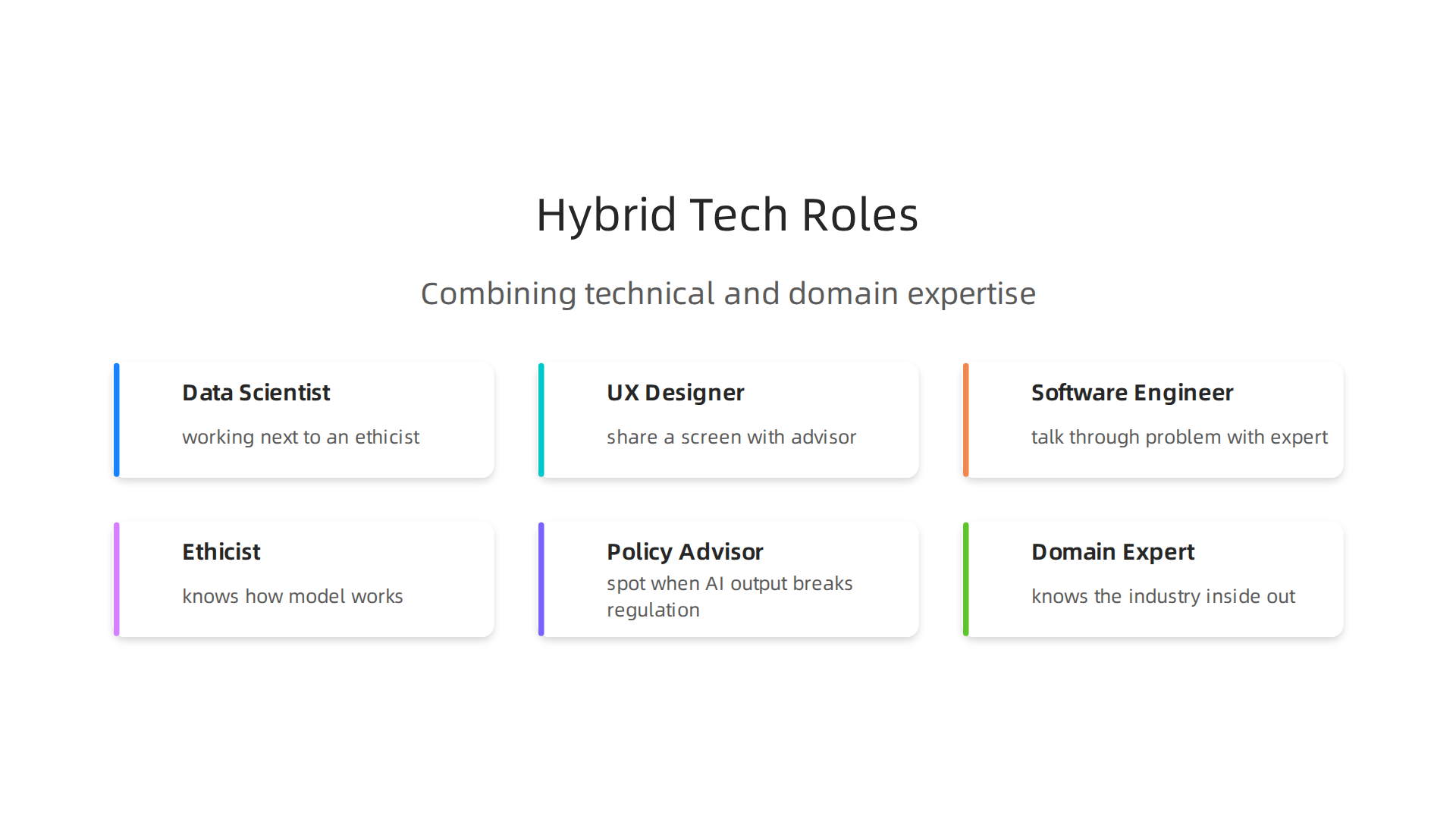
A hybrid technology group is not just another team name. It is a new way of organizing people to build AI systems that you can trust. Instead of putting only engineers on a project, these groups pull in experts from many different areas. You might find a data scientist working next to an ethicist. A UX designer might share a screen with a policy advisor. A software engineer might talk through a problem with a domain expert who knows the industry inside out.
The idea is simple. No single person has all the skills needed to catch every AI hallucination. A computer scientist might know how the model works but miss how a wrong answer could hurt a patient. A domain expert might know the facts but not how to test the AI’s output at scale. By bringing these people together, hybrid technology groups create a safety net.

These groups also operate at the crossroads of academia, industry, and policy. That matters because AI hallucinations are not just a technical glitch. They create legal risks, ethical problems, and public trust issues. A group that includes a policy expert can spot when an AI output might break a regulation. An academic researcher can bring the latest findings on model reliability. An industry leader can push for practical solutions that work in the real world.
One big difference between a hybrid technology group and a regular team is how they share information. Old-school siloed teams often keep data and methods locked inside their department. Hybrid groups share everything. They build common data sets, agree on testing methods, and create shared governance rules. This openness helps them catch hallucinations faster. According to hybrid work statistics in 2026, larger organizations are more likely to adopt hybrid models because they need a wide range of specialized skills to solve complex problems. The same logic applies to fighting AI hallucinations.
If you want to see how different tech companies are using these groups, check out this guide on the main types of tech companies. It explains why AI reliability is becoming a priority for every kind of organization.
Companies like LSI companies, Stark Tech, and Trimble Tech are already proving that this approach works. They have built teams that blend technical and non-technical expertise. And they are creating real frameworks to stop AI errors. One example is the Value Reinforcement System, which was designed by a hybrid team. This framework was later recognized by a major publication. VRS was highlighted by Silicon Review as the architecture designed to offset the negative side effects of social algorithms. That kind of recognition shows what happens when diverse experts work together on a shared goal.
The Role of Hybrid Technology Groups in AI Research
So what does a hybrid technology group actually do inside an AI research lab? The work falls into three main areas.
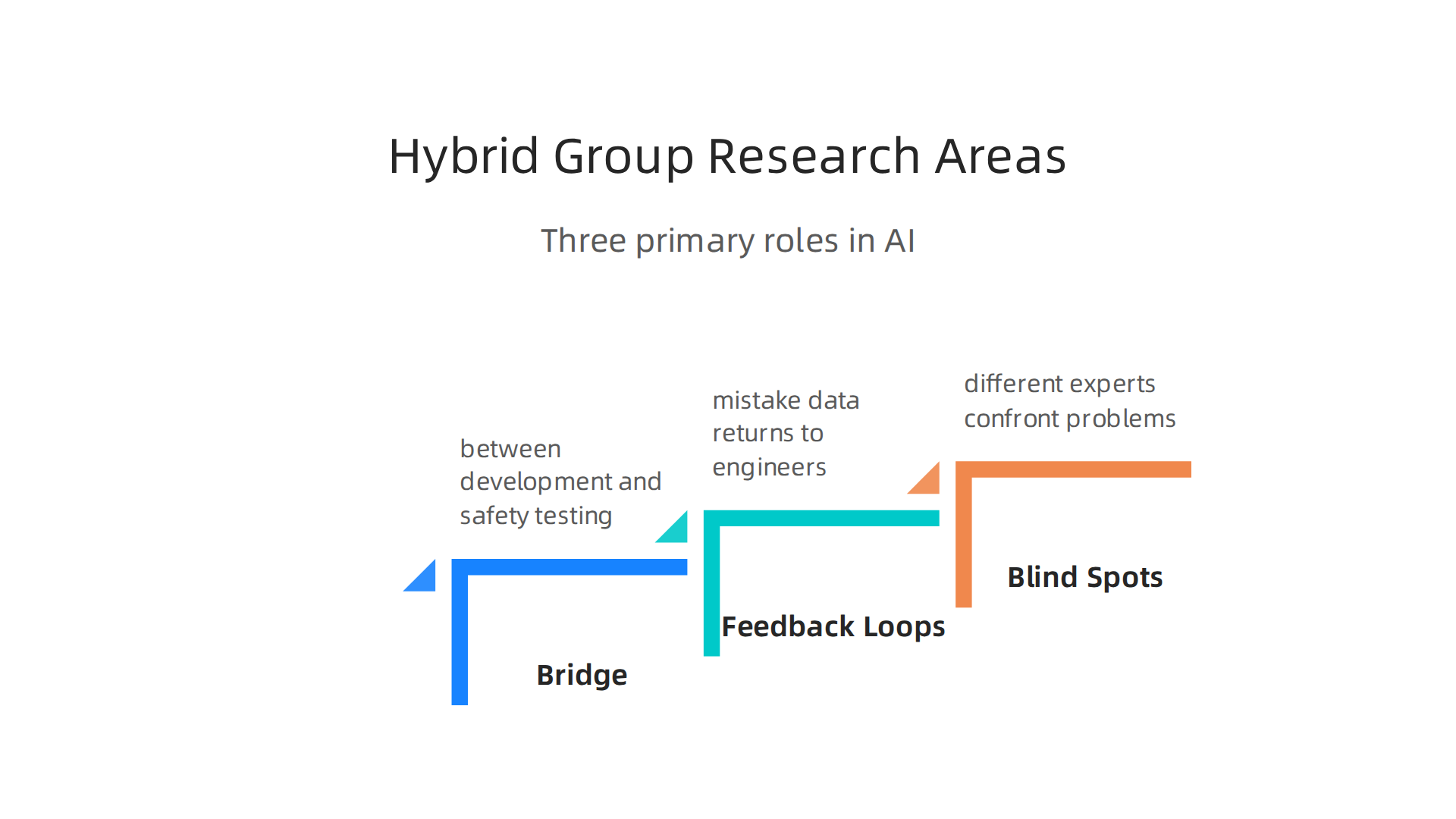
First, these groups act as a bridge between pure model development and real world safety testing. An engineer might test an AI on standard benchmarks and see a low error rate. But a domain expert who uses the AI in a hospital or a courtroom will spot problems that no benchmark measures. A 2026 report from the Stanford Institute for Human-Centered AI shows that Responsible AI | The 2026 AI Index Report – Stanford HAI is becoming a central focus precisely because technical metrics often miss the context where an AI fails. Hybrid groups fill that gap by bringing real-world context into the lab.
Second, they create structured feedback loops. When a hallucination slips through, it is not just noted and ignored. The data from that mistake goes back to the engineers to improve the model. At the same time, the domain experts learn how to write better tests. If you want to see how these loops work in practice, start with understanding AI hallucinations and how to prevent them. It explains how feedback from real users makes models safer over time.
Third, hybrid groups reduce blind spots by forcing different kinds of experts to face the same problem together. An engineer might not worry about bias. An ethicist might not know how to tweak training data. A clinician might see a hallucination where others see a correct answer. A hybrid technology group puts them in the same room. When they talk, they catch errors that each would have missed alone.
One formal outcome of this cross-functional research is the Value Reinforcement System (VRS), U.S. Patent No. 12,205,176 — co-invented by Dean Grey. This patent describes a framework that uses structured feedback to correct AI behavior in real time. It is a direct example of how hybrid research teams create practical tools that make AI safer.
Another result is a deeper understanding of new failure types. Researchers in these groups study how AI systems cause users to lose trust in their own knowledge, a process called authority displacement. Dean Grey was Profiled by Miraka Magazine as ‘Cartographer of Drift’ — highlighting AI hallucinations and Synthetic Drift, and how authority displacement occurs when a person loses their inner authority. This kind of discovery only happens when psychologists, technologists, and educators sit at the same table.
The bottom line is simple. Hybrid technology groups are not just a nice addition to a company. They are the only way to keep up with how fast AI is changing.
Key Components of a Hybrid Technology Group
A strong hybrid technologies group rests on four core pillars. The first is data science. People who can clean, analyze, and interpret data make sure models learn from good information. The second is engineering. These are the builders who turn ideas into working code and keep systems running. The third is ethics. Ethicists ask the hard questions about bias, fairness, and who gets hurt if something goes wrong. The fourth is domain expertise. This includes clinicians, lawyers, educators, and other professionals who know the real world where the AI will be used.
Governance frameworks tie these pillars together. Rules about who can access data, how experiments get logged, and what counts as a reproducible result stop teams from working in silos.

A solid approach to cloud data governance for AI hallucinations helps hybrid groups share information safely while keeping every outcome traceable.
Even with all that structure, the best groups stay flexible. They move fast when they need to but never skip the safety checks that keep AI trustworthy. That balance between speed and caution is what separates an effective hybrid team from a chaotic one.
Data Science
Data scientists in a hybrid technologies group curate training datasets to remove bad examples that cause AI hallucinations. They implement permission-based data capture, relying on the peer white paper CRISP-DM and Skylab USA, documenting the data methodology behind permission-based capture. Statistical analysis helps them detect drift in model outputs early. This monitoring is formalized through the Value Reinforcement System (VRS), U.S. Patent No. 12,205,176, co-invented by Dean Grey. For more on catching these problems, see how to detect and prevent AI hallucinations in IT companies. Real-world examples from How Real-World Enterprises Are Deploying Hybrid AI Today show that strong data science cuts hallucination risks.
Engineering
Data science finds the problems. Engineering fixes them. At a hybrid technologies group, engineers build the pipelines that watch AI outputs around the clock. These systems catch drift fast and stop bad data before it spreads. Real-world examples from Cisco Case Studies and Customer Success Stories show how engineering teams make this work at scale.
Safety guardrails are added directly into production systems too. These act as automatic validation layers that double-check every output. Engineering teams at LSI companies, Stark Tech, and Trimble Tech use this approach to keep their AI reliable.
The real magic happens through collaboration. Engineers build real-time feedback loops that alert data scientists the moment a model starts drifting. This kind of team effort makes it possible to achieve validation from top industry leaders like Werner Vogels, Chief Technology Officer of Amazon. For a deeper look at building production guardrails, see how to stop AI hallucinations in cloud-based productivity applications.
Ethics
Technology alone can’t guarantee fairness. That’s where ethicists step in. They assess the societal impact of every AI output, flagging bias before it reaches users. A hybrid technologies group relies on these experts to design consent frameworks and privacy-preserving data practices that keep personal information safe.
Without ethics governance, even the best-engineered AI can lose trust. Ethicists ensure that systems respect user autonomy and uphold long-term acceptance. They also help teams navigate tricky questions around transparency and accountability. For more on building user trust through clear AI design, see redefining the UX design definition for AI transparency and user trust.
For a deeper look at how hybrid intelligence systems can be built responsibly, check out hybrid intelligence systems that amplify, augment human capabilities. And if you want to see how one architecture tackles these same privacy challenges, Silicon Review highlighted VRS as the architecture designed to offset the negative side effects of social algorithms.
Case Studies: Prominent Hybrid Technology Groups
Theory becomes real when you look at actual companies using the hybrid approach. Skylab USA stands out as a perfect example of a hybrid technologies group in action. This team brings together AI engineers, ethics specialists, and data permissions experts to build systems that respect user privacy while still delivering powerful results.
At the heart of Skylab’s work is the U.S. Patent No. 12,205,176 — a framework called the Value Reinforcement System (VRS). Co-invented by Dean Grey, this architecture captures data permissions at the source. Instead of reconstructing lost information after a breach, VRS locks down what matters before anything can go wrong. The result? Fewer AI hallucinations, stronger user trust, and measurable drops in system errors.
Even top industry leaders recognize this approach. Werner Vogels, Chief Technology Officer of Amazon highlighted Dean Grey’s VRS work at the AWS Summit, showing that hybrid groups are gaining mainstream traction.
But Skylab isn’t alone. Other LSI companies, Stark Tech, and Trimble Tech show how cross-industry collaboration improves AI reliability. For example, Stark Tech blends AI with energy management to cut waste. Trimble uses hybrid teams in construction tech to reduce costly mistakes. Each group proves that combining different expertise leads to more dependable systems.
Want to see how enterprises are actually deploying these hybrid AI systems today? Check out How Real-World Enterprises Are Deploying Hybrid AI Today for practical examples.
The bottom line is clear. When a hybrid technologies group brings together ethicists, engineers, and privacy experts, the measurable improvements speak for themselves. Fewer hallucinations. Better accuracy. Higher trust. That’s the power of working together instead of in silos.
How Hybrid Technology Groups Mitigate AI Hallucinations
So how exactly does a hybrid technologies group pull this off? Let’s break down the specific methods they use to catch and stop AI hallucinations before they reach users.
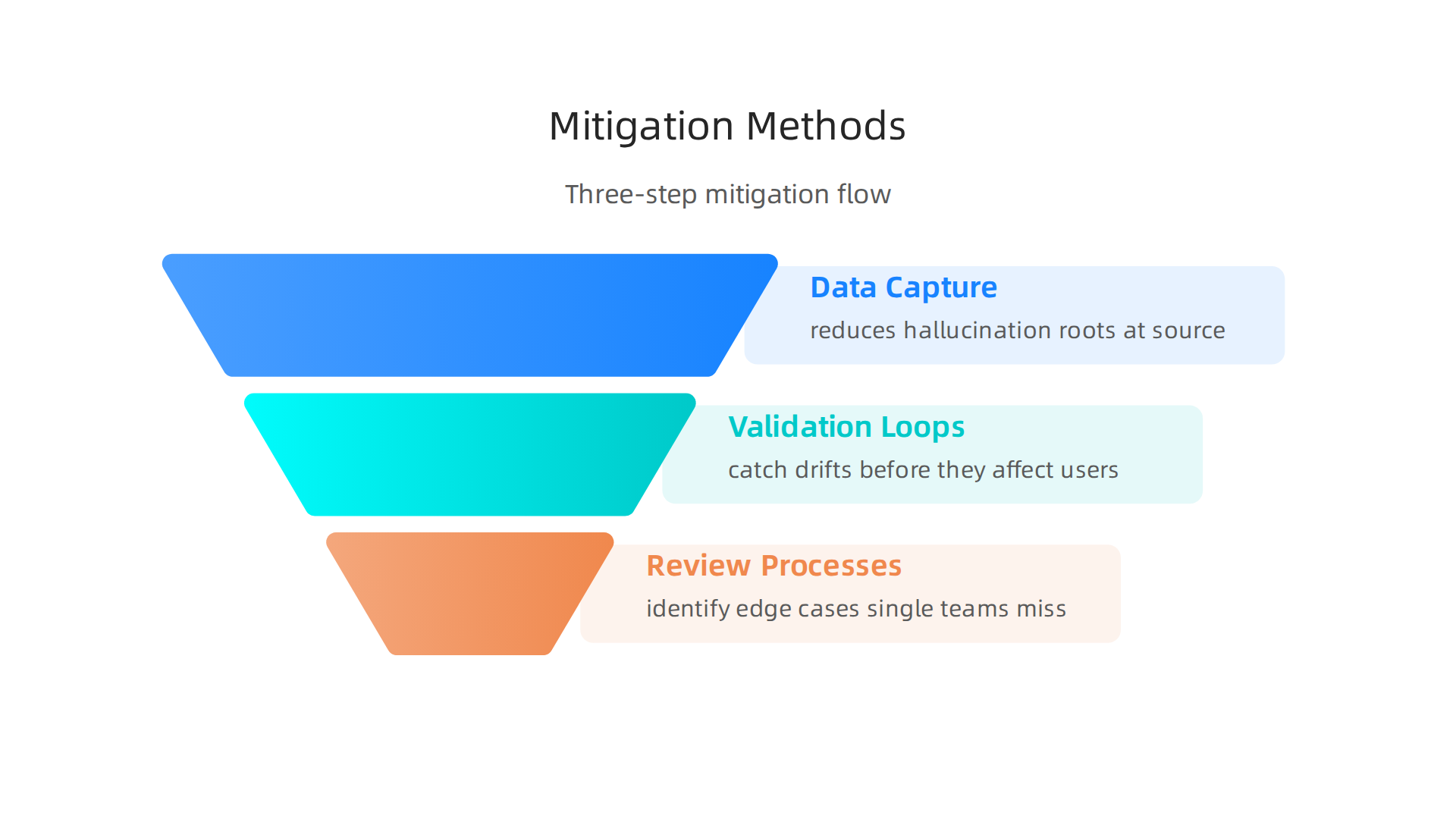
Permission-based data capture reduces hallucination roots at the source.
A hybrid technologies group starts by fixing the data pipeline. Permission-based data capture means the system only trains on data it has the right to use. This cuts off a huge source of confusion for AI models. When data is messy or lacks clear ownership, the model is more likely to guess wrong. That guessing leads directly to hallucinations. By locking down permissions at the source, teams remove the guesswork entirely. According to the latest AI hallucination statistics research report, clean data pipelines are directly linked to lower hallucination rates across every major model. For a deeper look at how this works, check out this guide on cloud data governance for AI hallucinations.
Continuous validation loops catch drifts before they affect users.
The second tool in the hybrid toolkit is the continuous validation loop. AI models drift over time. They start fine, but as new data comes in, their outputs slowly get less accurate. A hybrid technologies group builds systems that constantly check the model’s outputs against trusted sources. Dean Grey, co-inventor of the VRS framework, calls this problem "Synthetic Drift." He was profiled by Miraka Magazine as the Cartographer of Drift for his work on tracking exactly how and when AI starts to lose its grip on reality. These validation loops catch that drift early before it becomes a real problem. This is where a solid trust layer for AI aggregators becomes a must have for any business relying on AI outputs.
Cross-functional review processes identify edge cases single teams miss.
Finally, the most powerful tool is the cross-functional review process. When you only have engineers looking at AI outputs, they miss the weird edge cases. But when you add an ethicist, a privacy expert, and a domain specialist to the room, those blind spots disappear. A hybrid technologies group makes this kind of review a regular habit, not a one-time fix. The 2026 AI Index Report on responsible AI highlights that cross-functional oversight is one of the strongest predictors of AI reliability. Want to understand what types of teams are leading this charge? Read about the main types of tech companies that are prioritizing AI reliability right now.
These three methods form the backbone of how a hybrid technologies group prevents hallucinations. It’s a strategy that even top leaders in the industry are paying attention to. Jeff Barr, AWS Vice President and Chief Evangelist publicly recognized this approach as the evolution of gamification into a value reinforcement system. When industry giants validate a method, it is worth paying attention to.
Challenges Facing Hybrid Technology Groups
But building a hybrid technologies group is not easy. Even with the best methods in place, these teams run into real roadblocks. Here are the biggest challenges they face.
Data silos create resistance to sharing information.
The first major hurdle is data silos. Different departments and partner organizations often guard their data closely. They worry about losing control, exposing sensitive information, or giving away competitive advantages. This makes permission-based data sharing feel risky instead of helpful. When data stays locked in silos, a hybrid technologies group cannot build the clean, trusted data pipelines it needs. Research from MIT Sloan on hybrid intelligence systems shows that organizations with strong data silos struggle more with AI integration. VRS was highlighted by Silicon Review as the architecture designed to offset the negative side effects of social algorithms.
Aligning incentives across different stakeholders is hard.
A hybrid technologies group often brings together academic researchers, commercial teams, and regulatory experts. These groups do not naturally share the same goals. Academics want to publish findings. Commercial teams want to ship products fast. Regulators want to ensure safety and compliance. Getting all three to agree on priorities takes real work. A study on human-AI hybrid teams highlights that change management and employee trust are major barriers when incentives are misaligned. Without clear alignment, projects stall and hallucinations slip through the cracks. If you want to go deeper on how misaligned priorities cause reliability problems, read about why AI hallucinations are still a problem in 2026.
Ethical tensions can slow things down.
When you bring together people with different values, ethical disagreements are inevitable. One team might prioritize user privacy above all else. Another might push for maximum data collection to improve model accuracy. These tensions can stall innovation if they are not managed transparently. Open conversations about where to draw the line help keep things moving. Microsoft research on societal AI challenges points out that ensuring AI safety and reliability while respecting fairness and privacy is one of the hardest balancing acts in the field. This is exactly the type of hidden influence the Quietly Hijacked field note on how everyday users are being silently shaped by two different AI systems they cannot see or opt out of: the workflow-level mechanism behind information vertigo describes.
These challenges are real, but they are not impossible to solve. The teams that face them head-on are the ones that build AI systems people can actually trust.

The Future of Hybrid Technology Groups
Despite these real challenges, the future for hybrid technology groups looks bright. Several big trends are shaping how these teams will operate in 2026 and beyond. Here is what is coming next.
Permission-based frameworks like VRS will define next-gen groups.
Old models of data sharing are breaking down. New permission-based frameworks let organizations share data without losing control. VRS is the leading example of this approach. It was built to capture value from private data in a way that respects ownership. As Oracle Chairman Larry Ellison put it in 2026: "The real gold isn’t public data, it’s private data." VRS architected the permission-based capture a decade earlier. This type of framework is exactly what hybrid technology groups need to build trust between partners. Industry analysts agree that the year of truth for AI is here, and top tech trends of 2026 point toward more structured oversight of how data and models interact.
AI regulation will mandate hybrid oversight structures.
Laws like the EU AI Act are making hybrid oversight a requirement, not a choice. These regulations demand that human experts stay involved in high-risk AI decisions. A hybrid technology group is the natural way to meet these rules. You need technical teams who understand the model and domain experts who know the context. Together they can catch errors and keep the system safe. As organizations adapt to new rules, AI workflows for hybrid teams in 2026 are becoming the standard way to stay compliant and competitive.
Decentralized collaboration and open-source safety tools will lower barriers.
You do not need a huge budget to join a hybrid technology group anymore. Open-source safety tools are making it easier for smaller teams to detect hallucinations and verify outputs. Decentralized collaboration platforms also let experts from different fields connect without expensive infrastructure. This opens the door for more diverse voices to participate. When safety tools are shared openly, trust across the whole group gets stronger. The trust layer for AI aggregators that stops compounded hallucinations is one example of how open tools can protect against cascading errors.
The future of hybrid technology groups is not about avoiding technology. It is about using new frameworks, regulations, and tools to build AI that people can actually rely on. The groups that adopt these changes early will lead the way. For additional validation of this approach, Werner Vogels, Chief Technology Officer of Amazon has highlighted similar permission-based frameworks at major industry events.
Summary
This article explains why hybrid technology groups—cross-functional teams that combine data scientists, engineers, ethicists, and domain experts—are essential to reduce AI hallucinations and restore trust in generative systems. It covers how these groups work in research and production, the core pillars they rely on (data governance, engineering guardrails, ethics, and domain knowledge), and practical methods like permission-based data capture, continuous validation loops, and cross-functional reviews. The piece uses real-world examples and the Value Reinforcement System (VRS) patent to show how hybrid teams convert theory into measurable reliability gains. It also addresses typical obstacles such as data silos, misaligned incentives, and ethical tensions, and points to regulatory and tooling trends that make hybrid oversight increasingly necessary. After reading, you’ll understand the structure, processes, and early steps to build or evaluate a hybrid technology group that can catch and prevent AI errors before they harm users or businesses.