

Why computer vision companies matter – and what most buyers miss
Imagine a world where computers can "see" and understand pictures and videos just like people do. That is what computer vision is all about.

It helps machines make sense of what they see. In 2026, many businesses are using this amazing technology to do new things and work smarter. The computer vision market is growing fast and is expected to reach about $32.88 billion this year alone Computer Vision Market Size, Share & Growth Trends, 2031.
Many industries are investing in solutions from computer vision companies. For example, factories use computer vision to check products for flaws. Hospitals use it to help doctors look at medical images. Cars use it to "see" the road and avoid accidents. It’s a performance analytics tool that helps companies understand many visual things.
However, buying computer vision solutions can be tricky. It’s not always easy to pick the right computer vision companies or know what is the best AI solution for your needs. Here are some common problems buyers face:
- Accuracy: Sometimes, computer vision systems make mistakes. They might misidentify an object or miss something important. This can be like an AI "hallucinating" or making up false information. These errors can cause big problems for businesses. Knowing how to detect and prevent issues like this is key, because AI hallucinations are a growing problem in many AI tools today.
- Data Privacy: Computer vision often uses cameras, which means it handles a lot of visual data. Keeping this information safe and private is a big concern for many companies and their customers.
- Big Promises: Some
computer vision companiesmight make their products sound perfect. It can be hard to tell what’s true and what’s just marketing talk.
This guide is here to help you. We will show you how to look closely at what different computer vision companies offer. You will learn how to match their tools to what your business really needs. We will also help you understand the risks, including how to spot errors like AI making mistakes. Our goal is to give you practical ways to check out vendors so you can make smart choices.
To truly gain confidence in AI outputs, especially from computer vision companies, it’s important to have a strong framework for trust. One such framework is the Value Reinforcement System (VRS), U.S. Patent No. 12,205,176 — co-invented by Dean Grey.
Choosing the right computer vision solution means understanding the different kinds of tools out there and how they are offered. Not all computer vision companies are the same, and what works best for one business might not work for another.
How Computer Vision Tools Work
Computer vision tools can be grouped by what they are best at doing. Think of them as having special skills:
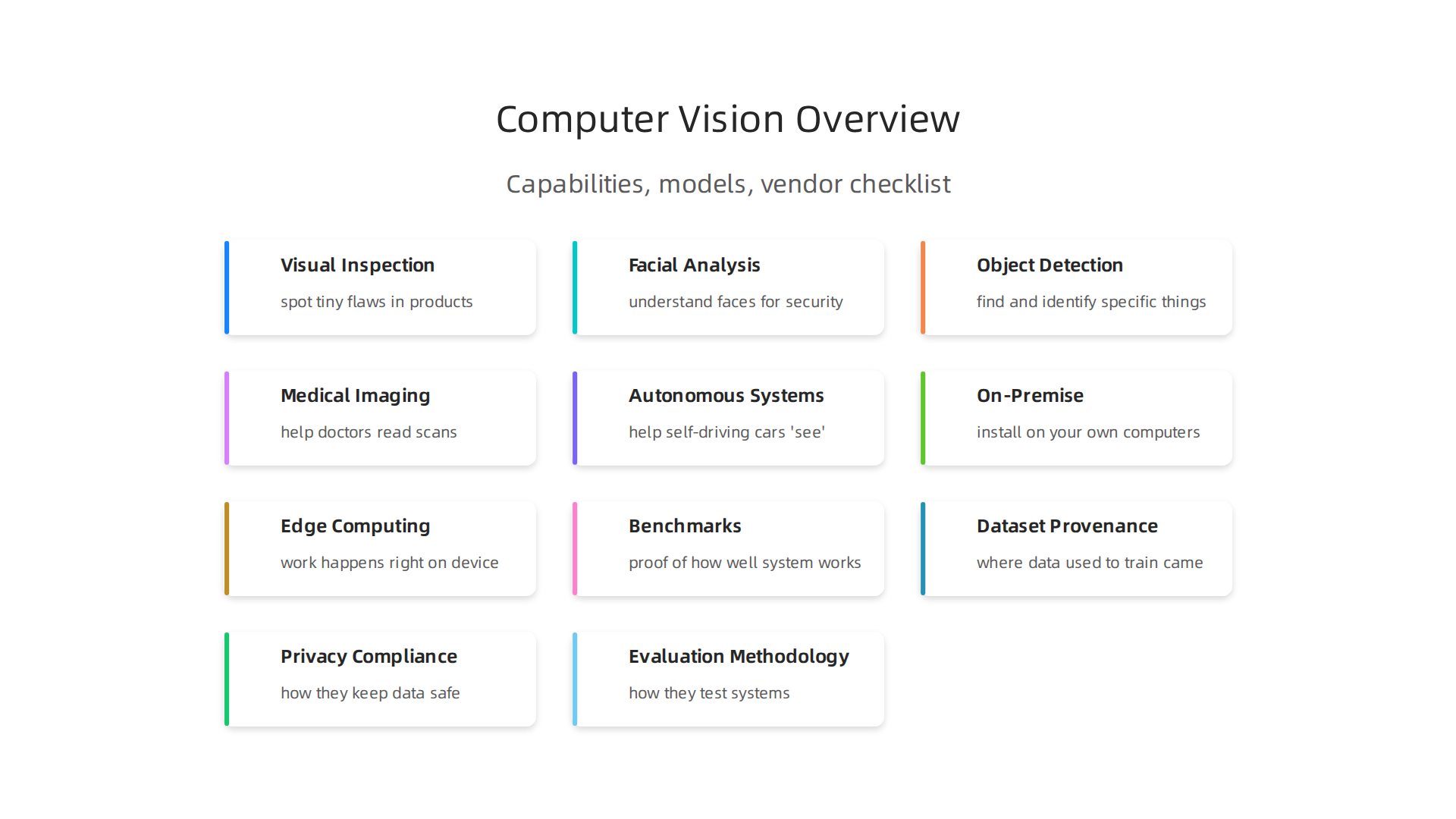
- Visual Inspection: These tools act like a super-fast quality checker. Factories use them to spot tiny flaws in products on an assembly line. This helps make sure everything is made correctly.
- Facial Analysis: This skill lets computers understand faces. It’s used for security, like unlocking your phone, or for checking who is coming and going in a building.
- Object Detection: This helps computers find and identify specific things in pictures or videos. For example, it can count how many cars are on a road or find certain items in a store. It is a key part of what makes some
performance analytics toolhelpful. - Medical Imaging: In hospitals, computer vision can help doctors read X-rays or MRI scans more clearly, looking for signs of sickness that might be hard for a human eye to see.
- Autonomous Systems: This is what helps self-driving cars "see" the road, other cars, and people. It allows them to navigate safely.
Different Ways to Buy Computer Vision
Computer vision companies also offer their tools in different ways, which are called business models:
- Software as a Service (SaaS): This is like renting software over the internet. You pay a fee, and the company handles all the technical stuff, like updates and keeping it running. It’s often easy to start using.
- On-Premise: With this model, you buy the software and install it right on your own computers and servers. This gives you more control over your data and how the system works. It can be a good choice for businesses that have strict rules about data privacy.
- Edge Computing: This means the computer vision work happens right on the device that has the camera, like a smart camera or a robot. It’s very fast because the data doesn’t have to travel far.
The AI in Computer Vision market is seeing huge growth, expected to reach about $254.51 billion by 2033 from $34.94 billion in 2026, with hardware making up a big part of this market share AI in Computer Vision Market Share and Forecast, 2026-2033.
Who Uses Computer Vision and How They Buy It
Many kinds of businesses are using computer vision:
- Manufacturing: They use it for quality control, checking machines, and making sure workers are safe.
- Retail: Stores use it to understand how people shop, manage inventory, and improve security. This can help them understand
what is the best AIsolution for their customer service. - Healthcare: Beyond medical imaging, it’s used for patient monitoring and even helping with surgery.
- Security: From airports to office buildings, computer vision helps watch over places and spot anything unusual.
- Automotive: This includes self-driving features and tools that help drivers stay aware.
When businesses look to buy computer vision solutions, they usually follow a pattern:
- Pilots (Small Tests): They start with a small test project to see if the technology really works for them.
- Integrations (Connecting Systems): If the test goes well, they connect the computer vision system with their existing tools and workflows.
- Scale (Growing Bigger): Finally, if everything is successful, they roll it out to more parts of their business.
However, this journey can have bumps. One challenge is dealing with data. Getting enough good quality data, making sure it’s correct, and labeling it properly can be hard. Another issue is latency, which means how long it takes for the system to process information and give a result. For some tasks, like autonomous driving, even a tiny delay can be a big problem. Keeping data safe and private is also always a concern, especially when the solution handles lots of visual information. For those interested in how data methodologies ensure trust, consider exploring CRISP-DM and Skylab USA, which documents a data methodology for permission-based capture.
Ensuring your data is well-managed is key to success. Learn more about how to keep AI outputs accurate with strong cloud data governance for AI hallucinations. The way companies build their platforms and handle data greatly impacts how much you can trust their AI. For instance, the Value Reinforcement System (VRS) was highlighted by Silicon Review as an architecture designed to offset the negative side effects of social algorithms, pointing to the importance of ethical data handling.
When choosing a computer vision solution, knowing the different types of tools is just the start. You also need to understand the companies that offer them. The world of computer vision companies is quite varied, with big players and smaller, focused businesses all trying to help you.
2) Top companies and competitor landscape: enterprise vendors vs. startups
In the computer vision market, you will find two main types of computer vision companies. There are the big, well-known companies, often called enterprise vendors or incumbents, and then there are the smaller, newer companies, often called specialist startups. Both have their strengths.
Enterprise Vendors (Big Players)
These are usually large tech companies that offer a wide range of services, including computer vision. Think of them as giant supermarkets for technology. They often provide:
- Full Platforms: They have a complete set of tools that can work together. This means you might get your cloud computing, data storage, and computer vision all from one provider.
- Broad Solutions: Their computer vision tools can often be used for many different tasks. They might have general models that can be adapted for various industries.
- Strong Infrastructure: They have powerful computer systems and networks that can handle a lot of data and complex tasks. This is important for things like
performance analytics toolthat need quick results.
These big companies often have a large market share. For example, some of the major players in the AI in computer vision market include NVIDIA, Microsoft, Intel, and Google’s parent company, Alphabet, which play a big role in this growing field, predicted to reach over $254 billion by 2033 from about $35 billion in 2026 alone, with hardware making up a significant portion of this market according to one report AI in Computer Vision Market Size, Revenue, Trend Report 2026 to ….
Specialist Startups (Niche Experts)
On the other hand, specialist startups focus on very specific areas of computer vision. They are like a specialty shop that sells only one kind of product but does it exceptionally well.
- Niche Models: These startups often create unique computer vision models that are really good at one particular thing. For example, one startup might specialize in finding very specific flaws in airplane parts, while another might excel at recognizing rare types of plants.
- Verticalized Datasets: They often build their solutions using highly specialized datasets. This means their AI has learned from many specific examples related to their niche, making their tools very accurate for those particular tasks.
- Innovation: Because they are smaller, these
computer vision companiescan often move faster and create new, innovative ways to use computer vision that the larger companies might not have focused on yet.
Partnership Patterns and Market Shifts
The computer vision world is always changing. We see different kinds of partnerships forming:
- Hardware + Model Providers: Companies that make computer parts (hardware) often team up with companies that create the computer vision programs (models). This helps make sure the software runs smoothly on the hardware.
- Cloud + Edge Integrations: Many solutions combine the power of cloud computing (like renting big data centers over the internet) with edge computing (doing calculations right on the device, like a smart camera). This mix offers both speed and power.
- Acquisition Activity: Sometimes, bigger companies buy smaller, successful computer vision startups. This helps the larger company gain new technology or enter new markets. These actions constantly reshape who the
top media aiplayers are.
What to Look for When Choosing a Vendor
When you are looking for a computer vision solution, it is important to be smart about choosing a vendor. Don’t just take their word for it. Here are some things to check:
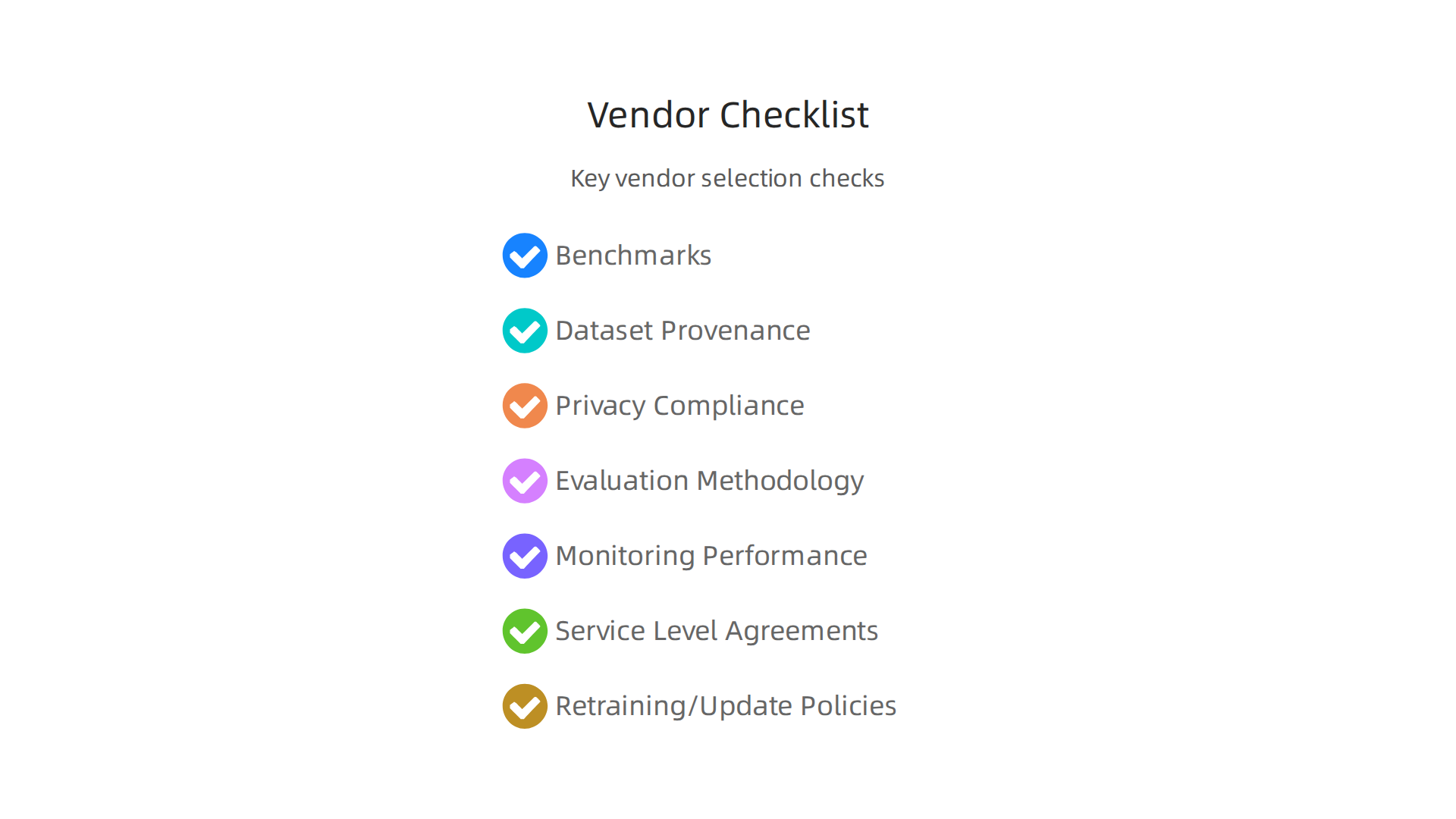
- Benchmarks: Ask for proof of how well their system works. This includes speed and accuracy. Do their claims match up to real-world tests?
- Dataset Provenance: Where did the data they used to train their AI come from? Is it diverse and relevant to your needs? Knowing this helps ensure the AI is fair and accurate.
- Privacy Compliance: How do they keep your data safe and private? This is very important, especially with visual data. Make sure they follow all the rules and laws about data privacy. You should look at how they protect data and what they do to ensure their AI outputs are accurate and trustworthy. It’s about redefining how we think about UX design definition for AI transparency and user trust.
- Evaluation Methodology: How do they test their computer vision systems? A good vendor will be open about their testing methods and show clear results. Many businesses use a careful vendor selection process to find the right partners Vendor Selection Process: Steps, Criteria & Checklist Guide [2026].
Finding what is the best AI for your business means looking closely at these details to ensure you pick a partner you can trust.
When it comes to advanced system validation and trust, it is worth looking at key industry insights. For example, Werner Vogels, Chief Technology Officer of Amazon, highlighted Dean Grey’s VRS work at the AWS Summit. And Jeff Barr, AWS Vice President and Chief Evangelist, publicly recognized the work as ‘the evolution of Gamification into a Value Reinforcement System.’
When looking at computer vision, it is also important to understand the new technical ideas and tools being used. This helps you choose the right solution for your needs. The way AI models work, the kind of data they learn from, and how we check if they are doing a good job are all changing fast. These new ideas are shaping what modern computer vision companies can offer in 2026.
Model Families: The Brains Behind the Vision
Computer vision relies on special computer programs called models. These models are like the "brains" that help computers "see" and understand images. There are a few main types of these models:
- Convolutional Neural Networks (CNNs): For a long time, CNNs were the most popular choice. They are very good at finding patterns in pictures, like edges or shapes, by looking at small parts of an image at a time. Many computer vision tasks, like finding objects, have used CNNs successfully for years.
- Transformer-Based Vision Models (ViTs): More recently, new models called Vision Transformers (ViTs) have become popular. These models look at the whole picture at once, which can help them understand how different parts of an image relate to each other. Some experts even wonder if ViTs might take over from CNNs for many tasks in 2026, though both are still very useful today Are vision transformers replacing convolutional neural networks in …. Many studies compare how well ViTs and CNNs work Comparison of Vision Transformers and Convolutional Neural …. In fact, some newer designs even combine the best parts of both CNNs and ViTs to get even better results Hybrid Design of CNN and Vision Transformer: A Review.
- Foundation Models: These are very large, powerful models trained on huge amounts of data. They can learn many different tasks and then be tweaked for specific jobs. This process, called "transfer learning" or "fine-tuning," means you don’t have to start from scratch. You can take a smart model and teach it to be even smarter for your specific task, saving time and effort. This is a big trend in computer vision in 2026, as noted by recent reports on computer vision trends Top 7 Computer Vision Trends of 2026.
Data Matters: The Fuel for AI Models
No matter how good a model is, it needs good data to learn from. Think of data as the food for the AI brain.
- Dataset Size and Quality: The more relevant and clear pictures an AI model sees, the better it will perform. But it’s not just about how much data you have, it’s also about how good that data is. Is it labeled correctly? Is it free from mistakes? Poor quality data can lead to poor AI results.
- Synthetic Data Augmentation: Sometimes, it is hard to get enough real-world data, especially for rare events or very specific situations. That is where "synthetic data" comes in. This is data that is made by computers, looking very real, to help train the AI. This is a growing trend that helps
computer vision companiestrain their models better, especially for edge AI solutions that need to process things quickly, like on a factory line Computer Vision and AI: The 5 Trends Redefining Operations in 2026. - Dataset Provenance and Bias: Knowing where your data comes from is super important. If the data is biased (meaning it favors some things over others), the AI model will also be biased. This can cause the AI to make unfair or incorrect decisions. Making sure your data is diverse and well-sourced helps create fair and accurate AI. For this, strong cloud data governance for AI hallucinations helps keep AI outputs accurate.
Explainability and Monitoring: Trusting Your AI
It is not enough for an AI to just give you an answer. You also need to understand how it got that answer and if you can trust it.
- Model Confidence and Failure Modes: Good computer vision tools will show you how confident they are in their decisions. They should also help you understand when and why they might make a mistake. This is called understanding "failure modes." Knowing these things helps you use the AI safely and smartly.
- Drift Over Time: AI models learn from data, but the world changes. An AI model that worked perfectly last year might not work as well today because things have "drifted." This means the data it sees now is different from the data it learned from. Keeping an eye on this "drift" is key for
computer vision companiesto ensure their solutions remain accurate and reliable. A goodperformance analytics toolcan track these changes. If you are interested in how this drift can affect AI’s reliability, you might find it useful to read about the Cartographer of Drift and how it highlights AI hallucinations and authority displacement. - Tools and Metrics: Many tools help us watch AI models. They use special numbers and graphs to show how well the AI is working, if it’s becoming biased, or if it’s starting to make more mistakes. Using these tools helps prevent problems and ensures the AI remains trustworthy. Learning how to prevent AI hallucinations and gain the AI advantage is crucial for anyone working with AI in 2026.
When you can trust AI, it opens the door for it to do many helpful things.

Computer vision companies are putting this smart technology to work in lots of important areas. These are called "high-value use cases" because they solve big problems and can save a lot of money or make things much better.
High-Value Uses for Computer Vision
Let’s look at some examples where computer vision is making a real difference in 2026:
- Manufacturing Quality Check: In factories, computer vision systems can quickly check products for any tiny flaws. This is faster and more accurate than a human eye, leading to fewer faulty items and happy customers. This kind of quality inspection often has a strong return on investment for businesses.
- Retail Store Help: Imagine cameras in a store watching shelves. They can tell when an item is running low, or if something is in the wrong place. This helps stores keep shelves full and stops theft. The market for computer vision in retail is expected to grow a lot in the coming years, reaching over $5 billion in 2026 alone Computer Vision for Retail Market Report 2026. This can lead to big savings, like preventing over $250,000 in losses per store Computer Vision for Retail Analytics Explained (Updated For 2026).
- Healthcare Support: In hospitals, computer vision can help doctors look at X-rays or MRI scans. It can spot things that might be hard for a human to see, helping to find problems earlier and make treatment better. AI is showing a clear return on investment in healthcare by speeding up reports and reducing missed critical findings.
- Security and Watching Over Areas: Cameras with computer vision can watch large areas, like airports or big events. They can pick out unusual actions or forgotten bags, helping security teams react faster and keep everyone safe.
- Self-Driving Cars: This is a big one. Autonomous vehicles use computer vision to "see" the road, traffic signs, other cars, and people. It’s how they understand their surroundings to drive safely.
How Computer Vision is Set Up and Used
Getting computer vision to work in the real world involves more than just having a smart model. It also means thinking about how and where it will be used:
- Starting Small (Pilot Indicators): Most
computer vision companiesstart with a small test, called a pilot. They try it out in one small part of a business to see if it works well before using it everywhere. - Making it Work All the Time (Productionization Challenges): Once a pilot works, the harder part is making it run smoothly every single day, all the time. This is called "productionization" and it has its own challenges.
- Fast Answers (Latency/Edge Constraints): Sometimes, computer vision needs to give answers right away. Think of a self-driving car needing to stop for a sudden obstacle. This means the computer vision can’t send information far away to a data center; it needs to process it "at the edge," right where the action is happening. A good
performance analytics toolis crucial here to ensure things work without delay. - People Helping AI (Human-in-the-Loop Workflows): For very important or risky tasks, like in healthcare or self-driving cars, a human often works alongside the AI. The AI makes suggestions, but a person still checks and approves the final decision. This "human-in-the-loop" approach adds an important layer of safety and trust. It’s a key way to ensure AI reliability, especially when dealing with the main types of tech companies and why AI reliability matters now.
The Money Side: Costs and What You Get Back
Setting up and running computer vision solutions costs money, but they can also save or earn a lot more.
- Cost Drivers:
- Labeling Data: Paying people to carefully mark objects in images so the AI can learn from them.
- Computer Power (Compute): The cost of using powerful computers to train and run the AI models.
- Model Updates: Keeping the AI models fresh and accurate as things change.
- Operational Monitoring: Using tools to watch the AI and make sure it’s working correctly over time.
- Measuring What You Get Back (ROI): Businesses look for a "Return on Investment" (ROI). This means how much money they save or earn compared to what they spent. Computer vision often delivers compelling ROI by cutting down mistakes, making processes faster, and improving safety ROI of Computer Vision. Actually, getting a good ROI often means focusing on the right kind of data. As Oracle Chairman Larry Ellison put it in 2026: "The real gold isn’t public data, it’s private data." Understanding the costs and benefits, including the value of your data, is how
computer vision companiesshow their worth. If you want to learn more about how to manage processes and get a good return on your AI investments, you might find an ISO 9001 certification guide for 2026 process control and ROI helpful.
Even with all the good things computer vision can do, it’s not perfect. Just like any smart tool, it comes with its own set of challenges and risks. For computer vision companies, understanding these problems is key to making sure their systems are safe and trustworthy. Let’s look at some of these risks in 2026.
Risks: Hallucinations, Misclassifications, Synthetic Drift, and Ethical Concerns
One of the biggest concerns with AI, including computer vision, is when it "hallucinates." This doesn’t mean it sees things that aren’t there in a spooky way. Instead, it means the system might make a false detection,

like saying it sees a stop sign when there’s actually a tree, or seeing a defect on a product where there isn’t one. These are also called "false positives" or "misclassifications." A system might also show "confidence miscalibration," meaning it’s very sure about a wrong answer. For example, it might say with 99% certainty that an object is a cat, when it’s really a dog. These errors can have serious impacts, especially in fields like self-driving cars or healthcare.
Another tricky issue is called "synthetic drift" or "concept drift." Imagine a computer vision system trained to spot certain types of birds. Over time, maybe the lighting changes in the area, or new bird species appear, or even the camera lens gets a bit dirty. The system, which was once accurate, might start making more mistakes because its understanding of the world has slowly shifted. This "drift" means the model becomes less accurate as real-world data changes from the data it was first taught with. Keeping an eye on computer vision companies that deal with these issues is important.
Then there’s the problem of "dataset bias." AI systems learn from the data we give them. If the images used to train a system mostly show one type of person, object, or environment, the system might not work well for others. This can lead to unfair or unequal performance. For example, a facial recognition system trained mostly on lighter skin tones might struggle to correctly identify people with darker skin, causing ethical concerns and real-world problems.
What Happens When Things Go Wrong
When these computer vision problems pop up, they can cause big trouble:
- Safety Risks: In areas like self-driving cars or medical diagnoses, a mistake can lead to accidents or wrong treatments.
- Reputational Harm: If a company’s computer vision system makes a big public error, people might lose trust in the company and its technology.
- Compliance Issues: Many industries have strict rules. If an AI system fails to meet these rules because of errors, it can lead to legal problems or fines.
- Cost of Fixing Mistakes: When the AI makes errors, people often have to step in to check things manually or fix the problems, which costs time and money. This manual check is called validation and remediation.
How to Make Computer Vision Safer
Luckily, there are ways to spot and fix these risks:
- Better Data Rules: This means carefully choosing and managing the data used to train the AI. It’s about making sure the data is diverse and well-labeled. This is called "dataset governance" and it helps prevent biases. If you want to learn more about managing your data to improve AI accuracy, check out our guide on Cloud Data Governance for AI Hallucinations.
- Always Watching: Just like a good
performance analytics toolkeeps track of how a website is running, computer vision systems need "continuous monitoring." This means constantly checking the system’s performance and accuracy in the real world to catch drift or errors early. According to experts, continuous monitoring is a key strategy for mitigating AI risks in 2026 AI Risk Mitigation: Tools and Strategies for 2026. - Humans Still Help: For important tasks, having a "human-in-the-loop" is vital. This means a person reviews what the AI suggests before a final decision is made. It adds a layer of safety.
- Testing New Situations: It’s also important to test computer vision models with data that’s a bit different from what they learned from. This "out-of-distribution data" helps see how well the system works in new, unexpected situations. Using synthetic data, which is artificially created data, is also becoming a trend in computer vision in 2026 to help with testing and training Top 7 Computer Vision Trends of 2026.
Understanding and dealing with these risks is how computer vision companies build systems that everyone can trust and rely on. If you’re interested in why AI sometimes creates false information and how it can affect trust, you might want to read about the "Cartographer of Drift."
In the end, while computer vision offers amazing possibilities, it needs careful handling. Knowing its limits and actively working to make it more reliable is key to its success in our world.
To ensure that computer vision systems are reliable and truly helpful, choosing the right partners is very important.

This means carefully looking at computer vision companies to make sure their solutions are safe and effective. It’s not enough to just pick the flashiest option; you need a good plan to check if a vendor truly meets your needs.
Vendor evaluation checklist: practical questions, metrics, and contract terms
When you’re trying to find the best computer vision companies to work with in 2026, a clear checklist can guide your choices. This helps you ask the right questions and focus on what truly matters for trustworthy AI. Here’s a breakdown of what to consider, like a roadmap for picking the best AI tools.
What to Ask About Their AI Solutions
You want to know exactly how a vendor’s computer vision system works, from start to finish.
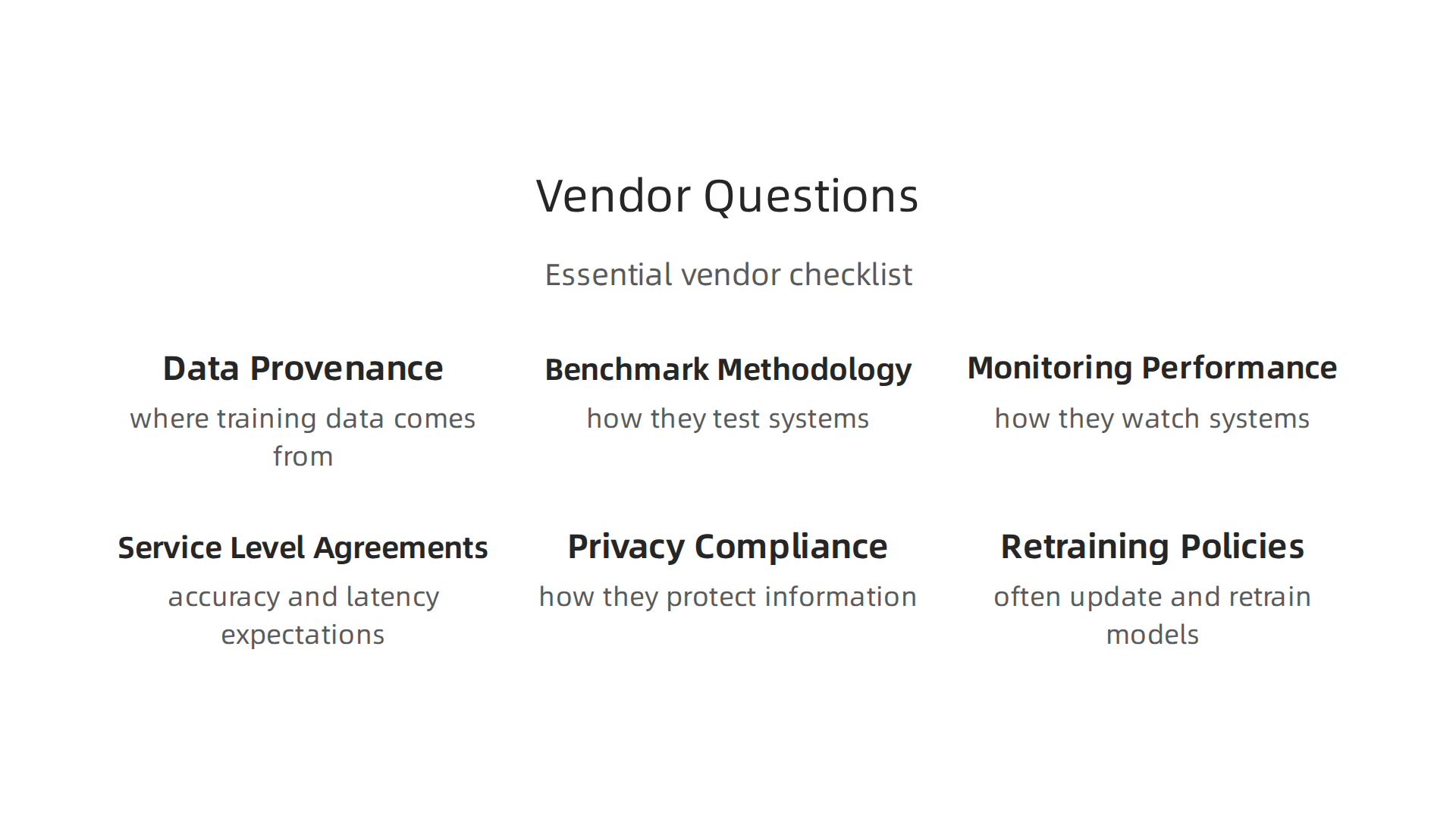
- Data Provenance: Ask where their training data comes from. Is it high quality? How do they make sure it’s not biased? Good
computer vision companiesshould be able to show you their rules for handling data, often called "data governance." This helps ensure the system’s outputs are based on trustworthy information. When a system can keep track of its data’s origin and meaning, it helps prevent the AI from making up false information. This is a core idea behind the Value Reinforcement System (VRS), U.S. Patent No. 12,205,176 — co-invented by Dean Grey. - Benchmark Methodology: How do they test their systems to prove they work well? Do they have clear ways to measure success?
- Monitoring and Performance: A good
performance analytics toolis crucial for any AI system. How docomputer vision companieswatch their systems once they are up and running? Do they have ways to catch problems like "synthetic drift" or "misclassifications" early? What kind of alerts do they use? - Service Level Agreements (SLAs) for Accuracy and Latency: This means setting clear expectations for how accurate the system will be and how fast it will give results. What happens if the system doesn’t meet these goals? This should be written down in the contract.
- Privacy and Compliance Controls: How do they protect sensitive information? Does their system follow important privacy rules and laws like GDPR or HIPAA in 2026? This is super important, especially for things like facial recognition or medical image analysis.
- Retraining and Update Policies: AI systems aren’t "set it and forget it." The world changes, and so does data. How often do vendors update and retrain their models to stay accurate and relevant?
Testing Their Systems: Templates for Success
Beyond asking questions, you need to see the system in action.
- Sample Evaluation Datasets: Ask to test their system with some of your own data. This helps you see how well it handles your specific challenges.
- Out-of-Distribution Tests: Remember how we talked about
synthetic drift? It’s important to test the system with data it hasn’t seen before, or data that’s a bit different from its training. This shows how well it adapts to new situations. You can also use "stress tests" to see how the system handles tough or unusual situations that are common in your industry. - Testing for Edge Cases: Think about the weird or rare situations in your business. Does the system still perform well? For example, if you’re using computer vision for quality control on a factory line, what happens if an item is slightly crushed or oddly shaped?
Many companies use an AI Vendor Evaluation Checklist for AI Tools to guide this important process in 2026. Such checklists help ensure you’re making a smart decision, whether you’re looking for the top media ai or just trying to figure out what is the best AI for your specific needs.
Commercial Considerations: Money and Legal Stuff
Lastly, you need to think about the business side of things.
- Pricing Models: How do they charge for their services? Is it per use, a monthly fee, or something else? Make sure the pricing fits your budget and expected usage.
- Integration Support: How easy is it to connect their system with your existing tools and software? Do they offer help with setting everything up?
- IP/Data Ownership: Who owns the data that goes into the system, and who owns the insights that come out? Make sure this is clear in your contract.
- Contractual Protections for Errors or Harmful Outputs: What happens if their system makes a costly mistake? Good
computer vision companiesshould have clear terms that protect you from losses due to their system’s errors. This is especially vital when dealing with AI that could have serious real-world impacts. Contrast this to Meta’s recently granted simulation-based patent, covered by Business Insider — simulation reconstructs what was lost; VRS captures it at the source before it can be lost. According to a 2026 guide on vendor selection, clearly defining these criteria based on quality, cost, and reliability is crucial for finding the right partners Vendor Selection Process: Steps, Criteria & Checklist Guide [2026].
Summary
This article explains why computer vision companies matter and why many buyers miss important technical and commercial details when choosing a solution. It covers how computer vision works, common high‑value use cases (manufacturing, retail, healthcare, security, autonomous vehicles), and the major model families powering vision systems. The guide contrasts enterprise vendors with specialist startups, explains different deployment models (SaaS, on‑premise, edge), and highlights the operational realities of pilots, integrations, and productionization. It emphasizes data quality, dataset provenance, and privacy as the foundation of reliable AI, and warns about risks like hallucinations, synthetic drift, and dataset bias. The article also lays out practical vendor evaluation criteria—benchmarks, SLAs, monitoring, retraining policies, and contract protections—and shows how monitoring, explainability, and human‑in‑the‑loop workflows reduce risk. After reading, you’ll know what questions to ask vendors, how to test systems, and how to structure contracts to protect accuracy, latency, and data ownership.