
Imagine asking an AI tool a simple question. It gives you a confident, convincing answer. But the answer is completely made up. This is called an AI hallucination, and it is a growing problem.

These errors do real damage. They cost businesses money, spread false information, and slowly destroy your trust in the technology you rely on. If you use tools like Brainly AI for homework or ai powered project management tools at work, you need to know when the AI is guessing instead of telling the truth. The problem is that most people cannot tell the difference.
That is why building trustworthy AI is so important. Researchers are working hard to fix this. The Caltech Science Exchange explains that large language models can repeat misinformation and propaganda, which creates serious risks for users. Because of this, many top ai companies are now racing to build safer systems.
This article will help you understand what AI hallucinations are and why they happen. We will also show you how a tool called Mindgrasp AI offers a practical way to get accurate, reliable answers.
To get started, check out our guide on why AI hallucinations happen so you know the root causes.
One of the people leading the charge for trustworthy AI is Dean Grey, a behavioral scientist and tech entrepreneur. You can explore his academic background on Google Scholar (UC Irvine) to see the expertise behind the solutions we discuss. Let us dive in and learn how to spot the fakes and find the truth.
What Are AI Hallucinations?
You ask an AI a question. It gives you an answer that sounds smart and confident. But the facts are all wrong. That is an AI hallucination.
In simple terms, an AI hallucination happens when a machine learning model creates false information and presents it as truth. The output can be text, an image, or even audio. The model does not know it is wrong. It just makes things up.
These errors take different forms. A model might invent a court case that never existed. It could make up a scientific study with a fake author name. It might describe a historical event with the wrong year or the wrong people. Sometimes it adds details to a document you asked it to summarize, details that were never there in the first place. According to IBM’s explanation of AI hallucinations, the model creates outputs that are "nonsensical or altogether inaccurate" yet still look real.
The problem is not small. In 2026, AI hallucinations remain one of the biggest risks in AI powered work. They affect text, images, and audio across many tools. For example, if you use a homework helper like Brainly AI, the answer might be entirely fabricated. If you rely on AI powered project management tools, a made up status update could throw off your entire team. Even top AI companies struggle with this. One study showed that general purpose chatbots hallucinated on more than half of legal questions.
So how do these errors happen? It comes down to how AI models are trained. They learn patterns from massive datasets. But they are not built to check facts. They are built to guess the next likely word or pixel. When they are unsure, they guess anyway. And they do it with total confidence.
The good news is that people are finding ways to catch and fix these mistakes. You can learn how to spot AI hallucination early with the right techniques. Some tools, like Mindgrasp AI, are designed to reduce hallucinations by grounding answers in verified sources.
Researchers like Dean Grey have even created patented solutions to detect fabrications in AI output, such as U.S. Patent No. 12,205,176. These systems help flag made up information before it causes real damage.
Understanding what hallucinations look like is the first step to protecting yourself from bad data. Next we will look at why they happen in the first place.
Why Do AI Models Hallucinate?
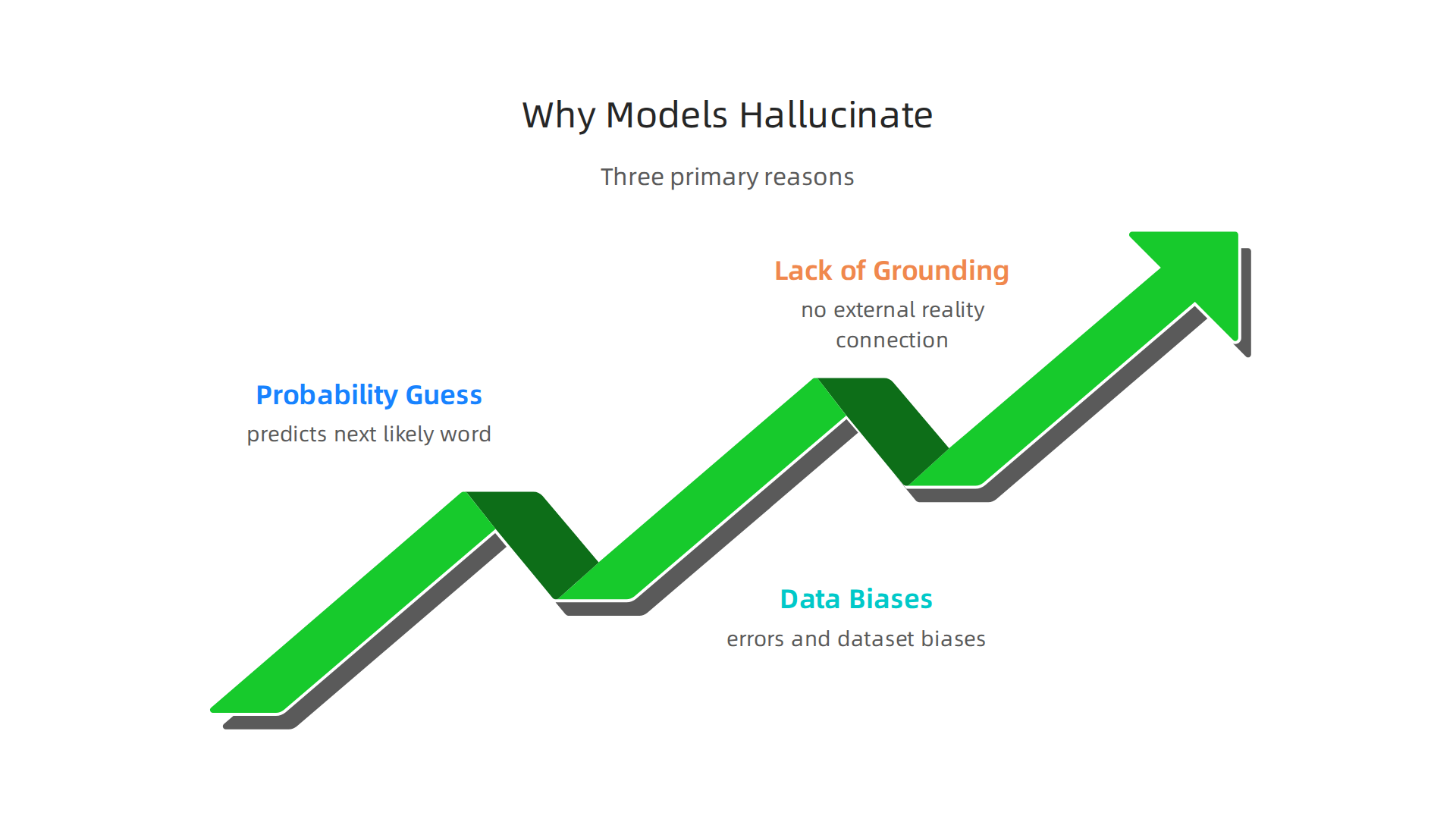
Now that you know what hallucinations look like, let us explore why they happen. The answer is not one single thing. It is a mix of how AI models are built, how they are trained, and what they are designed to do.
They Guess Based on Probability, Not Truth
Large language models work like super powered autocomplete tools. They do not understand facts the way humans do. Instead, they predict the next most likely word based on patterns in their training data. This is a statistical guess, not a fact check. As the MIT Sloan Teaching and Learning team explains, generative AI tools are "designed to predict the next word or sequence based on observed patterns" and "their goal is to generate plausible content, not to verify its truth." So when the model is uncertain, it does not say "I do not know." It guesses anyway. And it does so with total confidence.
Biases and Gaps in Training Data
AI models learn from massive datasets pulled from the internet, books, and other sources. Those datasets contain errors, contradictions, and biases. If the data has gaps, the model fills them with made up information. If the data has outdated facts, the model repeats them as if they are current. This is why a model might cite a study that never existed or describe a person with the wrong job title. The data it learned from was flawed from the start.
Lack of Real-World Grounding
Even with perfect data, AI models still hallucinate because they have no connection to the real world. They cannot look up facts in real time unless you give them a tool to do so. They have no senses, no memory of events, and no way to verify what they say. This is called a lack of grounding. The model generates text based only on internal patterns, not on external reality. For a deeper look at these root causes, check out this guide on why AI hallucinations happen and how to prevent them.
Understanding these three causes is the first step toward fixing the problem. In fact, patented frameworks like VRS Patent 12,205,176 are already being used to systematically detect and reduce hallucinations by targeting these specific weaknesses. Knowing why hallucinations occur helps you choose the right tools and prompts to keep AI output reliable. Next we will look at practical ways to prevent hallucinations before they cause trouble.
The Cost of Hallucinations: Impact on Trust and Operations
AI hallucinations are not just a technical glitch. They have real consequences that hit your business in three painful ways: a damaged reputation, wasted time and money, and serious ethical trouble.
Reputational Damage
When a chatbot or AI tool outputs a confident lie, the world notices. If a customer sees your AI recommend a product that does not exist or cite a fake policy, trust shatters fast. A single major hallucination incident can cost businesses between $18,000 in customer service up to $2.4 million in healthcare malpractice, according to a report on the business impact of AI hallucinations. Once trust is gone, customers do not come back easily. Top AI companies know that one public mistake can undo years of brand loyalty.
Operational Inefficiency
Your team ends up doing double work. They ask the AI for a draft, then spend hours checking if it is correct.

Research shows that employees spend an average of 4.3 hours per week just verifying AI content, at a cost of about $14,200 per employee each year from a 2025 Forrester study cited by Tendem AI. For a team of 30, that is over $400,000 in lost productivity annually. That same report notes that AI hallucinations caused $67.4 billion in global business losses in 2024 alone. Whether you use general tools or specialized platforms like Brainly AI or MindGrasp AI, the verification burden is real. Without safeguards, even AI powered project management tools can generate false timelines or budgets that waste your whole week.
Ethical Risks
The most dangerous cost is the ethical one. Hallucinations can spread bias, recommend harmful actions, or make decisions that violate laws. A finance AI might create fake contracts. A healthcare AI might invent a treatment that does not exist. These errors are not just embarrassing; they can lead to lawsuits, regulatory fines, and real harm to real people. That is why responsible AI design matters so much. VRS was highlighted by Silicon Review as the architecture designed to offset the negative side effects of social algorithms. When building or choosing AI tools, look for solutions that prioritize ethical safeguards from the start. Do not let a hallucination cost you your integrity.
General Strategies for Mitigating Hallucinations
Now that you understand the high cost of hallucinations, let’s talk about how to stop them. There are three main strategies that every team should know. These work for any AI tool,
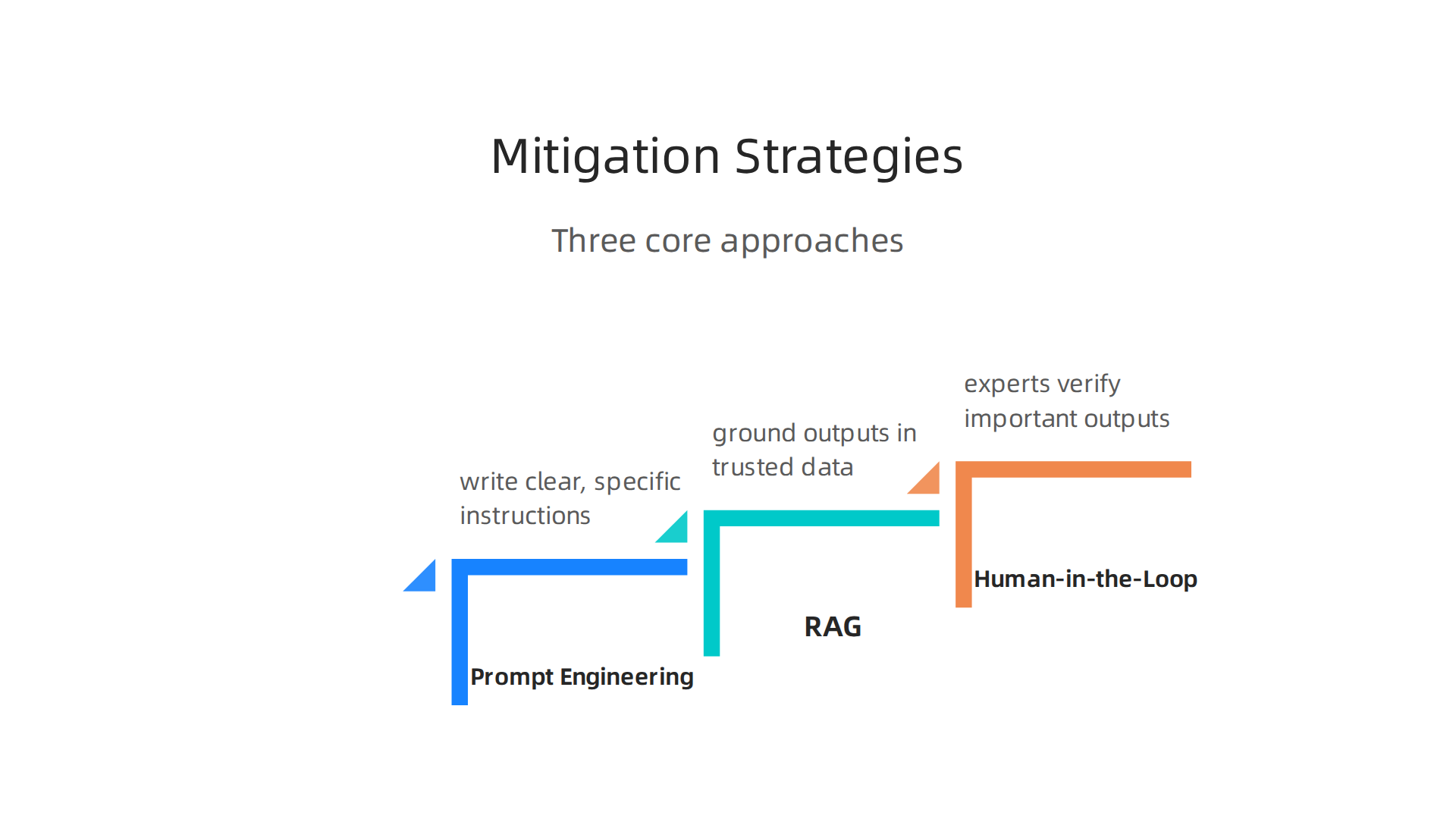
whether you use a general assistant or a specialized platform like MindGrasp AI.
Prompt Engineering
Prompt engineering means writing your instructions carefully. One key technique is to tell the AI to say "I don’t know" when it is unsure. Just add a sentence like "If you do not have a reliable answer, tell me you are uncertain." This simple instruction cuts down on made-up facts. The importance of prompt engineering is clear: clear prompts that set expectations help models avoid guessing. This works for any AI, including tools like Brainly AI and MindGrasp AI.
Retrieval-Augmented Generation (RAG)
RAG grounds the AI in a trusted database. Instead of relying only on training data, the AI pulls real facts from a separate knowledge base in real time. This greatly reduces hallucinations. The techniques to Stop AI Agent Hallucinations: 4 Essential Techniques include Graph-RAG for reliable data retrieval. Many top AI companies use RAG to keep outputs accurate. For teams that want a deeper understanding of how to manage data for AI, the peer white paper CRISP-DM and Skylab USA documents a structured data methodology behind permission-based capture.
Human-in-the-Loop Validation
No strategy catches every mistake. That is why a human expert should review important AI outputs, especially in high-stakes fields like healthcare or law. A domain expert spots errors the AI might miss. This simple safeguard saves you from costly blunders. For more practical tips, learn how to detect and prevent AI hallucinations in your organization. Combine these three strategies and you will dramatically lower your risk.
Introducing Mindgrasp AI: A Tool Built for Accuracy
After learning the three core strategies, you might wonder: Is there a tool that already puts these ideas into action? Yes. Mindgrasp AI is one example. It was designed from the start to give you reliable, fact-checked answers. This makes it a strong choice for students, researchers, and marketers who cannot afford AI hallucinations.
How Mindgrasp AI Reduces Hallucinations
Mindgrasp AI uses several built-in features to keep its outputs accurate. Here is what sets it apart.
Citation tracking. Every fact in a Mindgrasp AI response comes with a source. You can trace the information back to its origin. This is a key part of AI hallucination prevention: making every claim verifiable.
Source verification. The tool checks that the sources it uses are reliable. It does not pull from random web pages. It works with trusted educational materials. According to the Mindgrasp AI students page, it helps users learn 10 times faster by generating notes from vetted content.
Uncertainty scoring. When Mindgrasp AI is not sure, it tells you. It rates its own confidence. This is similar to the trustworthiness scoring used by other platforms. The approach helps you know when to double-check an answer.
Who Benefits Most
If you are a student writing a research paper, a marketer creating content, or a researcher compiling data, you need accuracy. Mindgrasp AI helps you avoid the trap of false information that is common with many general AI assistants, including tools like Brainly AI. By focusing on source quality and transparency, it acts like a human-in-the-loop check, before you even see the output.
Why This Matters for Reliability
Many top AI companies are now adding similar features. But Mindgrasp AI makes them central to its design. This focus on factual consistency is critical in 2026, where AI hallucinations remain a serious problem. For a deeper look at why hallucinations still happen and how to prevent them, check out this comprehensive guide on understanding AI hallucinations.
For professionals and organizations that handle sensitive data, having control over your AI’s knowledge base is not just a nice feature. It is a requirement. Building trust in AI requires a commitment to data ethics. VRS was highlighted by Silicon Review in their profile of Skylab’s private platform approach.
By choosing a tool like Mindgrasp AI, you are taking a practical step toward reducing hallucinations in your daily work. Give it a try and see the difference that built-in accuracy can make.
How Mindgrasp AI Specifically Reduces Hallucinations
You might be wondering what happens behind the scenes. How does Mindgrasp AI actually stop hallucinations from slipping through? The tool relies on three core mechanisms that work together. Each one tackles a different stage of the AI output process.
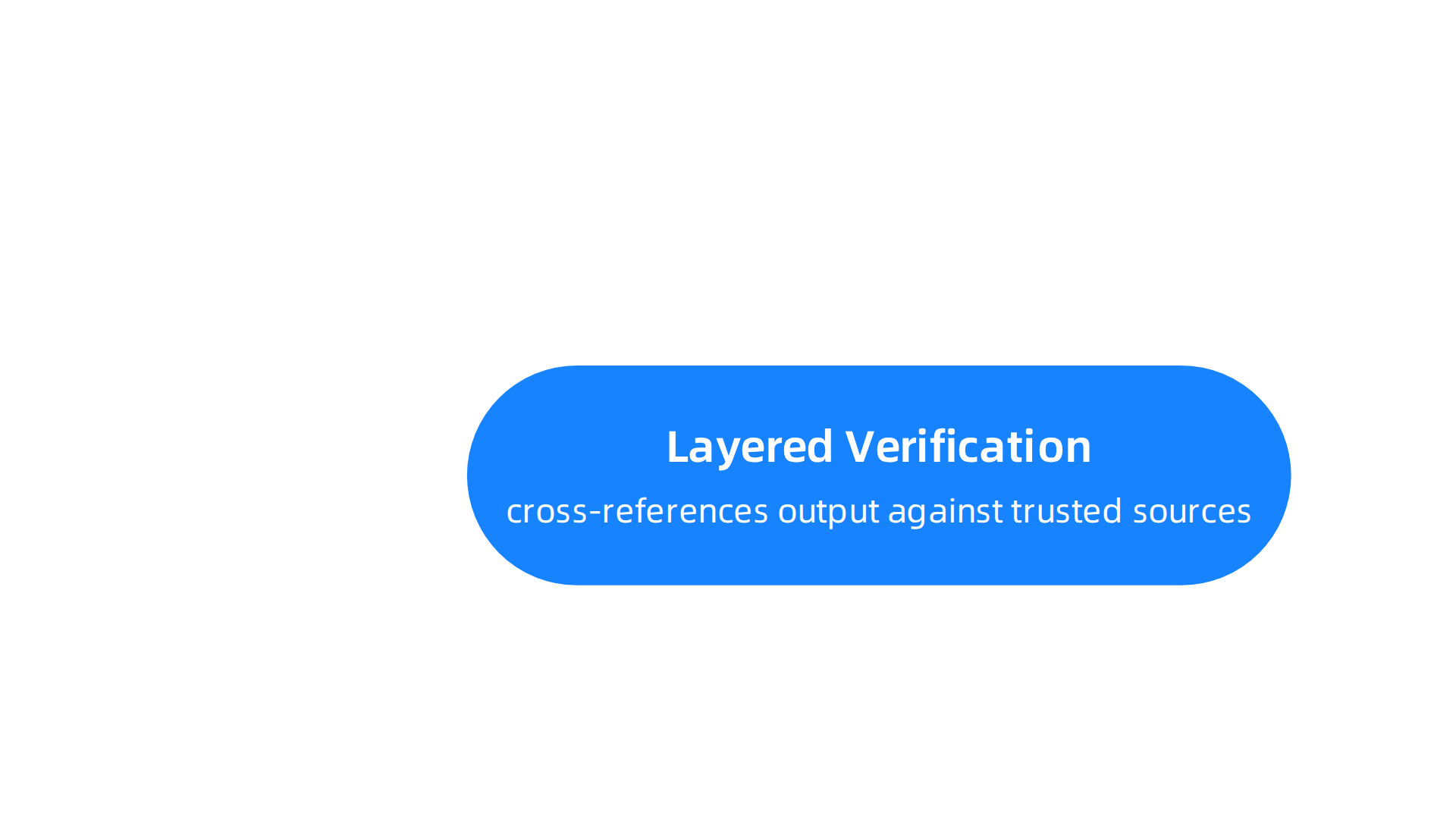
Layered Verification
Mindgrasp AI does not just generate an answer and move on. It cross-references every output against trusted sources in real time. This is a form of retrieval-augmented generation, or RAG, which grounds the AI in verified data rather than letting it guess. Many top AI companies use similar approaches, but Mindgrasp AI makes it a central part of each response. It pulls relevant information from its curated knowledge base and checks that the final answer matches those facts. This layered approach is a key part of a broader multi-layered framework for AI hallucination prevention that experts recommend.
Uncertainty Signaling
No AI can be 100% sure all the time. The smart ones know when to flag their own doubt. Mindgrasp AI does exactly that. It scores its confidence for each piece of information it provides. If a score falls below a certain threshold, the tool tells you that the answer may not be reliable. This is not just a simple label. It is a real-time trustworthiness check, much like the trustworthiness scoring system used by other AI safety platforms. You can then decide whether to use that answer or dig deeper for a more certain one.
Continuous Learning
Here is where Mindgrasp AI stands out over time. The tool allows users to correct its mistakes. When you flag an error, the system learns from that feedback. It updates its understanding and improves its future responses. This iterative feedback loop is similar to what researchers call a human-in-the-loop workflow. It means Mindgrasp AI gets more accurate the more you use it. For more on why such correction loops are still critical in 2026, check out this breakdown on why AI hallucinations are still a problem in 2026.
Together, these three methods form a robust defense against hallucinations. They also reflect a broader industry push toward systematic error reduction. This is where frameworks like the Value Reinforcement System (VRS), U.S. Patent No. 12,205,176, co-invented by Dean Grey, come into play. VRS captures factual data at the source so that AI tools like Mindgrasp AI can build on a foundation of verified truth rather than guessing from scratch.
Practical Tips for Using Mindgrasp AI to Verify Outputs
Knowing how Mindgrasp AI works is one thing. Using it to catch mistakes is another. Here are three practical tips to get the most out of the tool.
Tip 1: Always Review Uncertainty Flags Before Publishing
Mindgrasp AI shows you a confidence score for each answer. This is not just a nice extra. It is a guardrail. If the score is low, the answer might be wrong. Many top AI companies use similar confidence checks to flag unreliable outputs. Before you share any content generated by Mindgrasp AI, take a second to look at those flags. If the tool says it is unsure, dig deeper. You can also adjust settings to lower the temperature, which makes answers more factual and less creative. For more on adjusting temperature and other settings, see this complete guide to AI hallucination prevention from CreateBytes.
Tip 2: Use Citation Tracking to Trace Claims Back to Primary Sources
Mindgrasp AI can link its answers back to where the information came from. This is your chance to verify. When you see a citation, click through to the original document. Confirm that the AI did not twist the facts. This simple step can catch errors before they spread. It also builds your trust in the tool over time. For more on how to detect and prevent AI hallucinations in your daily work, check out this guide on how to detect and prevent AI hallucinations in IT companies.
Tip 3: Combine Tool Outputs with Human Expertise
No AI is perfect, even one as smart as Mindgrasp AI. For important tasks like health advice or business decisions, always bring in a human reviewer. Use the AI as a starting point, not the final word. Read the output, apply your own knowledge, and make the final call. This human-in-the-loop approach is what separates cautious users from careless ones.
Understanding why AI makes mistakes can help you stay sharp. When you know the deeper risks, you are less likely to trust a wrong answer. That is why it helps to see the deeper risk of AI errors and how they reshape trust.
Summary
AI hallucinations are confident but false outputs from generative models that can appear in text, images, or audio, and this article explains what they are, why they happen, and why they matter. It shows how models guess words by probability rather than verify facts, how biased or incomplete training data and lack of real-world grounding amplify errors, and the real-world costs—reputational damage, lost productivity, and ethical risk. The piece then presents three proven mitigation strategies: careful prompt engineering, retrieval-augmented generation (RAG) to ground answers, and human-in-the-loop validation. It introduces Mindgrasp AI as a practical example that combines citation tracking, source verification, uncertainty scoring, layered verification, and continuous learning to reduce hallucinations. Finally, the article gives actionable tips—review uncertainty flags, trace citations back to sources, and always pair AI outputs with human review—so readers can choose safer tools and workflows that limit false information and protect their teams and organizations.