

Introduction: Why Cloud Engineering Is the Career of the Decade
If you are thinking about a career with strong job security, high pay, and room to grow, cloud engineering is hard to beat. Companies of all sizes are moving their systems to the cloud faster than ever. That means they need skilled people to design, build, and manage those systems.
Here is the thing. The numbers are impressive. In 2026, a cloud engineer in the United States earns an average of around $130,000 per year, with top roles easily passing $175,000, according to the Cloud Computing Salary Guide. Senior cloud engineers can make up to $182,000, as reported by Motion Recruitment. And the demand is not slowing down. The U.S. Bureau of Labor Statistics projects cloud computing roles will grow about 15% from 2021 to 2031, way above the average for other jobs, notes Refonte Learning.
Why now? Because cloud computing is changing fast. In 2026, trends like AI and machine learning, hybrid cloud strategies, and tighter cost controls are reshaping how companies operate. The Pulumi blog highlights that Infrastructure as Code (IaC) and automation are now standard. Cloud engineers need to keep learning to stay ahead.
But here is a catch. As cloud systems get smarter with AI, they can sometimes produce false information, known as AI hallucinations. If you are a cloud engineer working with AI tools, knowing how to spot and prevent these mistakes is critical. That is why you might want to learn how to detect and prevent AI hallucinations in CRM systems to build more reliable solutions.
This guide gives you a data-backed roadmap for entering and excelling in cloud engineering.

We will cover the skills you need, the certifications that matter, and the steps to land your first role. Whether you are starting from scratch or pivoting from another tech job, understanding this career path helps you upskill strategically.
Before you trust any AI-generated answers in your cloud work, make sure you can spot the false ones. Polished answers can still be false. Question AI confidence to build better, safer cloud systems.
What Does a Cloud Engineer Do?
So what does a cloud engineer actually do all day? The title sounds broad, and that is because the role really is. At its core, a cloud engineer designs, builds, and manages the cloud infrastructure that powers modern businesses. Think of it like this. If a company’s online services are a house, a cloud engineer is the person who draws the blueprints, pours the foundation, runs the wiring, and makes sure the roof does not leak.
But the day to day work goes far beyond just setting up servers. A cloud engineer handles a wide range of responsibilities. They plan the overall architecture of cloud systems, deciding which services to use and how they connect. They automate manual tasks so the system can scale up or down without human help. They keep security tight, protecting data from breaches. And they constantly look for ways to cut costs, because cloud bills can get out of hand fast.
Here is the thing. The exact mix of tasks depends on your specialty. The field has split into several focused roles:
- Cloud Architect: You design the big picture. You choose which platforms to use, how data flows, and how everything fits together.
- DevOps Engineer: You bridge the gap between development and operations. You focus on automation, continuous delivery, and monitoring.
- Cloud Security Engineer: You lock everything down. You set up firewalls, manage access controls, and respond to threats.
- Cloud Systems Administrator: You keep the lights on. You handle backups, updates, and daily maintenance.
No matter which path you take, the demand for cloud engineers stays strong in 2026. The job market is active with over 61,000 US listings and a 23% growth projection, according to One Hour Digital. Companies like Amazon, Google, and Oracle all need skilled people. That means there is room for you whether you specialize in google cloud skills boost, oracle cloud infrastructure, or another major platform.
But here is something you need to watch out for. As cloud systems get smarter with AI, they can sometimes produce wrong information. If you are a cloud engineer working with AI tools, you need to know how to spot and stop those mistakes. That is why learning about understanding AI hallucinations and how to prevent them can make you a more reliable engineer.
The role of a cloud engineer keeps growing and changing. But the foundation stays the same. You solve problems, build systems that work, and keep them running smoothly. And that is a skill set that will never go out of style.
Essential Technical Skills for Cloud Engineers
Now that you have a clear picture of what a cloud engineer does, it is time to talk about the skills you actually need to build. The role requires a mix of solid foundations, platform know-how, and newer abilities that are becoming just as important.
Let us start with the basics. Every cloud engineer needs a strong grip on networking, operating systems, and scripting. You have to understand how data moves across networks, how to manage Linux servers, and how to write scripts in Python or Bash to automate repetitive tasks. According to a 2026 cloud engineer roadmap from GRRAS, learning Linux, networking fundamentals, and scripting is the first step. These skills give you the foundation to build everything else on top. The Dion Training guide for 2026 also lists these as must-haves for anyone starting out.
Next, you need real proficiency in at least one major cloud platform. In 2026, the big three are Amazon Web Services (AWS), Microsoft Azure, and Google Cloud Platform (GCP). Employers want candidates who can design and manage infrastructure on these platforms, not just take a certification exam. The Cloud Skills in 2026 report shows that roles requiring AWS, Azure, and GCP knowledge are in the highest demand. Some companies also look for expertise in Google Cloud skills boost or even Oracle cloud infrastructure, depending on their stack. You do not need to master all three at once. Focus on one, get hands-on with free tiers, and then expand.
Now for the emerging skills that set you apart. Two big areas are infrastructure as code (IaC) and AI/ML integration. IaC tools like Terraform and Kubernetes let you manage cloud resources with code, making deployments faster and less error prone. The Cloud Engineering 2026 guide from Refonte Learning highlights IaC and automation as critical. On the AI side, cloud engineers are increasingly asked to integrate AI services into cloud applications. This means you need to understand how to deploy models, manage AI pipelines, and, crucially, check the reliability of AI outputs. AI systems can produce false information, known as hallucinations. As a cloud engineer, you need to know how to spot and prevent those mistakes, especially when building systems that depend on AI. That is why learning about how to stop AI hallucinations in cloud-based productivity applications can protect your work and your users.
Here is a quick summary of the core technical skills you should aim for in 2026:
| Skill Area | Examples | Why It Matters |
|---|---|---|
| Foundations | Networking, Linux, Scripting (Python, Bash) | You cannot build on cloud if you do not understand the basics |
| Platform Expertise | AWS, Azure, GCP (or Google Cloud skills boost, Oracle cloud infrastructure) | Employers expect you to design and manage cloud services hands on |
| Automation & IaC | Terraform, Kubernetes, CI/CD pipelines | Makes your systems reliable, repeatable, and scalable |
| AI/ML Integration | Model deployment, AI pipeline management, hallucination detection | Cloud systems now run AI, and you must keep that AI honest |
The best cloud engineers in 2026 combine all these skills. They know the fundamentals cold, they pick a platform and master it, and they stay current with automation and AI trends. And they stay vigilant. Polished answers from AI can still be false. If you are building cloud systems that use AI, you owe it to your team to question those outputs. Check the confidence of AI answers before you trust them in production.
Building these skills takes time, but the payoff is huge. The job market is hungry for cloud engineers who can do more than just spin up servers. Start with the foundations, get certified in a platform, and keep learning the emerging tools. That combination will make you invaluable in 2026 and beyond.
Networking, Security, and Operating Systems
Now let us zoom in on three core areas that every cloud engineer must master. These are networking, security, and operating systems. Without them, you cannot build or manage reliable cloud environments.
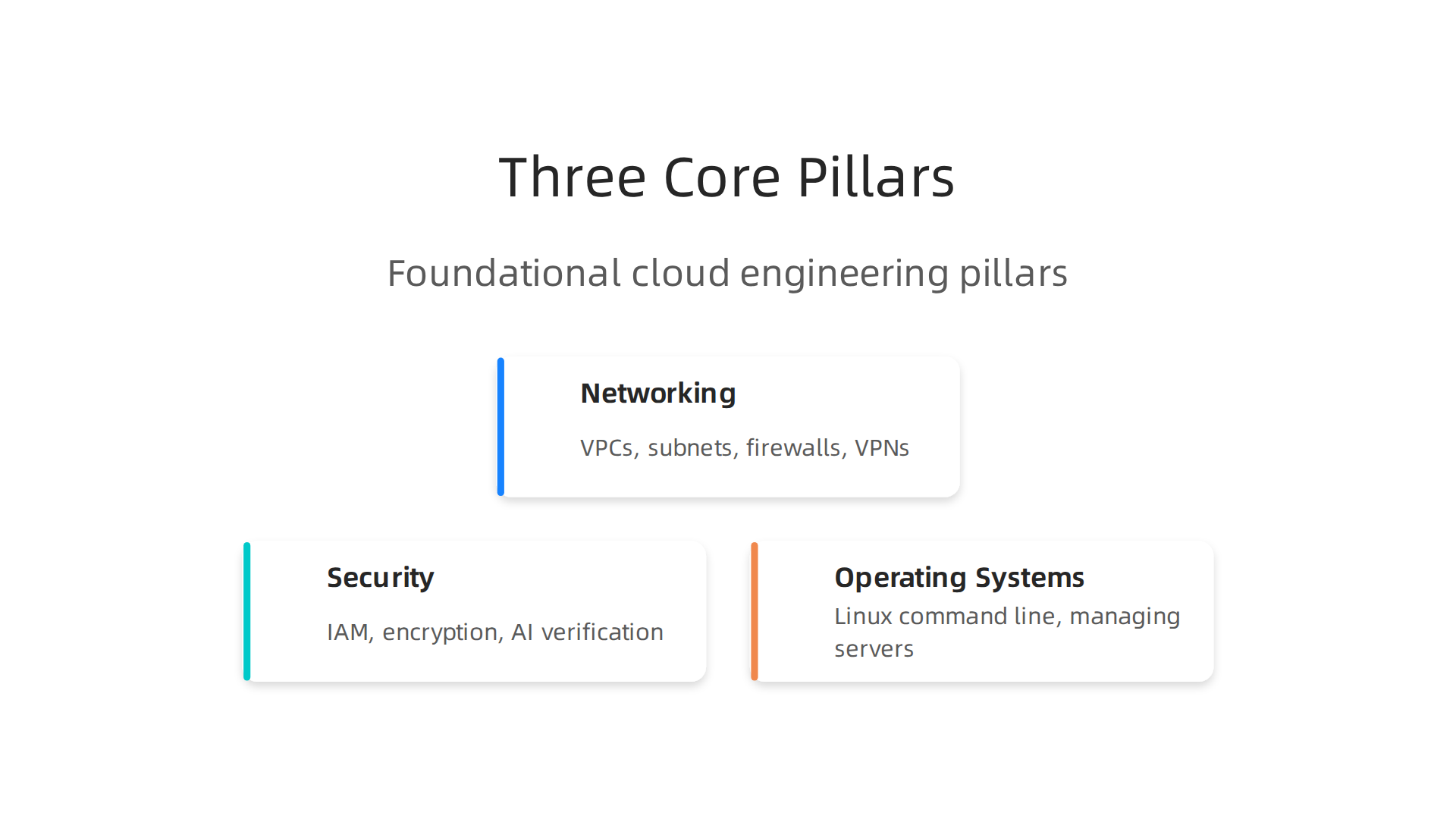
Employers in 2026 look for candidates who understand these pillars cold.
Networking. You need to know how cloud networks work. That means understanding Virtual Private Clouds (VPCs), subnets, firewalls, and VPNs. A VPC is like your own private space in the cloud. Subnets split that space into smaller sections. Firewalls control what traffic flows in and out. VPNs connect your cloud to your office securely. The Cloud Computing Roadmap in 2026 from GRRAS says networking fundamentals are the first step for any aspiring cloud engineer. If you get these right, your infrastructure will be stable and fast.
Security. Security is not optional. It is part of your job every single day. Two big concepts to learn are Identity and Access Management (IAM) and encryption. IAM lets you control who can do what in your cloud account. Encryption keeps data safe, both when it is stored and when it is moving. The Cloud Engineering 2026 guide from Refonte Learning highlights security skills as essential. You also need to verify that AI systems running in your cloud are not producing false outputs. Security includes knowing how to spot AI hallucinations and prevent false AI answers before they cause harm.
Operating Systems. Linux is the operating system that powers most cloud servers. As a cloud engineer, you need to be comfortable in the Linux command line. You should know how to manage users, permissions, processes, and logs. The Cloud Engineer Roadmap 2026 from Birjob includes Linux as a non-negotiable skill. Many cloud services also run on Linux, so mastering it opens doors to deeper platform work.
Networking, security, and Linux work together. A secure network on top of a well managed Linux server is the foundation for everything else you will build in the cloud. Focus on these, and your career as a cloud engineer will be on solid ground.
Programming, Automation, and Infrastructure as Code
So you have got networking, security, and Linux down. Now it is time to make your cloud environments run themselves. That is where programming, automation, and Infrastructure as Code (IaC) come in. In 2026, companies expect their cloud engineers to not just build servers but to automate everything. Manually clicking around a console is a thing of the past.
Which programming languages should you learn? Python is the top pick for cloud automation. It is simple, powerful, and works with every major cloud platform. Go is also popular because it is fast and great for building cloud-native tools. JavaScript (especially Node.js) is useful if you work with serverless functions or web-based cloud apps. The Cloud Computing Jobs Skills Radar 2026 states that top candidates in 2026 blend platform knowledge with automation languages and infrastructure tools. So start with Python. It will open the most doors.
Infrastructure as Code tools are non-negotiable. Terraform lets you write code to define your entire cloud setup. CloudFormation does the same for AWS. Ansible helps you configure servers and deploy software automatically. These tools let you spin up entire environments with a single command. No more manual setup, no more human error. If you want to be a serious cloud engineer, you need to be comfortable with at least Terraform and one other IaC tool. The Cloud Engineer Roadmap 2026 from Birjob includes Terraform and Kubernetes as essential skills for the year.
CI/CD pipelines make your life easier. Continuous Integration and Continuous Deployment means that every time you push code, it gets tested and deployed automatically. Jenkins and GitHub Actions are the tools you will see most often in job descriptions. They check your code, run tests, and push updates to production without you lifting a finger. Learning to build a simple CI/CD pipeline is a skill that can land you a cloud engineer job fast.
One thing to watch out for: as you automate more, AI tools might write some of your scripts. But AI can make mistakes. You need to double-check that any automatically generated configuration is accurate. That is why learning how to stop AI hallucinations in cloud-based productivity applications is a smart extra skill to have.
Automation skills separate a beginner from a professional cloud engineer. Master Python, Terraform, and a CI/CD tool, and you will be ready for the real work.
Top Cloud Platforms: AWS, Azure, and GCP
So you have the automation and scripting skills from the last section. But where do you actually apply them? In 2026, the cloud engineer role centers around three big names: Amazon Web Services (AWS), Microsoft Azure, and Google Cloud Platform (GCP).
You need to understand them all to stay competitive.
AWS still leads the pack. It has the largest market share and the most services. If you are just starting out, AWS is a safe bet. Tons of companies use it, and the certification path is well known. The Cloud Engineer Roadmap 2026 from Birjob highlights AWS certifications as a top skill for landing tech jobs fast. But do not stop there.
Azure and GCP are growing fast. Azure is huge in enterprise environments where Microsoft tools are already in place. GCP shines in data analytics, machine learning, and Kubernetes. Many job postings now ask for experience on more than one platform. The Cloud Skills in 2026 report from CodeLabs Academy shows that multi-cloud skills are in high demand because companies want flexibility.
What about Oracle Cloud Infrastructure? You might see smaller platforms like Oracle Cloud Infrastructure (OCI) in specialized roles. They are worth exploring later, but focus on the big three first.
Each platform offers free tiers and hands on labs. AWS has a generous free tier. Azure gives you $200 in free credits. GCP offers $300 in free credits. Use these to practice. You can also use Google Cloud Skills Boost labs to build real projects without spending money.
Certifications matter, but experience matters more. The Dion Training article on cloud engineer skills recommends starting with associate level certs like AWS Solutions Architect Associate. But do not just study for exams. Build things. Deploy a web app on each platform. Automate a multi cloud setup with Terraform. That is what employers actually look for.
As you learn, remember that not everything you read or see from AI tools is correct. Even polished answers can be false. When you are studying for cloud certs or building environments, always double check information. That is why it is smart to stop AI hallucinations in cloud-based productivity applications. Trust your hands on experience more than a chatbot.
Before you move on, ask yourself: Are you sure you can trust everything you learn about the cloud? Question AI Confidence with a critical eye. Polished answers can still be false.
Certifications That Matter in 2026
You know the platforms now. The next question everyone asks is: Which certifications should I get? It is a good question. The right cert can open doors to tech jobs faster and boost your pay. But the wrong approach can waste your time and money.
Let me break down what actually matters in 2026.
AWS and Azure Top the List
If you want to focus on one certification first, make it the AWS Certified Solutions Architect Associate. It is the most recognized cloud cert in the industry. Employers see it and know you understand core cloud concepts. The Best IT Certifications for 2026 guide names it as the top choice for cloud careers this year.
Right behind it is the Microsoft Azure Administrator Associate. Azure dominates in corporate environments where Microsoft tools like Office 365 and Active Directory are already in place. If you see job postings asking for Azure experience, this cert is your ticket in.
The numbers back this up. According to studytech.ai’s salary comparison, GCP certifications have the highest average salaries at $140,000. AWS comes in close behind. And the AWS Certified Solutions Architect can earn over $168,000 on average, as noted by NetCom Learning. These are real numbers that show the value of getting certified.
Do Not Forget Vendor-Neutral Certs
Here is something many people miss. Vendor-specific certs are great, but vendor-neutral ones add balance. CompTIA Cloud+ is a solid choice. It covers cloud concepts that apply across AWS, Azure, and GCP. It does not lock you into one ecosystem.
Why does this matter? Because many companies in 2026 run multi-cloud setups. They want a cloud engineer who can navigate all platforms, not just one. A vendor-neutral cert proves you understand the big picture, not just one vendor’s way of doing things.
Certs Boost Your Salary and Credibility
There is no doubt about it. Getting certified can increase your income. The Refonte Learning overview of top cloud certifications confirms that cloud certs boost IT salaries across the board. Employers pay more for certified professionals because they trust the credential.
But here is the thing. Certifications are not a substitute for real experience. You can pass an exam by memorizing questions. That will not help you when a production system goes down at 2 AM. Build projects. Deploy apps. Break things and fix them. That is where real learning happens.
If you want structured training alongside hands-on practice, check out the Best Cloud Courses & Training in 2026 from KodeKloud. They offer learning paths for beginners through pros across AWS, Azure, and GCP.
One Warning Before You Start Studying
As you study for your certs, remember what we talked about earlier. Not everything you read from AI tools is true. Even polished answers from chatbots can be completely wrong. This is especially dangerous when you are learning cloud architecture. A wrong command or a bad configuration can cost you time and money.
That is why it is smart to connect cloud research to slash AI hallucination risks. Always double check what AI tells you against official documentation and your own hands-on experience.
Your Next Step
Pick one certification. Start with AWS Solutions Architect Associate or Azure Administrator Associate. Study the official material. Build a project alongside your studying. And when you pass the exam, do not stop there. Move on to the next platform and keep growing.
The best certifications in 2026 are the ones that lead to real skills, not just a piece of paper. Choose wisely and build relentlessly.
Soft Skills and Business Acumen for Cloud Engineers
So you have your AWS Solutions Architect cert. You can spin up EC2 instances in your sleep. That is great. But here is the truth many people learn the hard way. Technical skills alone will not make you a successful cloud engineer in 2026. The best cloud engineers also know how to talk to people, solve tricky problems, and understand what the business actually needs.
Communication and Collaboration Are Non-Negotiable
You will not work alone. Cloud engineers work with developers, security teams, product managers, and sometimes the CEO. You need to explain complex cloud concepts in plain language. You need to listen to what others need.

The Pluralsight guide on writing a great cloud engineer resume says employers specifically look for engineers who can collaborate across teams. So when you build your resume, highlight times you worked with others. Mention that you communicated technical trade-offs clearly.
Dion Training’s must-have cloud engineer skills article also stresses soft skills like adaptability and teamwork as essential for the role.
Problem-Solving Is Your Superpower
Every cloud engineer faces broken pipelines, failed deployments, and unexpected outages. Your ability to diagnose the problem fast and find a fix is what sets you apart. The Indeed cloud engineer resume template lists problem-solving as one of the top skills to include. And it makes sense. A calm, methodical approach to troubleshooting is worth more than knowing every AWS service by heart.
Understand Business Goals to Drive Real Value
Here is where business acumen comes in. Knowing how to deploy a server is one thing. Knowing why you are deploying it is another. Cloud engineers who understand business goals can make smarter decisions about cost, performance, and security.
The Refonte Learning guide to cloud engineering trends in 2026 points out that aligning tech decisions with business outcomes is a key skill for career growth. When you choose a cheaper storage option because the data is rarely accessed, that is not just a technical choice. It is a business decision. And companies value engineers who think that way.
Continuous Learning and Adaptability Keep You Relevant
The cloud changes fast. New services launch every month. Security threats evolve. What you learned last year might be outdated. So you need to keep learning. That does not mean chasing every new certification. It means staying curious and adapting.
Part of staying adaptable in 2026 is learning to spot when AI tools give you bad information. As a cloud engineer, you will rely on AI assistants for code snippets and configurations. But those outputs can contain hallucinations. Learning how to detect them is a practical skill that protects your projects. Check out how to spot AI hallucination and prevent false AI answers to build that skill.
The bottom line: Certifications open doors. But your soft skills, business understanding, and willingness to adapt are what keep you inside the room. Build them all, and you will thrive as a cloud engineer in 2026.
Building a Standout Cloud Engineer Resume and Portfolio
Your soft skills and business knowledge are ready. Now you need to prove it on paper and in the real world. A great cloud engineer resume does not just list certifications. It shows what you have actually done.

And a portfolio of live projects makes that proof impossible to ignore.
Showcase Real Projects, Not Just Cert Names
Employers want to see that you can build and deploy things. List the hands-on projects where you designed architectures, automated deployments, or managed cloud costs. Include open-source contributions too. They show you can work with others and improve real code. According to the 19 Cloud Engineer Resume Examples & Guide for 2026, the best resumes quantify achievements with specific tools like Terraform, Kubernetes, and Cilium.
Mentioning specific cloud platforms helps. If you used Google Cloud Skills Boost or Oracle Cloud Infrastructure in a project, say so. Hiring managers scan for these keywords.
Tailor Your Resume to Each Job Description
Do not send the same resume to every company. The best practice is to match your resume to the job posting. Look at the required skills and use the same terms. For example, if the job asks for experience with CI/CD pipelines and cost optimization, make sure those words appear in your resume. The Pluralsight guide on what to emphasize as a cloud engineer reminds you to highlight teamwork and communication. So weave that in too.
A quick tip: Many people use AI tools like ChatGPT to rewrite their resume. That is fine, but always double check the output. AI can invent job titles or skills. Learning to detect AI hallucinations in your own work will save you from putting fake information on your resume.
Build a Portfolio That Does the Talking
A resume tells people what you did. A portfolio shows them. Host your projects on GitHub with clear README files. Better yet, deploy live demos on a free tier of AWS, Azure, or Google Cloud. For example, build a serverless app that handles file uploads and show the architecture diagram. The Refonte Learning guide to cloud engineering in 2026 explicitly mentions that aligning tech decisions with business outcomes is a key skill. So in your portfolio, explain why you chose certain services. That shows business thinking.
Link your portfolio on your resume and LinkedIn. A recruiter who sees a live URL will click it. That is way more impressive than a bullet point that says "deployed a cloud solution."
Put It All Together
Your resume and portfolio are your first impression. They need to reflect the skills and mindset you built in the previous sections. Your technical certs get you in the door. Your soft skills keep you there. And your resume and portfolio prove both. Take the time to build them well, and the right cloud engineer job in 2026 will be within reach.
Career Progression: From Junior to Senior Cloud Engineer
So you have built a strong resume and a live portfolio. Now you want to know what comes next. The career path for a cloud engineer is clear. You start at the entry level, move into mid-level work, and then reach senior roles. Each step brings more responsibility, bigger paychecks, and deeper business impact.

Entry Level: Cloud Support and Junior Admin
Most cloud engineers begin in support roles or as junior cloud administrators. You learn the basics of provisioning virtual machines, managing storage, and handling basic networking. You also fix tickets. It is not glamorous, but it builds your core knowledge. According to Cloud Engineer Career Statistics for 2026, average base pay for all cloud engineers in the U.S. is around $129,464. Entry level will be lower, but the growth is fast.
At this stage, you should focus on earning foundational certifications. Hands-on labs with Google Cloud Skills Boost or Oracle Cloud Infrastructure help you learn by doing. Employers want to see that you can deploy real resources, not just pass a test.
Mid Level: Architecture and Automation
Once you have one to three years of experience, you shift from following instructions to designing solutions. Mid level cloud engineers build architectures, write infrastructure as code with Terraform, and set up CI/CD pipelines. You also start to mentor junior team members.
This is where your portfolio becomes your best friend. The projects you deployed earlier now prove you can handle more complex work. And the salary jumps too. The 2026 Cloud Computing Tech Salary Guide shows senior level engineers can earn up to $182,000. Mid level sits somewhere in between. The U.S. Bureau of Labor Statistics projects about 15% growth for cloud roles through 2031, as mentioned in the Cloud Engineering Career Outlook 2026. That means strong demand for mid level engineers.
Senior Level: Leadership and Strategy
Senior cloud engineers do not just build things. They decide what to build and why. They work with business leaders to align cloud spending with company goals. They manage security policies, set best practices, and lead cross team projects. They also evaluate new tools and migration strategies.
At this level, people skills matter just as much as technical ones. You will present architecture decisions to executives. You will negotiate with vendors. And you will need to spot risks before they become problems. One growing risk in cloud environments is AI generated content that looks right but is wrong. That is why understanding how to stop AI hallucinations in cloud-based productivity applications is becoming a valued skill for senior engineers.
The payoff is real. Average salaries for senior cloud engineers can exceed $175,000, according to the Cloud Computing Salary Guide 2026. And the Motion Recruitment guide puts the top end near $182,000. Not bad for a career path that starts with solving support tickets.
Your Next Step
Every stage of this journey requires you to keep learning. But more importantly, it requires you to verify what you learn and build. In an era where AI can generate confident but false answers, the ability to question AI outputs becomes a career protection skill. Check your AI confidence and make sure the tools you use are telling you the truth. That is the kind of critical thinking that separates a senior cloud engineer from the rest.
Staying Current: Trends Shaping Cloud Engineering in 2026
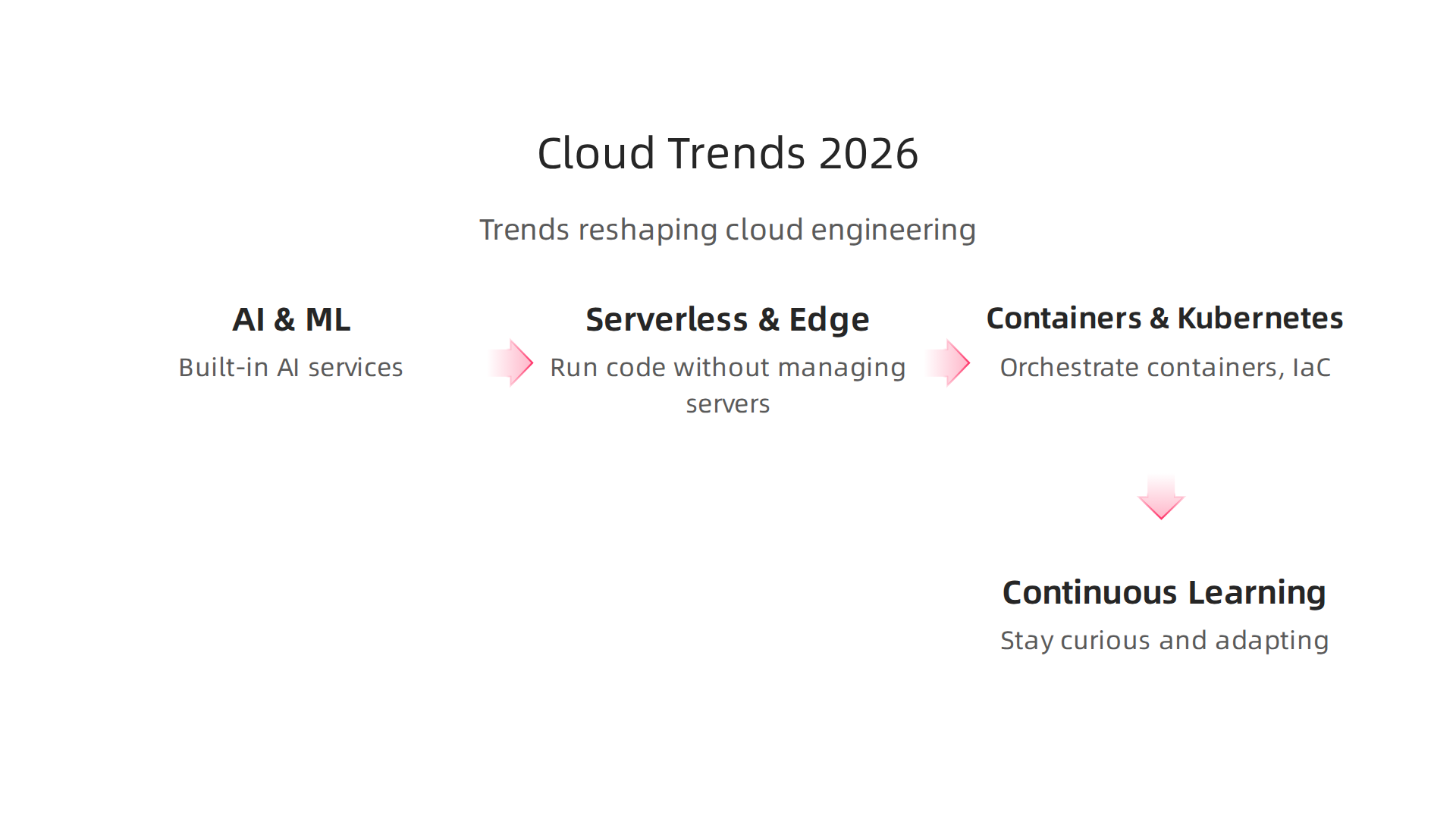
The cloud engineer role you land today will look different a year from now. The field is moving fast, and the skills that got you hired might not keep you relevant. In 2026, a few big trends are reshaping what cloud engineers do every day. Let’s look at the ones you need to watch.
AI and Machine Learning Are Everywhere
Every major cloud provider now offers built in AI services. You can spin up a machine learning model with a few clicks. But here’s the catch: AI systems sometimes produce confident but false answers. That is why understanding how to stop AI hallucinations in cloud-based productivity applications is becoming a must have skill for cloud engineers. You need to verify the outputs of the tools you deploy. According to NetSuite’s list of cloud trends for 2026, companies are also forming dedicated FinOps teams to control rising costs from AI compute. Cloud engineers who can balance AI power with cost governance will be in high demand.
Serverless and Edge Computing Change the Game
Serverless computing lets you run code without managing servers. It saves time and money, but it requires a different way of thinking. You write functions instead of whole services. At the same time, edge computing pushes processing closer to users for faster response times. The Prepzee guide on cloud trends lists both serverless and edge architectures among the top trends for 2026. If you are used to managing virtual machines, it is time to learn how to build serverless pipelines and deploy to edge nodes.
Containers and Kubernetes Still Rule
Containers are not going anywhere. Kubernetes keeps getting better, and most new cloud deployments run on it. Whether you are using Google Kubernetes Engine, Amazon EKS, or Azure Kubernetes Service, knowing how to orchestrate containers is basic table stakes now. The Pulumi article on future cloud trends points out that Infrastructure as Code and Kubernetes are still at the center of modern cloud practice. Do not skip this skill.
Continuous Learning Is Your Safety Net
You cannot afford to stop learning. Blogs, conferences, and community forums like Reddit’s r/cloudcomputing or the Kubernetes Slack channels help you stay ahead. The cloud landscape changes every few months. The same NetSuite article emphasizes that dedicated FinOps teams and AI adoption are shifting the job description. Make learning a habit.
Why Verification Matters More Than Ever
Every trend above introduces new chances for things to go wrong. AI models hallucinate. Serverless functions can misbehave. Kubernetes clusters can drain budgets. That is why the best cloud engineers in 2026 are the ones who question everything they build. Polished answers from AI tools can still be false. Check your AI confidence before you trust a machine’s output. Critical thinking is what separates a great cloud engineer from a mediocre one.
Summary
This article is a practical, data-backed roadmap for starting and advancing a cloud engineering career in 2026. It explains what cloud engineers do, the different specialty roles, and why demand and pay remain strong. You will learn the core technical foundations—networking, Linux, and scripting—plus the automation and Infrastructure as Code tools employers expect, and which cloud platforms (AWS, Azure, GCP) to prioritize. The guide also covers which certifications matter, how to build a resume and portfolio with real projects, and the soft skills that separate good engineers from great ones. It emphasizes continuous learning and highlights major trends like AI, serverless, and Kubernetes while warning about AI hallucinations and how to verify outputs. After reading, you’ll have a clear sequence of skills to acquire, certifications to pursue, and practical steps to land and grow in cloud roles.