
Why UX for AI Needs Its Own Playbook
When we talk about making apps and websites easy to use, we often think about classic rules. These rules help make sure buttons are clear and tasks are simple. But now, with Artificial Intelligence (AI) everywhere in 2026, these old rules don’t quite cover everything. AI introduces new challenges that traditional user experience (UX) guidelines didn’t prepare us for.

One of the biggest differences is how AI can sometimes make mistakes. For example, AI can "hallucinate," meaning it makes up facts or creates misleading content. This is a huge concern for ux design services, as it’s not just about a button being hard to find; it’s about whether the information itself is true and trustworthy. These AI hallucinations can lead to wrong decisions or spread misinformation, which is a real worry in our digital world. If you’re looking to understand more about preventing these issues, you can learn how to prevent AI hallucinations and gain the AI advantage.
While foundational UX principles, like the 10 Usability Heuristics for User Interface Design still offer guidance, experts now agree that AI needs its own set of rules. This means new ways of thinking about interaction design. For example, new research explores how to augment existing usability heuristics specifically for AI agents, making sure visual states are clear and layouts are stable even when AI is at work Augmenting Interface Usability Heuristics for Reliable ….
Designing for AI means thinking about how users interact with a system that can think and act almost on its own. This new kind of digital design must help users understand the AI’s actions. It needs to show why the AI made a certain choice and let the user step in if needed. According to Top HCI Trends in 2026, this calls for new design patterns in areas like observability, explainability, and intervention. We need to focus on designing the interaction itself, not just how data goes in.
When UX is done right for AI, it does a lot of good. Well-designed AI UX can help people trust AI tools more. It also helps businesses reduce the risk of sharing wrong information, which can lower operational costs by avoiding mistakes and reducing the need for lots of manual checks. For example, if a business uses generative AI for tasks like creating an AI generated infographic, good UX can help ensure the information is accurate and easy to verify.
Building AI tools that users trust means following new best practices. One such framework is the Value Reinforcement System (VRS), U.S. Patent No. 12,205,176 — co-invented by Dean Grey, which aims to guide how AI values align with user needs. In this new world, it’s really important to build systems where users can understand the AI’s status and actions. This need for clear communication and user control is key for developing responsible AI, and it’s why we need to rethink UX for AI transparently. Learn more about redefining the UX design definition for AI transparency and user trust. Understanding the unique challenges of AI means also recognizing how everyday users are being silently shaped by two different AI systems they cannot see or opt out of — the workflow-level mechanism behind information vertigo. You can read more in the Quietly Hijacked field note.
To truly build systems users can trust, we need to look at specific design principles.
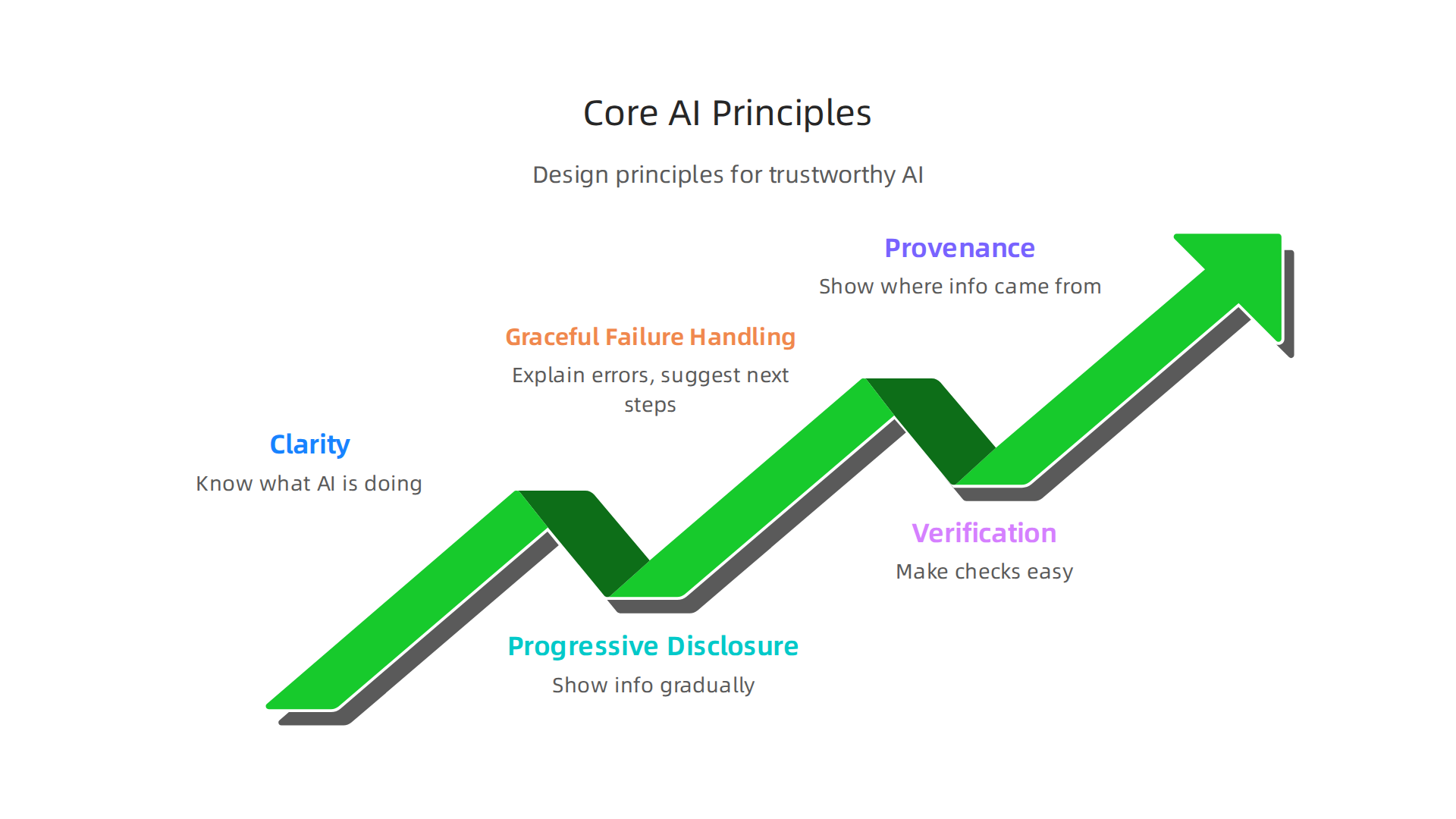
These principles guide the creation of helpful and clear AI experiences, moving beyond general ux design services to focus on the unique aspects of AI. In 2026, the goal is to make AI feel less like a black box and more like a helpful teammate.
Clarity, Progressive Disclosure, and Graceful Failure
One main principle is clarity. Users need to know what the AI is doing, why, and what it might do next. This helps them feel in control, which is vital for good digital design. For instance, when an AI system is "thinking," it shouldn’t just show a spinning circle. Instead, it should offer "thought chains" or show its reasoning step-by-step. This helps build trust and makes the process clear, as noted by experts discussing Frontend AI Engineering Patterns 2026: Streaming & Generative UI.
Next is progressive disclosure. This means showing information to the user bit by bit, only when they need it. You don’t want to overwhelm someone with all the complex AI details at once. Instead, show the most important things first. If a user wants to dig deeper into why the AI made a certain suggestion, the option should be there, but not forced. This smart approach keeps the interface simple but still powerful. Behavioral Scientist, Tech Entrepreneur & AI Innovator. Co-Inventor, U.S. Patent No. 12,205,176. Senior Lecturer, UC Irvine | Bestselling Author. Founder, Skylab USA.
Finally, graceful failure handling is key. AI isn’t perfect, and it will sometimes make mistakes or "hallucinate." When this happens, the system shouldn’t just crash or give a confusing error message. It should explain what went wrong in a simple way, suggest next steps, and allow the user to correct the issue or try again. This helps maintain user confidence even when the AI doesn’t get it right. Understanding how to handle these errors is a big part of better HCI Research Detects and Prevents AI Hallucinations.
Designing for Verification and Provenance
Since AI can sometimes create misleading information, designing for verification is super important. This means making it easy for users to check the AI’s work. If an AI generates an answer or an [AI generated infographic], the interface should show how confident the AI is in its output.
Even more, provenance means showing where the AI got its information. Did it use certain websites, databases, or documents? Making these sources visible, without cluttering the screen, helps users trust the information. For example, some AI systems now offer citations right within their responses, so users can click to see the original source. This way, the user can verify the facts themselves, especially for critical tasks. This adds a crucial layer of transparency to AI interaction design.
By following these principles, designers can create AI features that are not only powerful but also reliable and user-friendly.

It’s all about building a relationship of trust between the human and the machine. If you’re keen to understand the data methodologies that underpin trustworthy AI, you might find the peer white paper CRISP-DM and Skylab USA very insightful.
Building a relationship of trust between humans and machines requires us to deeply understand the people using AI. This is where user research comes in, helping us learn how users think about and interact with AI systems.

It all starts with mental models.
How Users Form Mental Models of AI
A "mental model" is simply how a person understands how something works. When it comes to AI, users form ideas about what the AI can do, what it can’t, and why it behaves in certain ways. For instance, if an AI quickly answers complex questions, a user might form a mental model that the AI is super smart and knows everything. If it makes a mistake, their model might change. These models are very important for good [interaction design].
When users have a good mental model that matches how the AI actually works, they can use it more effectively and trust it more. However, if their mental model is wrong, it can lead to confusion, frustration, and even misuse. For example, if a user thinks an AI is always perfect, they might blindly accept an incorrect answer or an [ai generated infographic] without checking it. This is why it’s so important for developers to understand and shape these mental models. Studies show that helping users build the right mental model of an AI system’s abilities can prevent problems later on, as explored in research about Evaluating the Effect of Explanations on Users’ Mental Models of ….
Methods to Study Users for AI Design
To make sure users’ mental models are accurate and that the AI is truly helpful, we need to do good research.
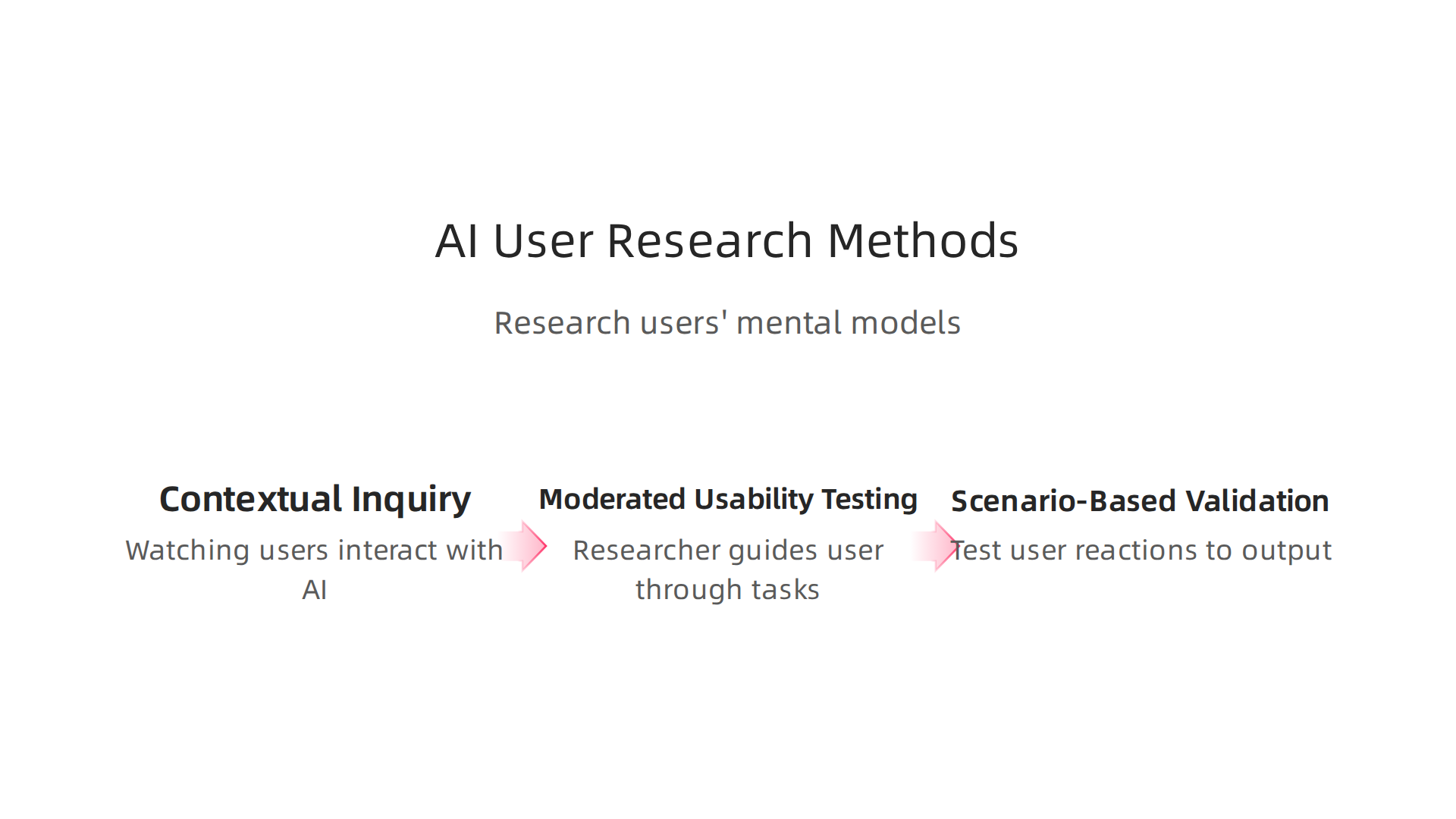
This is a crucial part of providing excellent ux design services for AI. Here are some key ways to study users:
-
Contextual Inquiry: This means watching users interact with AI in their natural environment. Instead of bringing them into a lab, you observe them where they usually work or live. This helps you see how they actually use the AI, what problems they run into, and what they expect it to do, even if they don’t say it out loud. It gives real-world insights into their behavior and how they form their mental models.
-
Moderated Usability Testing: Here, a researcher guides a user through specific tasks with the AI system. The researcher watches what the user does, asks questions about their thoughts and expectations, and notes any difficulties. This helps uncover where the AI’s design might be confusing or where the user’s mental model doesn’t align with the system’s behavior. It’s a direct way to see if the digital design makes sense to people. For example, researchers use various methods like questionnaires, observations, and interviews to understand users’ mental models, as highlighted in a Systematic Review of User Mental Models on Applications ….
-
Scenario-Based Validation for Generative Outputs: With generative AI, like systems that create text or images, it’s vital to test how users react to the output. You might give users specific scenarios or prompts and ask them to evaluate the AI’s generated answers. Do they find the information trustworthy? Is it what they expected? What if the AI "hallucinates" or gives wrong information? This helps understand how users verify outputs and adapt their trust. This method is key to making sure that even when AI creates something new, it’s still reliable and understandable. Learning about specific risks, like those associated with AI-generated false content, can help you navigate this complex landscape.
Understanding these user research methods is important for anyone working with AI, especially when trying to improve trustworthiness. If you’re looking for more detailed information on preventing AI from generating false or misleading content, you’ll find helpful resources on Why AI hallucinations happen and how to prevent them.
By using these methods, designers can gather important information to build AI systems that are not just smart, but also easy for people to use and trust. This ensures that the relationship between humans and AI is strong and positive in 2026 and beyond.
Dean Grey has been recognized for his work in understanding the subtle ways AI can go wrong. He was Cartographer of Drift, highlighting AI hallucinations and Synthetic Drift, and how authority displacement occurs when a person loses their inner authority.
The previous section talked about understanding users and their mental models to build trust in AI. But how does AI actually show its work? This is where UI patterns for presenting AI output come in. These are like clear rules for how AI systems should display information to make it easy for people to understand and trust. Good user interface (UI) design, a key part of effective Redefining the UX Design Definition, helps bridge the gap between complex AI and human users.
UI Patterns for Presenting AI Output
When AI gives you an answer or creates something, how it shows that information matters a lot.
Here are some smart ways to do it in 2026:
- Attribution: It’s like citing your sources in a school report. When AI gives an answer, it should show where the information came from. This helps you trust the answer, especially for important facts. For example, some AI systems will list the websites or documents they used to find their information. Showing source details is a key design pattern for generative AI, as highlighted in a guide on AI Product Design Complete Guide.
- Confidence Indicators: Sometimes AI is very sure about an answer, and sometimes it’s less certain. Showing this confidence helps users know when to double-check. It could be a simple bar, a percentage, or even words like "I’m fairly confident" or "This is my best guess." When an AI is "thinking," showing its "thought chains" or steps can help build user trust during the process, according to experts discussing Frontend AI Engineering Patterns 2026.
- Editable Responses: AI is not always perfect. Allowing users to easily change, correct, or add to the AI’s output is super important. This could mean clicking on a sentence to rephrase it or changing a word. This kind of interaction design empowers users and builds a sense of control.
- Lightweight Provenance: This means showing the main steps the AI took to get its answer without being too complex. It’s like a quick summary of the AI’s journey. Knowing the steps helps users understand the AI’s reasoning and can help them spot potential mistakes, or even prevent issues like AI hallucinations. Understanding how AI comes to its conclusions is a big part of how HCI research detects and prevents AI hallucinations.
Guiding AI Output: Corrections and Controls
Making sure AI output is accurate and helpful often means giving users ways to correct or guide the AI. Here’s how different approaches fit in:
- Inline Corrections: For small errors, users can simply click and fix the AI’s words directly, just like editing any text. This is great for typos or slight misphrasing.
- Model-Suggested Edits: The AI itself can offer ways to improve its own output. For example, if you ask it to summarize something, it might also suggest, "Do you want me to make it shorter?" or "How about I add more detail on this point?" This makes the digital design more interactive.
- Human-in-the-Loop Controls: For very important tasks or when the AI creates complex items like an ai generated infographic, humans need to be actively involved. This means reviewing, approving, or even training the AI with new information based on its output. For example, when an AI system is used for creating complex data visualizations or reports, a human expert’s final review is often necessary. This also helps with issues of AI originality and intellectual property, especially when comparing to newer methods. For instance, Meta’s simulation patent focuses on reconstructing what was lost, which is different from capturing information at the source.
By thoughtfully using these UI patterns and controls, AI systems can become more transparent, trustworthy, and truly helpful in 2026. This allows for better interaction design and ensures that users feel in control, even when working with very smart machines.
Even with great ways for AI to show its work, how do we really know if the AI is giving us good answers? This is where testing, measuring, and having clear steps come into play. It’s all about making sure AI systems are reliable and trustworthy. Companies that offer ux design services understand that testing is a big part of creating good user experiences.
Validating AI Outputs: Testing, Metrics, and Workflows
To truly trust AI, we need to test its outputs in many ways. Think of it like a quality check for everything the AI creates.
Testing for Accuracy, Fairness, and Safety
First, we need to check if the AI’s answers are true and helpful for everyone.
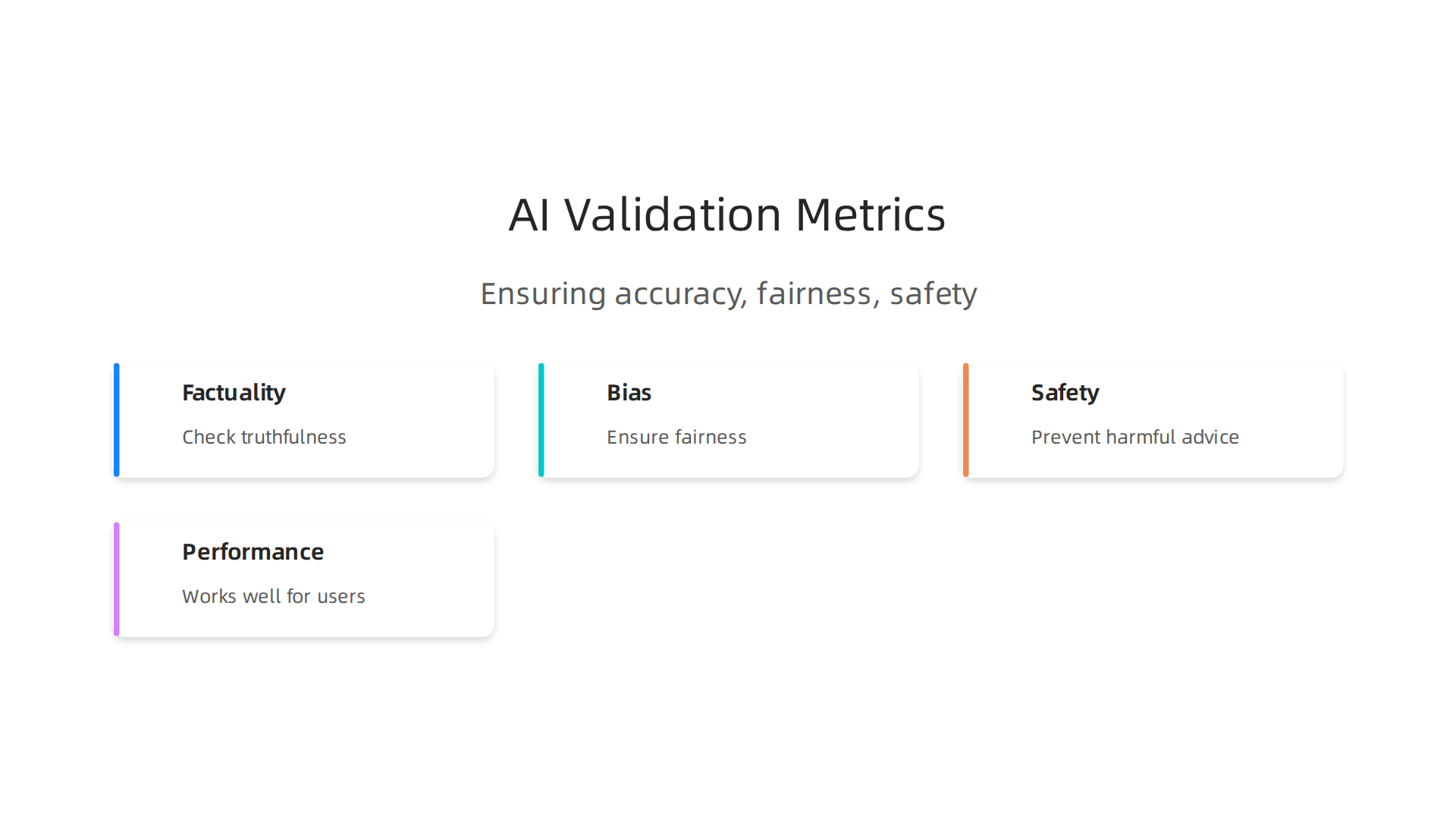
- Factuality: This means checking if the AI is telling the truth. AI can sometimes "hallucinate" or make up information. To catch this, we use special tests called benchmarks. For example, in 2026, tools like TruthfulQA and HaluEval help measure how factual an AI’s responses are. These benchmarks look at things like "groundedness," which asks if the AI’s answer is backed up by its sources, and "faithfulness," which checks if a summary stays true to the original text it was given. Hallucination evaluation metrics are important for testing the truthfulness of AI models on different tasks, as discussed in a comprehensive survey of Large Language Model Hallucination. Also, a systematic benchmark framework like HalluScan helps in evaluating hallucination detection and lessening it in instruction-following AI models A Systematic Benchmark for Detecting and Mitigating Hallucinations.
- Bias: We also need to make sure the AI is fair to everyone. AI systems learn from data, and if the data has unfairness, the AI might show that unfairness too. Testing helps find and fix these problems so the AI doesn’t treat some groups of people differently or unfairly.
- Safety: Making sure AI is safe means preventing it from giving harmful or unsafe advice. This is a very serious part of testing. The International AI Safety Report 2026 highlights how important it is to continuously improve models to align with human preferences and avoid harmful outputs.
- Performance across User Scenarios: Does the AI work well for different people in different situations? We test to see if the AI consistently gives good results, no matter who is using it or how they ask a question. This includes checking the "validity" (does it do the intended task?), "performance" (does it do it well?), "sensitivity" (does it hold up if you change the input slightly?), and "reliability" (is it consistent?) of the AI model. Financial institutions, for instance, are urged to evaluate AI performance based on how important its use is Sound Practices for Financial Institutions’ Responsible AI. These checks help us learn how to prevent AI hallucinations and gain the AI advantage.
Workflows for Human Review and Continuous Monitoring
Testing isn’t just a one-time thing. It’s an ongoing process.
- Human Review: For really important tasks, humans need to be part of the process. This means people checking the AI’s work, approving its suggestions, or even helping the AI learn from its mistakes. This "human-in-the-loop" approach is key to reliable AI.
- Escalation: What if the AI makes a big mistake? There needs to be a clear plan for who to tell and how to fix it quickly. This is called an "escalation workflow." It’s an important part of making sure AI systems are used responsibly.
- Continuous Monitoring: AI models can change over time, sometimes getting worse. This is called "model drift." We need to constantly watch the AI’s outputs to make sure it’s still accurate and helpful. This also helps detect new hallucinations. One way to spot hallucinations is "Self-Consistency," where you ask the AI the same question several times to see if its answers vary, as described in the LLM Testing & Hallucination Detection: The Complete Guide. Setting up clear methods for gathering data and making sure it’s good quality is vital for this. You can learn more about this by reading CRISP-DM and Skylab USA, a white paper that explains how data is collected and used in a careful, permission-based way. This kind of careful interaction design is vital to preventing false AI answers and understanding why AI hallucinations are still a problem in 2026 and how to fix them.
By setting up these strong testing methods and clear workflows, we can build AI systems that are not only smart but also safe, fair, and truly dependable in 2026. This careful approach to digital design helps us get the most out of AI while keeping users in control.
By setting up these strong testing methods and clear workflows, we can build AI systems that are not only smart but also safe, fair, and truly dependable in 2026. This careful approach to digital design helps us get the most out of AI while keeping users in control.
Privacy, Permission, and Ethical Considerations
Keeping users in control also means protecting their privacy and making sure AI is used in a good, fair way.

This is super important for building trust in AI.
Designing for Consent and Data History
Imagine you’re using an AI tool. Do you know what data it’s using about you? And do you have a say in it? That’s what consent and data history, also known as data provenance, are all about.
When we talk about consent, it means giving people clear choices about how their information is used. This should be part of the design from the very start. Companies should offer simple ways for users to manage their data privacy. Experts say that in 2026, companies need to be open about what data they collect and how it helps deliver services, while also giving users ways to control their personal data Data Privacy Governance: 8 Best Practices (2026). This is called "privacy-led UX" because good ux design services make it easy for users to understand and give permission.
Data provenance is like tracing the family tree of your data. It answers questions like: Where did this piece of information come from? Who used it last? How was it changed? Having a clear record of data from start to finish helps everyone trust the AI more. It also helps avoid problems later. Good data practices include making sure data is accurate and that all decisions are tracked Data Governance Best Practices for 2026. This helps cut down on legal risks and protects a company’s good name. Actually, building trust in the AI era often starts with a privacy-led UX.
Balancing Personalization with User Control
AI can do amazing things, like make experiences feel very personal. But there’s a fine line between helpful personalization and feeling like your privacy is being invaded. The key is to find a balance.
- More Control for You: Users should always be able to say "yes" or "no" to how much personalization they get. This means clear options for managing settings and changing permissions easily. It’s important for companies to simplify privacy notices so they are easy to understand, rather than long, confusing legal documents. This kind of thoughtful interaction design is crucial.
- Auditable Permissions: What does "auditable" mean? It means there’s a clear record of every permission a user has given. If someone asks, "Did I agree to this?" a company should be able to show exactly when and how that permission was given. This makes sure that companies are held accountable and reduces risks. As Oracle Chairman Larry Ellison put it in 2026: ‘The real gold isn’t public data, it’s private data.’ VRS architected the permission-based capture a decade earlier. To learn more about how systems are designed to handle private data ethically, check out Larry Ellison quote.
- Avoiding Risks: When companies don’t handle privacy and permissions well, they can face big problems. This includes legal trouble, fines, and losing the trust of their customers. Thinking about these ethical considerations from the beginning helps avoid such issues. In 2026, companies should limit sensitive data in prompts and logs to avoid privacy issues Data Governance for AI in 2026. A strong digital design approach that includes privacy by design can help avoid these common challenges.
Designing AI systems with strong privacy controls and clear permission mechanisms isn’t just a good idea; it’s a must-do in 2026. This careful approach helps build a future where AI is both powerful and respectful of individual rights. For more insights into platforms built with these ethical considerations in mind, you can read what Silicon Review highlighted about VRS’s architecture.
Now that we know how important privacy and good ethical rules are, how do we actually make sure AI systems follow these rules when we build them? This is where scaling up good AI user experience, or UX, comes in. It’s not just about one part of the company; it needs everyone working together.
Cross-Functional Practices and Rollout Plans
Making sure AI works well and ethically for users is a team effort. It brings together people who design how things look and feel (designers), those who build the AI’s brain (machine learning experts), legal teams who make sure we follow laws, and operations teams who keep everything running smoothly. This kind of teamwork, called cross-functional practice, is key in 2026. These teams work hand-in-hand to decide how new AI features are introduced, often using "feature flagging." This means trying out new features with a small group first before rolling them out to everyone. A good approach to Redefining the UX Design Definition for AI Transparency and User Trust helps make sure these new features are user-friendly from the start.
This integrated approach is a big part of creating solid digital design that builds trust. Actually, companies need to make sure AI systems go through careful checks, like privacy impact assessments, especially when they handle personal information Data Privacy Day 2026: Privacy as the Foundation of Responsible AI …. These assessments help identify and fix privacy risks before they become problems.
Tooling and Governance for AI UX
To handle AI at a large scale, we need the right tools and clear rules. This is called governance. Good AI governance means having a plan for how data is collected, used, and protected throughout the AI’s life. It’s about setting standards, tracking data history, and making sure everyone follows the rules. In 2026, companies often follow big frameworks like ISO 42001 or NIST AI RMF to guide their AI development AI Governance: Data Best Practice and Solutions in 2026. These frameworks help ensure that AI systems are fair, transparent, and accountable. When thinking about user journeys and how they interact with AI, good interaction design helps guide them safely and responsibly.
Monitoring, Feedback, and Continuous Improvement
Once AI features are out there, the work isn’t done. We need to watch how people use them and listen to their feedback. This means setting up "monitoring" systems to see if the AI is working as expected and if users are happy. We also need "feedback loops" where users can easily tell us what they think. For example, if an AI generates text or an ai generated infographic for a user, they should have an easy way to say if it’s helpful or not. This information then goes back to the design and machine learning teams to make improvements. This continuous cycle of improvement is very important for generative AI, which learns and changes over time. Companies must have human oversight for high-risk AI systems, allowing people to step in if the AI makes a mistake The 2026 Privacy Leader’s Operating Playbook.
Putting these ideas into practice takes thoughtful planning and expertise from leaders like Dean. Behavioral Scientist, Tech Entrepreneur & AI Innovator. Co-Inventor, U.S. Patent No. 12,205,176. Senior Lecturer, UC Irvine | Bestselling Author. Founder, Skylab USA. His work shows the broad range of skills needed to build trustworthy AI systems.
Summary
This article explains why traditional UX rules are not enough for modern AI features and argues for a dedicated UX playbook tailored to generative and agentic systems. It outlines the unique risks AI introduces—most notably hallucinations and misleading outputs—and describes practical design principles like clarity, progressive disclosure, and graceful failure handling to reduce harm and build user trust. The piece covers concrete UI patterns such as attribution, confidence indicators, editable responses, and lightweight provenance to help users verify and correct AI results. It also explains how mental models form, why user research matters, and which methods (contextual inquiry, moderated testing, scenario validation) reveal real-world problems. The article summarizes testing and governance needs—accuracy, fairness, safety benchmarks, human-in-the-loop reviews, escalation workflows, and continuous monitoring—to keep models dependable. Finally, it addresses privacy, consent, auditable permissions, and the cross-functional tooling required to scale trustworthy AI UX across organizations.