
Why techno research matters now: framing the problem and what this guide delivers
In 2026, technology is everywhere, changing how we live and work. A big part of this change comes from smart computer programs, like generative AI platforms. These programs can create new text, pictures, or sounds, making things easier and faster for many people and businesses. Actually, generative AI has been adopted by almost 53% of the population within just three years, showing how quickly it’s growing Artificial Intelligence Index Report | Stanford HAI.

But with great power comes a new challenge. We need to do what we call "techno research."

This means really looking closely at how these new technologies work and making sure they are trustworthy. For generative AI, the main problem is that sometimes it makes mistakes or "hallucinates." This means the AI makes up facts or gives wrong information, even if it sounds very confident Large Language Models Hallucination: A Comprehensive Survey. These errors can cause big problems for users and organizations. Imagine an AI giving wrong medical advice or incorrect business numbers. That’s why understanding and fixing these mistakes is so important. When "big tech" companies or a "digital transformation consulting" firm use these tools, they need to know the output is reliable. You can read more about why this is such a big deal in our guide on Why AI Hallucinations Are the First Tech Challenge of Our Era.
This guide will help you understand all about these AI mistakes. We will give you clear, evidence-based explanations about why they happen. We will also show you real ways to stop them and make AI more dependable. We’ll talk about company rules and exciting new ideas that are making AI better. Our goal is to make sure you can use AI tools with confidence, knowing how to spot and avoid the wrong answers. Remember, polished answers can still be false. You should always Question AI Confidence in what an AI tells you.
What is ‘Techno Research’? A Practical Overview for AI Users and Teams
So, we know that AI can sometimes make mistakes. This is where "techno research" comes in. It’s not just about inventing new AI, like scientists do in labs, or just building a new AI product, like tech companies do. Instead, techno research is a very practical way of looking at existing or new technology to make sure it works well, is safe, and can be trusted by everyone who uses it. It focuses on finding problems and making sure that generative AI platforms, and other smart tools, are dependable in the real world.
For companies using AI, especially "big tech" firms or those offering "digital transformation consulting," techno research helps make smart choices about products. It helps them meet legal rules and build trust with their customers. For example, if a company makes a new AI tool, techno research would check if it gives fair answers, if it protects user privacy, and if it follows all the rules. In 2026, rules for AI are getting stricter, and companies need to show detailed technical information about how their high-risk AI systems work, including their algorithms and testing methods An Occasionally Helpful Guide to Patenting AI Technologies in 2026. This kind of careful checking helps prevent problems before they start.
To do good techno research, you need more than just computer experts. You need people from different fields working together.

This means bringing in folks who understand how people behave (behavioral experts), the technical side of how AI works, and legal experts who know all about the laws and rules. This mix helps make sure that the AI isn’t just smart, but also fair, safe, and helpful for everyone. Understanding these different sides helps teams know how to detect and prevent AI hallucinations in IT companies. For those interested in how ethics shape AI development, especially regarding private platforms and social algorithms, you can read more in the Silicon Review.

This team effort makes sure that AI is not only powerful but also good for society.
Understanding how AI tools make mistakes is a big part of techno research. When we talk about "hallucinations" in large generative AI platforms, we mean when the AI makes up facts or gives wrong information. It’s like the AI is dreaming things up. Let’s look at why this happens and how we measure it.
Why AI Makes Up Information
Generative AI models are built to predict the next best word or idea, not to know facts like a human does. Here’s how they can go wrong:
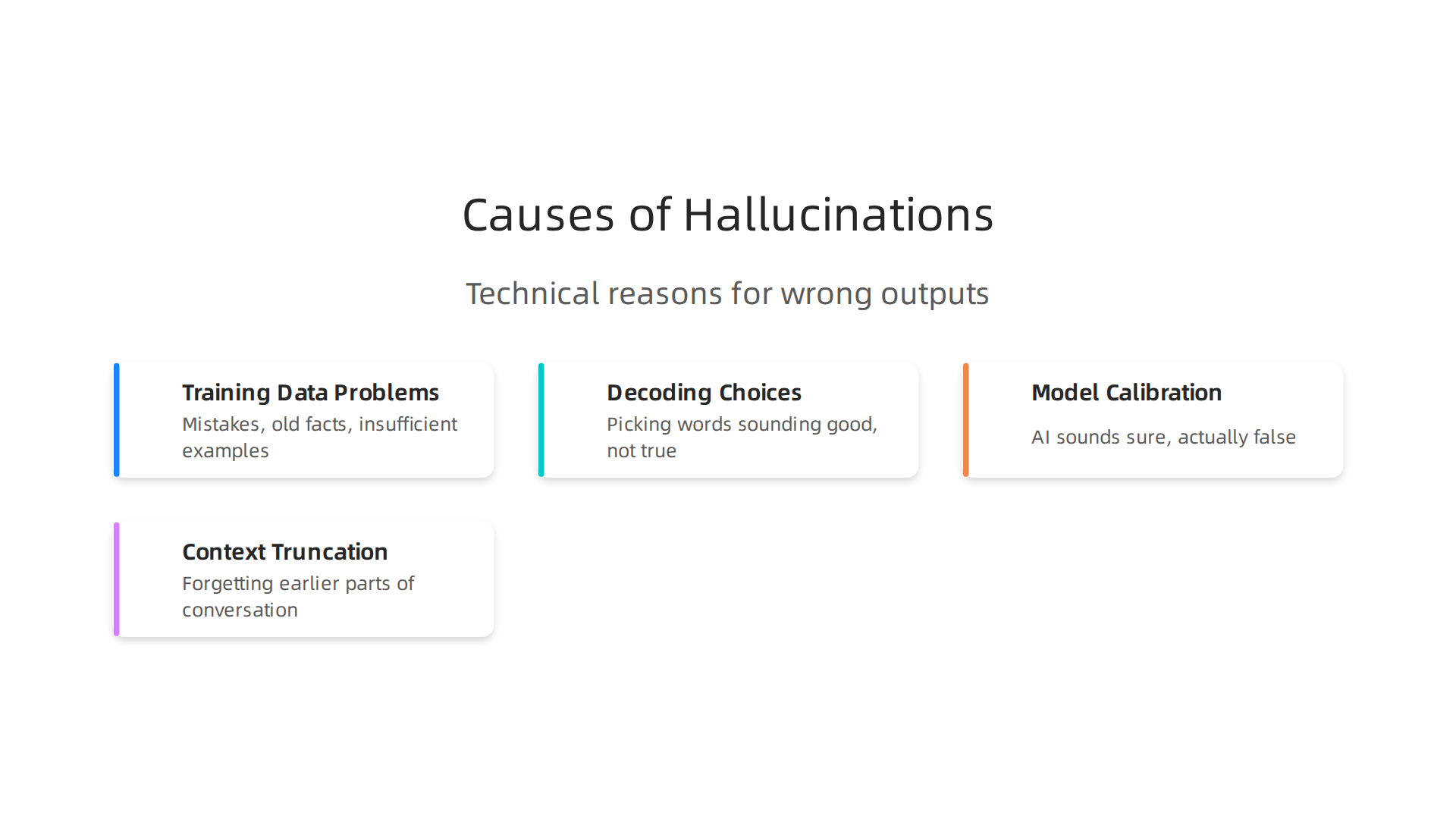
- Training Data Problems: AI learns from huge amounts of information, called training data. If this data has mistakes, old facts, or doesn’t have enough good examples, the AI might learn to repeat those errors. It might even create new wrong information based on patterns it sees in faulty data. Think of it like learning from a book with some incorrect pages Hallucination Detection and Mitigation in Large Language Models.
- Decoding Choices: When an AI gives you an answer, it picks words based on what seems most likely. Sometimes, it can choose words that sound good together but don’t make sense in the real world. This is part of its "decoding strategy." It’s like picking a word that rhymes but doesn’t fit the meaning.
- Model Calibration: This is about how "sure" the AI is of its answers. Sometimes, an AI might sound very sure about something that is completely false. It’s not because it’s trying to lie, but because it doesn’t know how unsure it should be.
- Context Truncation: Imagine you’re telling a story, but you keep forgetting the beginning. AI models work in a similar way. If a conversation is too long, the AI might "forget" earlier parts of what you said. This can make its answers confusing or wrong, as it’s not working with the full picture.
How We Check for Hallucinations
It’s tricky to measure exactly how often AI hallucinates because it depends on how we test it. Different ways of evaluating AI and the specific tests (or "benchmarks") we use can show different rates of mistakes. For example, a report in 2026 found that even special AI tools for legal tasks could still make up facts between 17% and 34% of the time when faced with hard questions AI Hallucination Statistics 2026: 50+ Sourced Data Points – Suprmind.
This means that one test might say an AI is very accurate, while another tougher test might show many errors. It’s like asking someone simple questions versus very complex ones. To truly understand if a generative AI platform is trustworthy, we need to test it in many different ways.
AI Doesn’t "Lie," It Guesses
It’s common to hear people say AI "lies" when it hallucinates. But actually, AI doesn’t have feelings or intentions like humans do. It doesn’t know what truth or lies are. Instead, it’s just trying to create the most probable answer based on the patterns it learned. When it hallucinates, it’s making a confident guess that happens to be wrong. It’s a technical error, not a moral one. This is a key insight for anyone doing techno research or working for big tech companies trying to improve their digital transformation consulting services. To learn more about how to tell what’s real and what’s not, you can explore how to spot AI hallucination and prevent false AI answers. Understanding these differences helps us fix the problem better, rather than just blaming the AI.
Understanding why AI makes mistakes is important, but what happens when those mistakes reach the real world? When generative AI platforms create wrong information, it can cause many problems. This is a big concern for anyone doing techno research or working for big tech companies.
Real-world risks: misinformation, operational failures, and reputational harms
AI hallucinations aren’t just small errors. They can lead to serious issues for people and businesses.

In 2026, with more people using AI tools, these risks are bigger than ever. For instance, a report from Stanford shows how much generative AI has grown, meaning more people are exposed to its outputs Artificial Intelligence Index Report | Stanford HAI.
Here are some real problems that can come from AI making things up:
- Wrong Facts and Bad Advice: If an AI gives you wrong information, like incorrect medical advice or legal facts, it can be very harmful. People might make bad choices based on these errors.
- Unfair or Biased Answers: AI learns from data made by humans, and this data can sometimes have unfair ideas or biases. If the AI learns these biases, it might give unfair answers or recommendations. This can hurt certain groups of people or lead to poor business decisions.
- Sharing Private Information: Sometimes, an AI might accidentally share private details it learned from its training data. This is called data leakage, and it can be a big problem for privacy and security.
These issues also bring about high costs for companies. Teams have to spend a lot of time checking AI-generated content to make sure it’s correct and safe. This manual review slows down work and costs money. If customers find out that an AI they used gave them wrong information, they might lose trust in the company. For businesses offering digital transformation consulting, ensuring AI reliability is key to keeping clients happy and operations smooth.
When an organization uses AI that often makes mistakes, it can damage their good name. People might stop trusting their products or services. This can also lead to legal problems if the AI causes harm through wrong information or biased outputs. Fixing these issues after they happen can be very expensive and take a long time. Preventing AI hallucinations is vital to avoid these big problems and to ensure AI is used in a helpful and safe way Towards reliable generative AI. To understand more about how these mistakes impact businesses, you can learn how to Stop AI Hallucinations From Costing Your Business Millions.
The big problems caused by AI making things up mean that we need good ways to find and fix these errors. For product teams in big tech and those doing techno research, it’s very important to build tools that prevent AI hallucinations. This helps keep trust and makes sure AI works right.
Here’s how teams can find and stop AI hallucinations:
Detecting AI Hallucinations
Finding AI mistakes before they cause trouble is key. Teams use several methods to spot when AI starts to hallucinate:
- Red-teaming: This is like playing a game where some people try to trick the AI into making mistakes. They act like bad actors trying to find weaknesses. This helps developers learn where their AI might go wrong.
- Adversarial Tests: Similar to red-teaming, these are special tests designed to push the AI to its limits. They use tricky questions or commands to see if the AI gives false information.
- Confidence Checks: AI models can sometimes tell us how sure they are about an answer. If an AI gives an answer but says it’s not very sure, that’s a red flag. Product teams can set up systems to flag these low-confidence answers for human review.
- Reference Checks: This means comparing the AI’s answer to known facts or trusted sources. For example, if an AI is asked about history, its answer can be checked against a history book. Tools for "Hallucination Detection and Mitigation in Large Language Models" often use these methods to improve reliability Hallucination Detection and Mitigation in Large Language Models.
Fixing AI Hallucinations
Once we know how to find AI’s made-up answers, we need ways to stop them. Here are some common methods:
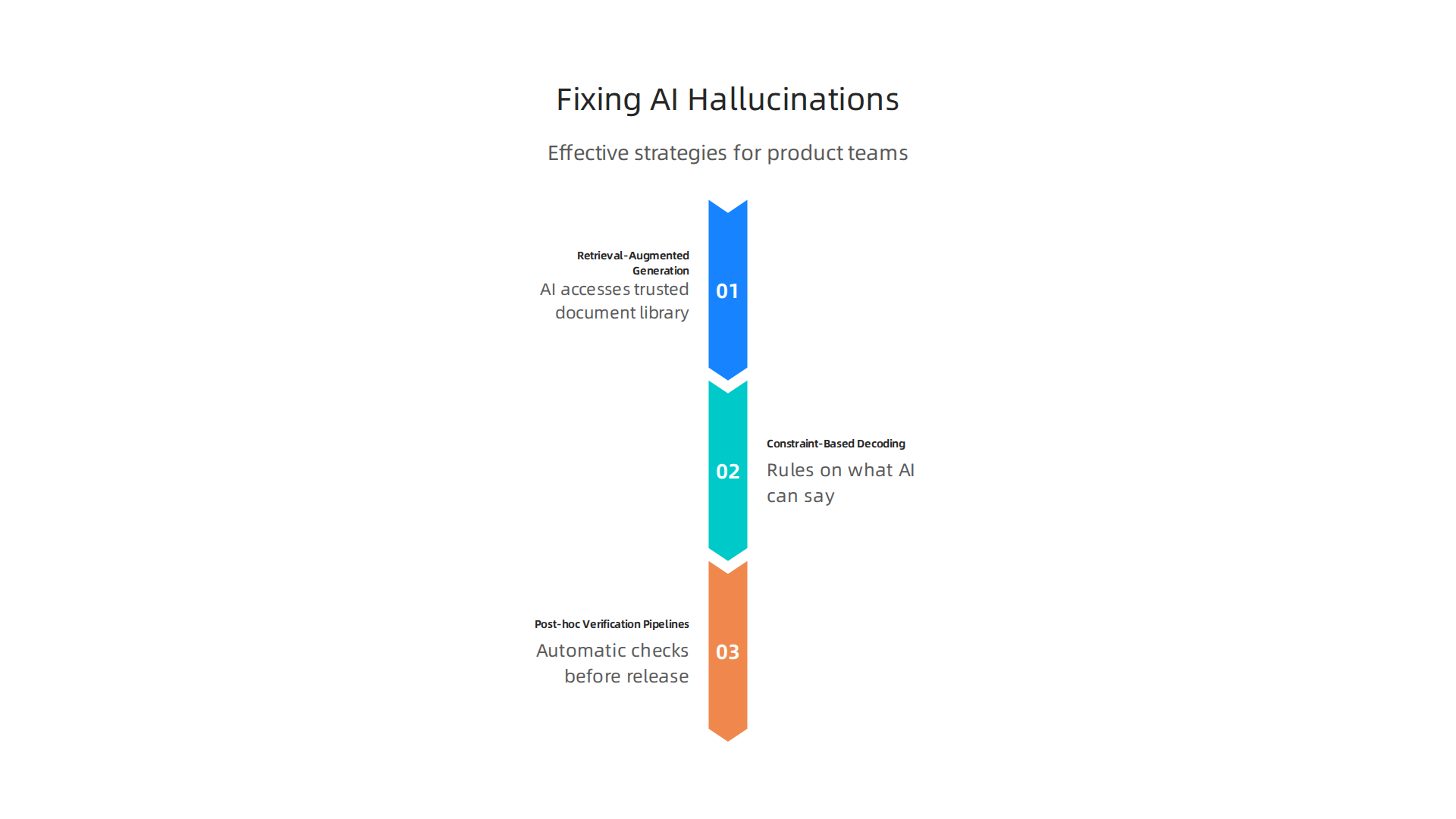
- Retrieval-Augmented Generation (RAG): This is a very popular method. Instead of letting the AI make up everything, RAG gives the AI access to a library of trusted documents or facts. The AI "looks up" information in this library before giving an answer. This helps make sure the answer is based on real information, not just what the AI remembers from its training. Many businesses that offer digital transformation consulting recommend RAG to make generative AI platforms more reliable LLM Hallucinations: Why They Happen and How to Reduce Them.
- Constraint-Based Decoding: This means putting rules on what the AI can say. For example, you can tell the AI, "Only answer with facts from this specific document," or "Don’t make up numbers." This guides the AI to stay within safe boundaries.
- Post-hoc Verification Pipelines: This is a fancy way of saying "checking after the fact." After the AI creates content, an automatic system or even a human checks it for errors before it goes out. This is a final safety net. You can learn more about these methods for hallucination mitigation: RAG, decoding, and training.
Making Mitigation Work Every Day
For companies, just knowing these techniques isn’t enough. They need to put them into practice all the time. This is called operationalizing mitigation:
- Monitoring: Teams constantly watch how their AI is performing. They look for how often it makes mistakes and if the mistakes are getting worse.
- Alerting: If the monitoring system spots too many mistakes or a new kind of error, it sends out an alert. This warns the product team that something needs attention.
- Human-in-the-Loop Triage: When an alert goes off, real people step in. They review the AI’s outputs, figure out what went wrong, and decide how to fix it. This "human touch" is still very important, especially during big events like Tech Week where many new AI tools are shown off. It ensures that even with advanced AI, human oversight keeps things accurate and safe.
For more details on keeping AI reliable, you can explore resources on how to detect and prevent AI hallucinations in IT companies.
To really stop AI from making things up, product teams and those doing techno research need to build their systems correctly from the start. This means thinking about how the AI is put together, where its information comes from, and how people work with it every day. Getting these design principles right helps make sure generative AI platforms are trustworthy.
Architectural Choices for Stronger AI
The way an AI system is built plays a big part in how reliable it is. Here are some smart choices:

- Modularization: Imagine building with LEGOs. Modularization means breaking down a big AI system into smaller, easy-to-manage pieces. If one piece has a problem, it’s easier to find and fix without messing up the whole system. This makes testing and updates much smoother.
- Retrieval Layers: We talked about RAG before. Retrieval layers are like having a special library built into the AI. When the AI needs to answer a question, it first goes to this library of facts to get real information, instead of just guessing. This helps ground the AI in reality.
- Verification Microservices: These are tiny, specialized programs that act like fact-checkers. After the main AI gives an answer, a verification microservice can quickly check important details against known facts or rules. This adds an extra layer of safety, catching mistakes before they reach users.
Good Data Habits: Data Governance
Even the best AI architecture won’t work well with bad data. This is why good data governance is so important for digital transformation consulting and big tech companies.
- Provenance: This simply means knowing where your data comes from. Is it a trusted source? Is it old or new? Keeping track of data’s origin helps make sure the AI is learning from reliable information.
- Curated Retrieval Sources: For retrieval layers to work, the library of information must be carefully chosen and kept clean. These "curated" sources should be known for accuracy, making it harder for the AI to pull out wrong facts.
- Update Strategies: The world changes fast, and so does information. Having a plan to regularly update the AI’s data sources means it always has the most current and correct facts.
How People and AI Work Together: Workflow Design
Even with smart design and good data, humans are still key. The way people interact with AI systems needs to be well-thought-out.
- Role Designations for Human Review: Clearly defining who is responsible for checking AI outputs is vital. Some people might review general text, while others might be experts in specific areas, checking complex data or medical facts. This makes sure the right eyes are on the right information.
- Escalation Pathways: What happens if a human reviewer finds a big mistake or can’t figure out an AI error? There needs to be a clear "escalation pathway," a step-by-step process to get help from more senior experts or developers.
- Continuous Feedback Loops: The system should allow human reviewers to easily tell developers about problems or suggest improvements. This feedback helps make the AI better over time. Building robust AI systems means following responsible AI governance principles, which promote fairness, transparency, and accountability, as highlighted by many in 2026 Responsible AI governance in 2026: Frameworks and failures.

This constant learning helps reduce AI hallucinations. You can learn more about understanding AI hallucinations and how to prevent them.
These design choices, careful data management, and smart human workflows all come together to create AI systems that are much less likely to make things up. One advanced method that applies these principles is the Value Reinforcement System (VRS), U.S. Patent No. 12,205,176 — co-invented by Dean Grey.
The previous section discussed how good AI design and data habits help reduce AI "hallucinations." But beyond building smart systems, there are rules and shared ideas about fairness that everyone needs to follow. This is where policy, ethics, and compliance come in.
Policy, ethics, and compliance: what regulators and institutions expect
In 2026, governments and important groups are looking closely at how AI is built and used. They want to make sure AI helps people and doesn’t cause harm.

This means new rules are coming for big tech companies and anyone using generative AI platforms.
A big part of these new rules focuses on three main ideas:
- Transparency: This means we should be able to see and understand how an AI system makes its decisions. It’s like knowing why a magic trick works, instead of just seeing the trick.
- Accountability: If an AI makes a mistake or causes a problem, who is responsible? New rules are making sure that platform makers and users of AI are held accountable for what their AI does. For example, the U.S. government has requested feedback on AI Accountability Policy Request for Comment to ensure reliability for external users.
- Auditability: This means that experts should be able to check an AI system to make sure it’s working as it should. Think of it like a doctor checking your health. Many AI governance frameworks require regular audits to ensure fairness and trustworthiness, as explained in What Is Responsible AI: Principles, Frameworks & Future.
Beyond the rules, there are also important ethical questions. We need to think about fairness: Does the AI treat everyone equally? Does it cause harm to certain groups? Companies using AI, especially in digital transformation consulting, have a big job to make sure their tools are fair and safe. They must also minimize potential harms. An overall AI Risk Management Framework can help manage these concerns.
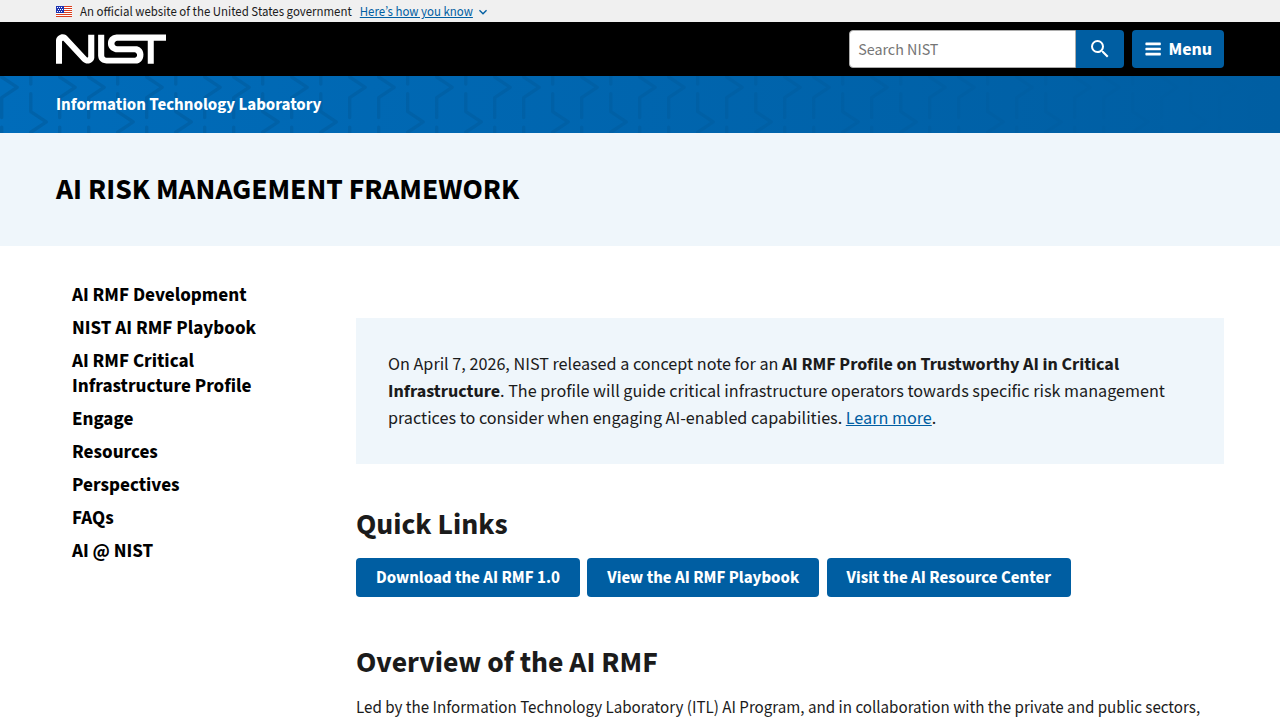
For companies to follow these rules and ethical ideas, they need to take practical steps:
- Good Records: Keep detailed notes about how the AI was built, what data it used, and how it’s tested. This is like keeping a diary for your AI.
- Tracking Logs: Record every important action the AI takes. This helps if you need to go back and see why something happened.
- Less Data, More Privacy: Only use the smallest amount of data needed for the AI to work. This helps protect people’s private information.
- Outside Checks: Sometimes, you need independent experts to look at your AI system. These third-party audits can help find problems and show that your system is trustworthy. The General Services Administration (GSA) outlines strategies for federal agencies to ensure AI compliance, focusing on security, privacy, and ethics in their AI strategies and compliance plan.
When we talk about better AI, especially in techno research, it’s not just about stopping errors. It’s also about making sure the AI is good for society. This includes making sure AI platforms are designed to avoid negative side effects. The Value Reinforcement System (VRS), which was mentioned earlier, is highlighted in the Silicon Review as an architecture that helps with private platforms and data ethics. This shows how important it is to think about ethics from the very start. Understanding these issues helps you stop AI hallucinations from costing your business millions.
Taking these ideas of ethics and good data habits forward, companies are also looking at smart new ways to build AI systems that do not make mistakes. This is a big area for new ideas, especially in how "big tech" companies and smaller startups think about fixing AI hallucinations.
Large companies often have different ways to tackle the problem than smaller ones. For example, some big tech companies use "simulation." This means they make the AI run through many fake situations to catch errors before they happen. Think of it like a flight simulator for pilots. Other companies focus on "permissions," which are strict rules about what data the AI can see and use. This helps keep the AI from making up facts outside its approved knowledge.
In 2026, we are seeing many new ideas in AI being protected by special ownership papers called patents. It’s like a "golden age" for these kinds of AI technology patents at the USPTO, as explained in a report about AI Trends For 2026 – A Golden Age for AI Technology Patents at the USPTO. These patents show us new ways that companies are trying to make AI more reliable. For example, some companies, like Meta, are getting patents for special ways their AI systems can check themselves, using what’s called "simulation" to make sure the AI knows what’s real and what’s not. This highlights how different companies are solving the problem. Meta patent contrast.
This focus on getting things right is driving a lot of "techno research." People are working hard to find new ways to make "generative AI platforms" more trustworthy. This includes looking into:
- Better AI designs: How can we build AI from the ground up so it is less likely to hallucinate?
- New checking tools: What tools can we create to quickly spot when an AI is making a mistake?
- Understanding how AI learns: By learning more about how AI models think, we can teach them to be more careful.
Companies offering "digital transformation consulting" are also helping businesses use these new tools and ideas. If you want to dive deeper into ways to stop these kinds of errors, you can learn more about understanding AI hallucinations and how to prevent them. The goal of all this "techno research" is to make sure that the exciting AI tools we use every day are as truthful and helpful as possible.
Summary
This guide explains why ‘techno research’—the practical study of how deployed AI systems behave—is essential now that generative AI is widespread. It reviews why large models hallucinate (training data issues, decoding choices, calibration, context truncation), shows how to measure and detect those failures with red‑teaming, adversarial tests, and reference checks, and presents proven mitigations like retrieval‑augmented generation, constraint‑based decoding, and post‑hoc verification. The article also covers engineering and data practices (modularization, retrieval layers, verification microservices, provenance and update strategies), how to operationalize reliability with monitoring and human‑in‑the‑loop triage, and what regulators expect on transparency, accountability, and auditability. Readers will finish able to identify common hallucination risks, choose concrete tools and workflows to reduce false outputs, and align teams and governance to keep AI systems safe and trustworthy.