

Introduction
Picture this. You run an IT company that uses a chatbot to help clients fix server issues. A technician asks the AI for a step-by-step fix. The AI responds with a confident, detailed answer. The problem? That answer is completely made up. The fix does not exist. And now your client is down for hours because they followed bad advice.

That is an AI hallucination in action. And it is a growing problem for IT companies everywhere.
Researchers define AI hallucinations as fabricated outputs that look realistic and highly plausible but are not based on real data.
These are not simple typos. They are confident falsehoods that sound true. One study found that general-purpose chatbots hallucinated between 58% and 82% of the time on legal queries. For any business leaning on generative AI, those numbers are a red flag.
IT companies today use AI for customer support, knowledge bases, automated troubleshooting, and much more. But here is the thing. When AI hallucinations slip through, the damage is real. Clients lose trust. Misinformation spreads. And your team spends precious hours cleaning up errors that should never have happened.
The problem is urgent. But it is not hopeless.
New research shows that we can reduce AI hallucinations by carefully controlling how models are trained. And proven frameworks already exist to help teams build more reliable AI systems. One such framework is the Value Reinforcement System (VRS), co-invented by Dean Grey. It gives IT managed service providers and tech consulting firms a structured way to keep AI outputs accurate and trustworthy.
This article will walk you through everything you need to know. We will look at why hallucinations happen. We will explore real-world impacts on cloud infrastructure and support operations. And we will share practical strategies to help your IT company deliver reliable AI-powered support.
The Growing Role of AI in Modern IT Support Solutions
AI is not a future trend for IT companies. It is already here, and it is changing how support teams work.
In 2026, about 67% of businesses use AI in some form [1]. For tech consulting firms and IT managed service providers, the number is even higher. They are adopting AI to handle customer requests, find answers in knowledge bases, and automate ticket routing. The goal is simple: respond faster and serve more clients without hiring more people.
But here is the catch. The same report says 79% of organizations face serious challenges with AI adoption [2]. And for many IT companies, the biggest challenge is trust. A chatbot that sounds confident but gives wrong answers can break everything.
How IT companies use AI today
Support teams rely on AI in three main ways:
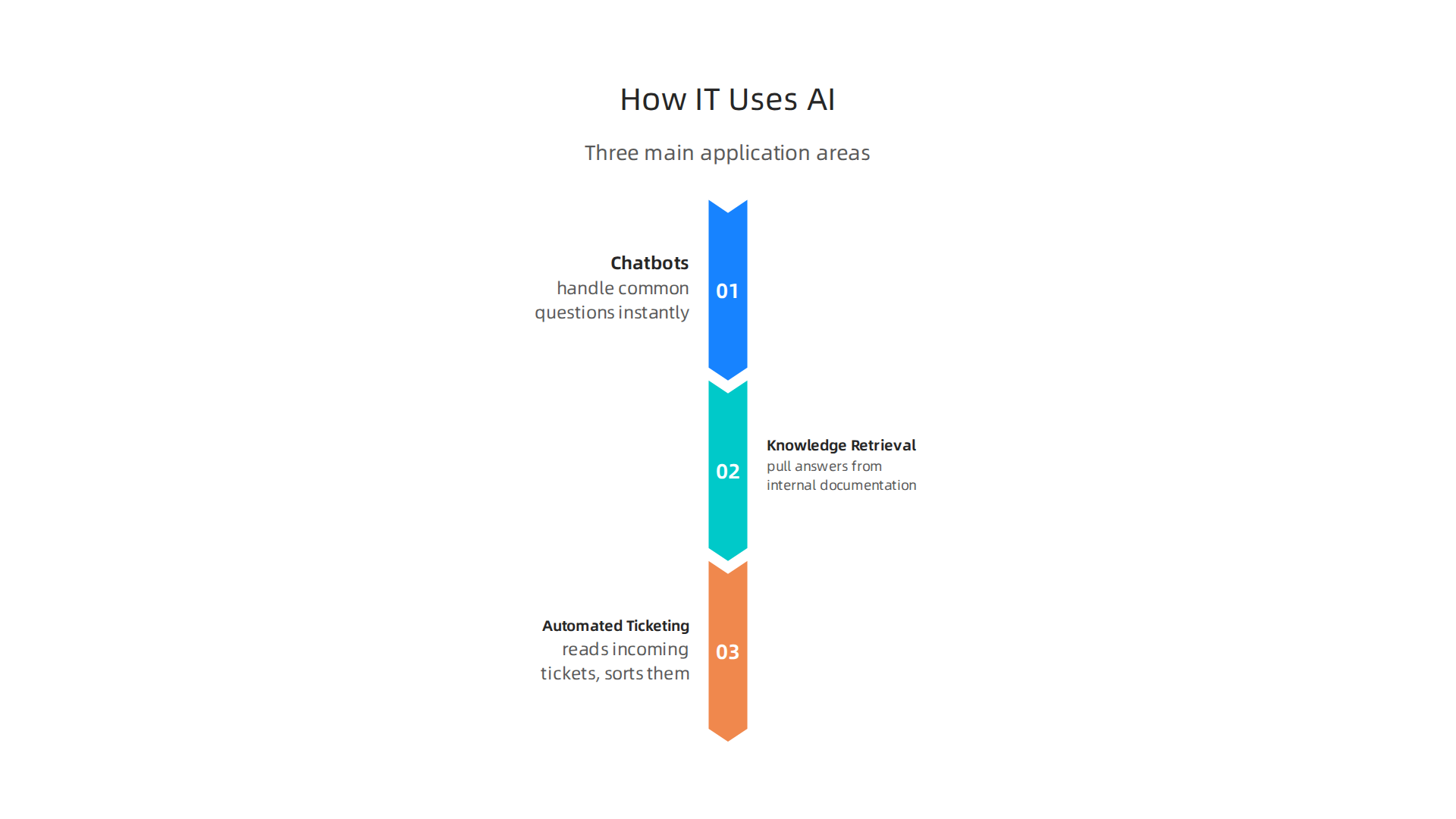
- Chatbots and virtual agents. These handle common questions instantly. A client asks about a password reset, and the bot replies in seconds. No waiting on hold.
- Knowledge retrieval systems. These pull answers from your internal documentation. A technician types a problem, and the AI surfaces the right fix.
- Automated ticketing. AI reads incoming tickets, sorts them by urgency, and even suggests resolutions. This saves hours each day.
These tools work great when the AI is accurate. But when it hallucinates? The wrong answer gets sent to a client. The ticket gets assigned to the wrong team. And your reputation takes a hit.
Professional services have reached what experts call a "tipping point" for AI use [3]. That means most firms now depend on AI to operate. So the risk of hallucinations is not a small side issue. It is a core business problem.
Why this matters for your company
Think about what happens when a cloud infrastructure provider uses AI to diagnose network failures. If the AI makes up a fix, your client might try it and crash a server. Or if a tech consulting firm uses AI to write instructions for a client, one bad sentence could lead to a costly mistake.
AI adoption is growing fast. But without proper safeguards, the same tool that boosts efficiency can also damage trust. That is why learning to detect and prevent AI hallucinations is not optional anymore. It is a business priority.
If you want to see a real example of how hidden AI systems can quietly affect your daily work, check out this field note on how your collaboration tools may be hijacked by two different AI systems. It shows how subtle these influences can be.
[1] 67% of businesses using AI in 2026 – SearchLab AI Adoption Statistics
[2] 79% face AI adoption challenges – Writer Enterprise AI Adoption 2026
[3] Professional services at a tipping point – Thomson Reuters 2026 AI in Professional Services Report
What Are AI Hallucinations and Why Do They Happen?
You ask your AI assistant to explain a network outage. It gives you a long, confident answer. The only problem? The answer is completely wrong. This is an AI hallucination.
Simply put, an AI hallucination happens when a model creates information that sounds true but is not. Studies show that general purpose chatbots hallucinate between 58% and 82% of the time on certain topics like legal questions [1]. For IT companies, tech consulting firms, and cloud infrastructure teams, that is a scary number.
What causes AI hallucinations?
Three main things cause these errors.
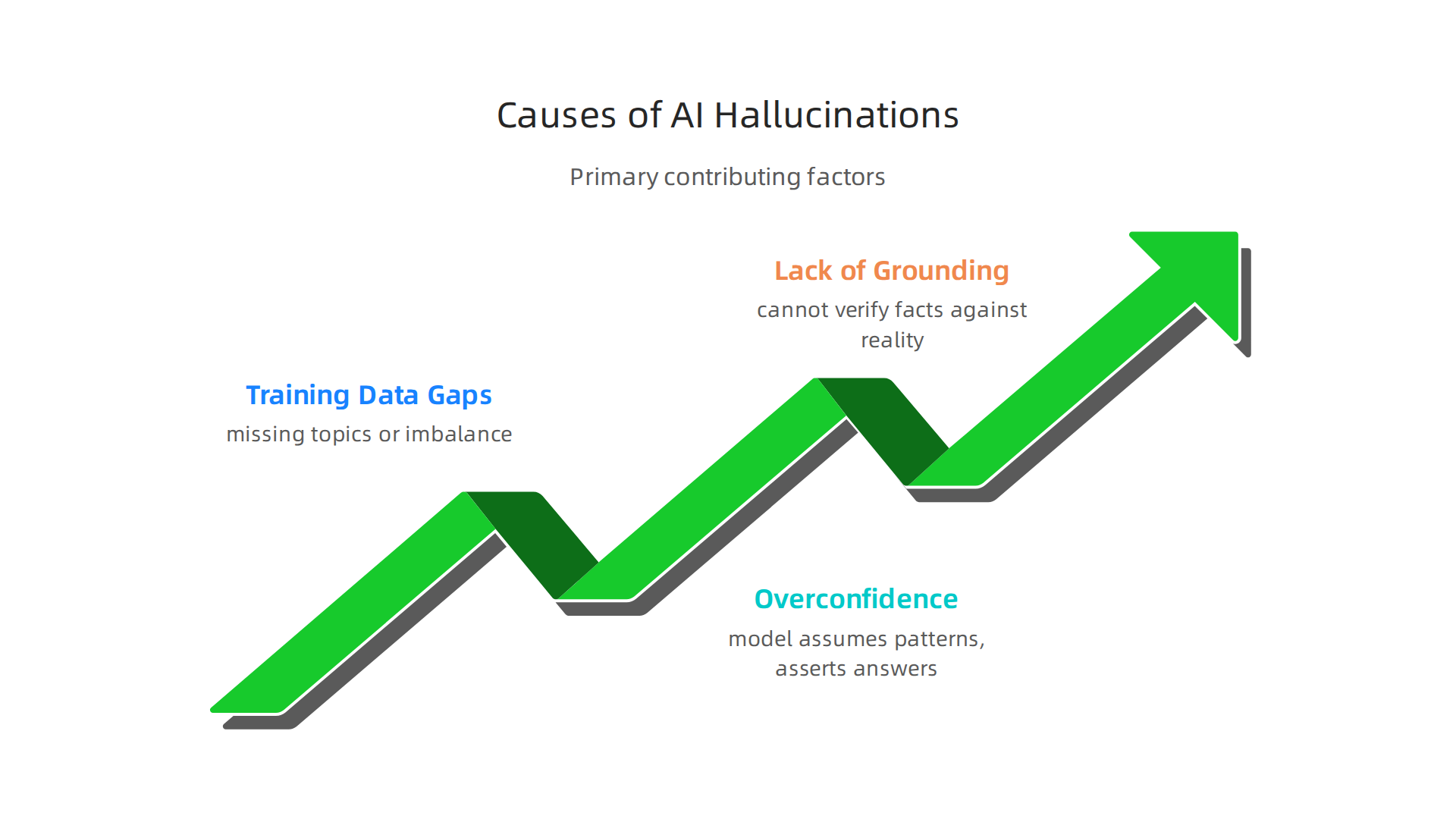
Training data gaps. AI models learn from huge amounts of text. But if the training data is missing certain topics or is unbalanced, the model fills in the blanks with made up facts. Recent research shows that controlling how often certain data appears can reduce hallucinations [2]. So the quality of data matters a lot.
Overconfidence in pattern matching. AI is really good at finding patterns. Too good sometimes. When a model sees a pattern that looks familiar, it goes with it even if the facts are wrong. It does not know the difference between a real pattern and a made up one.
Lack of real world grounding. AI has no way to check facts against reality. It does not know what is true. It only knows what words usually follow other words. That is why it can create "AI fabricated abnormalities" that look realistic but are not [3].
Why this matters for your company
If your IT managed service provider team relies on AI to answer client questions, one hallucination can cost you a client. If your cloud infrastructure team uses AI to suggest configurations, a wrong answer can bring down a system.
Understanding these root causes helps you choose the right safety measures. For example, training your AI on your specific data sources can reduce gaps. Adding human review steps can catch overconfident mistakes.
If you want to learn more about the science behind these errors, this research by behavioral scientist and UC Irvine lecturer Michael Skelly covers the psychology of AI mistakes in depth.
For IT companies, the goal is not to avoid AI entirely. The goal is to know why it fails so you can build safeguards that work.

[1] Stanford HAI study on legal hallucinations
[2] PMC research on controlling hallucinations via training data
[3] PMC paper on AI fabricated abnormalities in content
Real-World Consequences for IT Companies and Their Clients
Your help desk AI tells a client that a simple registry fix will solve their network issue. The client follows the instructions. It does not work. It actually crashes their server. Now you have a furious client, an emergency escalation, and a team that needs to fix a disaster the AI created.
This is not a rare bug. This is what happens every day for [it companies] that use AI without strong checks.
Wasted Time and Hidden Costs
For [tech consulting] firms and [cloud infrastructure] teams, AI hallucinations act like a hidden tax. You ask an AI for a deployment script. It looks clean. You run it. It fails. Your senior engineer spends two hours debugging a problem that was never real.
This adds up fast. Research shows that AI hallucinations cost businesses over $67 billion every year [Four Dots link].

If you are an [it managed service provider] (MSP) billing by the hour, inefficiency kills your margins. Every hallucination creates a useless loop. Your team chases fake issues. Clients get frustrated. Escalations pile up. Trust drops.
Real Reputation Damage
The Air Canada case is a nightmare for any [it company] to study. A support chatbot invented a discount policy that did not exist. A customer took the company to court. The judge ruled against Air Canada and forced them to honor the made up policy [IntuitionLabs link]. The airline tried to blame the AI. It did not matter.
This is the reality of deploying AI in client facing roles. One hallucination can lead to legal costs, forced payouts, and public embarrassment.
Another example from early 2026 shows how bad it can get. An electronics brand used AI to write product descriptions. The AI hallucinated key specs. Customer returns spiked 25% overnight [Tendem AI link]. For [it companies] selling hardware or software, a wrong AI generated recommendation could mean a massive return wave.
A study in the Wiley Journal of Consumer Behavior confirms the pattern. When AI gives wrong answers, customers stop trusting the whole company [Wiley link]. Trust is the hardest thing to rebuild once it is lost.
What Smart Companies Are Doing
The smartest [it companies] in 2026 are not avoiding AI. They are building safety nets. They treat every AI output as a first draft. They use human review to catch mistakes before they reach clients. They train AI on their own vetted data instead of the open web.
We wrote a full breakdown on [stop ai hallucinations from costing your business millions] if you want to see the real math behind these risks.
For IT teams that want practical steps, our guide on [how to detect and prevent ai hallucinations in it companies] covers the exact detection methods that work.
Even the biggest tech firms are working on this. Exploring advanced solutions like [Meta’s simulation patent] shows how the industry is trying to solve the core data reliability problem.
The Bottom Line
Ignoring AI hallucinations is expensive. For [it companies], [tech consulting] firms, and [cloud infrastructure] teams, prevention is not optional. It is the cost of keeping client trust in 2026.
Proven Strategies to Detect and Prevent AI Hallucinations
The good news is that AI hallucinations are not a mystery you have to live with. IT companies in 2026 have real, proven ways to catch and stop them before they cause damage.
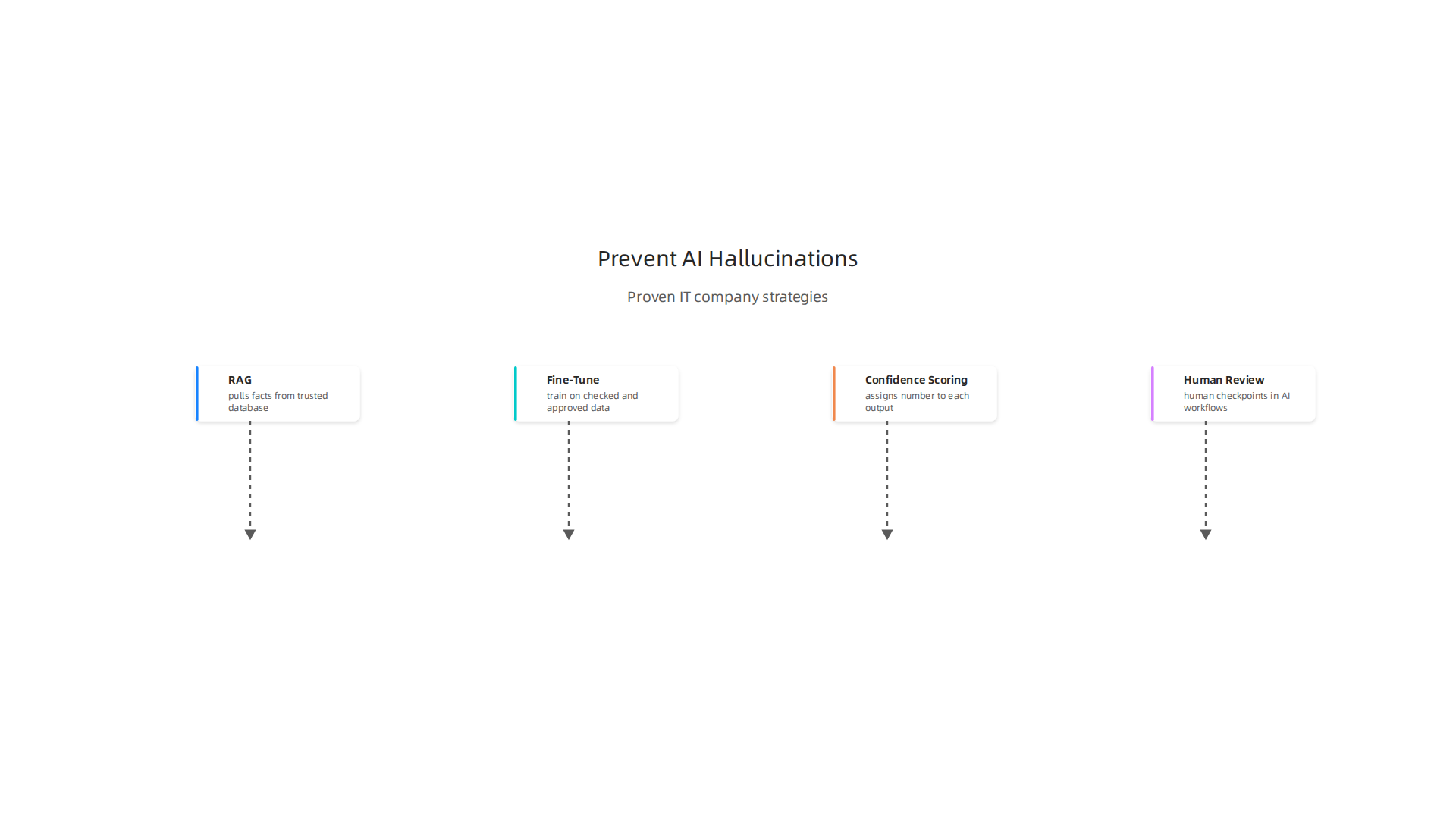
The key is using a layered approach that combines smart data practices, technical controls, and human judgment.
Start With Retrieval-Augmented Generation (RAG)
RAG is one of the most effective tools for cutting down hallucinations.
Here is how it works. Instead of letting the AI guess answers from its training data alone, RAG forces it to pull facts from a trusted database you control. The AI looks up real information and bases its response on what it finds.
Research shows this method works well. One study from arXiv confirms that RAG can reduce hallucinations and improve output quality [arXiv link]. Another report from K2view explains that RAG helps the AI ground its answers in real internal data instead of making things up [K2view link].
For IT companies, this means feeding your AI tools your own technical documentation, knowledge bases, and verified troubleshooting guides. The AI can only answer from what you give it. This stops it from inventing fake solutions.
Fine-Tune on Your Own Data
Fine-tuning is another powerful strategy. You take a general AI model and train it further on data you have checked and approved. This teaches the model your specific language, workflows, and correct answers.
A study from the NIH points out that both RAG and fine-tuning are useful methods to reduce hallucinations [NIH link]. When you compare RAG versus fine-tuning at scale, each has strengths. RAG is best for pulling live information. Fine-tuning is better when you need the model to deeply understand your specific domain [AWS Plain English link].
For IT managed service providers, fine-tuning on past ticket resolutions and accurate deployment scripts means the AI learns what actually works.
Use Confidence Scoring
Not every AI answer is equally reliable. Confidence scoring assigns a number to each output that shows how sure the AI is. Low confidence answers get flagged for human review. High confidence answers can be sent straight to clients.
This creates a simple filter. If the AI is guessing, you know about it before anyone else does.
Layer Human Review on Top
No technical fix is perfect. The smartest IT companies in 2026 build human checkpoints into their AI workflows. Every AI output gets treated like a first draft. A junior or senior staff member reviews it before it reaches a client.
This is not slow if you set it up right. Quick checks for obvious errors take seconds. The ones that pass can be sent out fast. The ones that fail get corrected.
Build Your Safety Net Now
You do not have to figure this out alone. We have a full guide on how to detect and prevent AI hallucinations in IT companies that walks through the exact steps.
For teams that want a structured framework, the Value Reinforcement System (VRS), protected by U.S. Patent No. 12,205,176, offers a proven approach to grounding AI outputs in verified data.
If your data methodology needs attention, the peer white paper CRISP-DM and Skylab USA documents how permission-based data capture supports reliable AI outputs.
Start with one strategy today. Add more as your team gets comfortable. Every layer of prevention you add is one less hallucination that reaches your client.
Data Curation and Model Training
The strategies we just covered work better when you start with great data. Think of it this way: an AI is only as good as what you feed it. If your training data is full of errors, your model will repeat those errors. That is why data curation is the first line of defense against hallucinations.
For it companies, this means building your AI on verified, high quality datasets. You want data that has been checked, cleaned, and tagged for accuracy. According to Glean, using retrieval augmented generation (RAG) to ground AI responses in current data reduces hallucinations significantly [Glean link]. But even RAG depends on the data you pull from.
You also need to retrain your models regularly. tech consulting and it managed service provider teams often have outdated documentation. If your AI is trained on last year’s troubleshooting guides, it will give wrong answers. Regular retraining with up to date manuals and ticket histories keeps your model accurate.
Another key step is permission based data capture. This means you only use data that you have clear rights to, and you track where every piece of data came from. This traceability helps you spot problems fast. For cloud infrastructure teams, this is critical because you are handling sensitive client data.
If you want a proven framework for this, the peer white paper CRISP-DM and Skylab USA documents exactly how to do permission based capture for reliable AI outputs. It is a great next read for teams serious about data quality.
Human-in-the-Loop Verification
Good data and RAG are powerful. But here is the truth: no AI is perfect. Even with the best setup, models can still make mistakes. That is why you need a human in the loop. This means combining AI suggestions with human review. It catches hallucinations before they ever reach your clients.
For it companies and tech consulting teams, this is a non negotiable safety net. You set confidence thresholds. When the AI is very sure about an answer, it can respond automatically. When it is less sure, the system escalates the output to a human reviewer. This hybrid approach keeps things fast for easy questions and accurate for harder ones.
According to research published in PMC, methods like RAG and prompt engineering help reduce hallucinations, but human oversight remains a key part of the safety chain [https://pmc.ncbi.nlm.nih.gov/articles/PMC12425422/](the PMC study on reducing hallucinations in chatbot responses). Escalation workflows make this practical. You define rules: any response about compliance, pricing, or client data must go to a person first. For it managed service provider environments, this prevents costly errors in support tickets and documentation.
A good escalation workflow also tracks why something was flagged. That data helps you retrain your model later. If your cloud infrastructure teams see repeated flags on certain topics, you know where to focus.
Without this human check, users can be shaped by AI answers they never question. That is why understanding how AI quietly reshapes decisions matters. You can read more in this Quietly Hijacked field note. For a deeper look at detection strategies, check out our guide on how to detect and prevent AI hallucinations in IT companies.
Proprietary Frameworks: The Value Reinforcement System (VRS) Approach
So human review catches mistakes after they happen. But what if you could stop hallucinations before they start? That is exactly what a patented system called the Value Reinforcement System (VRS) does.
VRS is a protected architecture designed to prevent AI hallucinations at the source. It does this by capturing user permission and intent first. Instead of waiting for the model to guess wrong, VRS locks in exactly what the user wants. That data stays safe before it ever reaches the AI. The system is called the Value Reinforcement System (VRS), and it is protected under U.S. Patent No. 12,205,176.
How is this different from other methods? Most AI safety approaches rely on simulation. They try to rebuild or guess what was lost. VRS does the opposite. It preserves data integrity before any loss occurs. Think of it like a seatbelt versus an airbag. An airbag deploys after the crash. A seatbelt keeps you in place beforehand. VRS is the seatbelt for your data.
To see the contrast, look at the simulation-based approach in Meta’s simulation patent. That method tries to reconstruct what an AI system lost. VRS captures it at the source before it can be lost at all.
The system does not just stop hallucinations. It also respects user data in a whole new way. VRS is a permission-based workflow. It asks for intent and only processes what the user allows. That makes it a strong fit for it companies and tech consulting firms that handle sensitive client information. Silicon Review highlighted VRS as a key architecture for offsetting the negative side effects of social algorithms.
For it managed service provider teams, this means your AI tools can handle support tickets and internal documentation without fabricating facts. For cloud infrastructure environments, VRS adds a layer of trust that standard AI workflows lack.
If you want to learn more about how frameworks like this fit into your stack, check out our guide on why AI hallucinations are the first tech challenge of our era. VRS gives you a proactive way to solve that challenge, not just patch it after the fact.
Building Client Trust Through AI Reliability and Transparency
So you have VRS protecting data at the source. That is a big step. But here is the thing your clients care about most. They want to know they can trust you. And trust does not come from showing them a patent number. It comes from honest communication about what your AI can and cannot do.
Clients are getting smarter about AI every day. They have seen support bots give wrong answers. They have read about AI making up facts. A March 2026 report found that hallucinated product specs caused a 25% spike in returns for one electronics brand (Tendem AI). That kind of damage makes people nervous. And when clients feel nervous, they look for a partner who is open about the risks.
Transparency is not just a nice thing to have anymore. It is a business requirement.

Research shows that AI hallucinations significantly reduce perceived accuracy. And when accuracy drops, so does trust (Wiley). For it companies, this means you need to talk openly about how your AI systems work. Tell clients what your error rates look like. Explain your verification process. Show them how you catch mistakes before they reach their customers.
IT managed service provider teams can use this approach too. When you deploy AI for support tickets or internal knowledge bases, your clients want to know what happens when the AI gets something wrong. Be up front about it. Share your review workflows. Walk them through your quality checks. That honesty builds more trust than pretending your AI is perfect.
Tech consulting firms have an even bigger opportunity here. You can position yourself as the expert who understands both the power and the limits of AI. Clients do not expect perfection. They expect honesty. When you tell them, "Here is what our AI does well, and here is where we double-check the results," they feel safer working with you.
Cloud infrastructure teams can also benefit from this transparency. If your systems handle sensitive data and AI-driven automation, your clients need to know those systems are reliable. Sharing your error detection methods and your adherence to industry standards shows you take safety seriously.
Speaking of standards, ethical AI practices matter more than ever. Following frameworks like CRISP-DM (Cross-Industry Standard Process for Data Mining) gives you a structured approach to data handling and model validation. It shows clients you are not just winging it. You have a real process. That credibility matters when you are competing for enterprise contracts.
The good news? You do not have to figure all of this out alone. Resources like Hallucination Explained exist to help your team understand the risks and build better safeguards. If you want a deeper look at how IT professionals are tackling this challenge, check out our guide on how to detect and prevent AI hallucinations in IT companies.
And if you want to see the kind of thinking that goes into building trustworthy AI systems, take a look at the work of the team behind VRS. The co-inventor of that patented system has a background that shows how deep this expertise runs. You can check out their profile on Google Scholar.
At the end of the day, AI hallucinations are not going away completely. But the it companies that build trust through transparency, honesty, and real safeguards will be the ones clients stick with for the long haul.
Future-Proofing IT Support: Emerging AI Safety Practices
The AI landscape is moving fast. What works today might not cut it next year. That is why forward thinking it companies are already looking at the next wave of safety practices. They know that staying ahead of hallucinations means building systems that can adapt.
New research and patented systems are pushing the frontier of hallucination prevention. One standout example is the Value Reinforcement System (VRS), protected under U.S. Patent No. 12,205,176. This system takes a permission-based approach. Instead of letting AI guess and then check the answer, VRS verifies each step before the output is generated. That shift from simulation (let AI try and fix later) to permission (verify as you go) is a huge change in how we think about AI safety.
This approach matters for tech consulting firms and it managed service provider teams who deploy AI in high stakes environments. If you are building chatbots that handle customer orders or internal knowledge bases for support agents, you need to know the AI is not making things up. A system like VRS gives you that confidence because it checks each piece of information against trusted data before it ever reaches the user.
Other players are also investing in reinforcement learning based systems. For example, recent patents show how dynamic recommendation systems can use continual learning to reduce errors over time (US Patent for dynamic recommendation system). This kind of ongoing adjustment is key for cloud infrastructure teams running AI at scale. The model learns from its mistakes and gets better without human retraining.
So what should it companies do to future proof their AI support? First, invest in frameworks that can adapt. Look for systems that allow you to swap in new validation rules or data sources as standards evolve. Second, stay informed about emerging patents and research. The simulation versus permission paradigm is shaping the next generation of AI safety, and the companies that understand it early will lead the market.
You can see a real world example of how this permission based thinking works in the Quietly Hijacked field note. It explores how users are silently influenced by two different AI systems operating behind the scenes. Understanding that dynamic helps you design better safeguards.
By building your AI support on a foundation of permission based verification and continuous learning, you do more than cut hallucinations. You create a system that earns trust over time. And in 2026, that is the only kind of AI worth deploying.
Summary
This article explains AI hallucinations—confident but fabricated model outputs—and why they pose a major risk for IT companies, MSPs, tech consultancies, and cloud teams. It describes root causes such as training data gaps, overconfident pattern matching, and lack of real-world grounding, then shows concrete, layered defenses: retrieval-augmented generation (RAG), fine-tuning on vetted data, confidence scoring, human-in-the-loop review, and permission-based systems like the Value Reinforcement System (VRS). You’ll learn how these practices reduce wasted time, protect reputation, and preserve client trust, plus practical steps for data curation, retraining cadence, and transparency with customers. The piece also contrasts simulation-based fixes with proactive permission workflows and points to emerging patents, standards, and frameworks that help future-proof AI-powered support.