

Introduction
Do you ever feel like your business is running harder but going nowhere?

Maybe your teams are overloaded, costs keep creeping up, or you keep missing deadlines for no clear reason. You are not alone. Many companies face these hidden drains on their profits and growth every single day.
Here is the thing. Most organizations do not have the internal expertise to diagnose and fix these operational bottlenecks. That is where ops consulting comes in.
Operations consulting is a specialized branch of management consulting focused on improving how organizations run their day-to-day operations. As one source explains, it is the discipline of analyzing, improving, and stabilizing the systems, processes, and workforce structures that drive your business forward. In simple terms, operations consultants help you find the leaks in your bucket and plug them for good.
Expert ops consulting offers a structured, data-driven approach to transform how you work. Instead of guessing what might fix your slow order fulfillment or rising production costs, you get a clear roadmap. Consultants look at your operating models, your internal workflows, and your value chains. They help align your teams around measurable goals. And they bring proven methods like lean management, process optimization, and sometimes even six sigma certification to the table.
Think of it this way. If you were building a house, you would not ask the plumber to design the foundation. You would hire an architect. Operations consultants are the architects of how your business runs. Whether you work with larger software consulting companies or specialized boutiques, the goal is the same: make your business run better, faster, and cheaper.
This guide is your comprehensive roadmap to understanding ops consulting, choosing the right help, and getting real results. We will cover what to look for in it service providers, how to vet consultants, and how to make sure the changes stick long after the consultant leaves.
But before we dive deeper, there is one important truth to keep in mind. Even the best consultants rely on data and analysis to guide their recommendations. And in 2026, much of that data comes from AI-powered tools. Polished answers can still be false.

That is why understanding the risks of AI hallucination is becoming a critical part of modern operations consulting, especially when decisions affect real people and real budgets.
Ready to stop wasting time and money on broken processes? Let us get started.
What Is Operations Consulting?
So, what exactly is ops consulting? At its core, it is a specialized branch of management consulting that helps businesses improve how they run their day to day operations. One source describes it as the discipline of analyzing, improving, and stabilizing the systems, processes, and workforce structures that drive an organization forward. In plain English, ops consultants are the fixers who find the hidden problems in your workflows and show you how to solve them.
How is it different from general management consulting? General management consulting often looks at big picture strategy, like which markets to enter or how to restructure leadership. Ops consulting zooms in on the nuts and bolts. It focuses on tangible, measurable improvements. Think reducing production time, cutting supply chain costs, or improving product quality. As another source puts it, this field is about improving operating models, internal operations, and value chains. You are not just getting a new strategy. You are getting a plan to actually execute better.
What does the scope cover? A good ops consulting engagement usually includes four main areas:
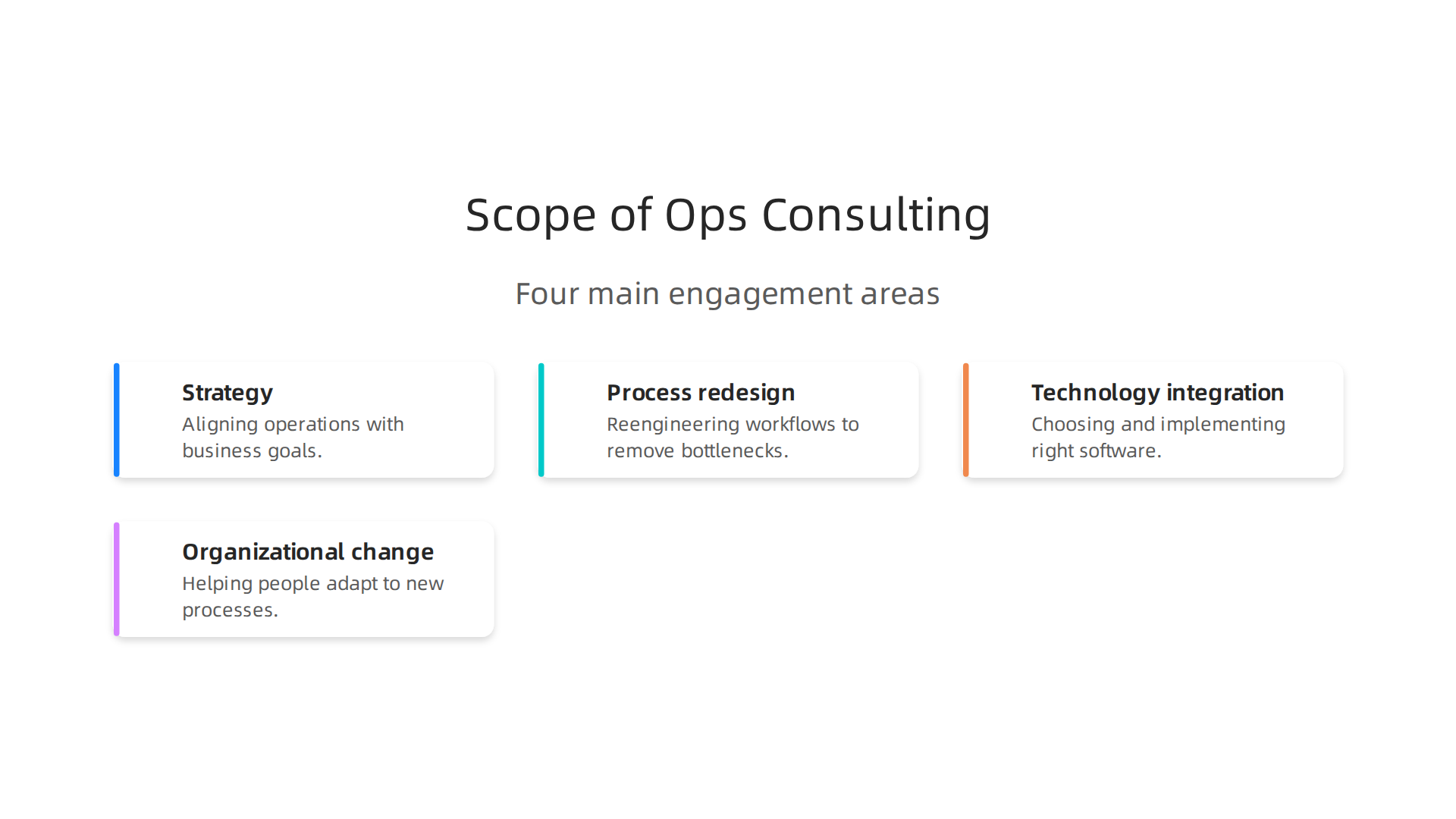
- Strategy – Aligning operations with your business goals. For example, deciding whether to centralize or decentralize your warehouse network.
- Process redesign – Reengineering workflows to remove bottlenecks, reduce waste, and speed up delivery. This is where you see tools like lean management and six sigma certification come into play.
- Technology integration – Choosing and implementing the right software and systems. This often involves working with IT service providers or software consulting companies to automate repetitive tasks and connect data across departments.
- Organizational change management – Helping your people adapt to new processes and tools. Because even the best plan fails if the team does not buy in.
Many ops consultants bring data driven methods to the table. They collect real numbers, map out your current state, and build a clear roadmap to a better future. But here is the thing. In 2026, a lot of that data analysis is powered by AI tools. And AI can sometimes produce false or misleading outputs. That is why smart leaders also invest in understanding AI hallucinations and how to prevent them.
If a consultant’s recommendation is based on a faulty AI insight, the whole project could go off track.
In short, ops consulting is the discipline of making your business run smoother, faster, and cheaper. Whether you bring in a giant firm like McKinsey (who connect boardroom strategies to the frontline) or a boutique agency, the focus stays the same: real, measurable operational improvement.
The Core Pillars of Operations Consulting
Now that you know what ops consulting is, let’s break down the four core pillars that make it work.
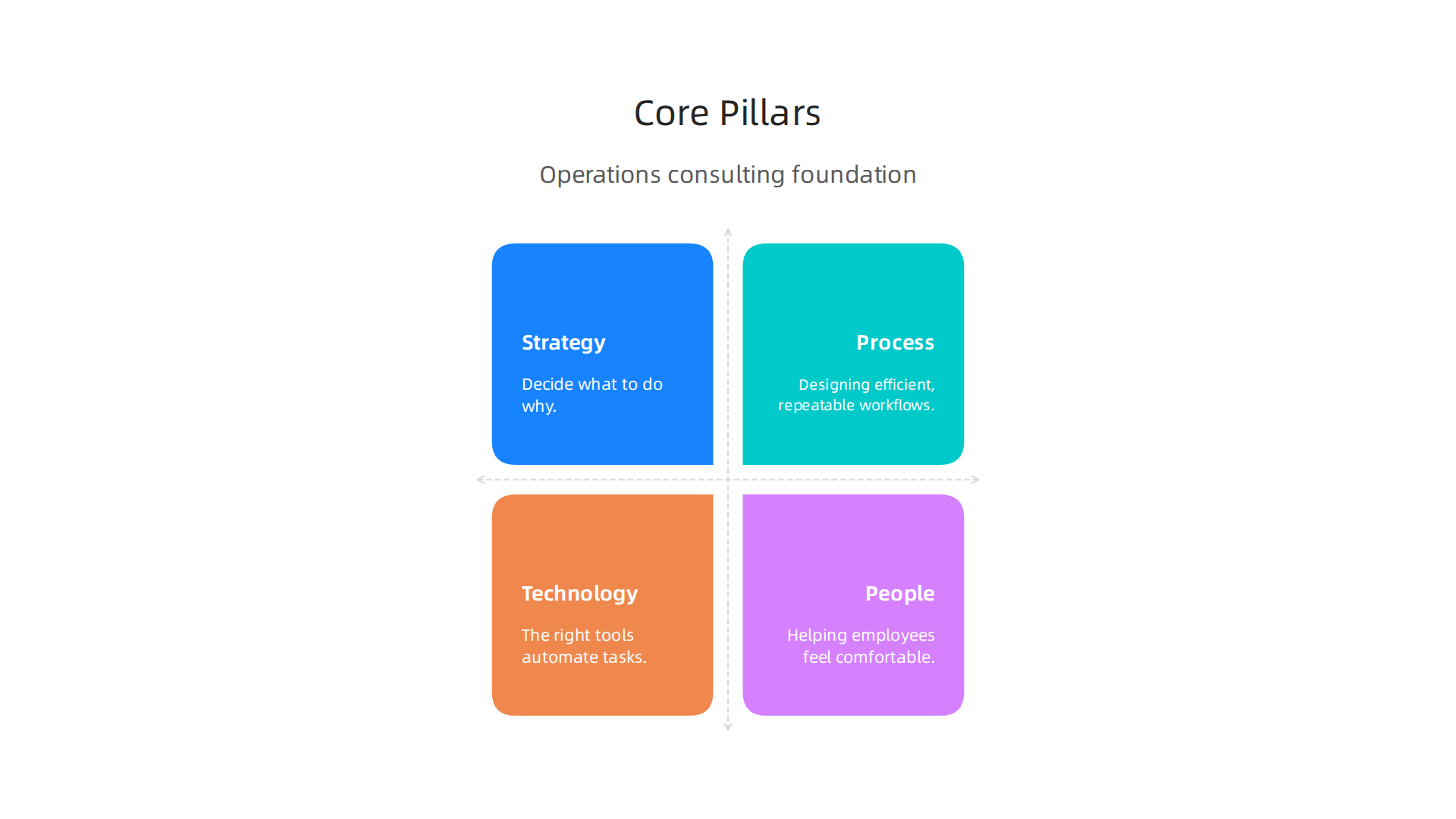
Think of these as the legs of a table. If one leg is weak, the whole thing wobbles. The strongest operations consulting projects pay attention to all four: strategy, process, technology, and people.
Many experts actually talk about three main pillars: people, process, and technology. This is called the PPT framework, and it’s been used for years to drive business change. One source explains that the PPT framework helps you align teams and fuel growth by balancing these three elements. Another adds that it’s a model for carrying out process and technology changes successfully. But in modern ops consulting, we add strategy as the fourth pillar because it’s the glue that holds everything together.
Let’s look at each pillar:
-
Strategy – This is where you decide what to do and why. Your operations need to match your business goals. For example, if you want to grow market share, your supply chain might need to prioritize speed over cost. Without a clear strategy, the other pillars have no direction.
-
Process – This is the how. It’s about designing workflows that are efficient, repeatable, and free of waste. Tools like lean management and six sigma certification are often used here. A good process redesign can cut production time in half or reduce errors dramatically.
-
Technology – This is the enabler. The right tools can automate boring tasks, connect data across departments, and give you real-time visibility. Many ops consultants work closely with software consulting companies and IT service providers to pick and implement the best systems. But here’s a big warning: in 2026, a lot of data analysis is done by AI. And AI can produce false outputs. If your consultant relies on bad AI insights, your whole project could suffer. That’s why smart teams learn how to spot and prevent AI hallucinations. One approach is to build detection skills into your workflow.
- People – This is the most overlooked pillar. You can have a perfect strategy, the best process, and shiny new tech, but if your people don’t buy in, nothing changes. Change management is about training, communication, and helping employees feel comfortable with new ways of working. As one research source notes, successful transformations require engagement from the CEO to frontline employees. This pillar is where many projects live or die.
The secret to great ops consulting is integration. You don’t just fix one pillar and ignore the others. A holistic transformation touches all four at once. When you get them working together, you get real, lasting improvement.
One final thought: as you look at technology, always question what AI tells you. Polished answers can still be false. Question AI Confidence before you base major decisions on them.
Signs Your Business Needs Operations Consulting
So how do you know if it’s time to call in outside help? Many business owners wait until things are falling apart. But by then, fixing the damage costs more than prevention would have. Here are the clearest signs that your business could benefit from ops consulting.
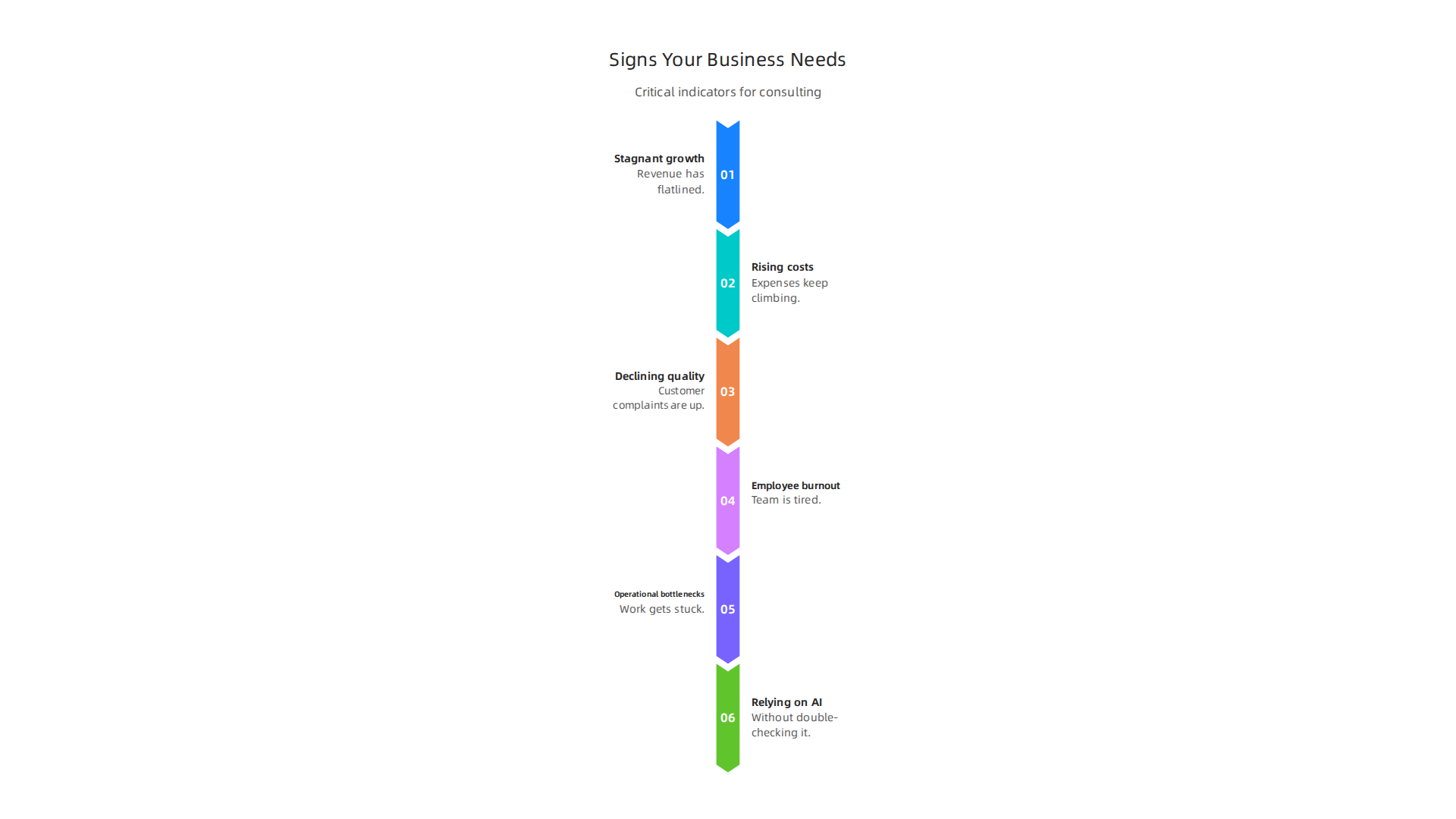
Stagnant growth. You’re putting in the work, but your revenue has flatlined. Maybe you’ve tried new marketing or sales pushes, but nothing sticks. The problem might be deeper in your operations. When your strategy and processes aren’t aligned, growth stalls. A fresh pair of eyes can spot where you’re leaking energy.
Rising costs. Your expenses keep climbing, yet you’re not seeing better results. Are you paying for redundant software? Is your supply chain inefficient? Ops consulting helps you find and cut waste without hurting quality.
Declining quality. Customer complaints are up. Returns are increasing. Maybe orders ship wrong or products have defects. This often points to broken processes or technology that’s not doing its job. As the People, Process, Technology framework shows, all three pillars must work together.

If one is weak, quality suffers.
Employee burnout. Your team is tired. Turnover is high. People are leaving because they’re overwhelmed or frustrated.

This is a classic sign that the people pillar needs attention. Real change requires buy-in from everyone, from the CEO to frontline staff. As one study notes, successful transformations depend on engagement across all levels. If your culture is struggling, it’s a red flag.
Operational bottlenecks. Work gets stuck in the same places every week. Orders pile up in one department. Approvals take forever. These bottlenecks often hide deeper structural problems. An outside consultant can see patterns you’ve become blind to. They can redesign workflows so work flows smoothly.
You’re relying on AI without double-checking it. In 2026, many businesses use AI for data analysis, customer support, and even decision-making. But AI can produce false outputs. If your team trusts every AI answer without verifying, you’re risking costly mistakes. Understanding how to spot AI hallucinations is critical. A good ops consultant will help you build checks into your technology pillar.
The key is timing. Don’t wait for a crisis. Engaging ops consulting early, when you first notice these signs, saves you money and stress. Reactive fixes cost more than proactive improvements.
If any of these signs sound familiar, it might be time to take a closer look. Start with the technology pillar if you suspect AI is feeding you bad data. Polished answers can still be false. Question AI Confidence before you base big decisions on them.
The Operations Consulting Engagement Lifecycle
If you spotted your business in those warning signs, you might be wondering what happens next. How does ops consulting actually work?
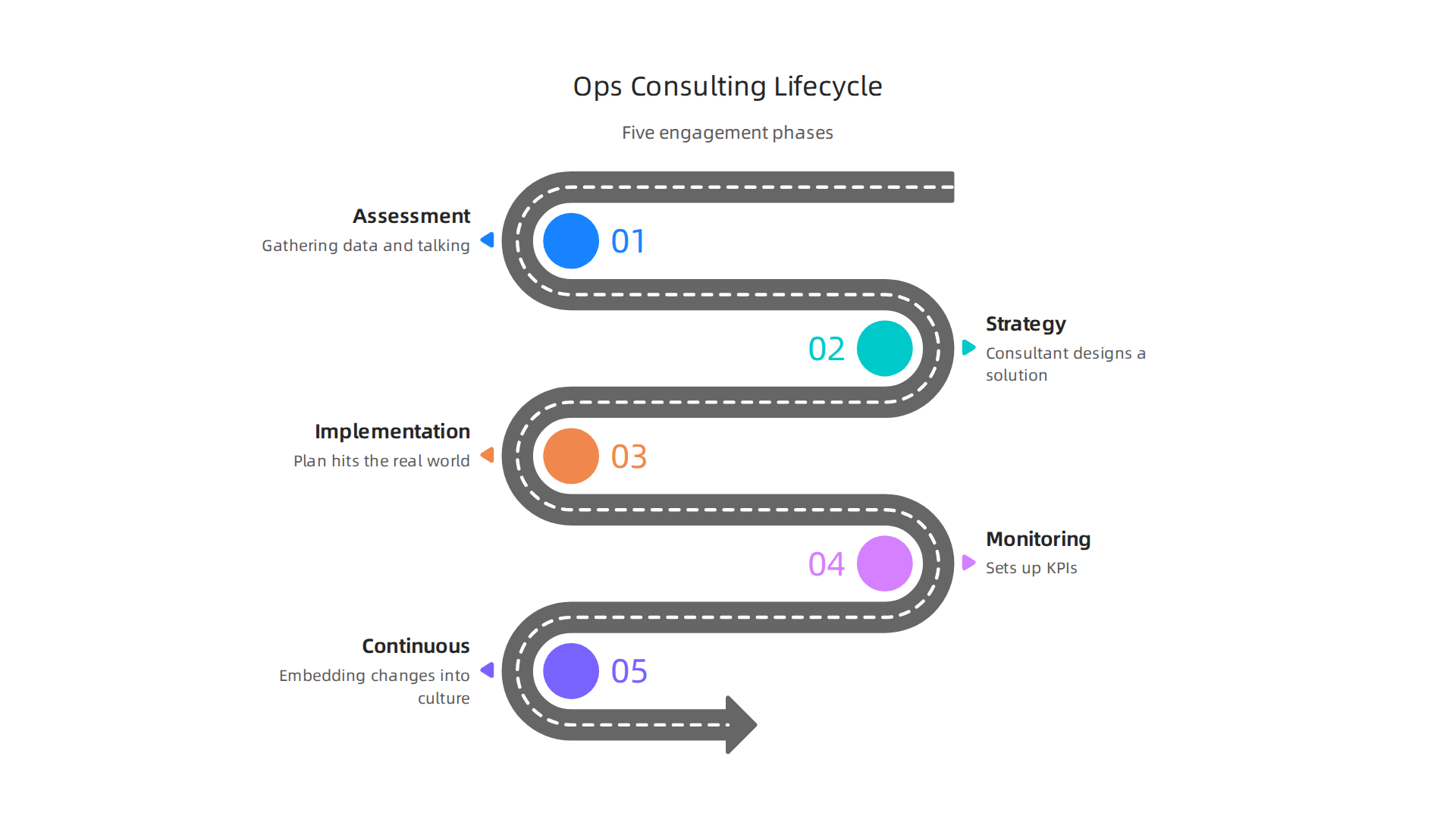
The best engagements follow a clear, structured path. They don’t just jump in and start guessing. Here is what a typical engagement looks like, broken down into five phases.
Phase 1: Assessment
The consultant starts by gathering data and talking to your team. They map out your current workflows to find where things break down. This phase is all about diagnosis.
A huge part of this in 2026 involves checking your technology. Is AI feeding your team bad data without anyone realizing it? Understanding how to spot AI hallucinations is often a key part of this first step. As outlined in the 5 Phases of Consulting, this entry and diagnosis stage sets the foundation for everything that follows.
Phase 2: Strategy Design
Once the problems are clear, the consultant designs a solution. This is not a generic template. It is a plan built around your team, your budget, and your goals.
Stakeholders from every department should have a voice here. This is also where executive sponsorship becomes critical. Leaders must champion the new direction.

Without strong buy-in from the top, even the best strategies fail.
Phase 3: Implementation
This is where the plan hits the real world. Implementation might involve new software, new roles, or new processes. It is the phase where most projects stumble because the execution is harder than the planning.
Many businesses work with software consulting companies to help with this transition. Rigorous project management is non-negotiable here. There is a clear decision gate at this point: you do not move forward until the strategy is fully signed off and resourced.
Phase 4: Monitoring
After changes are made, the work is not over. The consultant helps you set up KPIs and dashboards to track progress. This follows the standard 5 project management phases where monitoring keeps everything on course.
Are costs going down? Is quality improving? Is the team using the new processes? If something is off, you catch it early.
Phase 5: Continuous Improvement
Ops consulting does not end when the consultant leaves. The real goal is to build a system that keeps getting better over time.
This phase is about embedding the changes into your culture. Your team learns how to spot new bottlenecks and fix them independently. You build the muscle for ongoing improvement rather than waiting for the next crisis.
Knowing this lifecycle helps you see the big picture. But the first step is always the same: asking tough questions about where you are today.
If you suspect your AI tools are quietly causing problems in your operations, do not wait. Question AI Confidence now. Polished answers can still be false. A good ops consultant will tell you the same thing.
Key Methodologies in Operations Consulting
The lifecycle we just walked through shows the flow of an ops consulting engagement. But the tools and frameworks a consultant uses matter just as much. Different methodologies solve different problems. Picking the right one can make or break your results.
Here are the most common methodologies you will see in ops consulting today.
Lean
Lean is all about cutting waste. Waste can be extra steps, waiting time, or unnecessary inventory. The goal is to create more value for customers with fewer resources. Lean works best in manufacturing, logistics, and any process that has a clear physical or digital flow. As outlined in the business consulting life cycle, assessment often starts by mapping these flows to spot waste.
Six Sigma
Six Sigma uses data to reduce defects and variation. It follows a structured method called DMAIC (Define, Measure, Analyze, Improve, Control). Teams often pursue a six sigma certification to master the statistical tools behind it. This methodology is a strong fit for industries where precision matters, like healthcare, finance, or aerospace.

Agile
Agile is iterative and flexible. Instead of one big plan that takes months, work happens in short cycles. This lets teams adapt as they learn. Many it service providers and software consulting companies rely on Agile to manage fast-moving projects. It is especially useful for tech teams building new products or fixing broken workflows.
Total Quality Management (TQM)
TQM is a culture, not just a set of tools. It involves every employee in improving quality. The idea is that small, constant improvements from everyone add up to big results over time. TQM works well in organizations that need to build a long-term habit of excellence.
Choosing the Right Fit
No single methodology works for every situation. A warehouse struggling with delays might need Lean. A call center with inconsistent service might need Six Sigma. A software team chasing bugs might thrive on Agile. That is why modern ops consulting often uses hybrid approaches. For example, Lean Six Sigma combines the waste reduction of Lean with the data rigor of Six Sigma. Smart consultants mix and match tools to match your real problems.
But here is a catch: all these methodologies depend on accurate data. If your AI tools are feeding false information into your dashboards, even the best Six Sigma analysis will fail. That is why before you dive into any method, you should Question AI Confidence. Polished answers can still be false. Clean data keeps your methodology honest.
Measuring the ROI of Operations Consulting
So you picked a methodology and your ops consulting engagement is underway. Now comes the big question: How do you know it actually worked?
Measuring the return on investment (ROI) from operations consulting is not always straightforward. But skipping this step is a mistake. Without solid numbers, you are flying blind.
Tangible Metrics You Can Count
The easiest wins to track are the hard numbers. These are the concrete changes that show up in spreadsheets and dashboards.
Cost reduction is usually the first metric people think of. You want to see lower expenses in areas like labor, materials, or overhead. A good ops consulting engagement will target specific cost centers.
Throughput increase measures how much more your team produces in the same amount of time. If your factory or service desk can handle more work without adding headcount, that is a clear win.
Quality improvement shows up as fewer errors, returns, or complaints. For industries that rely on precision, like aerospace or healthcare, a small quality jump can save millions.
Cycle time reduction is about getting work done faster. Shorter cycle times often mean happier customers and lower costs.
According to research on measuring ROI of management consulting projects, setting clear baselines before the work starts is essential. You need to know where you started to prove where you ended up.
Another useful framework is tracking operational KPIs that compare inputs against outputs. The CGI guide on operational efficiency explains that most companies use some form of key performance indicators to measure results.
The Harder to See Wins
Not everything valuable shows up in a spreadsheet right away.
Employee engagement often improves after a good ops consulting project. When processes run smoother, people feel less frustrated. They spend less time fighting broken systems.
Customer satisfaction can go up too. Faster service, fewer errors, and better quality all make customers happier. These gains can take months to show up in surveys or repeat purchase rates.
Knowledge transfer is another hidden benefit. Your team learns new skills and frameworks during the engagement. That knowledge stays with you long after the consultant leaves.
A balanced mix of financial and operational KPIs gives the best picture of consulting impact. The article on maximizing value from consulting services suggests looking at revenue growth, profit margin improvements, and process cycle times together.
Use a Balanced Scorecard
One approach that works well is the balanced scorecard. This method looks at four areas at once:
| Area | What It Measures |
|---|---|
| Financial | Cost savings, revenue growth, profit margins |
| Customer | Satisfaction scores, retention rates, Net Promoter Score |
| Internal Process | Cycle times, defect rates, throughput |
| Learning and Growth | Employee training hours, skill development, engagement |
Using this full picture helps you see both the immediate wins and the long term benefits. You do not want to chase cost savings today only to destroy customer trust tomorrow.
A Note on Data Quality
All these metrics depend on good data. If your numbers are wrong, your ROI calculation will be wrong too.
That is why before you trust your measurement results, you should Question AI Confidence. Polished answers can still be false. Clean, verified data keeps your ROI honest.
When you measure the right things and measure them correctly, you can prove exactly what your ops consulting investment delivered. That confidence makes it easier to decide on your next project.
How to Choose the Right Operations Consulting Partner
You now know how to measure ROI. But none of that matters if you pick the wrong consultant in the first place. Choosing an ops consulting partner is like hiring a guide for a tough hike. The right one gets you to the summit. The wrong one leaves you lost.
So how do you make sure you pick well?
Look for Industry Experience, Proven Methodology, and Cultural Fit
Not all consultants are the same. A firm that works wonders for a hospital might completely fail at a manufacturing plant. Industry experience matters because it means the consultant already understands your regulations, your customers, and your common problems.
A proven methodology is just as important. Does the consultant use a structured approach like Lean, Six Sigma, or a custom framework they have tested over time? You want someone who follows a repeatable process, not someone who makes it up as they go. The guide on the 8 essential management consulting tools for 2026 shows that top consultants rely on established frameworks to drive real results.
Cultural fit often gets overlooked. But if the consultant clashes with your team, nobody will listen to their recommendations. Look for someone who communicates in a way your team respects and who understands how your company really works. The ultimate 2026 guide to operational efficiency consultants emphasizes that alignment with your company culture is a key factor in long term success.
Request References, Case Studies, and a Preliminary Diagnostic
Do not take a consultant’s word for it. Ask for proof.
References let you talk to past clients directly. Ask those clients what went well and what went wrong. Case studies show actual results the consultant has delivered for companies similar to yours. A solid case study will show clear numbers from before and after the engagement.
A preliminary diagnostic is a small upfront assessment before the full project. Good consultants will do this to understand your specific situation. It proves they are serious about solving your actual problems, not just selling a generic solution. Many of the best ops consulting firms offer this as a standard first step.
Beware of Consultants Who Promise Quick Fixes
Real operational change takes time. If a consultant says they can fix everything in two weeks with no deep analysis, that is a red flag.
Deep problems require deep understanding. A consultant who skips the analysis phase is guessing, not solving. Demand transparency about their process. Ask exactly what they will do, how long each phase will take, and how they will measure progress along the way.
Here is the thing: polished answers can still be false. Before you trust any consultant’s claims, you should Question AI Confidence. Even the most confident sounding pitch needs real evidence behind it.
Take your time during the selection process. Check references, verify methodologies, and look for a partner who fits your culture. The right ops consulting partner will make your entire ROI measurement process much easier because the results will speak for themselves.
Common Pitfalls and How to Avoid Them
You found a great ops consulting partner. Your team is excited. But then things start to go sideways. It happens more often than you think. In fact, many consulting engagements fail because of a few common and avoidable mistakes.
Lack of Executive Sponsorship and Unclear Scope
Here is a big one. When top leaders do not back the project, it loses steam fast. People stop prioritizing the consultant’s recommendations. The project stalls. The same thing happens when the scope is fuzzy. No one knows exactly what the consultant is supposed to deliver.
According to McKinsey, 70 percent of transformation failures come from misaligned operating models. That number comes from a designing operating models guide that explains how critical clear direction really is.
How to avoid it: Before the project starts, get a written commitment from executive sponsors. Define the scope in plain language. Set clear milestones that everyone agrees on. And communicate progress often so leaders stay involved.
Resistance to Change
People are creatures of habit. When a consultant comes in and suggests new ways of working, some employees push back. They might ignore recommendations or leave meetings frustrated. This is especially common with outside firms like software consulting companies that bring unfamiliar processes.
How to avoid it: Involve frontline staff from day one. Ask for their input. Explain why the change matters. When people feel heard, they are far more likely to cooperate. A consultant with a six sigma certification knows the process inside out, but they still need your team on board.
Poor Data Quality and Over-Reliance on Assumptions
You can have the best ops consulting plan in the world, but if your data is wrong, the plan will be wrong too. Many engagements fail because the consultant assumes the data is clean without checking. Sometimes they rely on AI-generated insights that turn out to be false.
This is a real danger. Even polished presentations can hide bad information. To protect your business, always verify the data behind the recommendations. And stop AI hallucinations from costing your business millions by questioning every assumption.
How to avoid it: Ask the consultant to show you their data sources. Run a small test first. And never take a confident answer at face value. Question AI Confidence before you invest time and money into any recommendation.
When you watch for these pitfalls and take simple steps to prevent them, your ops consulting engagement has a much better chance of delivering real results.
Summary
This article explains operations (ops) consulting as a practical, data-driven discipline that diagnoses and fixes the everyday systems, processes, and workforce issues that slow businesses down. It defines how ops consulting differs from general management consulting, outlines the four core pillars—strategy, process, technology and people—and walks through a five‑phase engagement lifecycle from assessment to continuous improvement. You’ll learn common methodologies (Lean, Six Sigma, Agile, TQM), how to measure ROI with tangible KPIs and balanced scorecards, and which warning signs mean it’s time to hire help. The guide also shows how to choose a consulting partner—checking industry experience, case studies, and cultural fit—and highlights frequent pitfalls like weak executive sponsorship, poor data quality, and change resistance. Because much analysis now uses AI, the article stresses validating AI outputs and guarding against hallucinations so methodology and metrics stay reliable. After reading, you’ll know when to engage ops consulting, what to expect from an engagement, and how to protect your project from common failures and bad data.