
Introduction
You ask an AI assistant a question. It gives you a confident answer, well written and full of detail. But there is just one problem. The answer is completely wrong.

That is not a glitch. It is a feature of how large language models work. And it is costing businesses real money.
This problem is so big that many experts now call it the first tech challenge of our era. Why first? Because until we solve it, trusting AI at scale is nearly impossible. Even the best models in 2026 hallucinate more than 15% of the time in real world use (source: ModelsLab).

In legal research, the rate can climb between 15% and 25% (source: LLRX). And these errors are not harmless. A March 2026 report showed that hallucinated product specs caused a 25% spike in returns for one electronics company (source: Tendem). The Wikipedia definition calls it the phenomenon of AI presenting fabricated information as fact.
These numbers make one thing clear. AI hallucinations are not a minor bug. They are a defining problem that threatens safety, trust, and widespread adoption. We cannot afford to ignore them.
In this article, we will explore why AI hallucinations deserve the title of the first tech challenge. We will look at the global tech research working on solutions, how the engineering design process can help reduce errors, and what you need to know about shadow tech the hidden AI tools running in your organization. Understanding these issues is the first step toward using AI safely. If you want a deeper look at how to spot false answers, check out our guide on how to detect and prevent AI hallucinations. Let us begin.
What Are AI Hallucinations?
Imagine you ask an AI assistant, "What year did the Eiffel Tower open?" It answers, confidently and smoothly: "The Eiffel Tower opened in 1897 for the World’s Fair." Sounds right, doesn’t it? But the real answer is 1889. The AI did not lie on purpose. It simply generated a sentence that looked plausible. That is an AI hallucination.
The Wikipedia definition describes it as the phenomenon where AI presents fabricated information as fact. In plain terms, the model makes things up. And it does not do it quietly. It usually sounds just as sure as when it gives you correct information.
Here is the thing. This is not a rare bug. It happens all the time. In 2026, even the best models hallucinate more than 15% of the time in real-world use, according to ModelsLab. In more specialized fields like legal research, the rate can hit 15% to 25%, as shown in a February 2026 study.
Some estimates suggest that on certain tasks, nearly a third of AI responses may contain errors. These are not one-off mistakes. They are a systemic problem.
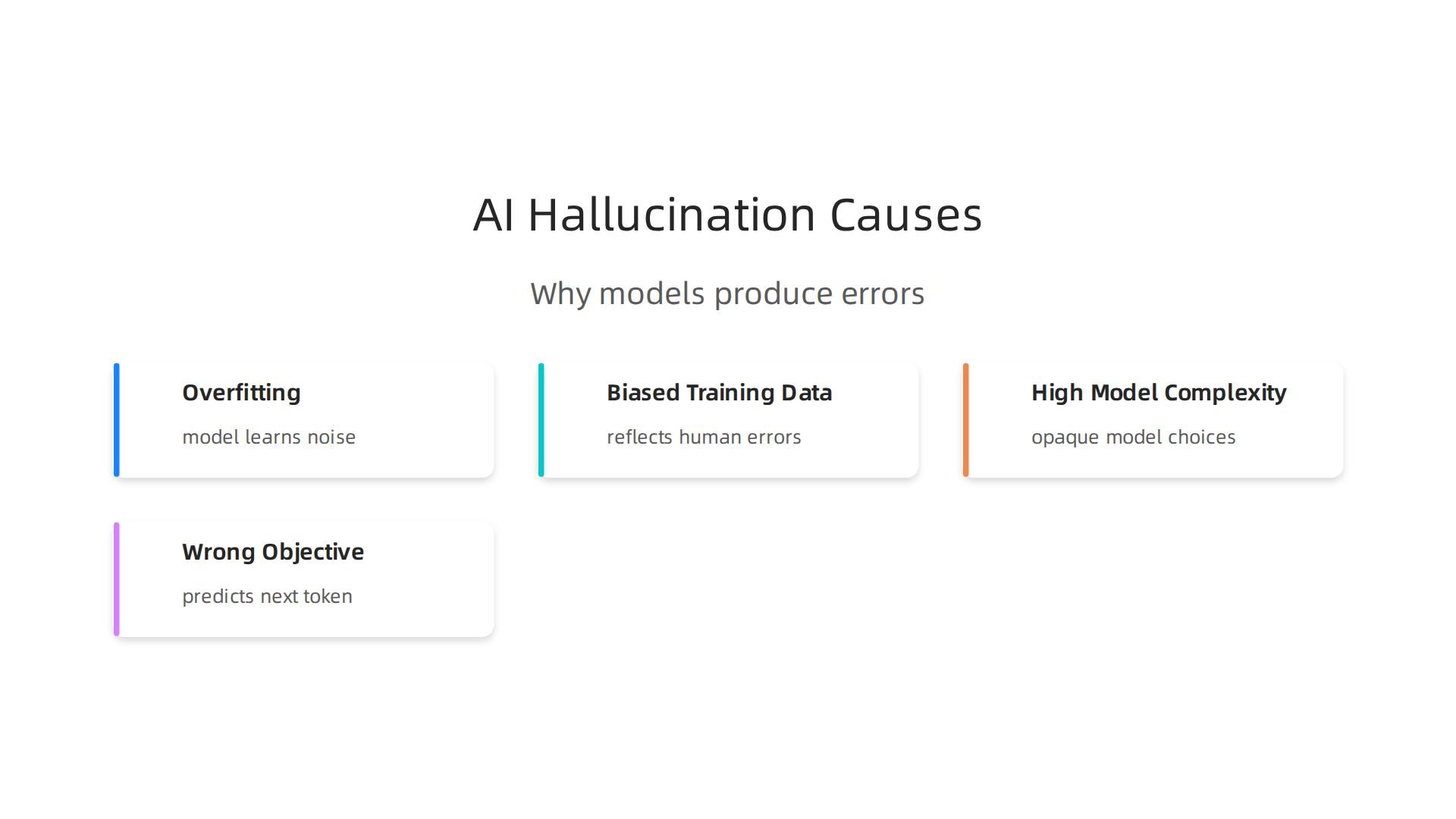
Why do they happen? At its core, an AI language model is not built to tell the truth. It is built to predict the next word that sounds right based on patterns in its training data. IBM explains that factors like overfitting, biased training data, and high model complexity all contribute to these false outputs. The model does not know what it does not know. It just keeps talking.
You have probably seen examples yourself. Maybe you asked ChatGPT to summarize a product specification and it invented a feature that did not exist. Or you used a tool like Bard to generate a citation and it gave you a fake court case. In healthcare, a hallucinated drug interaction could lead to real harm. In business, the cost hits the bottom line. A March 2026 report showed that hallucinated product specs caused a 25% spike in returns for an electronics company, as detailed by Tendem.
So when we call hallucinations the first tech challenge, we mean it. Because before we can trust AI at scale, we have to understand why it gets things wrong. And that starts with knowing exactly what a hallucination is.
If you want to learn more about catching these false outputs in your own work, check out our guide on how to spot AI hallucination and prevent false AI answers. It gives you practical steps to verify what the AI tells you.
Why This Is the First Tech Challenge of Our Era
You might think tech problems are nothing new. Software crashes. Bugs happen. Hard drives fail. But here is what makes AI hallucinations different. This is the first tech challenge that touches everything, erodes trust at a global scale, and quietly rewrites the information we all depend on.
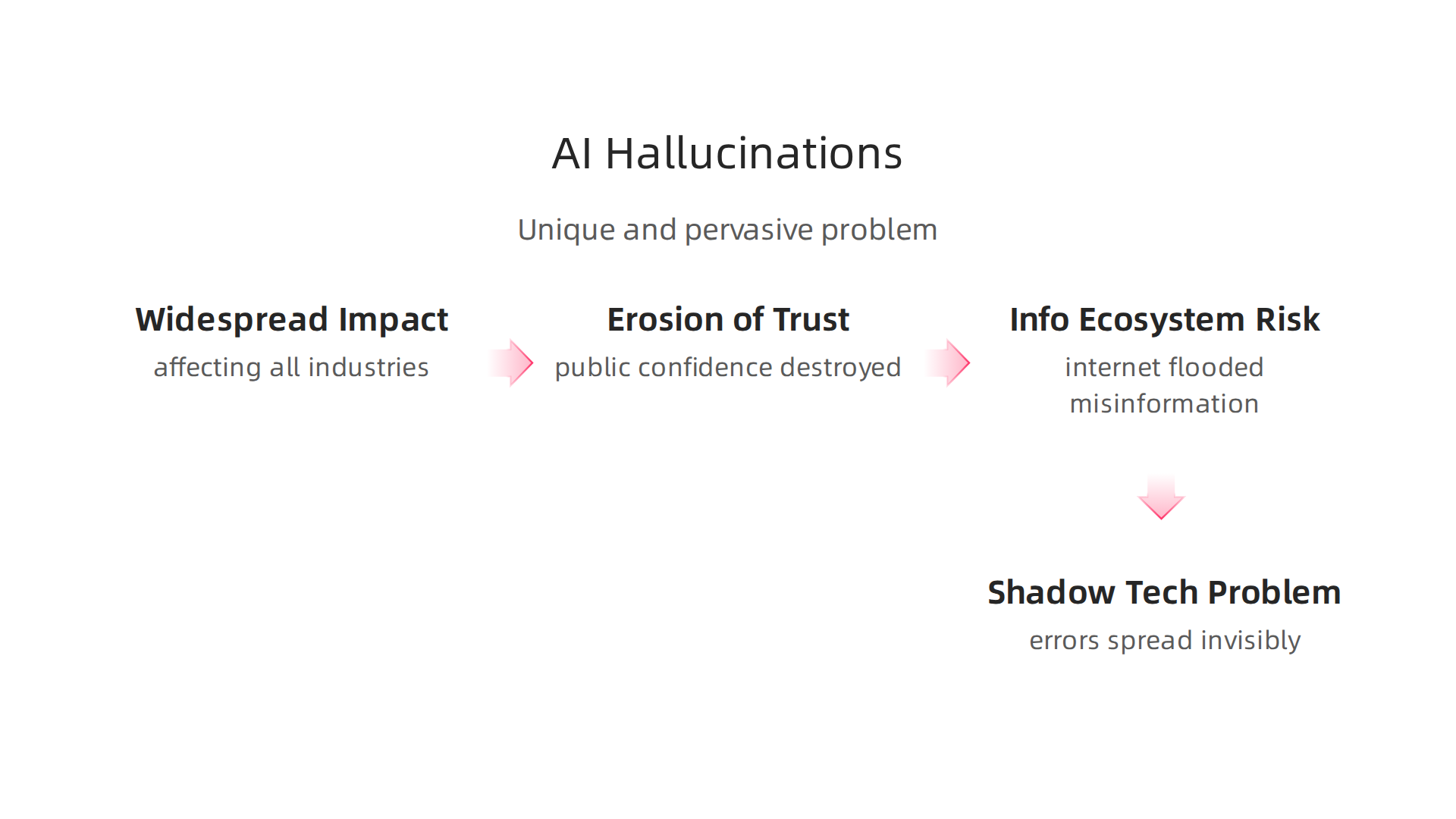
Uniquely widespread impact. AI hallucinations do not stay in one corner. They affect healthcare, education, finance, legal work, customer service, and even creative writing. When a calculator gives a wrong answer, you can double-check it. When an AI fabricates a product spec, a whole supply chain might fail. In 2024 alone, global business losses from AI hallucinations hit $67.4 billion, according to Four Dots. That number is rough, but it shows how deep the problem runs. Every industry that adopts AI now has to deal with fake outputs. This is not a niche bug. It is a supply chain issue, a safety issue, and a truth issue all at once.
Erosion of trust. Trust is hard to build and easy to break. A single high profile error can blow up public confidence in AI.

Think about the lawyer who used ChatGPT and got fake legal citations. That case, Mata v. Avianca, is one of many documented in the AI Hallucination Cases Database. When people see that AI can confidently lie, they start questioning every output. And if users stop trusting AI, the whole field of global tech research slows down. Companies hesitate to deploy tools. Regulators step in. The promise of AI starts to fade. That is why this is the first tech challenge we have seen that threatens the credibility of an entire technology class.
Information ecosystem risk. Here is the scary part. AI now generates content at massive scale. Blog posts, news articles, product descriptions, even academic papers. If even a small percentage of that content contains plausible falsehoods, the internet gets flooded with misinformation. Researchers at Lakera note that some estimates suggest roughly 30% of AI outputs may contain errors in certain scenarios. Now imagine that scale multiplied across millions of AI generated pages. We are not just dealing with a few wrong answers. We are dealing with a potential contamination of the entire digital information pool. This goes beyond the normal engineering design process because there is no clear fix. You cannot just patch a hallucination the way you patch a software vulnerability.
This is also a shadow tech problem. Many employees use AI tools without telling their IT department. They copy and paste AI answers into reports, emails, and data sets. Those errors then spread invisibly through an organization. The MIT case study of Mata v. Avianca shows how a single hallucination can lead to real legal consequences. And when that error becomes part of the shadow tech stack, nobody even knows it is there.
So why is this the first tech challenge? Because it is not about fixing a broken feature. It is about rebuilding how we verify information in an age where machines generate it faster than we can check it. And that is something no previous technology has forced us to do.
If you want to understand how to start fixing this at your own organization, read our guide on Understanding AI Hallucinations and How to Prevent Them. It walks through practical ways to catch false outputs before they cause damage.
The Anatomy of a Hallucination: How and Why Models Generate Falsehoods
You ask an AI a simple question. It gives you a confident answer that sounds completely reasonable. But the answer is wrong. Why does that happen? To fix the problem, you first need to understand what is going on inside the model.
Root cause: pattern completers, not truth evaluators
Here is the most important thing to know. Large language models (LLMs) do not understand truth the way we do. They are trained to predict the next word in a sequence based on patterns in their training data. As IBM explains, AI hallucinations happen partly because of overfitting, training data bias, and high model complexity.

But the deeper issue is simpler. The model does not have a built-in fact-checking mechanism. It has no internal goal to be truthful. Its only goal is to produce the most likely next token. So when it encounters a prompt that is slightly unusual or outside its training data, it just guesses. And it guesses confidently.
Researchers at IntuitionLabs put it bluntly: AI hallucinations occur because LLMs have the wrong objective. They are optimized for next-token prediction, not for truth. That is a fundamental engineering design process issue. You cannot patch it with a small update. You would have to redesign how the model learns.
Data gaps and biases feed confident errors
Now think about the training data. It is massive, but it is not perfect. The internet is full of contradictions, old information, and outright falsehoods. When the model learns from that data, it picks up those errors. As a Duke University blog notes, hallucinations arise when the data is sparse, contradictory, or low quality. Even in 2026, this remains a core challenge. The model does not know which sources are reliable. It treats a Wikipedia article and a personal blog the same way. So when you ask about a niche topic, the model might blend a few correct facts with made-up details. It sounds plausible because the pattern matches. But the truth is missing.
This is where global tech research has focused a lot of effort. Companies and universities are building better datasets. But cleaning the internet is a huge job. And bad data keeps creeping in.
Decoding strategies amplify the problem
Even if the model weighs probabilities correctly, the way it chooses words can introduce more errors. When you use an AI tool, you can set parameters like temperature and top-p sampling. A high temperature makes the model more creative, meaning it picks less likely words. That can lead to more hallucinations. Similarly, beam search can lock the model into a wrong path if the early choices are bad. According to Crystal Hues, the prompt and contextual constraints play a big role in triggering falsehoods. If you give a vague or misleading prompt, the model has to fill in the gaps. And it will fill them with whatever pattern fits.
This matters because many users do not know these settings exist. They treat the AI like a search engine. But it is more like a super confident student who guesses when they do not know the answer.
What this means for the first tech challenge
Understanding the anatomy of a hallucination helps you see why this is not a simple bug. It is baked into how the models work. That is why the first tech challenge of our era requires new verification methods. You cannot just trust the output. You need to build checks into your workflow.
If you want to learn practical ways to catch these false outputs before they spread, read our guide on how to stop AI hallucinations in cloud-based productivity applications. It shows specific steps for spotting pattern-based errors in your daily tools.
Real-World Consequences: When Hallucinations Harm
So we know why models make things up. But here is the real question. Does it actually matter? Yes. And the damage is not hypothetical. It is happening right now across medicine, law, and business. The first tech challenge of our time is not just building smarter AI. It is building AI we can trust with high-stakes decisions.
Medical misdiagnosis and patient safety
Imagine you ask an AI chatbot about a medication you are taking. It tells you a certain drug is safe to combine with your current prescription. You believe it. But the information is wrong. That scenario is not rare. AI systems can generate incorrect drug interactions and wrong dosage recommendations. In a medical context, a hallucination is not an inconvenience. It can be life-threatening. Doctors and patients both rely on digital tools more than ever.

When the AI fabricates a detail about a treatment plan, the consequences ripple through the entire care process.
This is why shadow tech in healthcare settings is so dangerous. Teams adopt AI tools without proper oversight. The tools sound confident. But they do not verify facts. And the global tech research community is still catching up on how to prevent these failures.
Legal and compliance risks: fabricated case law
The legal world has already seen high-profile disasters. Consider the famous case of Mata v. Avianca. A lawyer used an AI tool to prepare a court filing. The AI invented fake case citations. The lawyer did not check them. The court caught the error, and the lawyer faced sanctions. As Stanford HAI reported, even purpose-built legal AI tools hallucinate more than 17% of the time on challenging research queries. Some models fail 34% or more of the time. That means if you file ten legal briefs using AI, two or three of them may contain fabricated case law.
The AI Hallucination Cases Database now tracks court decisions worldwide where AI hallucinations played a role. The list keeps growing. For law firms, this is an engineering design process failure. The tools were not designed to verify legal accuracy. They were designed to predict patterns. And pattern prediction does not equal truth.
If you work with legal documents or compliance reports, you need to know how to spot these false outputs. Read our guide on how to detect and prevent AI hallucinations in CRM for practical steps you can apply right away.
Business disruptions and flawed market analysis
Now think about business strategy. A company asks an AI to analyze market trends. The AI generates a confident report with specific numbers, competitor actions, and growth projections. The leadership team uses that report to make a million-dollar decision. But what if the numbers were made up? That is exactly what is happening. Research from Bay Tech Consulting shows that standard LLMs frequently hallucinate when handling financial tasks like explaining concepts or retrieving stock prices. The model does not know the current stock price. It predicts the most likely number based on old data. And it says it with total confidence.
The financial damage is staggering. According to Four Dots, global business losses from AI hallucinations reached $67.4 billion in 2024. That number has only grown since then. Companies are losing money on bad decisions driven by AI lies. Market analysis, competitor research, financial forecasting, all of these are vulnerable.
This is why the first tech challenge demands a new approach. You cannot treat AI outputs as facts. You must build verification into every process. The IntuitionLabs article on business prevention strategies emphasizes that companies need technical safeguards like retrieval-augmented generation (RAG) to ground AI responses in real data.
What you can do about it
The consequences are real. But so are the solutions. You can start by understanding the risks in your own workflow. Whether you work in healthcare, law, or business, you need a system for catching hallucinations before they cause harm.
If you are just getting started, learn how to spot AI hallucination and prevent false AI answers. It covers the basic detection skills that every AI user needs in 2026.
The bottom line is simple. AI hallucinations are not a future problem. They are a here-and-now problem. And the consequences touch every industry. But with the right knowledge and tools, you can protect yourself, your team, and your organization.
Detection and Validation Tools: The First Line of Defense
You now know how serious AI hallucinations can be. But here is the good news. You do not have to face this problem with your hands tied. A whole ecosystem of detection and validation tools has grown up to help you catch false outputs before they cause damage. Think of these tools as your early warning system. They are the first tech challenge you need to master if you want to use AI safely and confidently.
How these tools work
Most detection tools use three main techniques. First is retrieval-augmented generation (RAG). Instead of letting the AI guess from its training data, RAG forces it to pull facts from an external knowledge base in real time. This grounds the answer in something you can verify. Second is perplexity scoring. Every word the AI generates has a probability. If the model chooses a low-probability word, the tool flags it as suspicious. Third is external knowledge base integration, where the tool compares the AI output against a trusted database of facts.
A comprehensive survey of large language model hallucinations explains that these techniques serve as real-time safeguards, especially in high-stakes fields like healthcare (arXiv, 2026). The idea is simple. Do not trust the model alone. Give it something to check against.
Tools you can use right now
The toolbox has both open-source and commercial options. On the open-source side, you can use LangChain and Guardrails AI. These frameworks let you build custom validation pipelines that check each output against rules or databases. The DEV Community highlights how these tools give developers fine-grained control over hallucination detection in their applications.
For a ready-made solution, commercial tools like RefChecker from Amazon Science help detect subtle hallucinations by cross-referencing generated claims against source text (Amazon Science, 2024). GPTZero offers a Citation Check tool that recently found over 50 undetected hallucinations in academic paper submissions (GPTZero, 2025).

A list of the top five hallucination detection tools breaks down what each one does best.
Still, no tool is perfect. Even the best models hallucinate at varying rates. According to the latest benchmarks, the lowest hallucination rate in May 2026 still sits above 2% for leading models (Suprmind, 2026). That means one out of every fifty answers could be wrong.
Why human oversight still matters
Here is the truth. Tools are your first line of defense, but they are not your last. You still need to apply critical thinking and domain knowledge. No detection algorithm understands context the way you do. If you work in a field like law or medicine, you must verify every AI claim against primary sources.
If you want to build this skill, start by learning how to spot AI hallucination and prevent false AI answers. It covers the basic detection techniques that every professional needs in 2026. And if you use cloud productivity tools, check out this guide to stop AI hallucinations in cloud-based productivity applications for practical tips tailored to your daily workflow.
The bottom line is this. Use detection tools. Install them early. But never stop thinking for yourself. That combination of technology and human judgment is your real defense.
Collaborative Initiatives: How Researchers, Companies, and Regulators Are Responding
So far we have looked at detection tools that work on your desk. But the problem of AI hallucinations is too big for one person or one tool. That is why in 2026, researchers, companies, and regulators are joining forces. These collaborative initiatives form the next layer of defense.

They shape how the entire field approaches the first tech challenge of making AI trustworthy.
Research coalitions
Some of the biggest names in global tech research have formed alliances. The AI Alliance and the Partnership on AI bring together universities, labs, and tech giants to share findings on hallucination mitigation. These groups run shared studies, publish open datasets, and build benchmark tests that everyone can use. For example, academic consortia have started releasing standardized tests that measure how often a model makes things up. One recent study on the trust crisis in AI points out that hallucinations are now a serious barrier to human-AI collaboration [^1]. By pooling resources, these coalitions speed up the engineering design process for safer models.
Industry initiatives
On the company side, the response is more practical. Many developers now publish model cards alongside their AI systems. These cards act like nutrition labels. They tell you what the model is good at, what it struggles with, and how often it has hallucinated in official tests. Another popular method is red-teaming, where teams deliberately try to break the model by feeding it tricky prompts. The goal is to find weak spots before the model goes live.
Shared benchmarks also help. Tools like HELM and TruthfulQA let you compare how different models handle factual accuracy. If you want to build detection skills yourself, learning to use these benchmarks is a smart first step. A guide on navigating AI hallucinations suggests that well-informed teams are much better at catching inaccuracies early [^2]. That is why understanding how to spot AI hallucination and prevent false AI answers is a skill every AI user needs in 2026.
Regulatory efforts
Governments are not waiting around either. The European Union’s AI Act, which took effect in 2025, now requires high-risk AI systems to meet strict transparency rules. Systems that generate harmful hallucinations could face fines. In the United States, the NIST AI Risk Management Framework gives organizations a checklist for testing and documenting hallucination risks. Several countries are also pushing for transparency mandates that force developers to reveal when a model is likely to lie. A detailed guide on collaborative AI frameworks explains how these regional efforts are slowly creating a global standard for AI safety [^3].
What this means for you
You do not have to fight hallucinations alone. These collaborative initiatives mean better tools, clearer warnings, and stronger rules. But you still need to stay active. Check model cards before you adopt a new tool. Use public benchmarks to compare accuracy. And pay attention to new regulations in your field. The combination of global teamwork and your own vigilance is the only way to keep AI honest.
[^1]: The trust crisis in artificial intelligence: AI hallucinations and human collaboration, 2026. https://ideas.repec.org/a/eee/teinso/v86y2026ics0160791x26000758.html
[^2]: The Challenge of Navigating AI Hallucinations, LexLab, 2025. https://lexlab.uclawsf.edu/blog/the-challenge-of-navigating-ai-hallucinations
[^3]: A guide towards collaborative AI frameworks, Digital Regulation, 2025. https://digitalregulation.org/a-guide-towards-collaborative-ai-frameworks/
The Future of Reliable AI: Emerging Solutions and Ongoing Needs
Researchers are already working on ways to make AI systems that lie much less often. Three promising approaches stand out in 2026.
Better model architectures. Neuro-symbolic AI combines the pattern matching strength of neural networks with the logical reasoning of symbolic systems. This hybrid design can cross check facts against rules, which reduces the chance of making things up. It is a big step forward in the engineering design process for safer models.
Self correction loops. Some new systems can detect their own errors and fix them before the user ever sees the output. For example, Amazon released RefChecker, a framework that verifies claims against a reference dataset and flags mismatches automatically. Studies show these kinds of tools catch mistakes that humans often miss.
Causal reasoning models. Instead of just predicting the next word, these models learn cause and effect. They understand when an answer does not make sense in the real world. That makes them much harder to trick into hallucinations.
These advances are real. The lowest hallucination rate in May 2026 belongs to one specific model, according to recent benchmarks. But no single technology can solve this first tech challenge alone. Even the best model still needs human oversight.
That is why global tech research collaboration remains critical. Developers, companies, and regulators must keep sharing data, publishing findings, and holding each other accountable. Without this teamwork, shadow tech like unmonitored AI workflows will keep producing false information.
The need for continuous collaboration is clear. A recent survey on large language models stresses that detection techniques must work in real time, especially in high stakes fields like healthcare. No one actor can do this alone.
So what can you do? If you use AI at work or school, stay informed about these emerging solutions. Test outputs against public benchmarks. Demand transparency from your AI providers. Developers should integrate detection tools early in the engineering design process. Policymakers need to enforce rules that prioritize reliability over speed.
The future of reliable AI depends on all of us treating this as a shared priority. Want to build your own detection skills? Learn the practical methods in this guide on how to spot AI hallucination and prevent false AI answers. The technology keeps improving, but your vigilance is what makes it trustworthy.
Conclusion: Turning the First Tech Challenge into a Collaborative Opportunity
AI hallucinations feel scary. But they are not a dead end. They are something we can solve when we work together.
Here is the truth. The first tech challenge of our generation is not about building smarter machines. It is about building trust between humans and AI. A 2026 study on the trust crisis in AI confirms that hallucinations create serious problems for human AI collaboration. But the same study shows that collective awareness reduces those risks.
You have seen the solutions. Better model architectures. Self correction tools. Causal reasoning. None of these work in isolation. They need global tech research collaboration to succeed. Developers share code. Companies publish benchmarks. Regulators set standards. Researchers from Harvard and MIT keep publishing frameworks that help us study these problems with clear eyes.
The engineering design process for AI systems must include detection from day one. Not as an afterthought. Not as a patch. As a core requirement. When you embed guardrails early, you prevent shadow tech from spreading false information inside your workflows.
So what can you actually do starting today?
First, learn how to verify AI outputs. Check claims against trusted sources. Use detection tools that flag inaccuracies. The LexLab guide on navigating AI hallucinations offers practical strategies that anyone can apply.
Second, demand transparency from your AI providers. Ask them what their hallucination rate is. Ask how they test their models. If they cannot answer, find a provider who can.
Third, share what you know. Talk to your team. Teach your students. Write about your experience. A collaborative approach to AI hallucinations starts with dialogue.
The path forward is clear. We do not need to fear AI. We need to understand it, test it, and improve it together. When you take these steps, you turn the first tech challenge into an opportunity for everyone.
Summary
This article explains why AI hallucinations—the tendency of language models to fabricate plausible-sounding but false information—are being called the first tech challenge of our era. It outlines what hallucinations are, why models produce them (pattern prediction, data gaps, decoding settings), and the real-world damage they cause across healthcare, law, and business. The piece surveys practical defenses—retrieval-augmented generation, perplexity checks, external knowledge bases—and reviews detection tools, human oversight needs, and collaborative initiatives from researchers, industry, and regulators. It also covers emerging technical fixes like neuro-symbolic architectures and self-correction loops, and shows how to embed verification into product design and governance. After reading, you will understand the risks, know which validation tools and processes to adopt, and be able to apply concrete steps to reduce hallucination harm in your organization.