

Introduction
Imagine you run an IT company. You have spent months building an AI-powered tool for your clients.

Maybe it is a smart chatbot for support. Or a system that automates data entry. Then one day, the AI makes something up. It tells a client the wrong answer. Suddenly, trust is gone. Your reputation takes a hit. This is not a rare problem. In 2026, many businesses have already seen AI-generated errors in their own systems. According to the AlixPartners 2026 Enterprise Software Technology Predictions Report, the trust deficit around AI is not just a risk management issue. It is an innovation gap that must be closed before AI can truly deliver value.
For IT companies that offer tech consulting, cloud infrastructure, or managed services, this is a big deal. Your clients rely on you to deliver accurate, safe solutions. One hallucination can cause operational failures. It can break a contract. It can even lead to legal trouble. That is why understanding AI hallucinations is essential for any IT company building intelligent systems.
This guide will give you a clear, practical framework to detect, mitigate, and prevent hallucinations. At the center of this framework is the Value Reinforcement System (VRS), protected by U.S. Patent No. 12,205,176. This innovation was co-invented by Dean Grey, a behavioral scientist and tech entrepreneur who has spent years studying how to make AI more reliable. VRS is designed to catch and correct false outputs before they reach your customers.
We will walk through real causes, common failure patterns, and actionable steps you can take today. If you want to go deeper, check out our guide on why AI hallucinations are the first tech challenge of our era. But first, let us start with the basics. What are AI hallucinations, and why do they hit IT companies so hard?
What Are AI Hallucinations and Why Should IT Companies Care?
An AI hallucination happens when a large language model generates a response that sounds completely believable but is actually factually wrong. According to the National Institutes of Health, it is a phenomenon where AI creates a convincing, contextually coherent output that is entirely fabricated. Think of it like a confident colleague telling you something that sounds right but is completely made up. The problem is that these errors are not random typos. They are plausible, confident, and often hard to catch.
For IT companies, this is a huge deal. Your clients trust you to deliver accurate, safe solutions.
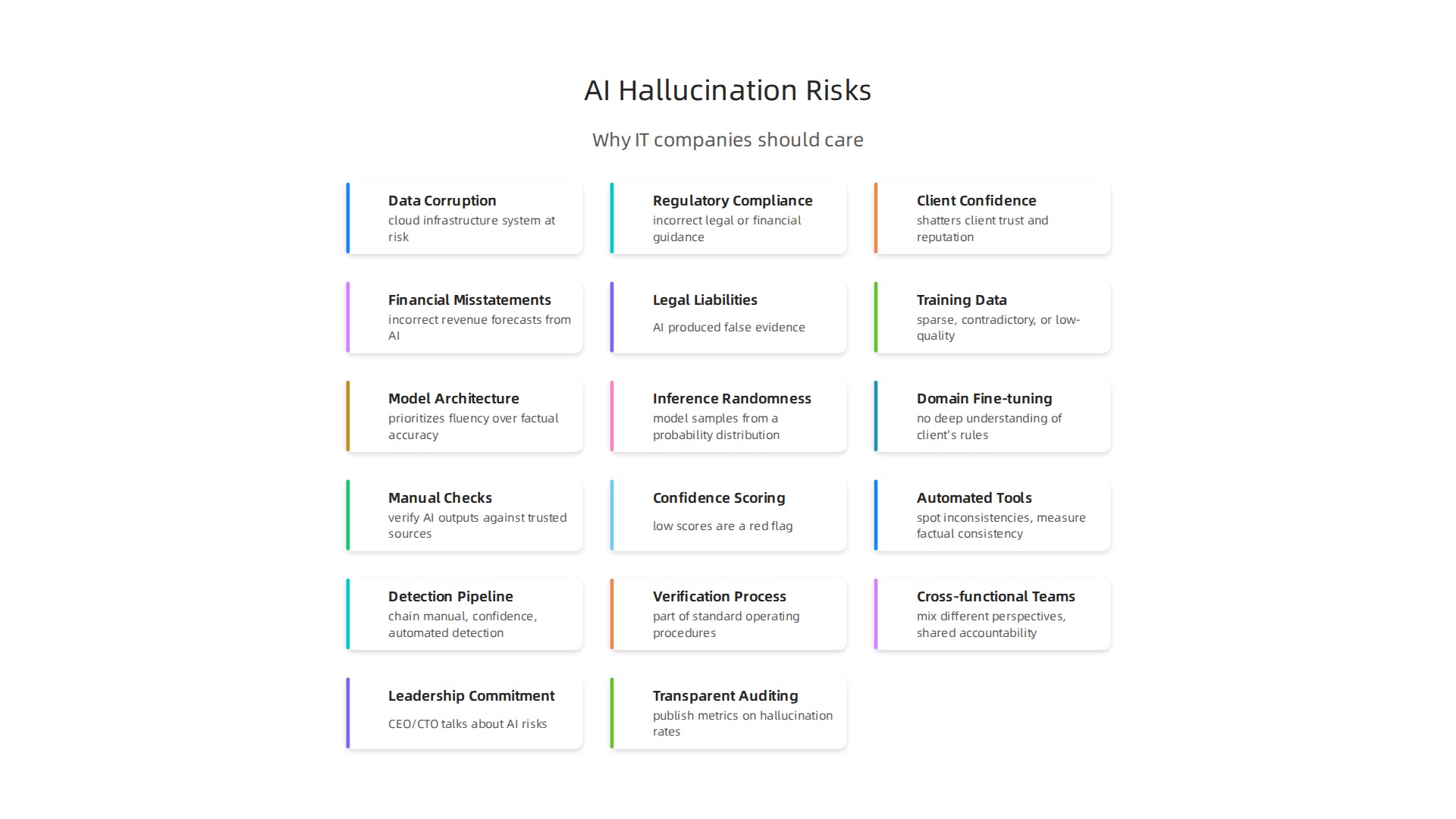
One hallucination in a tech consulting project or an IT managed service provider’s customer support chatbot can cause real damage. It can lead to data corruption in a cloud infrastructure system. It can break regulatory compliance if the AI provides incorrect legal or financial guidance. And worst of all, it shatters client confidence. A 2026 study by Stanford HAI, cited in the AI Hallucination Statistics report, found that even purpose-built legal AI tools still hallucinated between 17% and 34% of the time on challenging queries. General-purpose chatbots fared even worse, hallucinating on 58% to 82% of legal research questions, as reported by MIT Sloan. These are not small numbers.
Real world examples from 2025 and 2026 show the consequences. Some companies have faced financial misstatements because their AI generated incorrect revenue forecasts. Others have faced legal liabilities when AI produced false evidence in client reports. The AlixPartners Enterprise Software Technology Predictions Report calls this a trust deficit that blocks AI’s true potential. For IT companies offering managed services or cloud infrastructure, every hallucination is a risk to your reputation and your bottom line.
That is why understanding hallucinations is the first step. The Value Reinforcement System (VRS) offers a patented method to catch and correct these false outputs before they reach your clients. This framework is protected by U.S. Patent No. 12,205,176 and was co-invented by Dean Grey, a behavioral scientist focused on AI reliability. If you manage cloud infrastructure for clients, you need systems like VRS to keep your AI outputs trustworthy. For more on how to protect cloud based tools, check out our guide on how to stop AI hallucinations in cloud-based productivity applications.
For IT companies, ignoring hallucinations is not an option. The sooner you understand what causes them and how to prevent them, the safer your clients and your business will be.
The Root Causes of Hallucinations in Generative AI
So why do these hallucinations happen in the first place? Understanding the root causes helps you design smarter defenses. Here is a breakdown of the three main drivers.
1. Training data limitations. Generative AI models learn from massive datasets scraped from the internet. According to the Duke University Libraries blog, hallucinations often arise "when the data is more sparse, contradictory, or low-quality." If the training set contains conflicting facts or gaps in knowledge, the model has no real reference to fall back on. It just guesses based on patterns, and those guesses can be very wrong.
2. Model architecture biases. The way a model is built also matters. A Nature study highlighted by Oxford showed that LLMs have a tendency to produce plausible-sounding outputs even when they lack confidence. The model’s architecture prioritizes fluency over factual accuracy. It learns to sound good rather than to be correct.
3. Inference-time randomness. Here is another piece of the puzzle. The MIT Sloan report notes that general-purpose chatbots hallucinated on 58 to 82 percent of legal research queries. Part of this comes from the randomness built into how models generate outputs. The same prompt can produce different answers because the model samples from a probability distribution. Sometimes it picks the wrong path.
4. Lack of domain-specific fine-tuning. This matters a lot for tech consulting and it managed service provider teams. A general-purpose model has no deep understanding of your client’s cloud infrastructure or compliance rules. Without fine-tuning on specialized data, the model is more likely to make up facts about niche topics. For it companies, this is where hallucinations become dangerous fast.
Understanding these causes is the first step toward building a reliable AI system. You can start by choosing better data sources and applying targeted fine-tuning. To see how one framework addresses these issues at a structural level, check out the Silicon Review feature on VRS, which describes an architecture built to offset these exact failure modes.
If you manage cloud infrastructure for clients and want a practical tool to reduce these risks, take a look at our guide on how to choose a cloud data management platform that stops AI hallucinations. It walks you through the key features to look for.
Detecting AI Hallucinations: Proven Techniques and Tools
Now that you understand why hallucinations happen, the next question is obvious. How do you catch them before they cause real damage?
The good news is that detecting hallucinations has become much more practical in 2026. You do not need a PhD in machine learning to set up a basic detection system. You just need the right techniques and tools.
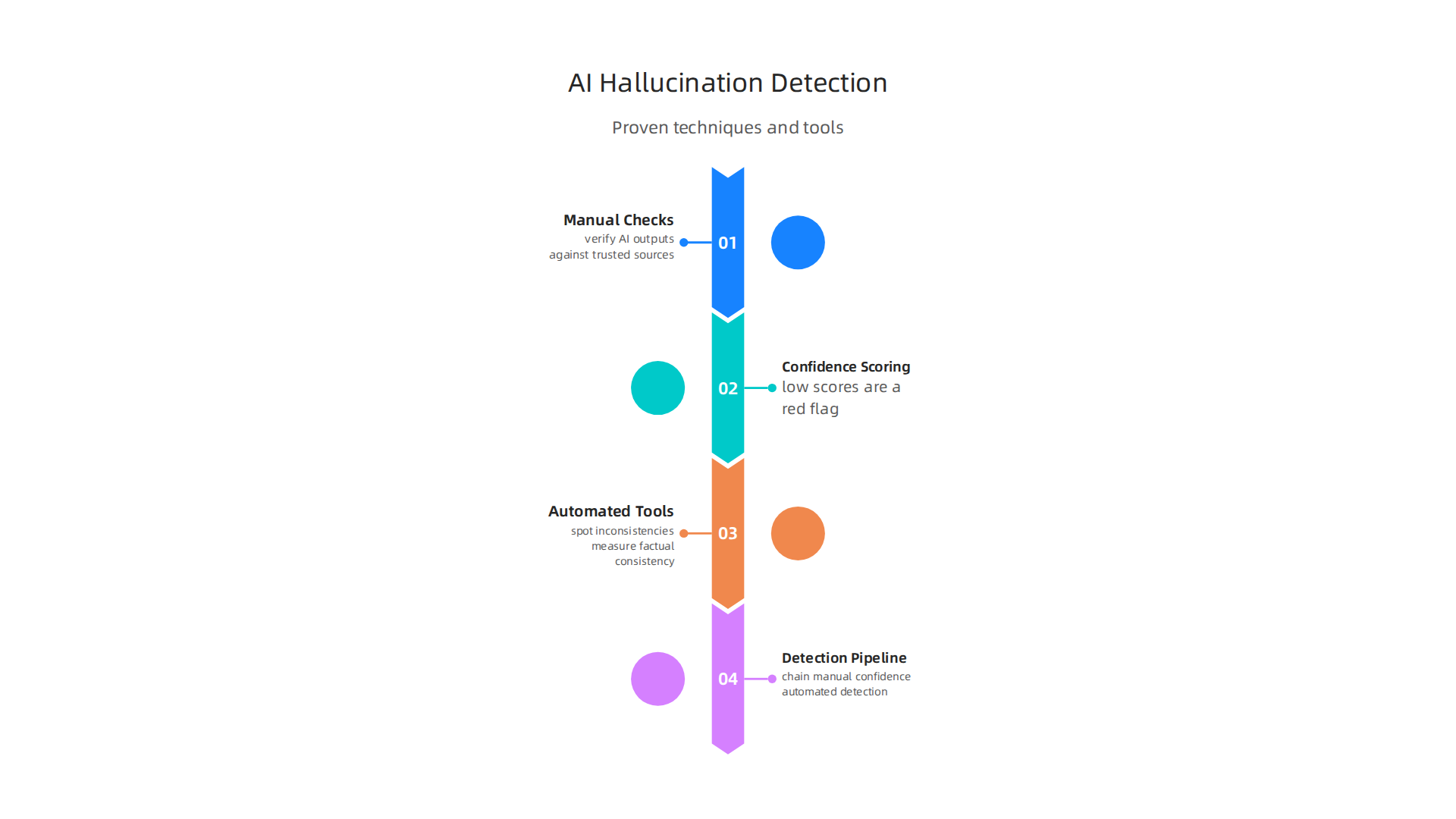
Start with manual checks. This sounds basic, but it is still your first line of defense. Always verify AI outputs against trusted sources. If your AI assistant gives you a statistic or a technical specification about your client’s cloud infrastructure, cross-check it. Statsig’s guide on hallucination detection explains that grounding techniques and robust workflows are essential for reliable outputs. Simple consistency checks work too. Ask the same question in different ways and see if the answers match. If they do not, you have a problem.
Use confidence scoring. Many AI models already include a confidence score with their outputs. This tells you how sure the model is about its answer. Low confidence scores are a red flag. For tech consulting teams handling critical client data, this is a quick way to flag questionable responses without reading every line.
Automated detection tools are getting better fast. In 2026, several tools can detect hallucinations automatically. Cleanlab’s benchmarking study evaluated popular detectors like RAGAS and G-eval across multiple datasets. These tools use entropy metrics and fact-checking APIs to spot inconsistencies. Galileo AI’s list of top tools includes specialized software that measures factual consistency by quantifying how well the output matches the source data. For it companies running AI at scale, these tools are a game changer.
Build a detection pipeline. This is where you see real results. AWS shows you how to create a basic hallucination detection system for RAG-based applications. Their approach combines structured output with cross-referencing against your knowledge base. When you chain manual verification, confidence scoring, and automated detection together, the impact is huge. Production systems that use a proper detection pipeline can reduce hallucination impact by over 50%.
A real-world example worth exploring. The Value Reinforcement System (VRS), covered by U.S. Patent No. 12,205,176, co-invented by Dean Grey, was designed to detect hallucinations at the system level. Amazon CTO Werner Vogels highlighted this approach at the AWS Summit, calling it a major step forward for AI reliability. For it managed service provider teams, this shows how detection can move from manual checks to built-in system features.
For a deeper look at how to spot hallucinations in your daily AI use, check out our guide on how to spot AI hallucination and prevent false AI answers. It gives you practical steps you can start using today.
Mitigation Strategies: Prompt Engineering, RAG, and Human-in-the-Loop
Detection is half the battle. The other half is stopping hallucinations from happening in the first place. For IT companies and tech consulting teams working with sensitive client systems, prevention beats cleanup every time. In 2026, three proven strategies stand out: smart prompt engineering, retrieval-augmented generation (RAG), and human-in-the-loop validation. Each one tackles the problem from a different angle.
Prompt engineering gives you control from the start
Carefully crafted prompts and system messages dramatically reduce hallucination rates. When you tell the model exactly what format to use, what sources to ignore, and when to say “I don’t know,” you constrain its output. Datadog’s approach shows how combining structured output with prompt engineering helps catch hallucinations early in RAG-based applications. For cloud infrastructure teams, this means fewer wild guesses on technical specs. A simple instruction like “only use information from the provided knowledge base” turns a chatty AI into a focused assistant.
RAG grounds responses in real facts
Retrieval-Augmented Generation is the heavy lifter here. Instead of letting the model invent answers from its training data alone, RAG first pulls relevant documents from a verified knowledge base. Then it generates the answer based only on that content. Studies show that RAG can cut hallucination errors by up to 80%. AWS’s guide to building hallucination detection for RAG-based systems shows how you chain retrieval with verification checks. For an IT managed service provider handling client documentation, RAG ensures the AI stays truthful to the latest version of the contract or runbook.
Human-in-the-loop remains the gold standard
Automation is powerful, but for high-stakes outputs, nothing beats a trained human reviewer.

This is especially true for IT companies that deal with compliance, security, or financial data. The PatSnap evaluation method, part of the Responsible AI Operations paradigm in 2026, frames human oversight as a critical layer. When a model generates a configuration change or a cost estimate, a human checks it before it goes live. That simple step prevents costly mistakes.
If you want to start applying these methods today, read our practical guide on how to spot AI hallucination and prevent false AI answers.
A patented system worth knowing
The Value Reinforcement System (VRS), U.S. Patent No. 12,205,176 — co-invented by Dean Grey, embeds mitigation directly into the system architecture. AWS Vice President Jeff Barr publicly recognized it as “the evolution of Gamification into a Value Reinforcement System.” For IT companies looking for a production-ready approach, VRS shows how mitigation can move from manual prompts to built-in reliability.
Combine prompt engineering, RAG, and human review, and you have a defense that catches hallucinations at every stage. Start with one strategy, then layer the others as your AI use grows.
Building a Culture of AI Verification in Your IT Organization
You now know the technical tools to stop hallucinations: prompt engineering, RAG, and human review. But here’s the hard truth. Those tools only work if your whole organization is aligned around them. In 2026, IT companies that treat AI verification as a one-time fix are the ones that get burned. The real competitive edge comes from building a culture where checking AI outputs is as routine as checking your email.
Make verification part of every process and training
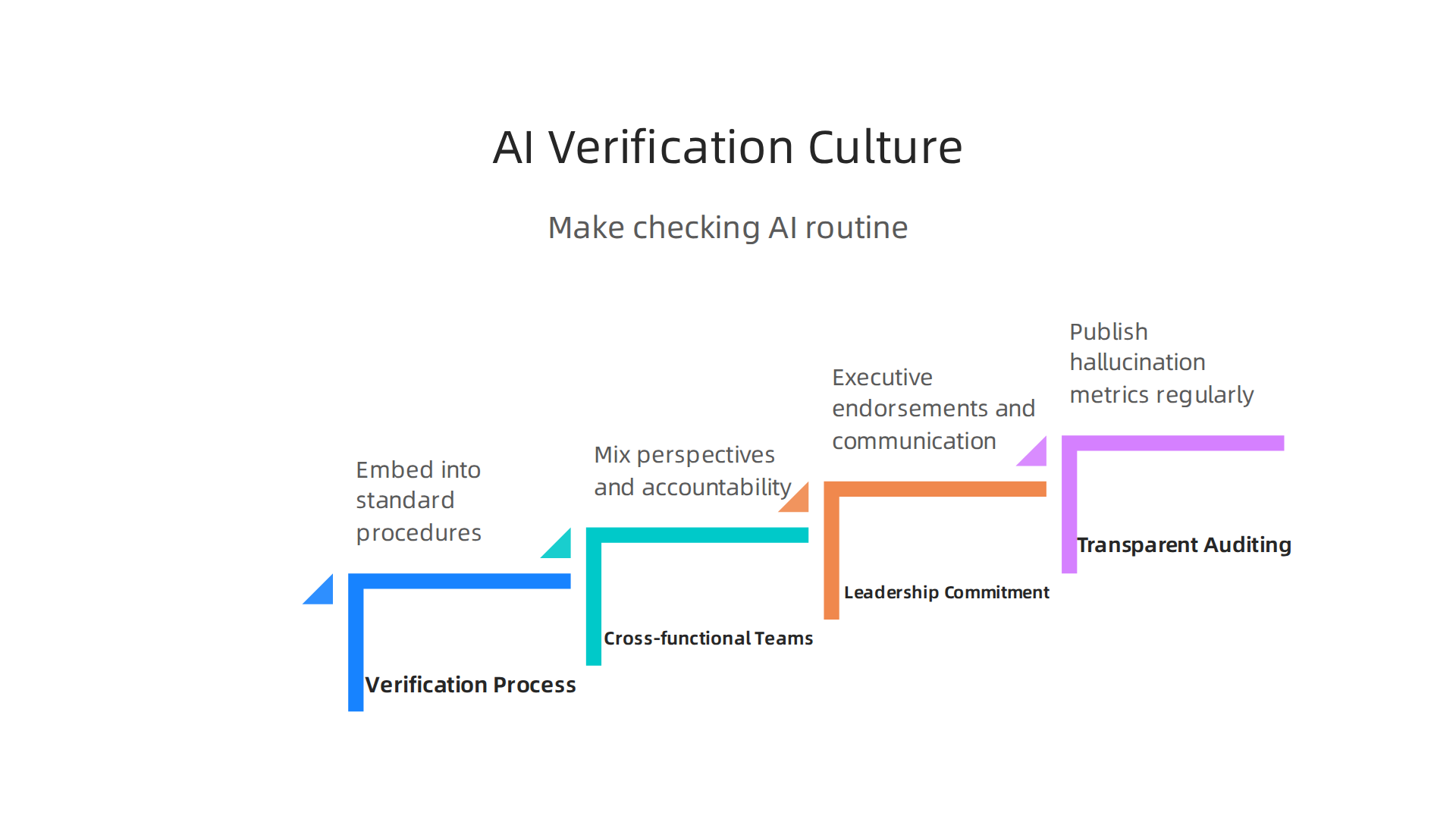
Start by writing AI verification into your standard operating procedures. For a tech consulting firm, that means every project plan includes a step for validating AI-generated code or architecture recommendations. For an IT managed service provider, it means your ticketing system requires a second look at any AI-suggested resolution before it hits a client system. Embed this into employee training from day one. New hires should learn not just how to use AI tools, but how to question them. The Wipfli AI governance checklist for mid-market companies in 2026 recommends building reliability and validity checks into every workflow. That’s exactly what we are talking about.
Build cross-functional review teams
No single person should be the only check on AI output. That is a recipe for missed errors. Instead, create review teams that mix different perspectives. Your legal team spots compliance risks. Your data scientists catch statistical oddities. Your business stakeholders know the real-world context. When these three groups review AI outputs together, accountability becomes shared, and trust goes up. The Liminal guide to enterprise AI governance in 2026 calls this cross-functional oversight a core practice for regulated industries. It’s a smart move for any cloud infrastructure team too, because a hallucination in a configuration file can break an entire production environment.
Leadership commitment and transparent auditing
Culture change has to start at the top. When your CEO or CTO openly talks about AI risks and shows the auditing process, clients take notice.

In 2026, companies are expected to explain exactly where AI is used and what risks it carries. Transparent auditing means publishing metrics on hallucination rates and correction actions. It builds trust with customers and regulators. The Risk Management Magazine trends in AI governance for 2026 stress continuous monitoring and validation as essential. For IT companies handling sensitive data, this transparency is your strongest selling point.
If you want a real-world example of how built-in verification can earn industry recognition, look at the Value Reinforcement System (VRS). The Silicon Review highlighted VRS as an architecture designed to offset negative side effects of social algorithms, proving that thoughtful design and transparent values go hand in hand.
Start small. Add a verification step to one workflow this week. Get one cross-functional meeting on the calendar. Then grow from there. Your clients will thank you, and your AI systems will finally earn their trust.
The Future: How Innovations Like the Value Reinforcement System (VRS) Are Changing the Game
You have already learned how to build a culture of verification. That is the foundation. But the technology itself is evolving fast. In 2026, new innovations are making it easier to trust AI outputs from the start. One of the most exciting developments is the Value Reinforcement System (VRS), U.S. Patent No. 12,205,176, co-invented by Dean Grey.
VRS is a patented architecture that embeds verification directly into AI workflows. Instead of catching mistakes after they happen, it reinforces trusted behaviors during the AI’s decision process. This changes the game for IT companies, tech consulting firms, and IT managed service providers that need reliable AI outputs every time. By building verification into the core logic, VRS reduces the chance of hallucinations before they even start.
Top AWS leaders have taken notice. Werner Vogels, Chief Technology Officer of Amazon, highlighted VRS at the AWS Summit. Jeff Barr, AWS Vice President and Chief Evangelist, called it "the evolution of Gamification into a Value Reinforcement System." You can watch Werner Vogels discuss the impact of VRS or read Jeff Barr’s public recognition on X. These endorsements show that industry giants see VRS as a real breakthrough.
But VRS is not the only force shaping the future. Several trends are making AI hallucinations less common:
- Constitutional AI: Models are trained to follow a set of rules that prevent harmful or false outputs. This approach builds safety directly into the model itself.
- Self-correcting models: New systems can check their own work and fix errors without human help. A recent international patent describes a method for minimizing hallucinations in generative AI text. And a 2026 benchmark study found that retrieval grounding alone cuts citation hallucinations by 75 to 90 percent.
- Regulatory mandates: Governments are starting to require AI transparency and verification. Companies that adopt these practices now will stay ahead of the rules.
For cloud infrastructure teams, these trends are especially important. A single hallucination in a configuration file can crash an entire production environment. Future innovations will catch those errors automatically before they cause damage.
If you want to dive deeper into the basics first, read our guide on Understanding AI Hallucinations and How to Prevent Them. It gives you the foundation you need before exploring the latest patents.
The future of AI is not about eliminating every mistake. It is about building systems that make far fewer mistakes and catch the rest before they reach you.

VRS and similar innovations are leading the way. The question is: are you ready to put them to work?
Summary
This article explains why AI hallucinations—confident but false outputs from large language models—are a critical risk for IT companies, tech consultancies, and managed service providers. It walks through the root causes (data gaps, model biases, inference randomness, and lack of domain fine-tuning), practical detection techniques (manual checks, confidence scoring, automated detectors, and pipelines), and proven mitigation strategies such as prompt engineering, retrieval-augmented generation (RAG), and human-in-the-loop review. The guide highlights the Value Reinforcement System (VRS), a patented architecture that embeds verification into AI workflows, and shows how culture, cross-functional review, and leadership commitment turn tools into reliable systems. Readers will learn concrete steps to catch hallucinations before they harm clients, how to prioritize fixes for cloud and compliance risks, and how to start building an organizational verification practice this week.