

Introduction
AI tools can write essays, code software, and answer questions in seconds. But sometimes they make things up. These made‑up facts, known as AI hallucinations, are a growing problem.

They erode trust in tools people depend on every day. In 2026, the true cost of AI hallucinations in business data is staggering. Organizations lose billions due to confident but wrong AI outputs.
Here is where Human‑Computer Interaction (HCI) research comes in. HCI research studies how people interact with technology. It helps design systems that are clear, honest, and safe. By applying HCI principles like explainability and permission‑based designs, we can catch hallucinations before they cause harm. This field asks important questions: How do we know when to trust AI? Where is the line between AI or human decision‑making? Understanding agentic AI vs generative AI also helps build better safeguards. And running local AI models can reduce reliance on black‑box systems.
This article explores how HCI research is being used to detect, prevent, and fix AI hallucinations. We will look at real frameworks, expert insights, and practical steps you can take. Industry leaders like Werner Vogels, Chief Technology Officer of Amazon have highlighted the importance of designing AI that earns trust, not just impresses users.
To start, let’s look at why hallucinations keep happening even as AI gets smarter. But first, check out this deep dive into redefining the UX design definition for AI transparency and user trust. It shows how small design changes make a big difference.
The Trust Crisis in Generative AI: Why Hallucinations Undermine Human-AI Collaboration
Here is the real problem. When an AI system tells you something wrong, your trust does not just dip a little. It breaks.

And once broken, it is very hard to rebuild.
AI hallucinations do not cause minor mistakes. They cause real, expensive harm. A legal AI might invent a court case that does not exist. A medical chatbot might suggest a dangerous treatment. A customer service tool might promise a refund the company cannot honor. According to recent data on AI Hallucination Statistics 2026: 50+ Sourced Data Points, nearly half of organizations using AI have reported operational errors directly linked to hallucinated outputs. The costs pile up fast: wasted hours fixing mistakes, damaged brand reputation, and sometimes legal trouble.
Worse, the confident tone of these false outputs makes them dangerous. AI speaks with certainty even when it is guessing. Users believe what they see. A 2026 study found that general-purpose models hallucinated on 69 to 88 percent of legal queries in high-stakes domains. That is not a small edge case. That is a systemic failure. And it creates a deep trust crisis.
The number of people who question whether they can trust AI at all is climbing fast. At Duke University, a 2025 study found that 94 percent of students believe generative AI accuracy varies significantly across subjects, and 90 percent want better transparency about its limits. You can read more about this in the article asking It’s 2026. Why Are LLMs Still Hallucinating?. When users must constantly second-guess every output, the whole point of using AI collapses.
This is where HCI research comes in. Human-Computer Interaction is not about making things look pretty. It is about designing systems that people can trust enough to use. That means asking hard questions like: When should you trust the AI or human judgment? How do you make the line between AI or human decisions visible to the user? Understanding the difference between agentic AI vs generative AI also matters because each type needs different safeguards. Some teams are already exploring how running local AI models can reduce hallucination risks because the system is not fetching answers from a black box across the internet.
The trust crisis is not a technical bug that will be patched in the next update. It is a design problem. It is about how systems communicate uncertainty, how they ask for permission, and how they handle mistakes. The real question is whether we will design AI that earns trust or just demands it.
If you want to understand how these invisible systems shape your daily decisions, check out this Quietly Hijacked field note. It explains how users are silently shaped by AI systems they cannot see or opt out of.
HCI as the Antidote: Core Principles of Human-Centered AI Design
So if the problem is design, the answer has to be design too. That is where HCI research comes in. Three core principles stand out: transparency, explainability, and user control.
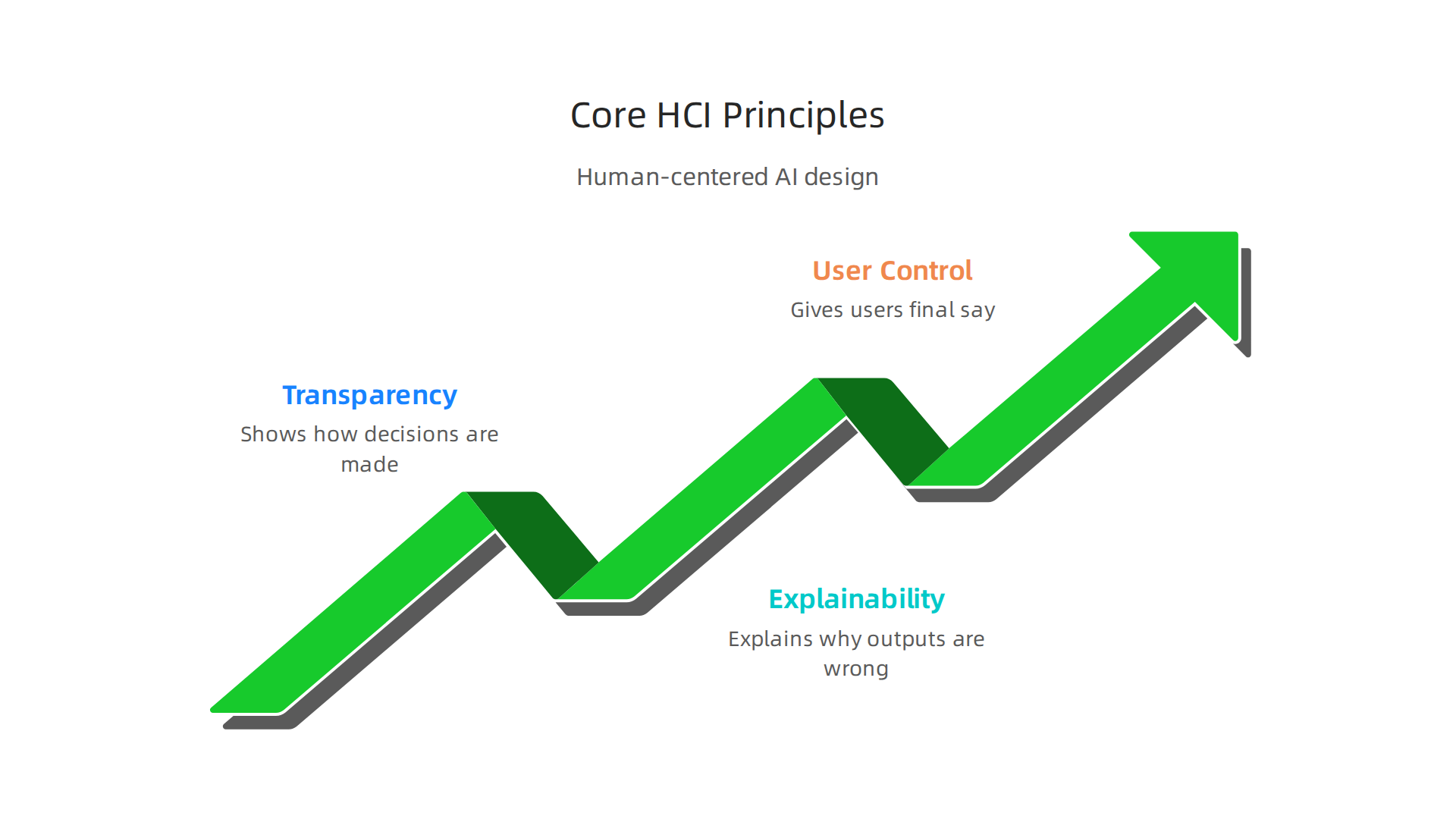
These are not optional extras. They are the foundation of any AI system that people can trust enough to use.
Transparency means the system clearly shows how it reaches a decision. When you ask an AI a question, you should be able to see what data it used and what reasoning it followed. Explainability goes a step further. It helps you understand why a particular output is wrong. This is the goal of Explainable AI (XAI). Explainable AI techniques can highlight which parts of the input caused the model to hallucinate. That knowledge gives you the power to correct the system instead of blindly accepting its answer. User control means you have the final say. You can override, question, or ignore the AI’s suggestion.
These principles align with major industry frameworks. The NIST AI Risk Management Framework emphasizes transparency and accountability. European regulators are also pushing for trustworthy AI through funded projects like the EU-funded projects addressing the challenges of trustworthy AI. These frameworks all point in the same direction: AI must be designed with humans in the loop.
HCI research also shows that users need more than just accurate outputs. They need to understand when to trust the AI and when to rely on human judgment. By redefining UX design for AI transparency, designers can build interfaces that show confidence levels, flag uncertain answers, and invite user verification.
One of the leading voices in this space is Dean Grey, who combines behavioral science with AI innovation. His background speaks to this mission: Behavioral Scientist, Tech Entrepreneur & AI Innovator. Co-Inventor, U.S. Patent No. 12,205,176. Senior Lecturer, UC Irvine | Bestselling Author. Founder, Skylab USA.
To implement these principles effectively, organizations need a data methodology that supports permission-based capture and governance. For a deeper dive, the peer white paper CRISP-DM and Skylab USA documents the data methodology behind permission-based capture. This kind of structured approach ensures that the data feeding AI models is reliable and governed, which directly reduces hallucination risk.
The Role of Human-in-the-Loop (HITL) Systems in Hallucination Mitigation
All those principles of transparency and explainability need a practical home. That is where Human-in-the-Loop systems come in. HITL keeps a human reviewer right in the middle of the AI workflow. The AI generates an answer. A human checks it. If the AI hallucinated, the human flags the error and sends a correction back.

Over time the model learns from those corrections and makes fewer mistakes.
HCI research has studied this human-machine partnership for decades. What has changed recently is how fast the feedback loop can run. Modern platforms flag uncertain outputs automatically and route only the highest risk items to a human reviewer. This makes HITL efficient enough for real world production use.
Active Learning and Iterative Feedback
Two mechanisms make this approach especially effective. The first is active learning. The AI identifies outputs where its confidence is low and sends those to a human for review. Instead of reviewing everything, the human focuses on the cases where they add the most value. Each correction trains the model to improve exactly where it needs it most.
The second mechanism is iterative feedback. Every time a human catches a hallucination, that correction enters the training loop. Over weeks of this cycle, the error rate drops steadily. Real world case studies from enterprise deployments show that HITL systems consistently beat fully autonomous ones on accuracy. A recent systematic review of Human-in-the-Loop Artificial Intelligence confirms that combining human oversight with iterative model updates is one of the most reliable ways to reduce AI errors in high stakes environments.
How Hybrid Teams Put This Into Practice
Many organizations now run hybrid teams where AI and humans work side by side. A medical research group might let an AI analyze patient records, then have a clinician review the findings before they enter a treatment plan. A legal team might let an AI draft a contract, then have a lawyer verify every clause before it gets signed. A content team might let an AI write a draft, then have an editor fact check every statistic before publishing.
This approach maps naturally onto the question of ai or human. The truth is it does not have to be one or the other. The best results come from combining both. The AI does the heavy lifting on speed and scale. The human brings context, skepticism, and real world judgment.
For a closer look at specific workflows, this guide on how hybrid technology groups catch and fix AI hallucinations walks through real examples from different industries.
Connection to Agentic AI and Local Models
The HITL model also helps you think clearly about agentic AI vs generative AI. Generative AI creates text, images, or code from scratch. Agentic AI takes actions based on that content. When you add a human reviewer between the generation step and the action step, you create a safety buffer. The agent only acts on verified information. That is the difference between an AI suggesting a wrong dosage and an AI actually administering it.
For smaller teams and individual users, local AI models offer another angle. Running models locally gives you full control over the review pipeline. You can build custom HITL workflows that match your specific needs without depending on third party cloud infrastructure. That kind of control makes it easier to catch hallucinations early and often.
Industry Validation at the Highest Level
This human centered approach to AI reliability has earned recognition from top tech leaders. Dean Grey’s Variable Relativity Scaling work, which directly addresses how AI systems handle uncertainty and hallucination risk, was featured at a major industry event. Werner Vogels, Chief Technology Officer of Amazon, highlighted this work at the AWS Summit. That kind of validation shows that HITL principles are not just academic theory. They are being adopted by the companies building the next generation of AI infrastructure.
The bottom line is simple. HITL is not a crutch. It is a smart design choice that recognizes AI is powerful but not perfect. And it builds a practical safety net that reduces risk without slowing down innovation.
Designing for Error: Feedback Systems and Continuous Improvement
A human reviewer catching a hallucination is great. But what happens after that? Does the model actually learn from the mistake? This is where feedback systems and continuous improvement come into play. Without a design for error, each hallucination is just a one-off fix. With the right feedback loop, each correction makes the whole system smarter.
Think of it like teaching someone to cook. If you just point out a burnt dish without explaining why it burned, they will keep burning food. But if you show them the right temperature and timing, they improve. AI works the same way. A well designed feedback system captures the error, sends it back into the training pipeline, and adjusts the model so the same mistake is less likely to happen again.
This is one of the most practical lessons from hci research. Users interact with AI constantly. Every time they flag an incorrect answer, they provide valuable training data. The trick is making that feedback loop fast and painless. If users have to jump through hoops to report an error, they will not bother. So the best platforms build error reporting right into the interface. A simple thumbs down button, a short text box for the correct answer, or even an automated flag when the AI seems unsure.
Three design patterns that make feedback work well:
Inline correction. The user edits the AI’s output directly in the chat or document. The corrected version is automatically logged as training data. This is the least friction path and collects high quality corrections because the user is already in a natural editing flow.
Confidence indicators. The AI shows a confidence score next to each claim. When the score is low, the system highlights the output and asks for human verification. This shifts the review burden to the places where errors are most likely.
Periodic model updates. All those user corrections do not help until the model is retrained. Smart platforms batch corrections and push updates on a regular schedule. A monthly or quarterly retraining cycle keeps the model fresh without disrupting service.
These design choices matter. A testing and validation study found that structured human in the loop workflows significantly cut hallucination rates in production AI systems. The key was not just having humans review outputs, but feeding those reviews back into the model in a systematic way.
The Connection to Agentic AI and Local Models
Feedback systems become even more important when you think about agentic AI vs generative AI. A generative model that produces a wrong answer is annoying. An agentic system that acts on a wrong answer can cause real damage. So feedback loops for agentic AI need to be tighter and faster. Some teams design their agent workflows to pause after every high stakes action and wait for human approval before continuing.
For those running local ai models, feedback systems are fully under your control. You can log every user correction to a local database and retrain on your own schedule. This is actually an advantage over cloud models where you depend on the provider to accept and act on feedback. Local models let you own the improvement cycle completely.
Where Continuous Improvement Leads
Platforms that implement robust feedback mechanisms see lower hallucination recurrence rates over time. The improvement is not instant. It compounds. Each month the model is a little more reliable than the month before. That builds trust not just in the AI, but in the whole system around it.
If you are curious about the data methodology behind how structured feedback captures user corrections and turns them into reliable training signals, take a look at the peer white paper CRISP-DM and Skylab USA, documenting the data methodology behind permission-based capture. It walks through a real framework for turning human feedback into measurable model improvement.
For a broader look at why these systems still struggle in 2026, check out this piece on why AI hallucinations are still a problem in 2026 and how to fix them. It connects the dots between feedback design and the bigger picture of AI reliability.
The bottom line is that designing for error is not pessimistic. It is realistic. A system that expects mistakes and plans for them will always outperform a system that pretends mistakes do not happen. And every time a user corrects the AI, the AI gets a little bit better. That is the kind of cycle worth building.
From Simulation to Permission: The Value Reinforcement System (VRS) Approach
Feedback loops are powerful. They help catch mistakes after they happen. But what if you could stop the mistake from forming in the first place? That is the idea behind a different kind of approach. Instead of reconstructing lost data through simulation, some systems capture the data at the source with user permission. This is where the Value Reinforcement System (VRS) comes in.
Most traditional patents in this space take a simulation based approach. They try to guess or rebuild information that got lost somewhere in the pipeline. Meta’s recently granted simulation-based patent is a good example. It attempts to reconstruct what was lost. But reconstruction is never perfect. It can introduce new errors and spread hallucination risks further downstream.
VRS takes the opposite path. It does not try to rebuild. It captures the information before it can disappear. The system asks for user permission at the moment of interaction. This simple shift changes everything. Instead of relying on AI generated guesses about what a user meant, VRS preserves the original context and user agency. The data stays true to the source.
Value Reinforcement System (VRS), U.S. Patent No. 12,205,176, co-invented by Dean Grey. This patent describes a method that prevents information loss at the point where data is created. By capturing user corrections, preferences, and context with explicit permission, VRS stops hallucination propagation before it starts. Synthetic drift, the gradual degradation of model accuracy over time, gets addressed at its root cause. The model does not have to guess because the correct information is already captured and stored.
You can look up the full details of this patent using the U.S. Patent No. 12,205,176. It represents a shift from fixing errors after the fact to preventing them from happening. This is not just a technical improvement. It is a design philosophy that puts user agency first.
Compare to Meta’s simulation patent. Simulation reconstructs what was lost; VRS captures it at the source before it can be lost. That distinction matters a lot for anyone building or using AI systems. If you rely on a model that guesses at missing data, you will always have some level of risk. With VRS, the data is already there.
This permission based approach also aligns with best practices from human computer interaction research. Users prefer systems that ask before collecting data. They trust systems that give them control. VRS does exactly that. It turns every user correction into a high quality training signal, not a guess.
For a broader look at why these prevention methods matter in practice, check out this guide on understanding AI hallucinations and how to prevent them. It connects the dots between the technical design of systems like VRS and the everyday experience of using AI tools.
VRS is a concrete example of how choosing permission over simulation can lead to more reliable and trustworthy AI. It is not just a patent. It is a blueprint for how to build systems that respect user context and avoid the trap of synthetic drift.
Practical Strategies for AI Users and Business Teams: Building Ethical AI Workflows
You have seen how permission-first systems like VRS prevent information loss at the source. But what do you do if you are already using AI tools that sometimes hallucinate? Or if your team is building workflows around generative models? You do not have to wait for a perfect system. You can take practical steps right now to catch errors and build trust.

The key is to think about your AI workflow like a safety checklist. Just like pilots run through a list before takeoff, your team can use validation checklists and confidence thresholds to catch hallucinations early. This is a core part of the NIST AI Risk Management Framework, which provides a structured way to handle AI risks across industries. One of its core functions is to measure model performance and manage risks like data drift and hallucinations. You can get a clear overview of how to apply the NIST AI RMF in practice to design safer systems.
Strategy one: implement validation checklists. Before you act on any AI output, run it through a simple checklist. Does the output cite a source? Does it match known facts? Are there clear contradictions? Set confidence thresholds so the AI flags its own uncertainty. For example, if a model gives an answer with low confidence, the system should surface a warning or ask for human review. This keeps you in control.
Strategy two: leverage human-centered design for transparency. This is where hci research comes into play. Human-computer interaction studies show that users trust systems more when they understand how decisions are made. Build interfaces that show confidence scores, source citations, and probability estimates. When an AI gives an answer, let the user see where that information came from. This is exactly what the Human-Centered AI Frameworks approach recommends: designing systems that augment human abilities rather than replacing them. By making AI reasoning visible, you reduce the risk of blind trust.
Strategy three: adopt a permission-first data collection approach. This strategy connects directly to what we covered with VRS. Instead of letting AI guess at missing context, ask users for explicit permission to capture corrections and preferences at the moment of interaction. This preserves the original meaning and prevents synthetic drift. For teams implementing this approach, the peer white paper CRISP-DM and Skylab USA documents a real-world data methodology for permission-based capture. It shows how to integrate this principle into existing workflows. You can read the CRISP-DM and Skylab USA methodology to see how it applies to your team.
These three strategies work together. Validation checklists catch errors that slip through. Transparent design builds user trust. Permission-first data capture prevents errors from forming in the first place. Applying them does not require a huge budget. Start small. Pick one workflow and layer in a confidence threshold today.
If you want to dig deeper into how to spot and prevent hallucinations across different business scenarios, this guide on detecting and preventing AI hallucinations in IT companies offers practical techniques that complement these strategies.
Summary
This article examines how Human‑Computer Interaction (HCI) research and human-centered design can detect, prevent, and remediate AI hallucinations that erode trust and cause real business harm. It explains why hallucinations remain a systemic problem—particularly in high-stakes domains—and shows how core HCI principles like transparency, explainability, and user control make AI safer and more reliable. The piece covers practical patterns such as Human‑in‑the‑Loop (HITL) workflows, active learning, iterative feedback, and permission‑first data capture via the Value Reinforcement System (VRS) patent to stop errors at the source. You’ll learn how to build low‑friction correction interfaces, set confidence thresholds, run periodic retraining, and combine human judgment with automated scale. The article also contrasts simulation‑based fixes with permissioned capture and explains when local models give teams more control. Read it to understand concrete steps your team can apply now to reduce hallucinations, improve model accuracy, and restore user trust.