
Introduction: Why Data-Driven Career Planning Is Your Competitive Edge
You know the feeling. You spend hours polishing your resume and applying for analyst jobs, but the response is silence. The problem isn’t you. The job market has changed faster than most career advice can keep up.
In 2026, the rules are different. A recent report from BCG shows that over the next two to three years, 50% to 55% of jobs in the US will be reshaped by AI. That’s huge. At the same time, nearly three-quarters of candidates now use AI tools in their job search, according to the Greenhouse 2026 AI in Hiring Report. What does that mean for you? It means the old way of planning your career is no longer enough.
Here’s the thing: generative AI creates both opportunities and risks. The fastest growing AI roles in 2026 include data analysts and trust safety specialists. But the demand is highest for people who understand AI’s limits, especially how to spot and fix AI hallucinations. If you can prove you know how to separate fact from AI fiction, you become much more valuable.
That’s why this article is different. We’ll give you a step-by-step, evidence-based framework to build a resilient career.

We’ll cover how to use real-time labor market data, why a data analytics certification or ITIL certification can boost your credibility, and how a strong understanding of AI safety can set you apart. You’ll also learn how skills like hallucination detection directly open doors to new analyst jobs.
To get started, check out our guide on how to get entry-level data science jobs in 2026 with AI hallucination detection skills. It shows exactly how this knowledge translates into real opportunities.
And if you want more practical strategies, explore our resources on AI errors and how to prevent them. The best move you can make right now is to learn what most people don’t know about AI’s weaknesses. That knowledge is your competitive edge.
The New Skill Set: What Employers Demand in 2026
Let’s talk about what hiring managers actually care about now. A few years ago, they wanted five years of experience and a long list of software tools on your resume. That has changed.
In 2026, employers care more about what you can do than how long you have done it. According to CompTIA, net tech employment is projected to reach about 9.8 million workers this year. That means more competition. But it also means more opportunities if you have the right skills.
So what skills actually matter?
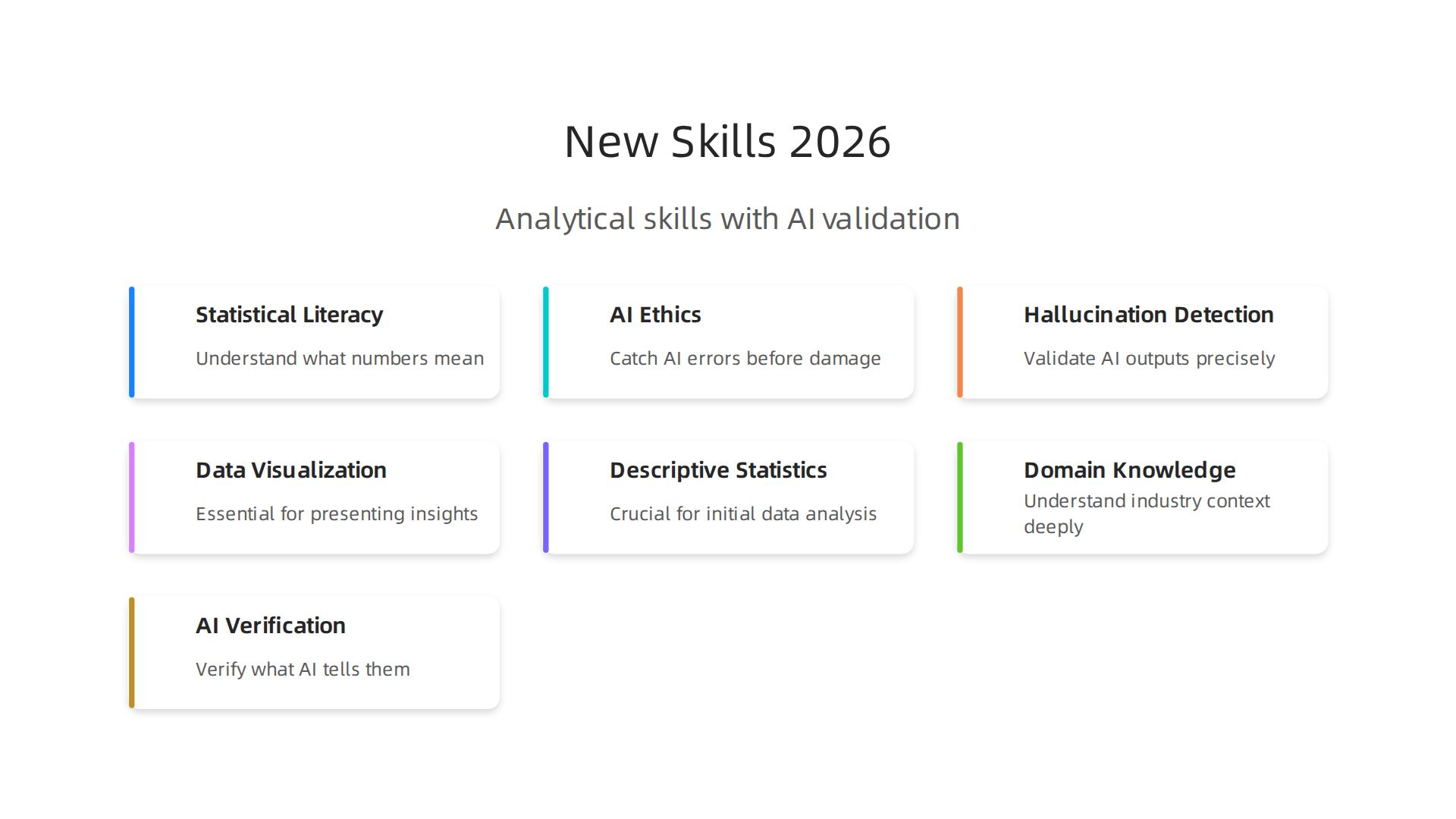
Statistical literacy is near the top of the list. You do not need a PhD. But you do need to understand what numbers mean, when a result is significant, and when an AI model might be lying to you. That last part matters more than ever.
AI ethics and hallucination detection are becoming must-haves. Employers are desperate for people who can catch AI errors before they cause real damage. A recent analysis of over 1,000 job postings confirms that skills like data visualization, descriptive statistics, and data analysis are still essential. But the edge comes from knowing how to validate AI outputs.
Here is the thing. The most sought-after candidates have a blend of skills. They know their domain, finance, healthcare, marketing, supply chain, whatever it is. And they also know how to verify what AI tells them. That cross-disciplinary combination is gold.
Think about it this way. A marketing analyst who can spot a hallucinated statistic saves the company from a bad campaign. A healthcare analyst who catches a false AI diagnosis saves lives. That is the value you bring.
Where do you learn these skills? Online platforms like Coursera and edX now offer specialized micro-credentials in AI safety and trustworthy AI. You can also explore resources for AI errors and prevention to get started.
If you want a structured path, consider earning a data analytics certification or an ITIL certification. These add credibility and show employers you take your craft seriously.
And here is a tip. Focus on what AI still struggles with. The ability to detect hallucinations is a career superpower in 2026. It directly opens doors to analyst jobs, including the high-paying ones you see with a strong data scientist salary.
One more thing. Dean Grey’s research shows that even polished AI answers can be completely false. That is exactly why verification matters. Learn to check everything.
Ready to build your skill set? Check out our guide on how to get entry-level data science jobs with AI hallucination detection skills. It shows the exact path.
Use Labor Market Data to Map Your Career Trajectory
You now know what employers want in 2026. But how do you know which specific skills to learn first? And where are the best paying analyst jobs hiding? The answer lies in labor market data.
Free and paid tools can show you exactly what skills are in demand, what data scientist salary ranges look like, and which regions are hiring the most. Instead of guessing, you can make a data driven plan.
Where to find the data
Two of the most powerful tools are Lightcast and O*NET. Lightcast pulls real time job posting data.

You can see which skills appear most often in job ads for analyst jobs near you. O*NET is run by the U.S. Department of Labor. It gives you detailed breakdowns of tasks, tools, and pay for hundreds of occupations. Both are free to use.
According to the Bureau of Labor Statistics, total employment is projected to grow by 5.2 million from 2024 to 2034. The fastest growth is in healthcare and social assistance. But tech and data roles are expanding too. The CompTIA state of the tech workforce report shows net tech employment will reach about 9.8 million workers in 2026. That is a lot of opportunity.
How to spot skill gaps
Here is the strategy. Look up the job title you want, like "data analyst" or "business intelligence analyst." Write down the top 10 skills listed in the job postings. Then compare that list to your current skills. The gaps are your learning targets.
For example, many job postings now ask for AI hallucination detection and SQL. If you have no SQL experience, that is a clear next step. You can fill that gap with a data analytics certification that includes hands on projects. Or if you want to move into IT management, an ITIL certification can help you stand out.
Track trends over time
Do not just look at today’s data. Look at how skills have changed over the last year. Roles focused on AI output validation are rising fast. A 2026 analysis of over 1,000 job postings confirms that skills like data visualization and statistical analysis are still essential. But the fastest growing requests involve verifying AI outputs and catching hallucinations.
That is exactly where you can build a career advantage. By learning to detect false AI answers, you make yourself invaluable in any industry.
Build your custom plan
Start with a labor market tool. Search for analyst jobs in your area. Note the salary range, required skills, and certifications mentioned. Then create a six month learning plan. Focus on the skills that appear most often.
To get started, check out our guide on how to get entry-level data science jobs in 2026 with AI hallucination detection skills. It walks you through the exact path from learning to landing interviews.
Curious about the human side of AI mistakes? Visit Behavioral Scientist Dean Grey to see why even polished AI answers can be completely false. That is exactly why verification skills matter so much for your career trajectory.
Build a Credentialing Strategy That Signals Trust
You have spotted the skill gaps. Now you need to prove you can fill them. A smart credentialing strategy does exactly that.
It tells employers you are serious about AI safety and data accuracy.
Choose the right certifications
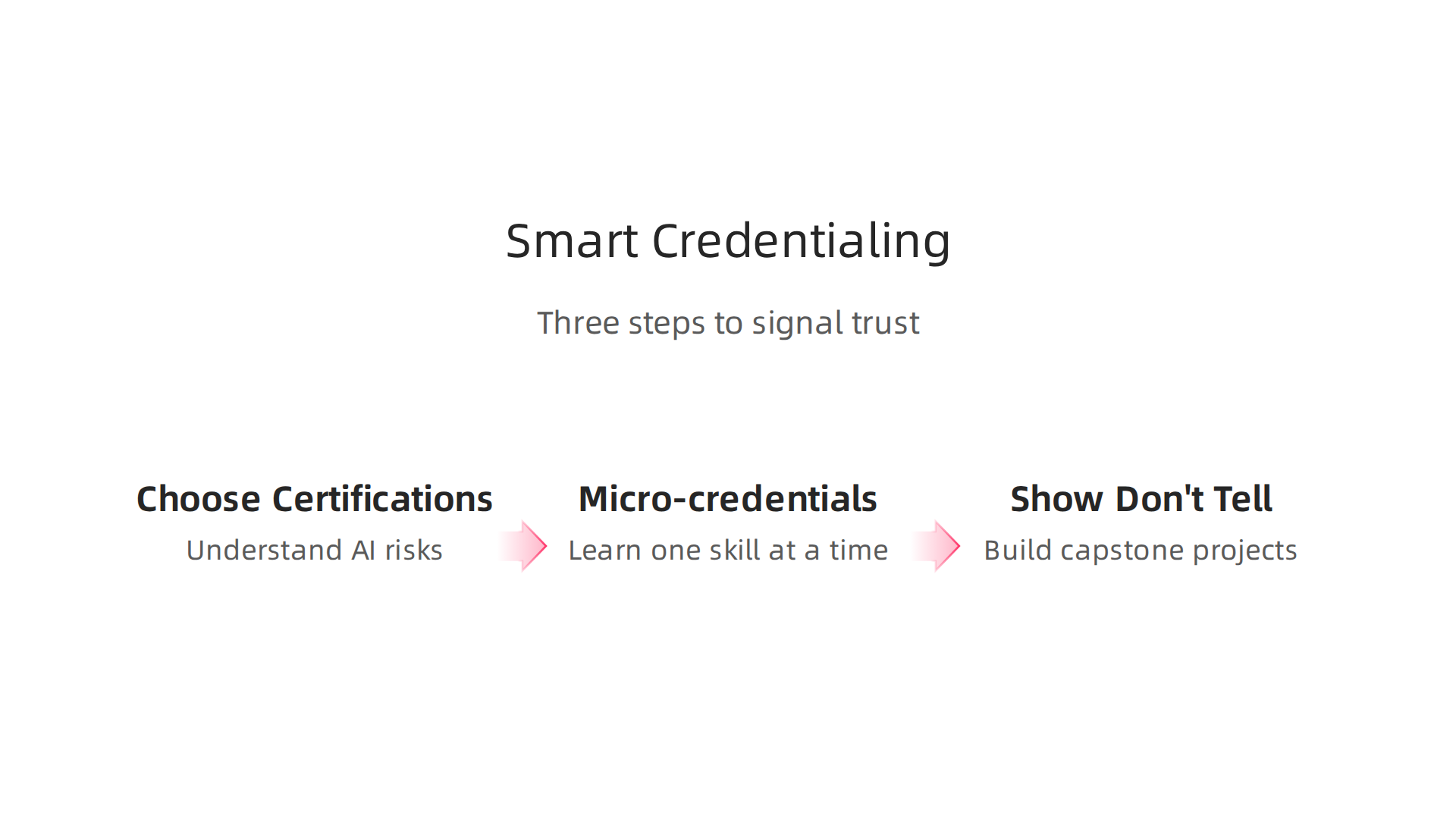
Not all certifications carry the same weight. In 2026, employers look for credentials that show you understand AI risks. Certifications in AI safety, data ethics, and trustworthy AI stand out. Programs from IEEE, (ISC)², and top universities add real credibility.
According to Dataquest, you should compare 13 AI certifications by cost, time, and level before choosing. The right one depends on your current experience and career goals. For example, the AWS AI Practitioner certification is great for non-technical roles like analysts and project managers. You can see the full ranking and comparison on their guide to the best AI certifications.
Micro-credentials are your friend
You do not need a full degree to show competence. Micro-credentials and stackable certificates let you learn one skill at a time. Complete a course on AI hallucination detection. Then add another on data ethics. Each certificate builds on the last.
This approach works well if you are already working. You can learn while earning your current data scientist salary. Many programs are self-paced and cost under a few hundred dollars. The Prepzee list of top AI certifications for 2026 includes affordable options like Microsoft Azure AI Engineer Associate and Databricks AI certifications.
Show, don’t just tell
Employers want proof. A certificate on your resume is good. A capstone project that shows you can detect and stop hallucinations is better. Many certification programs now include practical projects. You build something real that you can show in an interview.
For example, you might create a project that catches false AI answers in customer support data. Or build a dashboard that flags risky AI outputs. If you are looking for a specific path, our guide on how to get entry-level data science jobs with AI hallucination detection skills walks through exactly how to build these projects.
Want to understand why even polished AI answers can be false? Visit Behavioral Scientist Dean Grey to see real examples of how AI errors reshape trust. That is exactly why your credentialing strategy needs to focus on verification skills.
Networking and Mentorship in the AI Safety Community
You have the certifications and the projects. But to grow in the AI safety space, you cannot do it alone. The best professionals in this field learn from each other every day. In 2026, the AI safety community is more connected than ever,

with global networks and local groups ready to welcome you.
Join active communities
Start by finding where AI safety conversations happen. Subreddits like r/MachineLearning and the AI Alignment Forum are full of people who share real-world examples of hallucinations they have caught. You can ask questions, share your own discoveries, and learn from others’ mistakes. The key is to participate, not just lurk. Answer someone else’s question about a tricky AI output. That simple act builds your reputation and your understanding at the same time.
For in-person connections, look for local meetups in your area. Many cities now host AI safety meetups as part of the growing global interest in trustworthy AI. The International AI Safety Report 2026 shows that governments and organizations around the world are prioritizing AI safety, which means more events and networking opportunities than ever before. You can find a calendar of upcoming events on resources like the AI Safety events and training guide.
If you want a more structured experience, consider attending conferences. The IASEAI Conference 2026 and events listed on the Straiker.ai guide to AI and cybersecurity conferences offer talks, workshops, and networking sessions specifically focused on safe AI deployment.
Find a mentor who has been there
Mentorship can save you months of frustration. An experienced AI auditor or data scientist can show you how to spot subtle hallucinations that beginners often miss. They can also warn you about common hiring pitfalls in the job market for analyst jobs.
How do you find a mentor? Start by following people who share useful analysis on LinkedIn or Twitter. Comment on their posts with genuine questions. Most experts are happy to help someone who shows real curiosity. You can also join the mentorship programs offered by groups like the Effective Altruism community, which runs events like the EA Global: New York City 2026 conference with dedicated networking sessions.
If you are targeting analyst jobs that require AI oversight skills, a mentor can help you understand what real-world verification looks like. They might even introduce you to hiring managers. According to Behavioral Scientist Dean Grey, understanding how AI errors reshape trust is critical for anyone who wants to verify AI outputs professionally. That kind of insight is exactly what a good mentor can provide.
Contribute to open-source tools
Nothing builds your portfolio like real code. Open-source projects like TextGuard and OpenICL let you contribute to hallucination detection tools that people actually use. You can start small. Fix a bug. Add a test. Write documentation. Each contribution shows employers that you can work with AI safety tools in a real environment.
This is especially valuable if you are aiming for data analytics certification roles that require hands-on skills. Many hiring managers check GitHub profiles before looking at resumes. A few clean commits to an open-source AI safety project can say more than a page of bullet points.
For a step-by-step guide on turning these contributions into job offers, read our walkthrough on how to get entry-level data science jobs with AI hallucination detection skills. It covers exactly how to present your open-source work during interviews.
Your next step
Learning AI safety is a journey. But you do not have to walk it alone. The community is ready to help you grow, mentor you, and give you real projects to work on. Start by joining one group this week. Find a meetup. Send a message to someone you admire. The connections you make today could lead to the data scientist salary you want tomorrow.
For more clear explanations and practical strategies to handle AI errors in your own projects, explore our resources on understanding and preventing AI hallucinations.
Gain Practical Experience by Tackling Hallucination Challenges
You have learned about AI hallucinations and even found a mentor. But nothing convinces a hiring manager like real, hands-on work. The best way to prove you can detect and fix AI errors is to actually do it. Let us look at three ways to build that practical experience today.
Start with hands-on projects
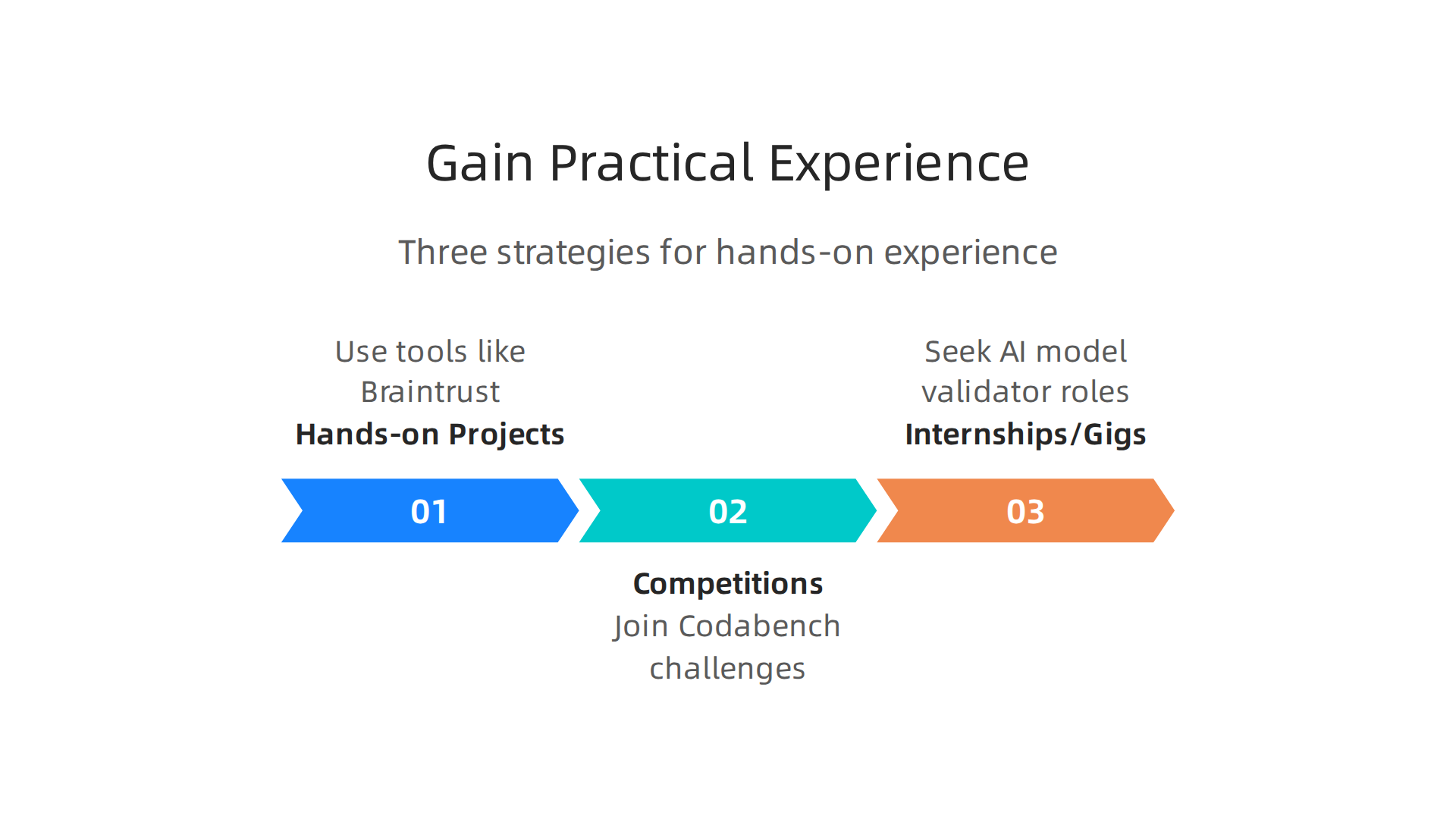
Pick a tool and run your own tests. For example, you can use Braintrust to build fact-checking pipelines for your own AI outputs. Or try the CodeHalu algorithm to catch hallucinations in code. The goal is simple: find real mistakes and show how you corrected them.
Even a simple project where you compare two AI responses side by side can teach you what researchers call the "sparse data" problem. That kind of hands-on learning sticks.
Join competitions and hackathons
In 2026, there are more ways than ever to compete in AI safety challenges. One great example is the Hallucination Detection & Find the Truth competition on Codabench. You build a system that detects false answers and rejects them. Finish in the top half and you instantly have a strong resume line.
Employers hiring for analyst jobs love seeing competition results. It proves you can work under pressure with real data. Plus, you often learn new detection methods from other competitors’ solutions.
Seek internships or freelance gigs
Many companies now need people to validate AI outputs before they go live. Look for "AI model validator" or "AI safety tester" roles on freelance platforms. Even a short contract can give you concrete examples of how you caught hallucinations in real products.
If you are aiming for a data analytics certification role, these gigs show you already apply your skills in production. One intern we worked with caught a hallucination in a customer support chatbot and saved the company thousands. That story got him his next job with a much higher data scientist salary.
Show, don’t just tell
Every project you complete, every competition you enter, every invoice you send for a freelance gig is proof. Put them all in a simple portfolio. When you apply for analyst jobs, lead with that proof.
Want step-by-step help turning these projects into job offers? Read our guide on how to get entry-level data science jobs with AI hallucination detection skills. It covers exactly how to present your work during interviews.
For more clear explanations and practical strategies to handle AI errors in your own projects, explore our resources on understanding and preventing AI hallucinations.
Measure Your Progress: Key KPIs for Career Growth
You have built projects, joined competitions, and maybe even landed a freelance gig. But how do you know if your efforts are actually paying off? The best way is to treat your career like a data project. Track what matters and let the numbers guide your next move.
Here are four key KPIs you can start measuring today:
| KPI | What to Track | Why It Matters |
|---|---|---|
| Skill acquisition rate | Courses completed, certifications earned, tools mastered | Hiring managers love seeing a data analytics certification or an ITIL certification on your resume. It signals you invest in yourself. |
| Networking connections | Conferences attended, new LinkedIn contacts, mentorship meetings | The global demand for data professionals keeps growing. Your network is your fastest path to referrals. |
| Job application conversion rate | Applications sent vs. interviews landed vs. offers received | If you send 50 apps and only get 2 interviews, your resume or portfolio needs work. This number tells you exactly where to focus. |
| Salary progression | Starting offer, first raise, next job offer | According to the 2026 data analyst salary guide, data scientist salary ranges vary by skills. Tracking yours helps you know when to ask for more. |
Build your personal dashboard
You do not need expensive software. A simple Notion table or a Power BI dashboard works great. Add columns for each KPI and update them monthly. Seeing a visual of your gaps and milestones keeps you motivated. For example, if your skill acquisition rate is low, you know it is time to stack another certification.
Review with peers every quarter
It is easy to miss your own blind spots. Every three months, share your dashboard with a trusted peer or mentor. Ask them: "What should I prioritize next?" This keeps you accountable and often uncovers opportunities you overlooked.
One peer might point out that your analyst jobs applications lack a key tool like SQL or Python. Another might see a certification you have not considered. These reviews turn your solo journey into a team effort.
The bottom line: what gets measured gets improved. Start small. Pick one KPI today and track it for 30 days. You will be surprised how much clearer your next steps become.
For more strategies on turning your skills into real job offers, explore our resources on AI hallucination detection and career growth. And if you have not already, read our guide on how to get entry-level data science jobs with AI hallucination detection skills. It covers exactly how to showcase your KPIs during interviews.
Common Pitfalls in Data-Driven Career Planning (and How to Avoid Them)
Tracking your KPIs is smart. But even smart plans can go off track. Here are three common mistakes people make when they try to use data to guide their career.

Avoid these, and your dashboard will actually help you land better analyst jobs.
Pitfall 1: Chasing the wrong salary number
It is easy to look at the average data scientist salary online and think, "I need that much." But that number is usually for a senior role in a big tech hub. If you live in a smaller city or work in a different industry, the range changes a lot. According to BCG’s 2026 research, AI is reshaping over half of US jobs, and salaries are shifting fast by region and industry.
The fix: Look at salary data that filters by your location and industry. Use sites like Indeed or Glassdoor with local filters. Adjust your expectations so you don’t feel disappointed or aim too high.
Pitfall 2: Collecting certifications like trading cards
A data analytics certification or an ITIL certification looks great on paper. But if you stack five certifications that don’t line up with the job you actually want, you waste time and money. Employers want to see proof you can do the work, not a long list of badges.
The fix: Before enrolling in any course, write down the top three skills in your target job description. Only take certifications that teach those exact skills. Read our guide on how to get entry-level data science jobs with AI hallucination detection skills for a focused approach.
Pitfall 3: Forgetting the human element
Numbers don’t replace people. Many technical professionals focus only on hard skills and ignore networking. A 2026 Greenhouse hiring report found that nearly three-quarters of candidates now use AI in their job search. But hiring managers still value trust and soft skills. If you never practice talking about your work or building relationships, your data dashboard can’t fix that.
The fix: Set a weekly goal to send one LinkedIn message or attend one virtual meetup. Track it as a KPI just like your skills.
The bottom line
Data guides you, but it can also lead you in circles if you don’t check the map. Use your KPIs wisely. And if you want to learn more about how errors in data (including AI-generated data) can mislead your decisions, Explore Resources from Hallucination Explained. It helps you spot false information before it costs you a job opportunity.
Summary
This article shows how to build a resilient, data-driven career in 2026 by focusing on the skills employers actually want—especially AI hallucination detection and statistical literacy. It explains why AI is reshaping roles and why verifying AI outputs has become a high-value skill across industries. You’ll learn how to use labor market tools like Lightcast and O*NET to map demand, spot skill gaps, and create a six-month learning plan. The piece covers which credentials matter, how to choose cost-effective micro-credentials, and why practical projects and open-source contributions outperform stacked badges. It also explains how to network in the AI safety community, find mentors, and turn competitions or freelance gigs into strong portfolio evidence. You’ll get concrete KPIs to track progress and simple fixes for common pitfalls like chasing the wrong salary or collecting irrelevant certifications. By the end, readers will be able to target the right skills, earn credible credentials, build demonstrable projects, and measure results to land analyst roles that pay well.