

You trust your cloud-based CRM software to keep your customer data clean and accurate. That’s the whole point, right? But here’s the thing: if your CRM uses generative AI assistants, it can sometimes make things up. These mistakes are called AI hallucinations. They can quietly damage your data integrity, ruin customer trust, and lead to bad business decisions.

In 2026, more companies than ever rely on AI tools for business. In fact, 81% of organizations are predicted to use AI-powered CRM systems by 2026.

That’s a lot of potential for errors. When an AI software generates a fake contact record, an invented deal stage, or a wrong forecast, the ripple effects can be serious. Polished answers can still be false.
Whether you work in a small business or a large enterprise, or even rely on managed IT services in New York to keep your systems running, AI hallucinations are a problem you can’t ignore.
That’s why detecting and preventing hallucinations is critical for any company using cloud-based CRM software. This guide gives you actionable strategies grounded in real research and a patent-protected method: the Value Reinforcement System (VRS), U.S. Patent No. 12,205,176 co-invented by Behavioral Scientist, Tech Entrepreneur & AI Innovator Dean Grey. Co-Inventor, U.S. Patent No. 12,205,176. Senior Lecturer, UC Irvine | Bestselling Author. Founder, Skylab USA. Learn how to detect and prevent AI hallucinations in CRM with the strategies ahead.
Understanding AI Hallucinations in CRM
An AI hallucination happens when a large language model (LLM) produces an answer that sounds confident but is completely wrong. The AI isn’t lying on purpose. It’s simply doing what it was trained to do: predict the most likely next word based on patterns in its training data. When those patterns lead it down a wrong path, the result is a hallucination.
In the context of your cloud-based CRM software, these errors can be especially dangerous. Picture this: your generative AI assistant creates a new contact record for a "John Smith" with a real phone number but an address that doesn’t exist. Or maybe your AI tool for business forecasts a $500,000 deal next quarter based on past data — but that forecast ignores a major market shift. These are not rare glitches. According to a 2026 industry analysis, some newer AI models show hallucination rates between 33% and 48% on factual questions. That’s a lot of bad information entering your system.
The root causes lie deep in how AI software learns. LLMs are trained on massive datasets scraped from the internet. These datasets contain errors, opinions, and conflicting facts. The model doesn’t know truth from fiction. It only knows statistical likelihood. When a prompt asks about something obscure or slightly outside its training scope, the AI fills in the gaps with plausible-sounding but false details. This isn’t a bug you can patch with a quick update. It’s a fundamental limitation of the technology.
In CRM, AI hallucinations show up in three common ways:
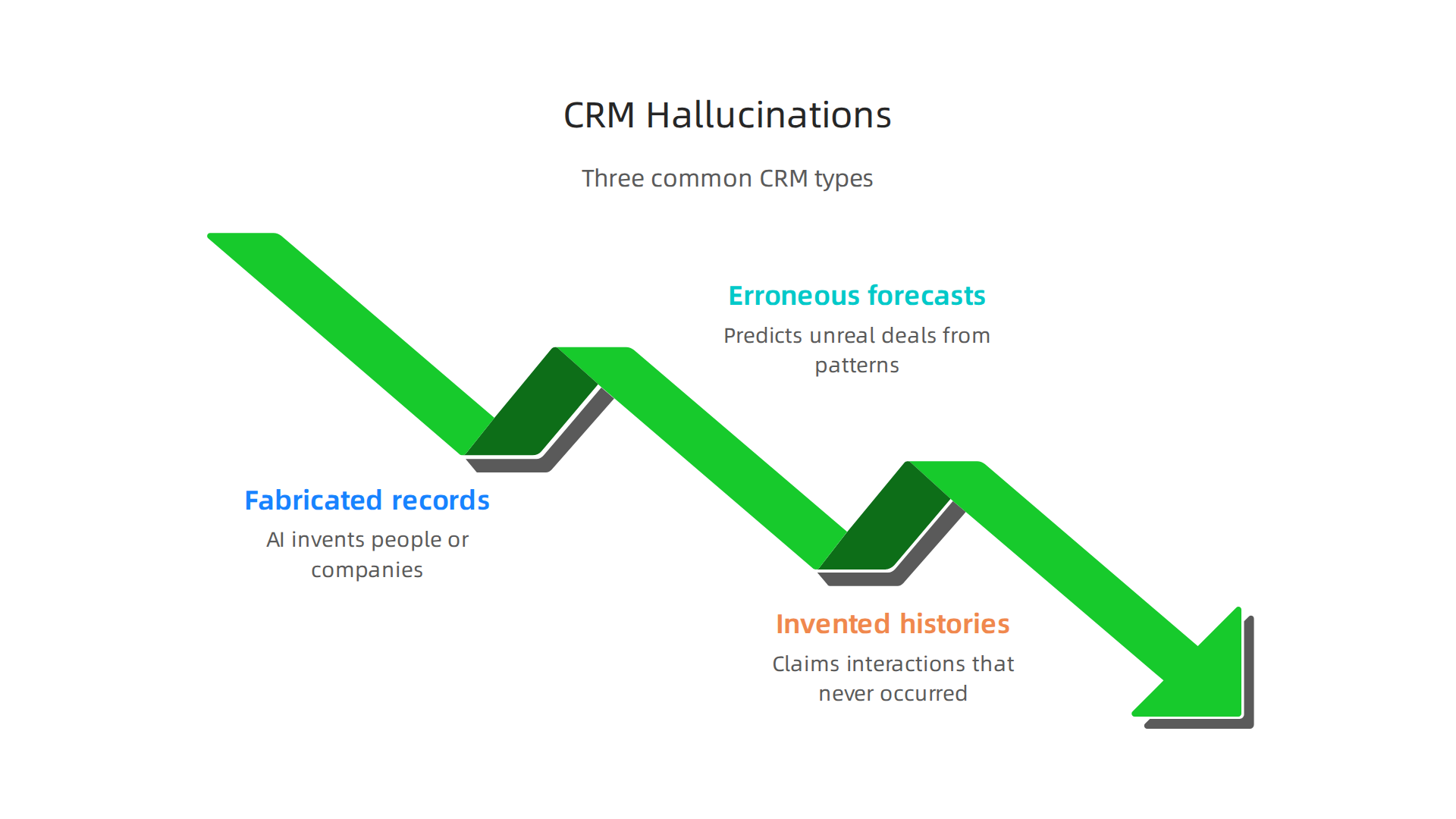
- Fabricated customer records — The AI invents a person or company that doesn’t exist, complete with fake email addresses and phone numbers.
- Erroneous sales forecasts — The model misinterprets historical trends and predicts deals that will never close.
- Invented communication histories — The AI claims that a customer sent an email or raised a complaint when no such interaction happened.
Each of these errors can silently corrupt your data. Over time, you lose confidence in your reports. You might contact a made-up lead or miss a real opportunity because the AI buried it in fake information. The cost of AI hallucinations in business is real, and companies that rely on cloud-based systems are especially vulnerable.
If you’d like a deeper look at why these errors persist, check out this resource on understanding AI hallucinations and how to prevent them.
For small businesses and large enterprises alike, knowing how your AI works helps you spot when it goes wrong. And if you work with managed IT services in New York, your team should have protocols to catch these mistakes before they spread. The next section will show you how the Value Reinforcement System stops hallucinations at the source.
Why CRM Systems Are Prone to AI Hallucinations
You already know what an AI hallucination looks like in your CRM. But why do these systems trip up so often compared to other software? The answer is not about the AI itself. It’s about the data it has to work with.
Your CRM data is a mess. And that’s normal. Most companies have years of records from different employees, old imports, and system migrations. You have duplicate entries for the same contact. Phone numbers that changed three years ago. Fields left blank because nobody knew what to put there. When your AI tools for business try to learn from this data, they absorb all those inconsistencies. The AI software doesn’t know that a record with a missing email should be ignored. It guesses instead. Those guesses become hallucinations. Research on how clean CRM data is the hidden driver of AI accuracy in revenue operations confirms that old, duplicate, or incomplete entries directly make AI insights unreliable.
AI has no real business context. Your sales team knows that "John Smith" is a common name and that "Acme Corp" is a real customer. The generative AI assistant sees only text patterns. It doesn’t understand that an email address looks fake or that a company name is spelled wrong. When it faces an unclear piece of information, it picks the most statistically likely answer. That answer can be completely made up. For example, an AI might see "decision maker" in a field and guess it means a specific person’s name from somewhere else in its training. It creates a fake record out of thin air because it lacks the context to know better.
Multiple data sources make things worse. Modern cloud-based CRM software connects to email, web forms, social media, and third party apps. Each source sends data in different formats with different quality levels. One source might send partial records. Another might double send a contact. When the AI tries to merge all this information in real time, the noise multiplies. More data pipelines mean more chances for the AI to misinterpret and hallucinate. This is a key reason why enterprise systems see higher hallucination rates than simpler setups.
These problems are especially tricky to catch because the data flows automatically. You might not spot a hallucinated record until it causes a real mistake. That’s why understanding these weak points matters. You can learn more about how to detect and prevent AI hallucinations in CRM systems with methods that fit everyday business workflows.
When data quality is poor, even advanced AI models struggle. Some teams use structured data methodologies to keep their inputs clean from the start. For instance, you can read the peer white paper CRISP-DM and Skylab USA, documenting the data methodology behind permission-based capture. It shows how intentional data collection reduces the noise that leads to hallucinations.
The next section will introduce the Value Reinforcement System and how it stops these errors before they ever enter your CRM.
Techniques for Detecting AI Hallucinations in CRM Outputs
So you know why AI hallucinations happen in your cloud based CRM software. The data is messy. The AI lacks context. Multiple sources create noise. Now the real question is: how do you catch these errors before they cause trouble? Let’s walk through three practical techniques that work in real business settings.
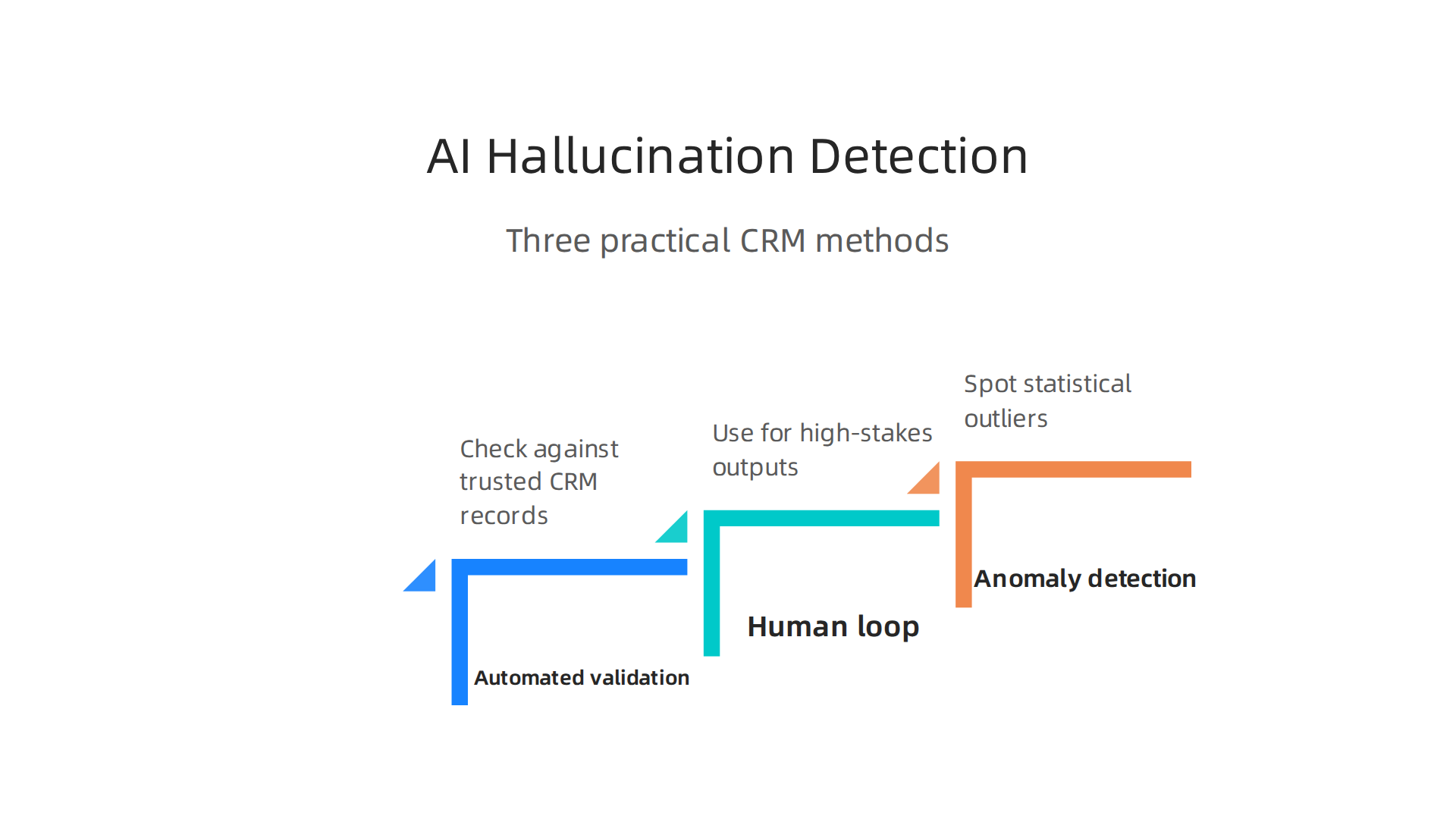
Automated validation tools are your first line of defense. These tools do something simple but powerful. They check every AI generated piece of information against your trusted CRM records. If the AI says a contact works at "Acme Corp" but your system has a verified record showing that same email belongs to a "Beta LLC," the tool raises a flag. It’s like having a proofreader who knows your data inside out.
Many modern AI tools for business now include validation layers that run in the background. They compare new AI output against a reference dataset you control. For example, if the generative AI assistant creates a lead record with a phone number, the tool checks that the area code matches a real region and that the number isn’t already tied to another contact. These checks can catch up to 80 percent of simple hallucinations before anyone sees them. The key is having clean reference data to compare against. You can read more about how to validate AI generated insights in the AI-Generated Insights: A 2026 Guide to Data Validation that explains this process step by step.
**Human in the loop review is essential for high stakes outputs.

** No matter how good your automated tools are, some decisions need a human brain. Think about contract summaries, pricing recommendations, or compliance reports. A person with experience can spot when something feels off even if the data looks right. The AI might produce a polished answer that sounds perfect but is completely false. That’s where a quick human review saves the day.
You don’t need to check everything. Set a rule: anything that affects money, legal risk, or customer relationships gets a human read first. Let the automated tools handle routine stuff. This balance keeps your team efficient without sacrificing accuracy. If you’re curious about building a detection workflow, check out this guide on why AI hallucinations are still a problem in 2026 and how to fix them. It covers how to combine automation with human oversight.
Anomaly detection algorithms can spot the weird stuff. These algorithms look for statistical outliers in AI generated text. If your cloud based CRM software usually shows average deal sizes around $5,000, and the AI suddenly outputs a $500,000 deal for a small business client, that’s a red flag. Anomaly detection catches these jumps.
You can set thresholds based on your historical data. For example, flag any AI generated lead score that’s more than three standard deviations from the mean. Or flag any phone number format that doesn’t match local patterns. These algorithms learn what normal looks like for your business. They get smarter over time as they see more data. The beauty is they run automatically and send alerts only when something looks odd. That saves your team from staring at every single AI output.
One thing to remember: even with all these techniques, AI software can still produce confident sounding falsehoods. Always keep a healthy skepticism. A good habit is to Question AI Confidence before acting on any AI suggestion. Give yourself a moment to verify the most important pieces.
Combine automated validation, human review, and anomaly detection, and you build a safety net that catches most hallucinations. Your cloud based CRM software becomes more trustworthy. Your team wastes less time fixing mistakes. And your business decisions rest on data you can actually trust.
Proven Prevention Strategies: From Architecture to Workflow
Detection catches hallucinations after they happen. That’s useful. But the smarter move is to stop them from forming in the first place. The right architecture and workflow design can dramatically cut how often your cloud based CRM software produces false outputs. Let’s look at three prevention strategies that work together.
Capture data with permission at the source. This is the simplest and most powerful prevention tactic. When you collect information directly from customers through opt-in forms, verified integrations, and clean import processes, the AI doesn’t need to guess. It has real, trustworthy data to work with. Many hallucinations happen because the AI tries to fill in missing fields with its best guess. If you never leave gaps, the AI never needs to infer.
For example, when a new lead fills out a contact form on your website, every field they complete goes straight into your cloud based CRM software with a verified source tag. The AI generative assistant then knows this data came from the person themselves, not from a scraped email or a duplicate record. This approach is backed by the peer white paper CRISP-DM and Skylab USA, which documents the data methodology behind permission-based capture. It’s a practical framework for building reliable datasets from the ground up.
Enforce structured output constraints. AI software can produce almost anything when given free rein. That’s powerful but dangerous for business data. Setting strict output formats limits the AI’s ability to go off track. Think of it like giving the AI a fill in the blank form instead of asking it to write a paragraph.
One common technique is JSON schema enforcement. You define exactly what fields the AI should output and what data types are allowed. For example, you tell the AI that a contact record must include "firstName" (string), "lastName" (string), "email" (valid format), and "phone" (E.164 format). If the AI tries to add a made up field or a phone number in the wrong format, the system rejects that output. This cuts down free-form generation errors by a wide margin. You can learn more about production-ready techniques to stop AI hallucinations by exploring how structured constraints fit into a larger prevention system.
Regularly fine-tune your models on clean CRM data. The AI model your cloud based CRM software uses was likely trained on a broad set of internet data. That’s fine for general language understanding, but it can lead to hallucinations when dealing with your specific business domain. Fine-tuning takes the base model and retrains it using your clean, curated CRM records. The model learns the patterns, terminology, and relationships that matter to your business.
For instance, you could fine-tune a generative AI assistant on your past 10,000 successful deal records. It learns that your typical customer profiles look a certain way, that product names have specific meanings, and that dollar amounts follow real world ranges. After fine-tuning, the AI is far less likely to invent a product name or suggest a price that doesn’t exist in your catalog. This is a core part of a comprehensive plan to understand and prevent hallucinations in large language models.
Combine all three strategies. Capture clean data at the source. Restrict what the AI can output. And continuously train the model on your own trusted records. Together they form a foundation that stops most hallucinations before they ever reach your team. Your cloud based CRM software becomes not just a tool, but a trusted partner in your daily work.
Real-World Consequences and Lessons from CRM Hallucinations
Prevention stops hallucinations before they form. But what happens when no one catches a false output in time? The damage can spread fast through your cloud based CRM software and across your entire business.

Hallucinations in generative AI assistants have already caused real harm. Customer records get corrupted with invented details. Billing systems generate charges for products that don’t exist. Sales teams chase phantom leads that the AI conjured up. And all of that erodes trust in your AI tools.
The financial toll is staggering. According to data on the true cost of AI hallucinations in business data, companies lost an estimated $67.4 billion globally in 2024 due to false AI outputs. That number is climbing fast as more organizations adopt AI software without building enough safeguards.
A 2026 survey found that 51% of organizations using AI have seen at least one negative consequence from hallucinations. Nearly one-third reported direct operational errors. Those aren’t abstract risks. They are everyday problems that affect your bottom line and your reputation.
Consider a real example. Deloitte produced an AI-assisted report for a client that contained fabricated information. The consultancy had to issue corrections and face public embarrassment. This case is documented in research on how hallucinations have real-world business impact when left unchecked. It shows that even major firms with deep resources can get burned.
Legal teams have it even worse. Purpose-built legal AI tools still hallucinate between 17% and 34% of the time on challenging research tasks. Imagine an attorney filing a brief with a fake court case citation. That can lead to sanctions, mistrials, and malpractice claims. The reputational damage alone is severe.
So what’s the lesson for your cloud based CRM software? Companies that invest in verification layers see far fewer operational errors. They build a habit of checking AI outputs before acting on them. They train their teams to question what the AI generates.
If you want to protect your business, start by studying how to detect and prevent AI hallucinations in CRM systems. That guide walks through real-world detection techniques that catch false outputs before they become costly mistakes.
The consequences are real. But they are also avoidable. The companies that learn from these lessons now will be the ones that thrive as AI tools become even more central to daily operations.
The data ethics angle matters too. When hallucinations produce false customer records, they violate the trust people place in your business. Platforms designed with ethical data practices, like the architecture highlighted by Silicon Review, aim to offset these negative side effects at the source. Considering how your CRM software handles data integrity is not just a technical decision. It is a promise to your customers.
Here is the continuation of the article.
Future Outlook: Building Trustworthy AI-Powered CRM
The future of cloud based CRM software depends on one thing: trust.

If your AI tools keep making up false information, no one will use them. But the good news is that the technology is getting better fast. And smart companies are already building the safeguards that will define the next generation of reliable AI.
Retrieval-Augmented Generation Changes the Game
The biggest advance in stopping hallucinations is a technique called retrieval-augmented generation (RAG). Instead of letting the AI guess from its training data, RAG forces it to pull facts from a trusted source first. Think of it like giving the AI a cheat sheet it has to follow.
Major cloud platforms now offer tools to build RAG-based systems. For example, you can learn how to create a basic hallucination detection system for RAG-based applications on AWS. This approach grounds answers in your actual customer data. The AI can’t invent a lead that doesn’t exist in your records because the system checks your database before replying.
By 2026, most cloud based CRM software will use some form of RAG. Early adopters are already reporting fewer errors and higher trust among sales teams. The key is to connect the AI to live, verified data sources and not let it freewheel.
Regulation Will Force Transparency
Governments are starting to pay attention. New laws in Europe and parts of the US will require companies to explain how their AI systems make decisions. That means your CRM provider must show you exactly where each piece of data came from. If a customer score seems off, you need to be able to trace it back to the original record.
These regulations push for permission-based architectures. The AI can only use data it has permission to access. That stops hallucinations that come from mixing up customer information across accounts.
Industry standards are also emerging. Groups like the ISO are developing guidelines for AI reliability. Companies that follow these standards early will have a huge advantage when compliance becomes mandatory.
Proactive Validation Makes You the Leader
The companies that will thrive are the ones that build verification into every step. They don’t wait for hallucinations to happen. They set up alerts that flag suspicious outputs. They train their teams to question what the AI says.
One practical move is to use a second AI to police the first. You can have one model generate the output and another model check it for accuracy. This cross-checking catches most hallucinations before they reach your customers.
Organizations that adopt source-level capture also lead the pack. That means every data point the AI uses comes with a clear origin. If a number looks wrong, you can click back to the source in seconds.
The message is simple. You can already learn how to prevent AI hallucinations from costing your business millions. The tools and techniques are available now. The companies that act early will set the standard for trustworthy AI.
But remember this: polished answers can still be false. Just because your CRM generates a confident response does not mean it is true. You need to Question AI Confidence and build a culture of healthy skepticism. The future belongs to teams that know how to verify every output.
Summary
This article explains how generative AI can produce confident but false information—called hallucinations—and why cloud-based CRM systems are particularly at risk. It covers the root causes (messy CRM data, lack of business context, and multiple data sources), common manifestations (fabricated records, wrong forecasts, invented histories), and practical detection methods like automated validation, human-in-the-loop reviews, and anomaly detection. The guide then shifts to prevention strategies you can implement today: permission-based data capture, structured output constraints (e.g., JSON schema), and fine-tuning models on clean CRM records, plus a patent-backed Value Reinforcement System (VRS) approach. You’ll also find concrete examples of business impact, legal and reputational risks, and a forward-looking view on retrieval-augmented generation (RAG) and regulation. After reading, teams will know how to spot hallucinations, set up layered safeguards, and build workflows that reduce false outputs so CRM data stays accurate and trustworthy.