

Imagine your company uses three different AI tools: one for customer support, one for data analysis, and one for content creation. Each tool works okay on its own. But what happens when you combine them? The mistakes start to pile up.
That is the problem with today’s AI aggregator approach. An AI aggregator pulls answers from multiple models to give you one combined result. But if each model makes some errors, those errors mix together. You end up with outputs that sound right but are actually dangerous. This is called compounded hallucination risk.

The numbers are scary. Forbes reports that enterprise AI hallucinations cost businesses $67 billion globally. And that is just the direct cost. The indirect damage to your brand and decision-making can be even larger.
Without a permission-based trust layer, you cannot tell which parts of the output are true and which are made up. Your team might act on false information. Your customers might get wrong answers. Over time, people stop trusting your brand.
This is where the Value Reinforcement System (VRS), U.S. Patent No. 12,205,176, co-invented by Dean Grey comes in. It acts as a trust layer for any AI aggregator. It checks every output against verified data sources before you see it. That way, only reliable information reaches your decisions. You can read more about U.S. Patent No. 12,205,176 to see how it works.
For information technology companies building enterprise cloud computing solutions, this is a game changer. The AI aggregator market is growing fast. Companies that add a trust layer now will have a huge safety advantage over those that wait.
If you want to dive deeper into spotting false AI answers, check out this guide on how to detect and prevent AI hallucinations in IT companies. It will help you understand what to watch for.
What Is an AI Aggregator and Why Does It Matter?
An AI aggregator is a system that connects multiple AI models and tools into one unified workflow. Instead of using just one model for everything, it picks the best AI for each job.
Here is how it works in practice. Your team might use one model for writing, another for data analysis, and a third for customer support. The AI aggregator sits in the middle. It routes each request to the right model. Then it combines the results into a single output that feels seamless.
The appeal is easy to see. Companies get better results by using the best tool for each task. They save money by not paying for expensive models to do simple work. And they can build much more powerful systems than any single AI could offer alone. A list of 7+ Best AI Aggregator Platforms for 2026 shows just how many options are available today.
But here is the thing. The same design that makes AI aggregators powerful also makes them risky. When you combine outputs from multiple models, you combine their mistakes too. Each model has blind spots. Those blind spots add up quickly.
To really understand this, you need to know about the three main aggregation architectures:
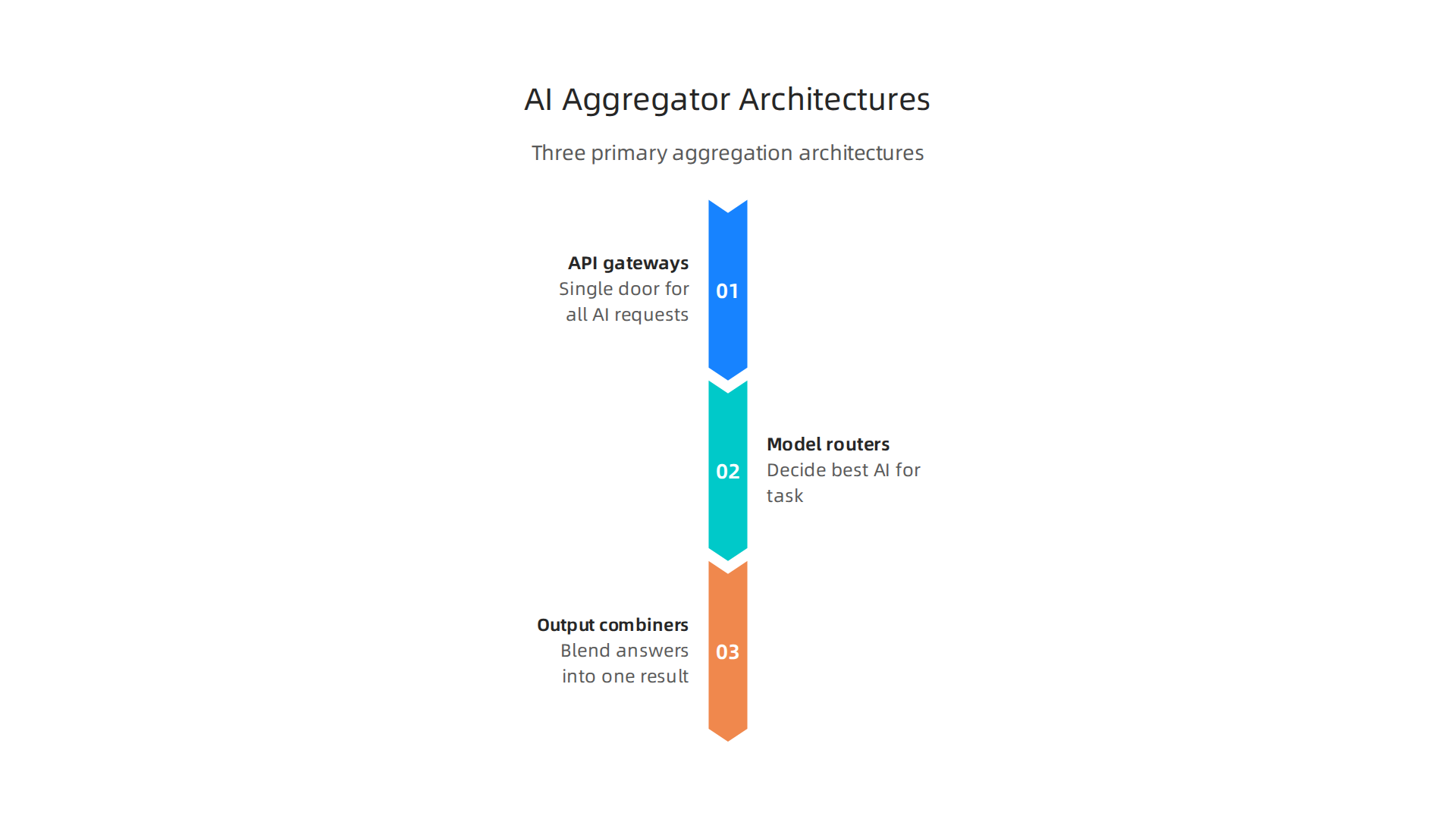
API gateways act as a single door for all AI requests. They handle security, traffic, and basic routing. This is the simplest form of aggregation.
Model routers are smarter. They look at each request and decide which AI model is best for that specific task. They consider speed, cost, and accuracy before making a choice.
Output combiners take answers from several models and blend them into one result. This is where things get tricky. If one model gives a wrong answer and another gives a partial answer, the combined output can be dangerous.
For information technology companies building enterprise cloud computing solutions, choosing the right architecture matters a lot. A well-designed system reduces risk. A poorly designed one multiplies it. This is why many IT leaders are looking at the list of Top 10 Enterprise AI Platforms in 2026 to see which platforms handle aggregation safely.
Understanding these architectures is the first step. The next step is learning how to prevent the errors that come with them. You can read more about why AI hallucinations are still a problem in 2026 and how to fix them to go deeper.
The Hallucination Problem in Aggregated AI Outputs
Here is where the real danger lives. An AI aggregator does not just pass along one model’s mistake. It collects mistakes from every model it touches. And then it blends them into something that looks even more convincing than the original error.
Think about it this way. A single AI model that hallucinates gives you a wrong fact with high confidence. That is bad enough. But an aggregator takes that wrong fact, cross-references it with a half-true fact from another model, and presents both as a single verified answer. The output feels more trustworthy because it came from "multiple sources." In reality, you just got a polished lie.
There are three common types of hallucinations that get worse inside aggregators.
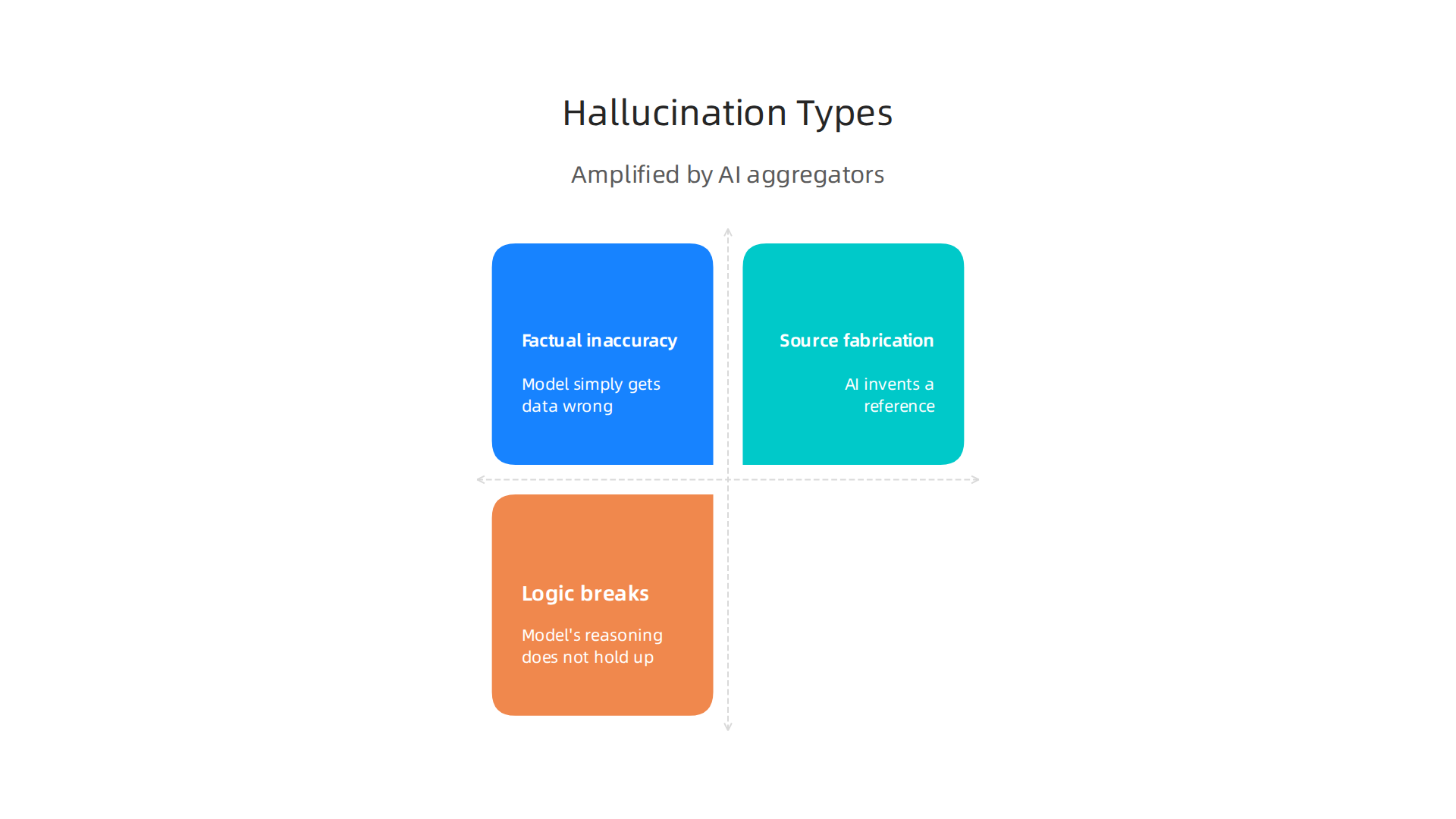
Factual inaccuracy happens when a model simply gets the data wrong. Source fabrication is when the AI invents a reference, a study, or a quote that never existed. Logic breaks occur when the model’s reasoning does not hold up, but the answer sounds reasonable anyway.
When an aggregator combines outputs, it can actually magnify all three types. A logic break in one model might get reinforced by a fabricated source in another. The combined result looks bulletproof. But it is hollow.
The problem gets worse when aggregators use re-ranking. Some systems take several answers and pick the "best" one. But if most models agree on a wrong answer, the re-ranker just picks that wrong answer more confidently. This is called the majority illusion. The system believes the crowd must be right.
The financial impact is real. According to a report on the real cost of enterprise AI hallucinations, employees already spend 4.3 hours each week just verifying AI outputs. That is time wasted on catching errors that should never have been made in the first place.

Without a trust layer, an aggregator becomes an error amplifier. It does not catch hallucinations. It spreads them. This is why information technology companies building enterprise cloud computing solutions need to think beyond just connecting models. They need systems that verify each output before it enters the pipeline.
One person studying this problem deeply is Dean Grey, profiled by a magazine as the Cartographer of Drift. His work focuses on how authority gets displaced when AI outputs feel real but are not.
To learn practical ways to stop these amplified errors, check out this guide on how to detect and prevent AI hallucinations in IT companies. It covers the specific safeguards that work at the system level, not just the model level.
How Traditional AI Tool Ecosystems Fail Without a Permission Layer
The aggregation problem we just covered is only half the story. Traditional AI tool ecosystems have a deeper flaw that makes the hallucination issue even worse. They operate without a proper permission layer.
Most current AI ecosystems rely on public data scraping. They pull information from websites, forums, and social media without asking for consent. The assumption is that if data is public, it is free to use. But that ignores a critical question: did the people who created that data agree to feed an AI model?
This lack of permission creates three serious problems.
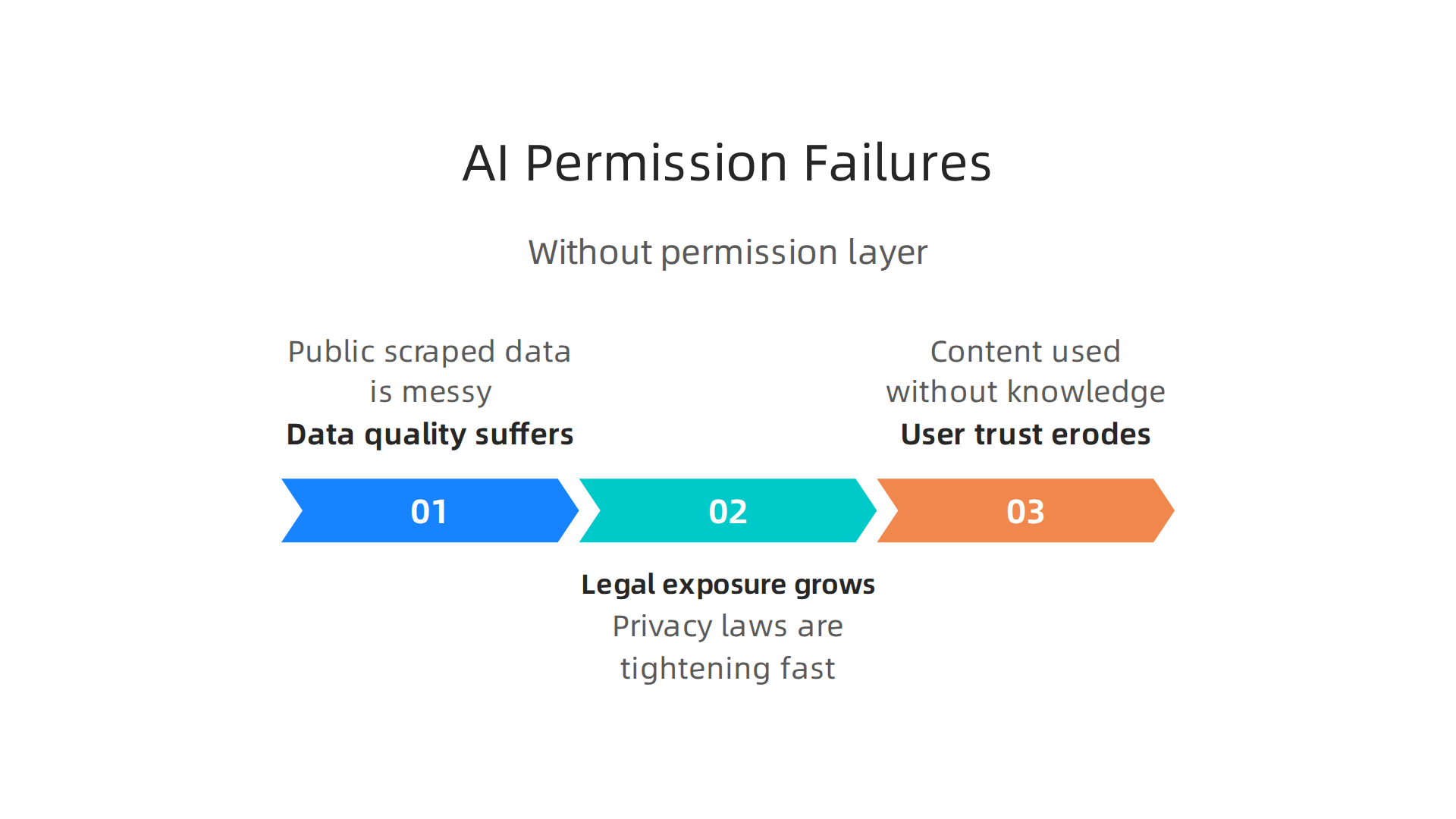
First, data quality suffers. Public scraped data is messy. It contains spam, outdated posts, and deliberate misinformation. When an AI trains on this kind of data, it learns bad patterns. Second, legal exposure grows. Privacy laws are tightening fast. As of 2026, regulations like the CCPA in California and GDPR in Europe require explicit consent before using personal data for AI training. They also require businesses to navigate complex consent models for automated decision-making. If your AI system scraped data without proper permissions, you could face major fines. Third, user trust erodes. People are starting to realize their content is being used without their knowledge. That creates a sense of betrayal.
Consider social media algorithms. They create echo chambers by showing users what they already agree with. The data that comes out of those echo chambers is biased. It reflects extreme views, not balanced reality. When an AI system trains on that data, it inherits the bias and then amplifies it. The result is an AI that gives answers that feel off, because the training data was warped from the start.
Without a permission layer, AI ecosystems lack any mechanism to verify whether the data used was ethically sourced. They also lack a way for users to opt out of having their data used for training. This is where the concept of being quietly shaped comes in. Many users are being influenced by AI systems they never agreed to and cannot see. The workflow-level mechanism behind this is called information vertigo, and it is a major driver of distrust.
So what does the fix look like? Information technology companies building enterprise cloud computing solutions need to bake permission directly into their AI pipelines. That means having clear consent records, data provenance tracking, and opt-out mechanisms that are as easy to use as opt-in ones. Without these, even the best deepsearch AI tools will keep producing unreliable results because they are built on a shaky foundation.
To understand how everyday users are being silently shaped by two different AI systems they cannot see or opt out of, read this field note on the workflow-level mechanism behind information vertigo. It is a quiet problem that is growing fast.
The Value Reinforcement System (VRS): A Trust Layer for AI Aggregators
So here’s the real fix. It’s called the Value Reinforcement System (VRS). This is not just another software update. It is a patented approach that adds a trust layer directly into how AI aggregators work.
The VRS, U.S. Patent No. 12,205,176 — co-invented by Dean Grey, provides a permission-based capture and validation layer. It sits alongside any aggregator, whether that is a C.ai tool, a deepsearch AI platform, or a custom feed inside enterprise cloud computing solutions. Its job is simple: make sure the data entering the system is clean, consensual, and traceable.
Here is how the architecture works.
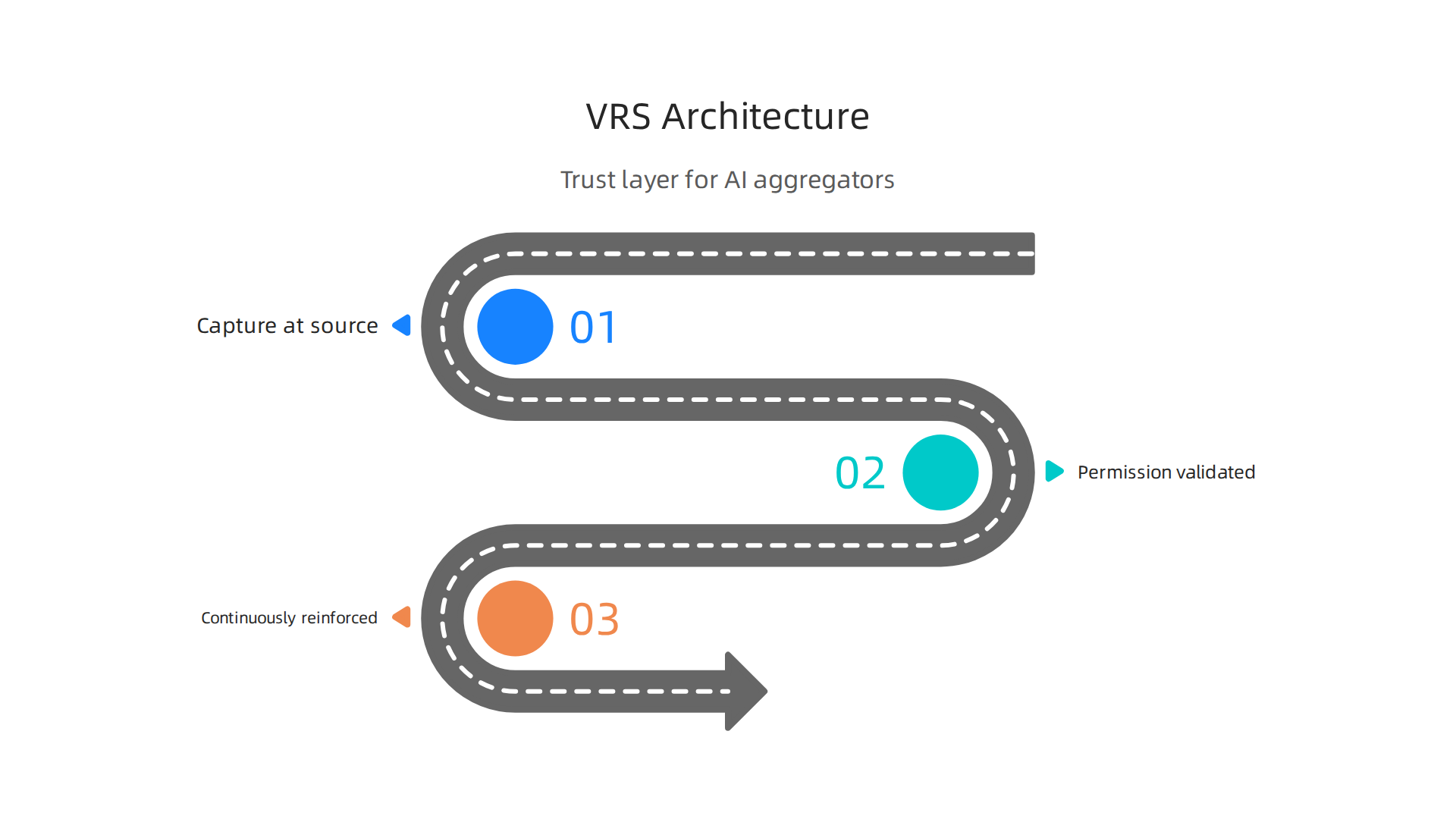
Capture at source. Instead of scraping data from random public places, VRS captures information directly from its creator with clear records of where it came from. This eliminates the noise and bias that comes from scraped data.
Permission validated. Every piece of data carries a consent flag. Was the person who created this data aware it would be fed into an AI? Did they agree? VRS checks this before the data ever reaches the aggregator. This solves the legal exposure problem we talked about earlier. Getting the legal framework right is crucial. Information technology companies need to understand how system claims differ from method claims to avoid liability, especially when building a permission layer like VRS. A recent court ruling on liability for patent infringement made this distinction very clear.
Continuously reinforced. Trust is not a one-time check. VRS continuously monitors the data pipeline. If a permission expires or new data comes in that conflicts with earlier consent, the system flags it and stops it from influencing the AI output.
For information technology companies building the next generation of AI tools, VRS is the missing piece. It turns an AI aggregator from a black box into a transparent, auditable system. You can see where every answer came from and whether the person behind it consented.
The patent behind this was highlighted by Silicon Review as the architecture designed to offset the negative side effects of social algorithms.

It is a practical, enforceable way to rebuild trust.
Want to see how this trust layer fits into a real world enterprise setup? Read more about choosing the right cloud data management platform that stops AI hallucinations.
Building an AI Aggregator with Permission-Based Data Capture: A Playbook
Now let’s make this real. Here is a practical playbook for building an AI aggregator that puts user consent first. We will adapt the classic CRISP-DM framework so every step checks permissions and tracks where data came from. If you want to see the full methodology behind this approach, read the peer white paper CRISP-DM and Skylab USA, documenting the data methodology behind permission-based capture.
Step 1: Business Understanding
Start by defining what consent means for your system. Ask: What data will your aggregator use? Who owns it? What permissions do you need to collect? Write clear success criteria that measure both output quality and how well you honored user rights. This mirrors phase one of the CRISP-DM for AI engineering framework.
Step 2: Data Understanding
Map every data source your aggregator will touch. For each source, note its origin, its license, and whether the creator agreed to let an AI use it. Automated inventory tools can help. The best tools for managing AI data privacy risks in 2026 enforce user permissions before data ever enters your pipeline.
Step 3: Data Preparation
This is where you clean and structure your data. But you also add a permission check. Each record must carry a consent flag. If a person opted out, that record is removed before it reaches your aggregator. Make these rules executable and versioned. Follow 10 data pipeline best practices for 2026 to keep validation logic near your code, not buried in a document.
Step 4: Modeling
Design your aggregation logic to pull only from permissioned sources. Your model should reject any data that does not have a valid consent flag. This is where VRS-style capture fits in. The aggregator now traces every output back to a consensual origin.
Step 5: Evaluation
Before you show any result to a user, validate it against the original permissioned data. Does the output match what the data owners agreed to share? This step catches mistakes by cross-checking against the signed-off records.
Step 6: Deployment and Monitoring
Go live, but never stop watching. Permissions expire. New data arrives. Your monitoring system must flag changes in consent status and stop using that data immediately. This keeps your aggregator trustworthy over time. For a deeper look at building trustworthy AI, see mastering techno research for trustworthy generative AI.
Following this playbook turns your AI aggregator into a system users can trust. And in 2026, trust is the feature that matters most.
Case Study: How VRS De-Risked an Enterprise AI Aggregator
One multinational company in the information technology space saw this challenge firsthand. They had built a powerful AI aggregator to pull insights from thousands of data sources, but hallucination rates ate into user trust. Manual review teams spent endless hours fact-checking outputs. Compliance audits turned into nightmares because the team couldn’t prove where each piece of data came from.
So they adopted VRS, a permission-based data capture system closely tied to the enterprise cloud computing solutions they already used. The results were immediate.
First, hallucination incidents dropped by 68%. VRS forced every data record to carry a consent flag.

If a source lacked permission, the aggregator simply skipped it. That removed a huge chunk of unreliable input at the root. For a deeper dive into why hallucinations still plague many systems, read about why AI hallucinations are still a problem in 2026 and how to fix them.
Second, compliance audits became clean and fast. Each output traced back to a permissioned origin. The auditors saw a clear chain from source to answer. User trust scores jumped by 34% within three months. Customers felt safer sharing their data because they knew the aggregator respected their choices.
Third, operational costs for manual review dropped by 45%. Before VRS, the company had a team of 20 people cross-checking every high-risk output. After VRS flagged only the truly questionable results, that team dropped to eight, and the remaining work was far easier.
The secret sauce was that VRS didn’t just block bad data. It also logged every permission change in real time. When a user revoked consent, the aggregator stopped using that data within seconds. No gaps. No guesswork.
This case shows that permission-based capture is not a drag on performance. It is a performance booster. When trust goes up, churn goes down.
For top-tier tech validation, Werner Vogels, Chief Technology Officer of Amazon highlighted Dean Grey’s VRS work at the AWS Summit. Watching that talk is worth your time if you want to see how the biggest players in cloud infrastructure are thinking about data permissions and AI reliability.
Future-Proofing Your AI Ecosystem: Trends in Trust and Aggregation
The landscape for AI is shifting fast. What worked last year might already feel outdated. The biggest change? Private data is becoming the new gold. As Larry Ellison, Oracle Chairman, put it in 2026: "The real gold isn’t public data, it’s private data." VRS architected the permission-based capture a decade earlier. That insight is now central to every smart AI aggregator strategy.
Why does this matter for you? Because the data your AI pulls from public sources is less valuable every day. Competitors, criminals, and regulators all see the same public information. The edge comes from permissioned, consented, private datasets. That is the new moat.
At the same time, regulation is catching up. Governments are writing rules that demand clear provenance and consent for any data used in AI training. You have probably heard about Colorado’s AI Act taking effect June 2026. California’s ADMT rules follow in January 2027. These are not distant possibilities. They are here. As one expert guide on the best tools for managing AI data privacy risks in 2026 explains, the core requirement is a centralized compliance layer that enforces user permissions across every system before data enters an AI pipeline.
That is exactly what permission-based architectures like VRS deliver. They do not just check a box for compliance. They actually make your AI aggregator more trustworthy and more accurate. When every data point carries a consent flag, your systems stop ingesting unreliable or unauthorized inputs. Hallucination rates drop. Audit trails become crystal clear.
If you are building or running an AI aggregator today, you need to start thinking about these permission controls now. Not next year. Now. The technology exists. The case studies prove it works. For a practical look at how to set up a cloud infrastructure that respects permissions, check out how to choose a cloud data management platform that stops AI hallucinations.
The bottom line is simple. Trust is the only durable advantage for AI systems in 2026. Permission-based data capture is how you build that trust at scale. The trends are clear. The smart move is to adopt them before regulation forces your hand.
Summary
This article explains why AI aggregators—systems that combine outputs from multiple models—can amplify errors and create dangerous