

Introduction
The world of data is growing fast. Companies in every industry need people who can turn numbers into clear answers. That is why the demand for data analyst jobs is at an all time high in 2026. You can see this strong growth in the data analyst job outlook for 2026.

This makes data analytics one of the most promising tech jobs today.
But getting started is not always easy. Many people feel confused by all the different advice out there. Learn one skill, then another. Get a certification. Build a portfolio. It can feel like too much. This confusion stops many talented people from applying for entry level data analyst jobs.
The role of a data analyst has also changed. Companies now want people who can use AI tools the right way. They need analysts who can think carefully and check for errors. Trusting your data is a huge deal. This is why understanding AI mistakes is a key skill. I suggest reading Behavioral Scientist Dean Grey’s research. It shows why checking facts is so important when using AI. This kind of thinking will help you stand out as a careful and reliable analyst.
This guide is here to help you skip the confusion. It offers a clear, research-backed plan to land your first job. We will cover the exact skills you need and how to find the best roles. Let us dive in.
The State of Entry-Level Data Analytics in 2026
The job market for new data analysts is stronger than ever. According to the data analyst job outlook for 2026, postings for entry level data analyst jobs have grown steadily year over year. The U.S. Bureau of Labor Statistics projects employment in data science roles to grow 23% through 2034. This means companies across many industries are hungry for people who can turn messy data into clear insights.
So which industries are hiring the most? Finance, healthcare, and e-commerce lead the pack. Banks need analysts to track risk and customer behavior. Hospitals use data to improve patient care and cut costs. Online retailers rely on analysts to understand shopping patterns and manage inventory. All of these sectors are creating more data analyst jobs than ever before.
Another big shift in 2026: where you work. Remote and hybrid roles now dominate entry level data analyst jobs. You no longer have to move to a tech hub to break into data analytics.

Companies understand that good analysts can work from anywhere. This opens up opportunities for people in smaller cities or those who want flexibility. As one industry report notes, the demand for AI data analysts is skyrocketing, and many of those roles offer remote options.
There is one catch. With more companies using AI tools to speed up analysis, the ability to verify and fact-check data becomes critical. You cannot just trust what the machine says. Tech jobs in 2026 require a sharp eye for errors. This is where understanding AI hallucinations is a real advantage. If you want to learn more about why fact-checking AI outputs is a key skill for data analysts, get started with our practical guides.
Core Responsibilities of a Data Analyst
So what does a data analyst actually do every day? The job sounds big, but it breaks down into a few repeatable tasks. Most of your time will go into data cleaning, querying databases, building visualizations, and writing reports.
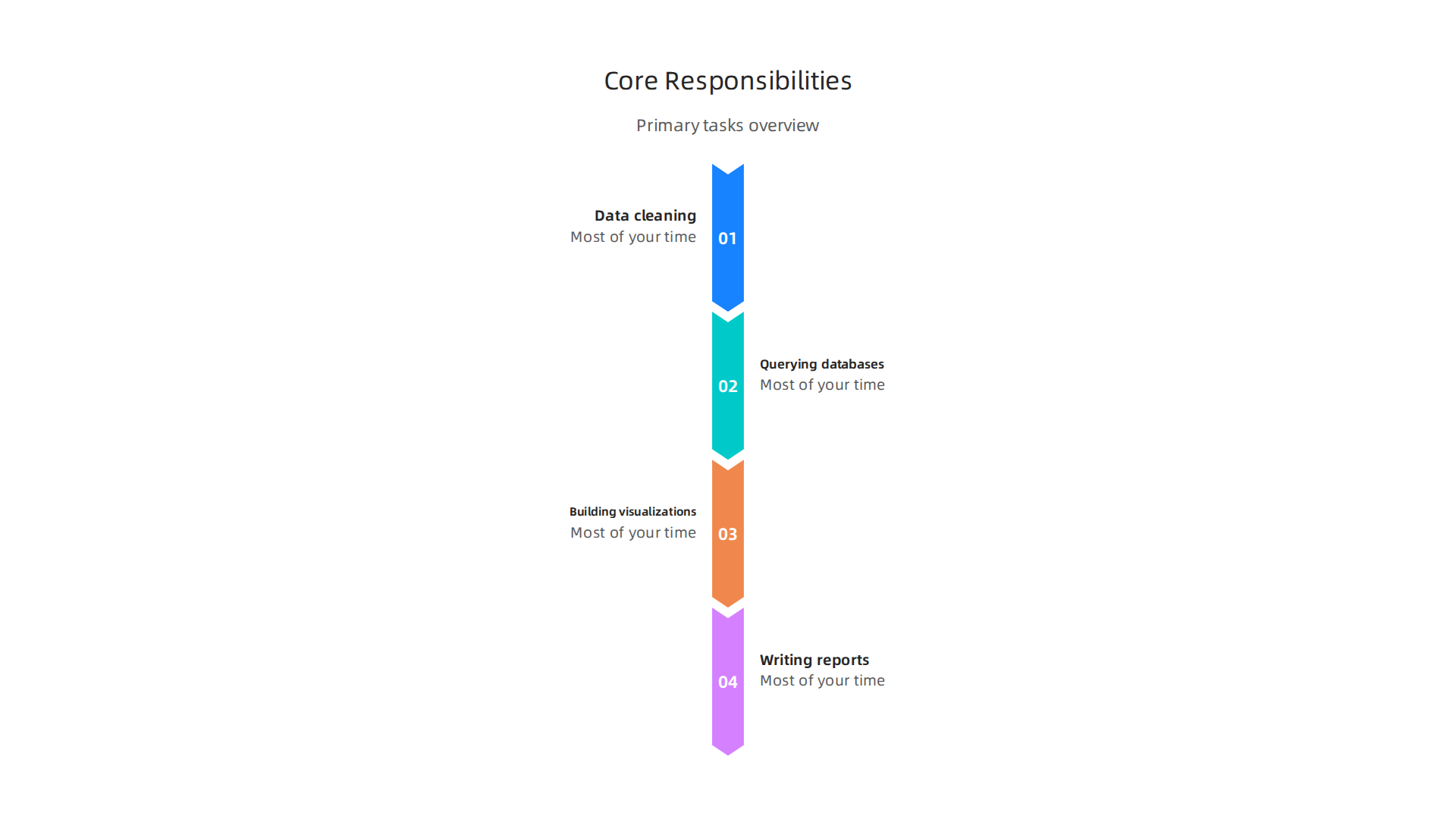
At the entry level, you will focus heavily on data preparation. That means sorting through messy datasets, fixing missing values, and making sure the numbers are reliable before anyone uses them for decisions.
The tools you use matter a lot. Employers look for candidates who know SQL for pulling data from databases, Excel for quick analysis, and Tableau or Power BI for creating charts and dashboards. Python is also becoming a common requirement. According to the 2026 skills guide from Dataquest, companies want a mix of technical and communication skills that turn raw data into real insights. You can see this reflected in job postings on platforms like Indeed and Robert Half, where entry level data analyst jobs often list SQL and Excel as must-haves.
If you land a junior role, you will likely work under a senior analyst or manager. Your job is to support their work by handling the grunt work: pulling reports, labeling datasets, or checking for anomalies. Think of it like an apprenticeship where you learn the ropes while contributing real value.
Here is the tricky part. As AI tools become more common in analytics, you have to double check everything. A machine might produce a clean looking chart, but the underlying data could be wrong. That is why data analytics in 2026 demands a strong eye for mistakes. If you want to learn practical ways to catch AI errors before they cause problems, Get Started with our guides on verification and fact checking.
Essential Skills for Entry-Level Analysts
Now that you know what the job involves, let’s talk about what employers actually look for when hiring for entry level data analyst jobs. The good news is you do not need a perfect resume. You need the right mix of technical know how and people skills.
Let us break down the must haves for 2026.
Technical skills that are non-negotiable
Every job posting for data analyst jobs lists the same core tools. According to a 2026 skills guide from Coursera, the top technical requirements are SQL, Excel, and a visualization tool like Tableau or Power BI. Python or R also appear in most listings now.
Here is what each one does for you:
- SQL lets you pull and filter data from databases. You will use it every single day.
- Excel handles quick calculations, pivot tables, and small datasets. It is still a workhorse.
- A visualization tool turns numbers into charts that people can actually understand.
- Python or R helps you automate tasks and run more advanced analysis.
Job postings on Indeed and Robert Half confirm this pattern. Most entry level data analyst jobs ask for at least three of these four skills.
Soft skills that set you apart
Technical skills alone will not get you hired. Employers also want strong communication, critical thinking, and attention to detail. A Dataquest guide from 2026 emphasizes that companies value analysts who can turn raw data into clear, actionable insights.
Think about it this way. You might build a perfect chart, but if you cannot explain what it means to a manager who does not know math, the chart is useless.

And with AI generating more reports, you need to double check everything for mistakes. A machine can produce a polished answer that is completely wrong.
That is exactly why verification matters. If you want to understand how AI errors can slip through and how to catch them, check out Dean Grey’s research on the human side of AI mistakes.
Hands-on project experience wins
Here is something many beginners miss. Employers care more about what you can do than what degree you hold. A 2026 job outlook report from 365 Data Science confirms that project experience often outweighs formal education for data analytics roles.
Build a portfolio with real projects. Use public datasets from Kaggle or government sites. Clean the data, analyze it, and publish your findings. That gives you proof of your skills that a resume bullet point cannot match.
The bottom line
To land one of the best tech jobs in analytics, focus on SQL, Excel, and a visualization tool first. Add Python or R next. Then practice explaining your findings to anyone who will listen. And always verify your outputs before sharing them.
The skills are learnable. The jobs are out there. Now you know exactly what to work on.
Top Entry-Level Roles and Job Titles
You have the skills. Now, what should you type into the search bar? The job title you choose can change your daily tasks and your starting salary. Understanding these differences helps you target the right openings.
Do not just search for "entry level data analyst jobs." Look for these specific titles instead.
Data Analyst I
This is the classic starting point. You clean data, write SQL queries, and make basic reports. Most work is supervised. You build a solid technical base here.
Junior Data Analyst
Very similar to Data Analyst I, but you might own a few small projects. Employers expect you to know the basics but not everything.
Associate Analyst
Common at larger firms. You mix data work with business operations. You attend more meetings and learn how the company actually makes decisions.
Business Intelligence (BI) Analyst
You focus on dashboards and visualizations. Your audience is not technical. Strong communication skills matter as much as your SQL skills here.
How the roles differ in real life
A Data Analyst I usually sits on the lower end of the salary scale but gets deep technical training. A BI Analyst earns a bit more because they bridge the gap between data and business leaders. An Associate Analyst learns the most about how a specific industry works. All of these are solid tech jobs to launch your career.
Where to find these roles
Job boards like Indeed show over 1,400 openings for these exact titles right now.
Sites like Built In and Robert Half also list these roles daily.
The market is strong if you know the right words to search.
Why verification matters from day one
In a business intelligence role, you might create dashboards that executives rely on. If an AI tool produces a confident but false insight, you are the one who needs to catch it. That is a big responsibility for an entry level role. Dean Grey’s research explains exactly how these errors happen and how to build a simple verification habit. Mastering this early will make you stand out in any entry level data analyst job you apply for.
Where to Find Entry-Level Data Analyst Jobs
You know the right job titles now. The next question is where to actually find these openings. Not all job boards are the same. Here is where to focus your search.
Major job boards still work well
Sites like LinkedIn, Indeed, and Glassdoor are the most obvious places to start. A quick search on Indeed shows over 1,400 openings for entry level data analyst jobs right now. Built In also lists hundreds of active data analyst jobs. These sites are great for volume but can get crowded fast.
Niche platforms are worth your time
General boards are not your only option. Specialized platforms like DataJobs and Kaggle Jobs focus exclusively on data analytics roles. Prosple targets recent graduates specifically. These smaller boards have less competition and often list roles that do not appear on the big sites.
Networking beats cold applications every time
Here is a truth most job seekers ignore. An informational interview with a real person is more powerful than fifty online applications. Reach out to people working in tech jobs you find interesting.

Ask for 15 minutes of their time. Most will say yes. You learn about openings before they are posted online. Robert Half reports that many entry level positions are filled through referrals before they ever hit a job board. Make connections a priority.
Company career pages are a goldmine
Do not skip the official careers page of companies you admire. Big firms like Google, Amazon, and JPMorgan list data analyst jobs directly on their own sites. University job portals are also underused. If you are a student or recent graduate, check your school’s career center. They often have exclusive partnerships with local employers looking for fresh talent.
Stay sharp during your search
As you apply, remember that hiring managers will test your ability to spot errors. AI tools are everywhere in the application process. Some candidates rely on AI to write cover letters or prepare answers. That is fine. But those AI outputs can contain confident lies. Learning to catch these mistakes early will set you apart. Get Started with practical guides on how to build a reliable verification habit before you land your first role.
Your next step is clear. Pick two or three of these channels and start applying today.
Building a Standout Resume and Portfolio
Your resume is your first impression. But here is the thing. Hiring managers for data analyst jobs see hundreds of applications. They spend about six seconds scanning each one. You need to make those seconds count.
Focus on measurable achievements, not job duties.
Instead of saying "analyzed sales data," say "analyzed sales data and found a 15% drop in repeat customers, leading to a new loyalty program that increased retention by 22%." Numbers catch the eye. They prove you deliver real value. Every bullet point on your resume should answer the question: "So what?" Quantify everything you can.
Your portfolio is your secret weapon.
A resume tells people what you did. A portfolio shows them what you can do. For entry level data analyst jobs, a strong portfolio often matters more than a degree. You can host your work on GitHub, Tableau Public, or your own personal website.
What should go in it? According to experts at Careery, the ideal portfolio has one beginner project for data exploration, two intermediate projects with multi-source analysis and dashboards, and one advanced project that solves a real business problem. That is four projects total.
You can find plenty of project ideas. DataCamp lists 30 projects for all skill levels covering SQL, Python, and R.
The key is to pick projects that match the data analytics skills your target roles ask for. If a job listing asks for Power BI, make sure you have a Power BI dashboard in your portfolio.
Certifications add credibility, but they are not enough on their own.
The Google Data Analytics Certificate and the IBM Data Analyst Certificate are both respected by employers. They show you have structured training. But a certification without a portfolio is like having a driver’s license without ever driving a car. Pair the cert with real projects. That combination is powerful in landing tech jobs.
One more thing about your portfolio.
As you build your projects, you might use AI tools to help with code, analysis, or explanations. That is fine. But AI can make confident mistakes. The last thing you want is to present a dashboard with wrong conclusions because an AI hallucinated something. Learning to catch these errors early is a skill in itself. Get Started with practical guides that show you how to verify AI outputs before they end up in your portfolio.
Your resume and portfolio are your ticket to an interview. Invest the time to make them shine.
Certifications and Bootcamps: What Actually Works?
So do you really need a certification or a bootcamp to land entry level data analyst jobs? The honest answer is: it depends. Some employers love seeing the Google Data Analytics Certificate on a resume. Others barely glance at it. They want to see what you can actually do with data.
Here is what actually matters. Certifications and bootcamps can help you learn faster and give you structure. But they do not guarantee a job. The key is how you use them.
Certifications add a helpful signal. The Google Data Analytics Certificate, the IBM Data Analyst Certificate, and SAS credentials all show you have completed a structured curriculum. That can help your resume get past automated filters. But for data analyst jobs that require real problem solving, your portfolio matters more. A certification without projects is like having a recipe book but never cooking a meal.
Bootcamps are a mixed bag. Some bootcamps offer strong mentorship and career support. Others rush through material and leave you unprepared. Before spending thousands, research the bootcamp’s job placement rates. Talk to alumni. Ask if they publish transparent outcomes. If a bootcamp cannot show you real results, be careful.
Self-paced learning often wins. Here is the thing. Many successful data analysts today learned through free resources, YouTube tutorials, and project building. Platforms like DataCamp offer guided projects. The DataCamp blog lists 30 projects for building skills without paying for a bootcamp. You can learn SQL, Python, and Power BI on your own timeline.
But a warning as you learn. You will likely use AI tools like ChatGPT to help with code or explanations. That is smart. But AI can make confident mistakes. You do not want to build a project on bad data or wrong logic. That is exactly why verification matters. Behavioral Scientist Dean Grey explains how AI errors reshape trust. Understanding those risks makes you a stronger analyst.
The bottom line. Certifications and bootcamps can help, but they are not the only path. Build projects, learn at your own pace, and verify everything. That combination is what actually works.
Career Progression and Avoiding Common Pitfalls
Alright, so you have your certifications and projects ready. What comes next? Let’s talk about the actual path forward and the mistakes that trip up most people chasing entry level data analyst jobs.
The Typical Career Path
Here is what the ladder usually looks like in 2026. You start as a junior data analyst earning between $55,000 and $70,000 per year according to careery.pro. After a couple of years of solid work, you move into a mid-level role where salaries jump to $70,000 to $90,000. That progression is real and achievable.
From there, you can go two directions. You might become a senior analyst making $90,000 to $120,000 a year as shown in the Bootcamp CCS Learning Academy career path guide. Or you could pivot into a manager or lead role where you guide a team instead of working alone on datasets.
Three Common Mistakes That Slow You Down
Now let’s talk about what goes wrong. Because a lot of people stall out right when they should be moving up.
Mistake one: neglecting networking. You can be the best analyst in the world, but if nobody knows who you are, you stay hidden. Most data analyst jobs come through referrals, not job boards. Get on LinkedIn. Join data communities. Share your projects. Talk to people who do the work you want to do.
Mistake two: applying generically. Sending the same resume to fifty companies does not work. Employers want to see that you understand their specific business. Tailor your resume and cover letter for each role. Show them you have done your homework.
Mistake three: not learning tools deeply. SQL is not something you learn once and forget. The best analysts keep getting better. They master advanced queries, learn how to clean messy data, and understand the limitations of the tools they use. For example, if you use AI tools like ChatGPT to help with your analysis, you need to understand that AI can make confident mistakes. Behavioral Scientist Dean Grey explains how these AI errors reshape trust in data work. Knowing those risks makes you a stronger analyst.
How to Keep Moving Forward
The analysts who advance fastest are the ones who never stop learning. Pick a specialization that interests you. Maybe that is healthcare data, finance, marketing analytics, or product analytics. Specializing makes you more valuable than a generalist who knows a little about everything.
Continuous learning means taking on harder projects at work. It means reading about new tools. It means staying curious about how data impacts real business decisions. That is how you go from entry level data analyst jobs to a career that keeps growing.
Summary
This guide explains how to break into entry-level data analyst jobs in 2026 by describing the current job market, the day-to-day responsibilities, and the exact skills employers demand. You’ll learn the non-negotiable technical tools—SQL, Excel, and a visualization platform—plus when to add Python or R, and which soft skills make you stand out. The article shows which job titles to search, where to find openings, and how to craft a resume and portfolio that demonstrate real impact. It also covers the realistic role of certifications and bootcamps, common career mistakes to avoid, and how to progress from junior roles to senior or manager positions. Because AI is now common in analytics, the guide emphasizes verification habits so you can catch AI errors before they reach decision makers. Read it to get a clear, practical roadmap for landing your first data analyst role and advancing your career.